
Forex Expectancy: Why Win Rate Alone Does Not Make You Profitable
Learn the simple expectancy formula that explains whether a Forex strategy has an edge, why high win rate can still lose money, and how risk-reward changes the break-even point.

Topic archive
Short answer: page 4 of the Education archive lists 24 earlier ForexTradeLab articles from Apr 2026 – May 2026.
Learn the simple expectancy formula that explains whether a Forex strategy has an edge, why high win rate can still lose money, and how risk-reward changes the break-even point.
A practical guide to Forex drawdown: absolute vs relative drawdown, maximum drawdown, recovery math, safe limits, and the rules that keep a trading account alive.

How to identify real support and resistance, why levels break or hold, and three risk-aware ways to trade them — bounces, breakouts, and retests — without false certainty.

How to set stop-loss and take-profit levels using structure, ATR, volatility and risk-reward rules — without arbitrary pip distances.

A practical prompt playbook for forex traders who use ChatGPT, Claude, Gemini or other LLMs for market prep, journaling, risk checks and post-trade review without asking AI to predict price.

A calculation and reference guide explaining how to convert a current XAU/USD quote into a per-gram estimate and why local retail gold prices differ. This page does not provide a live quote.
A model-resilient comparison of ChatGPT, Claude, Gemini, DeepSeek, and Grok for forex research, document summarisation, coding, journaling, and source verification. Includes a transparent evaluation method, official vendor sources, and strict trading-risk safeguards.

A complete guide to multi-timeframe analysis — the method professional forex traders use to align higher-timeframe trend direction with lower-timeframe precision entries. Covers the top-down framework, timeframe combinations, practical examples, and the mistakes that make most traders' multi-timeframe analysis worse than useless.

A practical, step-by-step guide to passing forex prop firm challenges in 2026 — covering rule analysis, strategy selection, drawdown management, psychological discipline, and the mistakes that eliminate most traders before they ever reach a funded account.
The honest 2026 explanation of how retail forex brokers actually fill your orders — Market Maker (B-book), Straight-Through Processing (A-book), Electronic Communication Network, and the hybrid models that dominate the real industry. With the trade types that suit each model, the conflict-of-interest risks, and how to verify a broker's claim before opening an account.
Both hit records. Both have evangelists. Strip out the noise and look at what the data — flows, volatility, correlation, real returns — actually shows.
A detailed look at whether forex is gambling: legal definitions, skill vs chance, the structural differences between a trading plan and a bet, and how leverage turns analysis into a casino — plus practical checks to see which side you are on.
Guide to forex session timing: Sydney to New York, the London–New York overlap, volatility versus spread, pair-by-pair tendencies, news windows, and timezone verification for common regions.
A thorough answer to how risky forex really is: market risk, leverage, liquidity, counterparty, operational, and psychological risk — with realistic statistics, a risk-reduction framework, and what ‘acceptable risk’ looks like in practice.
There is no universal 'best' investment. This guide outlines how to align your goals, time horizon, and risk tolerance with asset classes, while demystifying the role of active trading versus long-term investing.
Major macro themes that could shape currency volatility in 2026: central-bank policy paths, the US dollar, energy and safe havens, Asia and data releases—plus how to use themes without overfitting your strategy.
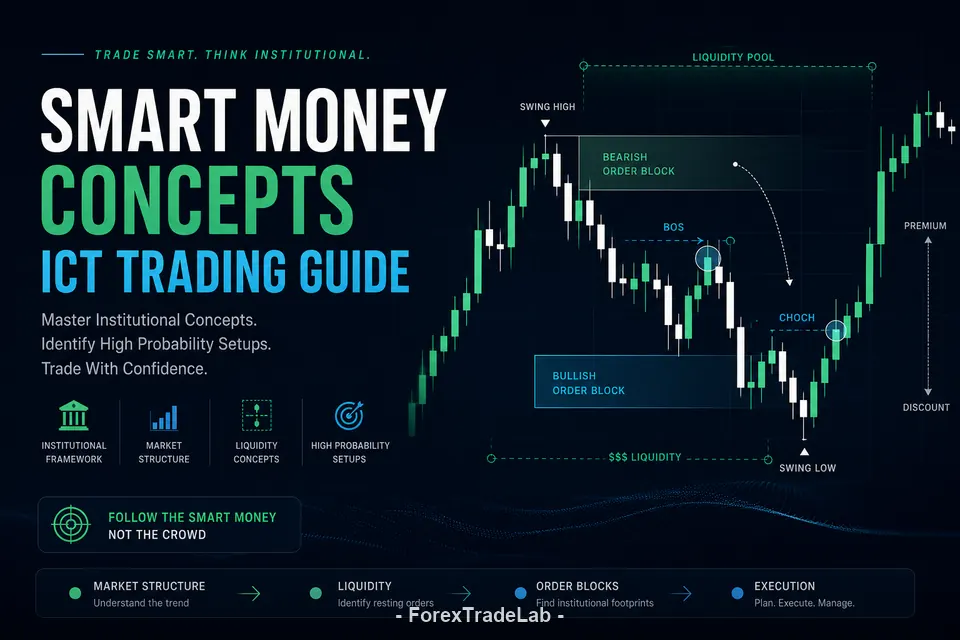
A structured, no-hype 2026 guide to Smart Money Concepts and ICT trading — market structure, order blocks, fair value gaps, liquidity sweeps, premium/discount, killzones, gold/FX application notes, and honest limitations.
The seven procedural mistakes — overtrading, revenge trading, martingale averaging, moving stops, and more — that kill more retail forex accounts than bad analysis ever will, plus the rules that neutralise each one.
A single reference lesson covering the four transaction-cost concepts — spread, swap, lot and pip — with worked examples on EUR/USD, USD/JPY and XAU/USD so you can size every trade correctly.
A practical framework for reading the forex economic calendar: which releases move which pairs, the difference between consensus and surprise, volatility windows, and how to size around binary events.
Most losing strategies work in one market regime and break in the other two. This playbook teaches you how to identify whether the market is trending, ranging or post-news, and which setup to use in each.
An evidence-based answer to how long it takes to learn Forex mechanics, why profitability has no reliable timetable, and which safety milestones to use before risking capital.
A free 12-week Forex self-study curriculum for 2026 with weekly lessons, demo exercises and milestone checkpoints.
A complete Forex trading plan template with a real worked example for 2026 — goals, strategy rules, risk management, daily routine, and weekly review checklist. Copy, customize, commit.