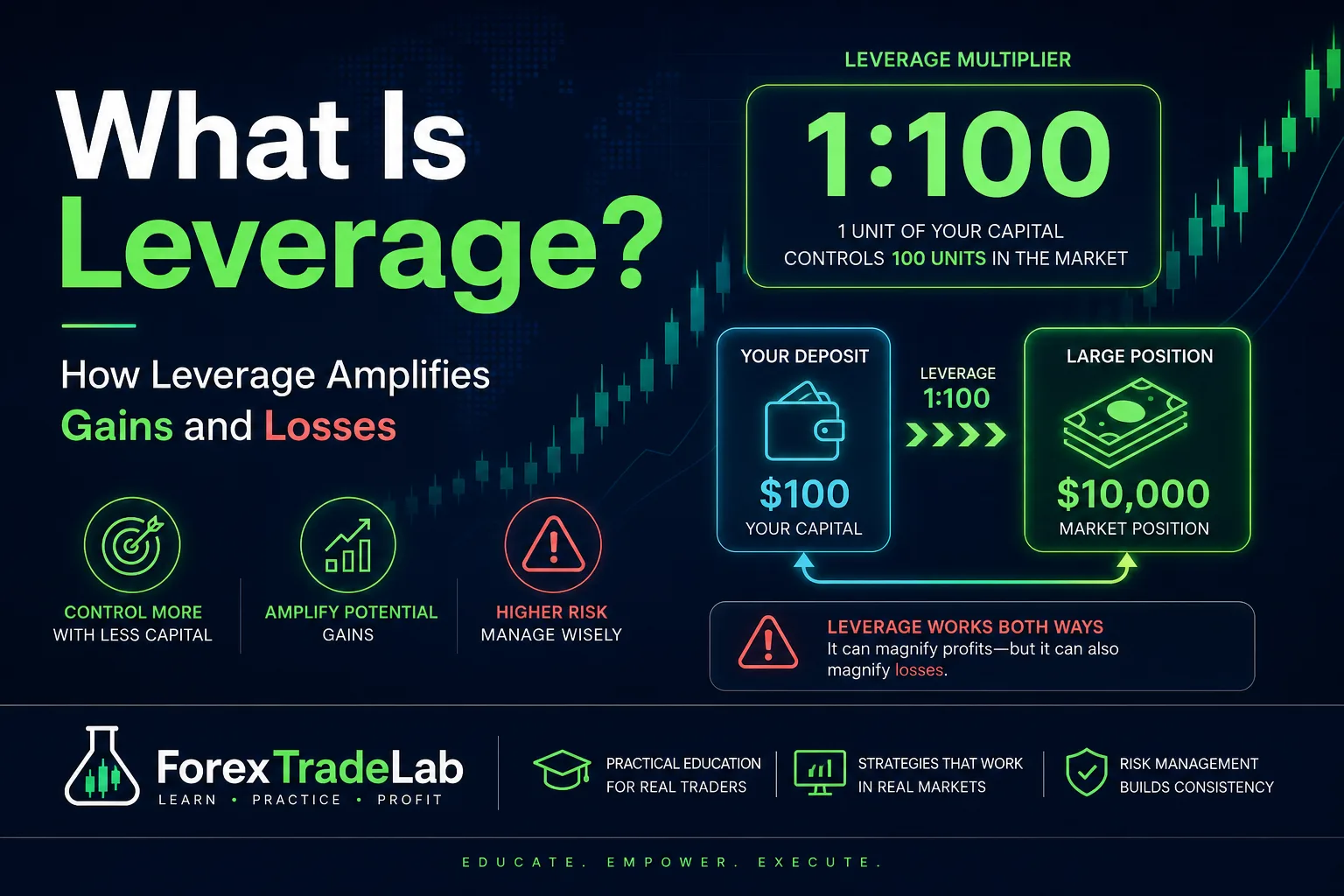
- Leverage increases exposure capacity, not trading skill; margin is collateral rather than a loss limit; effective leverage measures actual exposure; position size should come from cash risk and stop distance; regulation and client protections vary.
- What leverage is
- How leverage works
- Leverage ratios from 1:10 to 1:1000
- Profit and loss examples
- Leverage and margin
- Effective versus advertised leverage
- Retail leverage caps checked in October 2026
- Regulatory limits and protections
- The risks of leverage
- Position sizing before leverage
- Common leverage mistakes
- A practical leverage checklist
- Leverage glossary
Forex leverage can make a small deposit sufficient to open a meaningful currency position. It can also turn an ordinary market move into a large percentage loss. That is why a useful leverage decision begins with the amount an account can lose—not with the largest ratio displayed on a broker’s website.
This guide explains the mechanics in plain language. It does not recommend a particular broker, strategy, or leverage setting. Forex and contracts for difference are speculative products. Learn the basics of what forex is before trading a leveraged instrument with real money.
What leverage is#
Short Answer
Leverage allows a trader to control a position larger than the cash set aside from the account. A 1:100 ratio means that $1 of margin can support up to $100 of notional position value, subject to the broker’s rules.
Detailed Explanation
Leverage changes the relationship between a position’s full market value and the collateral needed to open it. Without leverage, buying $10,000 of an asset normally requires $10,000 in cash. With 1:100 leverage, a broker may require approximately $100 as margin for a $10,000 position. The market gain or loss, however, still comes from the entire $10,000 position.
In forex, every trade involves a currency pair. Buying EUR/USD means buying euros while selling U.S. dollars. Position value is commonly called notional value. It is this notional value—not the margin figure—that determines how strongly price movement affects account equity. Leverage does not predict direction, improve an entry, reduce trading costs, or make a poor strategy profitable. It simply makes larger exposure possible with less collateral.
This distinction matters because trading platforms naturally emphasize margin: used margin, free margin, margin level, and maximum volume. Those numbers are operationally important, but they can distract from the number that should drive risk decisions: the amount of cash lost if the trade reaches its exit. A broker may allow a position because its collateral rules are met. That is not a judgment that the position is appropriate for the trader’s account.
Example
Assume EUR/USD trades at 1.1000. Buying 100,000 euros has a notional value of roughly $110,000. At simplified 1:100 leverage, the estimated required margin is $1,100. If the pair rises 50 pips, a standard lot gains approximately $500 before costs. If it falls 50 pips, it loses approximately $500. The $1,100 margin did not limit the loss to $1,100; it merely allowed a $110,000 position to be opened.
Common Mistake
Calling leverage “free money” is misleading. It is exposure capacity. Another mistake is assuming that the margin number is a maximum loss. Loss depends on price movement, position size, costs, execution, and the protections that apply to the account.
Professional Tip
Use the term “notional exposure” in your trading journal. It directs attention to the full position value that moves with price, rather than the smaller collateral amount shown on the order ticket.
How leverage works#
Short Answer
The simple margin formula is required margin = notional value ÷ leverage ratio. Profit and loss are calculated from the full position size, not from the margin posted.
Detailed Explanation
Suppose a broker permits 1:50 leverage and a trader opens a $50,000 notional position. The simplified margin requirement is $1,000. The broker is not necessarily transferring $49,000 into the account as spendable cash. Instead, its margin system allows the trader to maintain that amount of market exposure while reserving $1,000 as collateral.
Account equity is typically the account balance adjusted for unrealized profit and loss. Used margin is collateral attached to open positions. Free margin is generally equity minus used margin. Many platforms also show margin level, commonly calculated as equity divided by used margin times 100. Definitions, hedging treatment, tiered rates, and stop-out thresholds vary by broker, so the product specification and client agreement are authoritative.
When a position loses value, equity falls. If equity becomes too low relative to used margin, available margin declines. A broker can warn the client, restrict new trades, or automatically close positions at its stated stop-out level. This mechanism manages the broker’s collateral risk; it is not a substitute for a personal stop-loss or portfolio-risk plan. In a rapid move, the price at which liquidation occurs can be worse than expected.
Example
An account contains $5,000 and opens a $50,000 position at 1:50. Estimated used margin is $1,000, leaving about $4,000 free margin at entry. A 2% adverse move on $50,000 is a $1,000 unrealized loss. Equity falls to roughly $4,000. The margin arrangement made the trade possible, but it did not change the fact that a 2% move cost $1,000.
Common Mistake
Do not treat free margin as money available to risk. It is a buffer for losses, costs, and changing requirements. Do not wait for a broker’s stop-out to act as the planned exit; it may occur after a loss much larger than the amount originally intended.
Professional Tip
Before every order, write down the notional size, maximum planned cash loss, and estimated margin. An order is not fully defined if any of those three figures is unknown.
Leverage ratios from 1:10 to 1:1000#
Short Answer
The ratio states the maximum exposure supported by each unit of margin. Higher ratios reduce required margin for a given position, but they do not require a trader to use a larger position.
Detailed Explanation
For a $10,000 position, 1:10 leverage requires about $1,000 margin; 1:30 requires about $333; 1:50 requires $200; 1:100 requires $100; 1:500 requires $20; and 1:1000 requires $10. These are deliberately simplified figures. Live requirements can change with the instrument, exchange rate, account currency, volume tier, weekend policy, and whether other positions offset or add to risk.
It is tempting to see higher leverage as a ladder of opportunity. It is more accurately a ladder of capacity. A 1:1000 account permits a trader to reserve very little collateral for a large position. It does not make that position sensible, and it does not make a market move smaller. A trader offered 1:500 can choose to run only 1:2 effective leverage. Conversely, a trader with a 1:30 cap can still overexpose an account by using nearly all available capacity.
High advertised leverage can be convenient for an experienced trader who has a carefully sized position and wants margin efficiency. It also removes friction that might otherwise prevent impulsive oversizing. The appropriate limit is based on the loss at the stop, the size of a plausible gap, open correlated positions, and account equity—not on a marketing label.
Example
For a $20,000 position, estimated margin is $2,000 at 1:10, $667 at 1:30, $400 at 1:50, $200 at 1:100, $40 at 1:500, and $20 at 1:1000. If the position falls 1%, the loss is $200 at every ratio before costs. Only collateral changes.
Common Mistake
“One-percent margin means one-percent risk” is false. At 1:100, one percent describes the margin fraction, not the loss limit. Comparing brokers solely by maximum leverage also ignores regulation, execution quality, costs, and client protections.
Professional Tip
Set a personal ceiling for effective leverage. A personal exposure limit travels with you across brokers and account types, while an advertised maximum does not describe what you are actually using.
Profit and loss examples#
Short Answer
Leverage does not change the pip value of an already chosen position. It changes the margin needed to hold that position, while position size and price movement determine the financial result.
Detailed Explanation
For many major pairs quoted in U.S. dollars, one standard lot is 100,000 units and one pip is approximately $10. A mini lot of 10,000 units is approximately $1 per pip, and a micro lot of 1,000 units is approximately $0.10 per pip. Cross pairs and non-USD accounts can have different pip values, so calculate rather than assume. Review what a pip is and what a lot is before relying on standard-lot examples.
On a standard lot worth about $10 per pip, a 25-pip loss is about $250, a 50-pip loss is about $500, and a 100-pip loss is about $1,000, before spread, commission, financing, or slippage. On a $2,000 account, those losses are 12.5%, 25%, and 50% of equity. The platform may permit the order under a high leverage setting, but permission does not make the risk proportionate to the account.
Gains are symmetrical. A 50-pip favorable move produces roughly $500 on that same position before costs. Leverage does not select winning trades for amplification. A trading method needs a tested edge and controlled loss size; a large ratio supplies neither.
Example
A $4,000 account risks 1%, or $40, with a 40-pip EUR/USD stop. The maximum approximate pip value is $40 ÷ 40 = $1, which is about 0.10 lot. At 1.1000, that position is about $11,000 notional. At 1:100, estimated margin is $110; at 1:30, about $367. The intended 40-pip loss remains near $40 under either ratio.
Common Mistake
Do not calculate the profit target first and select volume that makes the win look exciting. That reverses risk control. Do not omit spread and commission from loss planning, especially for small targets or short-term trades.
Professional Tip
Use the lot calculator to translate cash risk and stop distance into volume. Confirm the instrument and account-currency assumptions before placing the trade.
Leverage and margin#
Short Answer
Leverage and margin describe the same arrangement from opposite directions: leverage is exposure relative to collateral, while margin is the collateral required to hold exposure.
Detailed Explanation
At 1:100 leverage, the simple margin rate is 1%. At 1:50 it is 2%; at 1:30 it is about 3.33%; and at 1:10 it is 10%. The relationship is margin rate = 1 ÷ leverage. Margin is not a down payment that reduces the market value of the trade. It is collateral reserved while the position remains open.
When a position is closed, used margin is released according to the broker’s system. Profit or loss remains in equity. Margin is also different from an expense: spread, commission, and overnight financing are costs; margin is collateral. For a separate explanation of terminology and margin levels, see what margin is.
Requirements are not always fixed. Brokers can use different rates for major and exotic pairs, larger volumes, weekends, or scheduled high-risk periods. Conversion changes can affect accounts whose base currency differs from the instrument. Some brokers treat hedged positions differently. These details are reasons to retain a generous buffer rather than calculating to the exact minimum margin.
Example
Two $25,000 positions at 1:50 each use roughly $500 margin, for $1,000 total. In a $3,000-equity account, free margin begins near $2,000. If the positions are long EUR/USD and long GBP/USD, both may be harmed by broad U.S. dollar strength. The platform shows two tickets, but the economic risk can resemble one larger directional view.
Common Mistake
Do not use all available margin because the platform accepts the order. Do not assume separate pairs automatically diversify risk. Correlated trades can lose together, while floating losses reduce the usable buffer.
Professional Tip
Treat broker minimum margin as an operational requirement, not your risk-management target. Keep enough unused equity to absorb realistic adverse movement and possible requirement changes.
Effective versus advertised leverage#
Short Answer
Advertised leverage is the maximum ratio a broker makes available. Effective leverage is the actual total open notional exposure divided by current account equity.
Detailed Explanation
Effective leverage answers the practical question: how much market exposure is the account carrying now? If an account with $10,000 equity controls $20,000 notional exposure, its effective leverage is 2:1. If it controls $100,000, its effective leverage is 10:1. This measure remains useful when a broker offers several product-specific ratios.
The formula is effective leverage = total open notional exposure ÷ account equity. Use equity, not the original deposit, because unrealized profit and loss change the capital available to absorb further losses. Translate positions into the account currency before adding them. Gross exposure helps assess margin and total market activity. Net exposure helps reveal directional offset. Both can matter because partially offsetting trades can still have spread, gap, and basis risks.
Advertised leverage matters after a strategy has defined a sensible trade: it tells you whether sufficient margin is available. It should not define the volume. A trader can have access to 1:500 while using 1:3 effective leverage. Equally, an account subject to a 1:30 limit can have harmful effective exposure if it uses most of its capacity.
Example
An account has $8,000 equity, is long $16,000 EUR/USD, and short $8,000 USD/JPY. Gross exposure is $24,000, or 3:1 effective leverage. If equity falls to $6,000 without any new trade, effective leverage rises to 4:1. The account has become more exposed relative to capital because losses reduced the denominator.
Common Mistake
Do not calculate effective leverage from a historic deposit while ignoring current equity. Do not use used margin as a proxy for notional value: a high-leverage account can show low used margin while holding large exposure.
Professional Tip
Review effective leverage after each new order and after a drawdown. A journal column for gross exposure often reveals when several individually small positions have become a large combined risk.
Retail leverage caps checked in October 2026#
Short Answer
For many retail CFD clients in the United Kingdom, the EEA and Australia, major currency pairs remain capped around 30:1, and gold around 20:1. US retail off-exchange forex at NFA Forex Dealer Members follows Financial Requirements Section 12: a security deposit of at least 2% of notional value for a named list of currencies (about 50:1), and 5% for other transactions (about 20:1). The NFA’s own examples put EUR/USD at 2% and USD/MXN at 5%. A higher ratio on a screen belongs to a different entity or a different client classification until the agreement proves otherwise.
Detailed Explanation
ESMA’s 2018 CFD intervention, carried into national rules, limits retail opening leverage to 30:1 when the pair is any two of the US dollar, euro, yen, sterling, Canadian dollar and Swiss franc. Other currency pairs and gold are at 20:1. The same package requires margin close-out at 50% of the minimum required margin and negative-balance protection for the retail CFD account those rules cover. The FCA’s permanent rules in PS19/18 use the same major-pair ratio: initial margin of at least 3.33%, about 30:1. ASIC’s product-intervention order uses 30:1 for major currency pairs and 20:1 for gold. For US retail forex, NFA Financial Requirements Section 12 requires each Forex Dealer Member to collect at least 2% of notional value on transactions in the British pound, Swiss franc, Canadian dollar, yen, euro, Australian dollar, New Zealand dollar, Swedish krona, Norwegian krone and Danish krone, and 5% on other transactions. Where the two currencies carry different percentages, the higher one applies. Read the current rule against the legal entity that will hold the money.
The arithmetic is why the cap exists. With $1,000 of margin, 30:1 supports about $30,000 of notional exposure. A 1% adverse move is about $300 before costs, or 30% of that margin. At 500:1 the same $1,000 supports about $500,000, and a 1% move is about $5,000. National authorities told ESMA that 74–89% of retail CFD accounts in the samples they reviewed lost money, with average losses in those samples from €1,600 to €29,000. That range is the historical basis of the standard warning. It is the wrong number to paste onto every broker in 2026. Where FCA or ESMA-style rules apply, the firm must show its own percentage for the preceding 12 months. Sizing from a stop, rather than from the cap, is covered in risk management and starting capital.
Example
A UK retail CFD account is inside the 30:1 major-pair cap. The same person who then opens an account with an offshore affiliate may see 500:1. The chart can match. The complaint route, client-money rules and loss treatment follow the agreement, which is why broker selection starts with the legal name.
Common Mistake
Reading “up to 1:30” as advice to run positions at 1:30. Effective leverage — open notional divided by equity — comes from the stop, and on a durable plan it sits well inside the legal maximum.
Professional Tip
Write the legal entity, the regulator and the margin percent for the symbol before comparing two leverage settings. If that entity is absent from the register, this section describes someone else’s account.
Sources: ESMA product-intervention notice; FCA PS19/18; ASIC Instrument 2020/986; NFA Financial Requirements Section 12.
Regulatory limits and protections#
Short Answer
Retail leverage rules depend on the client’s jurisdiction, broker entity, instrument, and classification. ESMA-style measures generally cap retail leverage on major forex pairs at 1:30 in the European Economic Area.
Detailed Explanation
Regulators use retail leverage limits because small margin requirements can make rapid losses more likely. The European Securities and Markets Authority introduced CFD product-intervention measures, and national regulators have adopted related permanent measures. Major currency pairs are commonly associated with a 30:1 retail cap; lower caps apply to other product categories. Rules and local implementation can change, so verify the current regulator source and exact account terms.
For retail CFD clients of UK FCA-regulated firms, a major-FX position requires at least 3.33% initial margin, equivalent to approximately 30:1 maximum leverage. FCA rules also require account-level margin close-out at 50% of required maintenance margin and negative-balance protection for the qualifying CFD account. These protections can still result in forced closure and loss of all funds allocated to that CFD account; they do not guarantee a stop-loss fill. They do not automatically apply to professional-client, offshore, or differently regulated accounts.
Other jurisdictions use different regimes. In the United States, retail off-exchange forex is subject to CFTC and NFA oversight and leverage constraints that differ by currency category. An international brand may operate multiple legal entities. An offshore entity might offer a much higher ratio, but this can also change complaint routes, marketing oversight, client-money arrangements, and negative-balance provisions.
Elective-professional classifications can have different leverage options, but eligibility often depends on experience, transaction history, or financial criteria and can reduce protections. It is not a shortcut for a novice to make speculation safer. Regulation creates boundaries around a product; it cannot make an oversized trade prudent.
Example
With $1,000 margin, a 1:30 major-pair cap supports about $30,000 of notional exposure, while 1:500 supports about $500,000. A 0.5% adverse move on $500,000 is about $2,500 before costs. The larger ratio changes capacity, not probability.
Common Mistake
Do not assume a broker brand identifies the entity that will hold your account. Check the legal entity, authorization, leverage schedule, margin policy, and protections. Do not confuse a large advertised ratio with regulatory endorsement.
Professional Tip
Read the product disclosure and margin policy before funding. The CFTC, the relevant national regulator, and official broker documents are more reliable for legal protections than promotional claims.
The risks of leverage#
Short Answer
The main risk is oversized exposure: a normal market move becomes large relative to account equity. Leverage also increases sensitivity to gaps, costs, correlation, and forced liquidation.
Detailed Explanation
Currency prices can move quickly after central-bank decisions, inflation releases, geopolitical developments, or liquidity shocks. A position that appears manageable during routine trading can be difficult to close at the intended price in a fast market. A stop-loss helps define planned risk but is normally an instruction to execute after a trigger, not an unconditional promise of a specific fill. The difference is slippage.
Leverage magnifies more than directional movement. Wider spreads, commissions, overnight financing, and rollover effects reduce equity. Several correlated trades can multiply the same macro view. For example, long EUR/USD, GBP/USD, and AUD/USD may each be vulnerable to a broad U.S. dollar rally. Three order tickets do not necessarily mean three independent risks.
Losses also become harder to recover from as drawdown grows. A 10% drawdown requires an 11.1% gain to recover. A 50% drawdown requires a 100% gain. Raising size after a loss to recover quickly is a common leverage-driven error that can turn a manageable drawdown into a forced closure.
Example
A $3,000 account opens a $150,000 position, creating 50:1 effective leverage. A 1% adverse move costs about $1,500 before costs—50% of equity. The same account with $15,000 exposure, or 5:1 effective leverage, loses about $150 on the identical market move.
Common Mistake
Do not move a stop farther away while holding the same volume; that increases cash risk. Do not average down without a written maximum exposure. Do not assume a broker’s liquidation mechanism will protect the account at the loss you intended.
Professional Tip
Measure risk at portfolio level. Add the plausible losses of correlated positions, then compare that total to account equity before opening another trade.
Position sizing before leverage#
Short Answer
Choose a cash loss you can accept, choose a logical stop distance, calculate volume from those inputs, and then use leverage only to confirm margin availability.
Detailed Explanation
Position sizing separates a trade idea from account survival. First define a fixed cash amount or percentage risk. Next, place the stop where the trade thesis is invalidated, rather than where a large volume would be convenient. Then calculate the pip value and volume that make the loss at that stop equal to the selected risk. Finally, check estimated margin, trading costs, correlation, and total effective leverage.
The simplified formula is position size = cash risk ÷ (stop distance × pip value per unit). A calculator handles currency conversion and contract specifications, but it cannot decide whether the stop is logical or the risk budget is suitable. If a reasonable stop produces a volume below the broker’s minimum, the trade may not fit the account. Tightening a stop solely to force a larger volume is not a solution.
Risk percentage is a policy choice rather than a universal number. Some traders use less than 1% per trade; others use a different tested limit. The essentials are consistency, a maximum total open risk, and a drawdown plan. Risk management explains the broader process.
Example
A $10,000 account permits a maximum planned loss of $75. A setup requires a 60-pip stop. Maximum approximate pip value is $75 ÷ 60 = $1.25. On a major USD-quoted pair this is around 0.125 lot; if 0.01 increments apply, 0.12 lot risks about $72 before costs. Whether the broker offers 1:30 or 1:100 does not change the planned $72 price risk.
Common Mistake
Do not select 0.10 lot as a default because it sounds small. With a wide stop or small account, it may be too large. Do not use the same lot size across pairs without checking pip value and volatility.
Professional Tip
Record risk in account currency: “This trade risks $72 plus a cost allowance.” A concrete dollar figure is harder to rationalize away than an abstract volume.
Common leverage mistakes#
Short Answer
Most leverage failures come from using maximum capacity as a sizing guide, ignoring combined exposure, or treating margin alerts as a risk plan.
Detailed Explanation
The first mistake is equating platform permission with personal permission. The platform checks collateral rules, not whether the order is appropriate for your income, experience, or risk policy. The second is focusing on percentage return without stating dollar loss. A large possible gain is meaningless if one loss can damage the account beyond the strategy’s ability to recover.
The third is forgetting that unchanged positions become more leveraged after losses reduce equity. The fourth is using an unusually tight stop only to justify a larger lot size. Stops should reflect invalidation and tested volatility. The fifth is treating a winning trade as “house money” and raising size without a written rule.
Further errors include holding full leverage through major announcements without allowing for gaps, overlooking financing on longer holds, and spreading exposure across accounts so that aggregate risk is not visible. No account setting compensates for a missing position-size limit.
Example
A $2,500 account has a 100-pip stop and a $25 risk budget. The suitable approximate pip value is $0.25, or 0.025 lot on a major USD-quoted pair. If 0.01 steps apply, 0.02 lot risks about $20 and 0.03 risks about $30. Opening 0.50 lot because 1:500 makes margin inexpensive would risk about $500 at the same stop, or 20% of the account.
Common Mistake
Never add size merely because a previous trade won. Never remove a stop because the margin buffer appears ample. A demonstration account also does not prove that the same leverage is emotionally or operationally suitable in live conditions.
Professional Tip
Add a “reason for size” field to the journal. “Maximum available” and “I wanted a bigger return” identify a process failure before it becomes a financial loss.
A practical leverage checklist#
Short Answer
A sound workflow checks the trade thesis, cash risk, stop, volume, margin, costs, correlation, and broker protections before the order is sent.
Detailed Explanation
Use this checklist:
- Define the pair, direction, entry logic, and invalidation point.
- Place a stop based on invalidation and normal volatility, not on a desired lot size.
- Set a maximum cash loss consistent with account and portfolio limits.
- Calculate volume from the stop distance and pair-specific pip value.
- Estimate spread, commission, financing, and potential slippage.
- Confirm that required margin leaves a substantial free-margin buffer.
- Calculate gross and net effective leverage across every open position.
- Check the economic calendar, liquidity conditions, and weekend exposure.
- Verify the broker entity’s margin, stop-out, and negative-balance rules.
- Record the plan before entry and do not increase size merely because price moves against you.
Example
A trader plans a 0.08-lot GBP/USD long with a 50-pip stop. Price risk is approximately $40 before costs. Before entering, the trader sees an existing EUR/USD long and a Bank of England decision in 20 minutes. The new order is not evaluated in isolation: combined dollar exposure and event risk determine whether the trade fits the account plan.
Common Mistake
A checklist fails when it is only box ticking. “Margin available” does not answer whether a realistic adverse move is survivable. Listing an event but changing nothing when it matters is not risk control.
Professional Tip
Pre-calculate common account sizes only as a reference. Recalculate when stop distance, pair, equity, currency conversion, or correlated exposure changes.
Leverage glossary#
Short Answer
A few precise terms prevent the damaging confusion between collateral, exposure, and loss.
Detailed Explanation
Advertised leverage: The highest ratio made available to an eligible account for a product.
Effective leverage: Total open notional exposure divided by current account equity.
Equity: Account balance adjusted for unrealized profit and loss.
Free margin: Equity remaining after used margin, according to the broker’s calculation.
Leverage ratio: The relationship between position value and required margin, such as 1:100.
Margin: Collateral required to open and maintain a leveraged position.
Margin call: A warning or condition that usable margin has fallen under the broker’s policy.
Margin level: A percentage commonly calculated as equity divided by used margin times 100.
Notional value: The full market value of a controlled position.
Pip: A standardized small movement in a currency pair; its cash value depends on position size.
Position size: The number of units or lots bought or sold.
Slippage: The difference between expected order price and actual fill price.
Stop-out: Automatic position closure when a broker’s stated margin threshold is reached.
Used margin: Collateral currently reserved for open positions.
Example
For a $30,000 position in a $6,000-equity account, effective leverage is 5:1. If the broker offers 1:100, used margin may be around $300. The $300 is margin, $30,000 is notional value, and 5:1 is the actual leverage being used.
Common Mistake
Do not use “margin” and “risk” interchangeably. Low required margin can coexist with very high risk, and a larger margin requirement does not itself reveal how much will be lost.
Professional Tip
Before trading live, identify notional value, used margin, free margin, equity, and effective leverage in a demonstration account. Understanding these labels is more valuable than memorizing any broker’s maximum ratio.