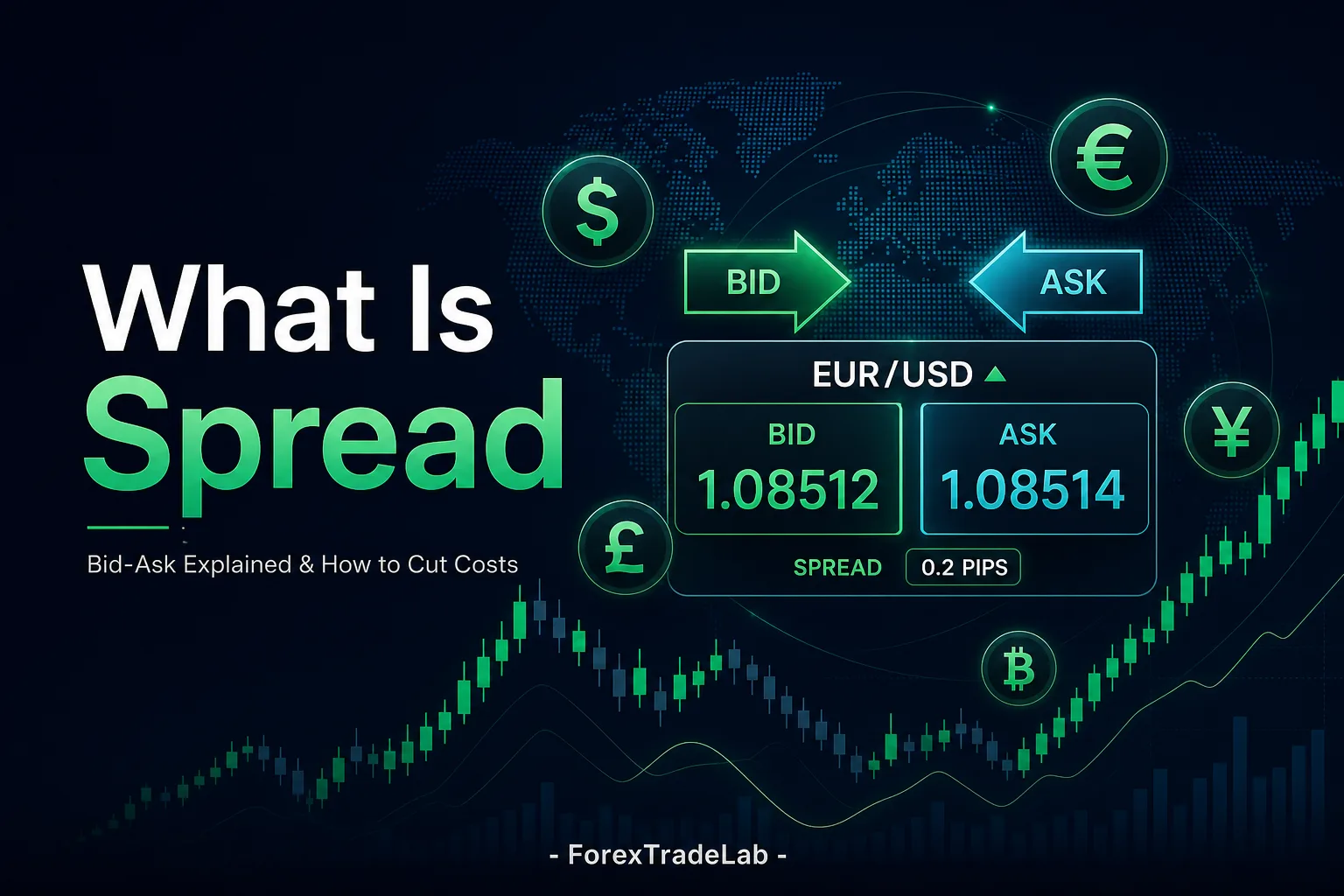
- Spread is the difference between bid and ask price — it is your primary transaction cost on every single trade
- Variable spreads can widen dramatically during news events, so avoid entering positions right before high-impact releases
- Trade major pairs during the London-New York overlap (13:00-17:00 GMT) for the tightest spreads
- Compare live spreads across brokers regularly — small differences compound significantly for frequent traders
- What Is Spread in Forex?
- Understanding Bid and Ask Price
- How Spread Is Measured
- Fixed vs Variable (Floating) Spread
- What Affects Forex Spreads?
- Spread Comparison by Pair Type
- How Spread Impacts Your Trading
- How to Minimize Spread Costs
- Common Mistakes Related to Spread
- Conclusion
- Measure the All-In Cost, Not the Headline Spread
- Spread and Execution Quality
- A Spread-Aware Trading Plan
- Spread Checklist
- Glossary
What Is Spread in Forex?#
Every currency pair on a forex platform is displayed with two prices — one slightly higher than the other. The gap between those two numbers is called the spread, and it is the primary cost you incur on every single trade. In concrete terms, the spread is the difference between the ask price (the price you pay to buy) and the bid price (the price you receive when you sell). When you open a position, your trade is immediately marked against you by the width of the spread, which means you start with a small unrealized loss before the market moves a single tick.
Consider a real-world EUR/USD quote:
- Ask (buy price): 1.10520
- Bid (sell price): 1.10500
- Spread: 1.10520 - 1.10500 = 0.00020 = 2 pips
If you click Buy at 1.10520, the platform values your open position at the current bid of 1.10500. Those 2 pips represent the distance the market must travel in your favor before your trade reaches break-even. Only price movement beyond that point becomes profit.
For the majority of commission-free retail accounts, the spread is how the broker generates revenue from each transaction. There is no separate fee — the cost is embedded inside the quote itself. That makes spread a guaranteed expense on every trade, whether you profit or lose. Commissions vary by account type, slippage depends on execution speed, but the spread is always present. A trader opening 15–20 positions per week may barely notice a 0.4-pip spread difference on any single trade, yet across a full quarter that marginal gap quietly compounds into hundreds or even thousands of dollars in extra cost.
Understanding Bid and Ask Price#
Every forex quote you see on a chart, order panel, or price ticker is composed of two numbers displayed side by side. Understanding which number applies to which action is essential for calculating your actual entry cost and your effective profit or loss on every trade.
| Price | Definition | When It Applies |
|---|---|---|
| Bid | The price at which the broker buys from you (your sell price) | When you sell (go short) a currency pair |
| Ask | The price at which the broker sells to you (your buy price) | When you buy (go long) a currency pair |
The ask is always higher than the bid. The distance between them is the spread.
Full Example#
Suppose EUR/USD is quoted at 1.10500 / 1.10520:
- You click Buy — your entry is the Ask at 1.10520
- You click Sell — your entry is the Bid at 1.10500
- The broker captures the 2-pip difference on every completed round-trip transaction
Now imagine you bought at 1.10520 and the market advances to 1.10540/1.10560. Your closing price (bid) is now 1.10540. Profit: 1.10540 - 1.10520 = 2 pips. The price moved 4 pips in total, but the spread consumed half of that movement. Your net gain is 2 pips, not 4.
How the Broker Profits#
On commission-free (standard) accounts, the spread itself is the broker's primary revenue source. The broker aggregates quotes from multiple liquidity providers, applies a small markup on both the bid and ask side, and retains the difference. On ECN or raw-spread accounts, the broker passes through near-raw interbank prices with minimal markup and instead charges a transparent per-lot commission — typically $3–$7 per round trip. For active traders, the total cost on ECN (raw spread + commission) is nearly always lower than the wider, all-inclusive spread on standard accounts, which is precisely why professional and high-frequency traders gravitate toward raw-spread models.
How Spread Is Measured#
Spread is expressed in pips — the standard unit of price movement in the forex market.
Pips and Pipettes#
For most currency pairs, one pip equals the fourth decimal place (0.0001). For JPY-based pairs, one pip corresponds to the second decimal place (0.01). Modern brokers display an additional digit called a pipette, which equals one-tenth of a pip and provides fractional pricing:
| Pair | 5-Digit Quote | Spread | In Pips |
|---|---|---|---|
| EUR/USD | 1.10500 / 1.10520 | 0.00020 | 2.0 pips |
| EUR/USD | 1.10502 / 1.10510 | 0.00008 | 0.8 pips |
| USD/JPY | 149.500 / 149.520 | 0.020 | 2.0 pips |
| GBP/JPY | 188.100 / 188.145 | 0.045 | 4.5 pips |
Why Pipettes Matter#
Pipettes enable brokers to offer tighter, fractional spreads — 0.6 pips rather than rounding up to 1, or 1.3 instead of 2. This precision benefits traders directly. Saving 0.2 pips on each trade may appear trivial in isolation, but over 100 trades per month on a standard lot, that amounts to $200 in reduced costs. The effect is magnified for high-frequency strategies like scalping, where targets are narrow and each tenth of a pip has a tangible impact on profitability.
Major vs Exotic Spread Examples#
- EUR/USD (the world's most liquid pair): typical spread 0.1–1.0 pip
- GBP/USD: typical spread 0.5–1.5 pips
- USD/TRY (exotic): typical spread 20–50 pips
- EUR/ZAR (exotic): typical spread 50–150 pips
The cost difference is enormous. A 1-pip spread on EUR/USD costs $10 per standard lot. A 40-pip spread on USD/TRY costs roughly $400 per standard lot. The pair you choose to trade is one of the single most impactful cost decisions in your forex career.
Fixed vs Variable (Floating) Spread#
Brokers offer two fundamentally different spread models. The one you trade on can significantly shift your total costs depending on your strategy and the market environments you typically encounter.
Fixed Spread#
A fixed spread remains constant regardless of what is happening in the market. Whether liquidity is overflowing or a major central bank announcement has just landed, the quoted spread does not change.
Advantages:
- Fully predictable cost per trade — ideal for precise backtesting and strategy optimization
- No surprise widening during volatile events
- Straightforward profit and loss calculations at any time
Disadvantages:
- Typically wider than variable spreads under normal conditions (e.g., 2 pips vs 0.6 pips on EUR/USD)
- Usually offered by market maker (dealing desk) brokers
- You overpay during calm, high-liquidity periods when a variable spread would be substantially tighter
Variable (Floating) Spread#
A variable spread adjusts in real time based on available liquidity, market demand, and current volatility. During high-volume sessions it can compress to near zero; during thin or volatile periods it can expand sharply.
Advantages:
- Can drop to 0.0–0.3 pips on major pairs during peak liquidity windows
- Reflects genuine interbank market conditions and live pricing dynamics
- Lower average cost over time for traders who schedule entries during optimal sessions
Disadvantages:
- Can spike to 10–30+ pips during major news releases without warning
- More difficult to backtest reliably because historical spread data varies between platforms
- Demands active awareness of session timing, liquidity cycles, and the economic calendar
Comparison Table#
| Condition | Fixed Spread | Variable Spread |
|---|---|---|
| Normal market hours | 2.0 pips | 0.3–0.8 pips |
| London–New York overlap | 2.0 pips | 0.1–0.5 pips |
| Major news release (NFP, FOMC) | 2.0 pips | 5–30 pips |
| Low liquidity (late Sunday, holidays) | 2.0 pips | 3–8 pips |
| Broker model | Market Maker / Dealing Desk | ECN / STP / No Dealing Desk |
| Best suited for | Beginners, news traders | Scalpers, high-volume traders |
What Affects Forex Spreads?#
Understanding what drives spread movement allows you to select optimal trading conditions and sidestep avoidable costs. Five primary factors determine whether spreads are tight or wide at any given moment:
1. Market Liquidity#
Liquidity measures how many active buyers and sellers are participating at a given time. When liquidity runs deep, price providers compete aggressively for order flow, compressing spreads in the process. EUR/USD — the single most traded pair globally — consistently delivers the tightest spreads because its liquidity pool dwarfs every other instrument. Exotic pairs with fewer participants carry naturally wider spreads due to thinner order books and reduced competition among liquidity providers.
2. Trading Session and Time of Day#
The forex market operates around the clock on weekdays, but liquidity peaks and troughs vary dramatically across sessions. The three major trading centers — Tokyo, London, and New York — produce distinct liquidity windows throughout the day:
| Session | Hours (GMT) | Liquidity Level | Typical EUR/USD Spread |
|---|---|---|---|
| Sydney/Tokyo | 00:00–08:00 | Moderate | 0.8–1.5 pips |
| London | 08:00–16:00 | High | 0.3–0.8 pips |
| London–New York Overlap | 13:00–17:00 | Highest | 0.1–0.5 pips |
| New York | 13:00–22:00 | High | 0.5–1.0 pips |
| Late New York / Gap | 22:00–00:00 | Low | 1.0–3.0 pips |
3. Economic News and Events#
High-impact economic data releases create volatility bursts that temporarily push spreads wider. The events with the greatest spread impact include:
- Non-Farm Payrolls (NFP) — released the first Friday of each month
- Central bank interest rate decisions (FOMC, ECB, BOE, BOJ)
- CPI / Inflation reports
- GDP releases
- Geopolitical shocks (elections, military conflicts, trade sanctions)
During these releases, liquidity providers widen their quotes to shield themselves against rapid, unpredictable price swings. Retail spreads may stay elevated for seconds to several minutes after the data hits the wire.
4. Currency Pair Type#
Different pairs carry fundamentally different spread costs based on their global trading volume:
- Majors (EUR/USD, USD/JPY, GBP/USD): highest volume — tightest spreads
- Minors / Crosses (EUR/GBP, AUD/NZD): moderate volume — moderate spreads
- Exotics (USD/TRY, EUR/ZAR, USD/MXN): low volume — widest spreads
5. Broker Model#
The broker's execution model fundamentally shapes how spreads are sourced and presented to you:
- Market Maker (Dealing Desk): The broker takes the opposite side of your trade internally. Spreads tend to be fixed and slightly wider, but they remain stable even during high-volatility episodes.
- ECN (Electronic Communication Network): Your orders are matched directly with external liquidity providers. Spreads are variable and can approach zero, but a per-lot commission is charged on each transaction.
- STP (Straight Through Processing): Orders flow straight to liquidity providers without broker intervention. Spreads are variable with a small built-in markup; no separate commission is applied.
Spread Comparison by Pair Type#
The currency pair you choose to trade has a direct and meaningful impact on your spread cost. The table below shows typical spreads across pair categories during normal market conditions:
| Category | Example Pairs | Typical Spread | Cost per Standard Lot |
|---|---|---|---|
| Major | EUR/USD | 0.1–1.0 pip | $1–$10 |
| Major | USD/JPY | 0.3–1.0 pip | $2–$7 |
| Major | GBP/USD | 0.5–1.5 pips | $5–$15 |
| Minor | EUR/GBP | 1.0–2.0 pips | $12–$25 |
| Minor | AUD/NZD | 1.5–3.0 pips | $10–$20 |
| Minor | EUR/AUD | 1.5–3.0 pips | $10–$20 |
| Exotic | USD/TRY | 20–50 pips | $12–$30 |
| Exotic | EUR/ZAR | 50–150 pips | $27–$80 |
| Exotic | USD/MXN | 30–80 pips | $15–$40 |
Pip values for exotic pairs fluctuate with exchange rates; costs shown are approximate.
How Spread Impacts Your Trading#
Spread is not an abstract statistic on your chart — it directly reduces the net profit of every single position you open. Here is how to quantify that impact precisely.
Cost Calculation by Lot Size#
The formula is straightforward:
Spread Cost = Spread (in pips) × Pip Value × Number of Lots
| Lot Size | EUR/USD Pip Value | Cost at 0.6-pip Spread | Cost at 2-pip Spread |
|---|---|---|---|
| Standard (1.00) | $10.00 | $6.00 | $20.00 |
| Mini (0.10) | $1.00 | $0.60 | $2.00 |
| Micro (0.01) | $0.10 | $0.06 | $0.20 |
Now consider a scalper who places 20 trades per day using 1 standard lot. At a 2-pip spread, the daily spread expense is $400. On a 0.6-pip spread account, the identical activity costs only $120 — a daily saving of $280. Over a 20-day trading month that amounts to roughly $5,600 saved. Projected across a full year, this single factor accounts for more than $67,000 in cost difference.
Impact on Different Trading Strategies#
| Strategy | Typical Target | Spread as % of Target (2-pip spread) | Impact Level |
|---|---|---|---|
| Scalping | 5–15 pips | 13–40% | Very High |
| Day Trading | 20–50 pips | 4–10% | Moderate |
| Swing Trading | 50–200 pips | 1–4% | Low |
| Position Trading | 200–1000 pips | 0.2–1% | Minimal |
Scalping is the strategy most vulnerable to spread costs. A scalper aiming for 10 pips of profit with a 2-pip spread needs the market to advance 12 pips in their favor to reach that target — requiring 20% more price movement compared to a hypothetical zero-spread scenario.
Break-Even Analysis#
To break even on any trade, the price must move in your direction by at least the spread. For a long (buy) position on EUR/USD with a 1.5-pip spread:
- Entry price (ask): 1.10520
- Break-even point: the bid must reach 1.10520 — meaning it needs to climb 1.5 pips from its starting level of 1.10505
- Every pip of movement beyond that translates directly into profit
This subtly shifts your effective risk-to-reward ratio. A trade with a 20-pip stop loss and 40-pip take profit actually risks 20 pips to gain only 38.5 pips (40 minus the 1.5-pip spread). The real ratio drops from 2:1 to 1.925:1.
How to Minimize Spread Costs#
Every pip you save on spread feeds directly into your bottom line. Here are six proven approaches to keep spread expenses at their minimum:
1. Trade Major Currency Pairs#
Major pairs — EUR/USD, USD/JPY, GBP/USD, USD/CHF, AUD/USD — sit at the epicenter of global forex liquidity and consistently produce the tightest spreads available. Unless you have a well-tested, demonstrable edge in exotic markets, majors should constitute the core of your trading activity.
2. Trade During Session Overlaps#
The London–New York overlap (13:00–17:00 GMT) is the optimal window for minimal spreads. Global trading volume reaches its daily zenith during this period, compressing spreads to their lowest levels. Steer clear of major pairs during the late New York session or the early Sydney opening when liquidity thins and spreads widen noticeably.
3. Choose the Right Account Type#
ECN and raw-spread accounts deliver near-raw interbank pricing and charge a transparent per-lot commission — typically $3–$7 per round trip. For active traders, the combined cost (raw spread + commission) is almost invariably lower than the wider, all-inclusive spread on standard accounts.
4. Avoid Opening Trades During High-Impact News#
In the 5–10 minutes surrounding major economic releases, variable spreads can spike to 5–20 times their normal width. Review an economic calendar each morning and either close positions before the data release or wait for spreads to normalize before entering new trades.
5. Compare Brokers Regularly#
Spread competitiveness among brokers shifts over time. The broker with the tightest EUR/USD spread last year may no longer hold that position today. Periodically compare live spreads across your shortlisted brokers — even a 0.3-pip improvement saves $3 per standard lot per trade, which accumulates rapidly for frequent traders.
6. Use Limit Orders Instead of Market Orders#
Market orders execute at the prevailing ask or bid, which may include a momentary spread spike. Limit orders let you specify your desired entry price, shielding you from inflated spreads during micro-volatility bursts. This is particularly valuable in the initial seconds following a news release.
Common Mistakes Related to Spread#
Even experienced traders fall into spread-related traps. Recognizing these common errors can safeguard your account over the long run.
Ignoring Spread in Profit Calculations#
Many traders set take-profit and stop-loss levels based on raw pip movement without factoring in the spread. A 20-pip take profit on EUR/USD with a 1.5-pip spread yields only 18.5 pips of net profit. Always build the spread into your risk-to-reward analysis before placing any trade.
Trading Exotic Pairs as a Beginner#
Exotic pairs like USD/TRY, USD/ZAR, or EUR/NOK appear attractive due to their large daily ranges, but their 20–50+ pip spreads create a steep cost barrier. The price must move substantially in your favor just to cover the spread before profit begins. Develop your skills and build consistency on major pairs before venturing into exotics.
Scalping During News Events#
Scalping requires tight, stable spreads to be viable. Opening scalp positions immediately before or during a major economic release — when spreads can inflate from 0.5 pips to 15+ pips — virtually guarantees a loss on entry. Always wait for post-news spread normalization before resuming scalp trades.
Not Checking the Live Spread Before Entry#
Most trading platforms display the current spread on the chart or in the order panel in real time. Failing to glance at this number before clicking Buy or Sell can result in entering during a temporary spike. This is especially costly on variable-spread accounts where the spread changes every second.
Assuming All Brokers Offer the Same Spread#
Spreads differ substantially between brokers, between different account types at the same broker, and even between different server locations. Two traders opening identical EUR/USD positions at the exact same moment may pay very different costs depending on their broker infrastructure and account configuration.
Conclusion#
Spread is one of the most fundamental — and most frequently overlooked — costs in forex trading. It silently reduces your profit on every position, and its cumulative effect over weeks and months can be the difference between a profitable year and a losing one.
Key takeaways:
- Spread is the difference between the bid and ask price — your guaranteed cost on every single trade
- Fixed spreads deliver cost certainty; variable spreads offer lower averages but can spike during news and low-liquidity windows
- Major pairs carry the tightest spreads (0.1–1 pip); exotic pairs can exceed 50 pips
- Spread disproportionately impacts short-term strategies like scalping — consuming up to 40% of a scalper's profit target
- Trade during the London–New York overlap, choose ECN accounts, and focus on major pairs to keep spread costs at a minimum
- Always incorporate spread into your profit targets and risk-to-reward calculations before entering any trade
By understanding how spread works and actively managing your exposure to it, you transform what most traders treat as an invisible overhead into a controllable variable — giving you a concrete, measurable advantage over those who ignore it.
Measure the All-In Cost, Not the Headline Spread#
Short Answer
The cheapest-looking account is not necessarily the cheapest way to trade. Compare the expected spread, commission, financing, conversion charge, slippage, and any platform or inactivity fees for the way you actually trade.
Detailed Explanation
An advertised “from 0.0 pips” spread describes a minimum observed quote, not a promise about the price available when you trade. Raw-spread accounts commonly add a commission. Standard accounts commonly build more of the fee into the quote. Neither model is automatically better: a trader who opens and closes a liquid major during an active session may prefer one result, while a trader who holds a cross pair overnight may find that financing dominates the entry spread.
Put every cost in one unit before comparing accounts. For a USD account trading EUR/USD, a simple illustration is:
all-in entry-and-exit cost = spread in pips + round-trip commission expressed in pips + expected slippage in pips
If a one-lot EUR/USD trade has a 0.2-pip raw spread and a $7 round-trip commission, the commission is approximately 0.7 pip when one pip is $10. The visible all-in cost is therefore about 0.9 pip before slippage and overnight financing. A 1.1-pip commission-free quote might be more expensive or cheaper depending on the prices actually received, not on the label alone.
For a non-USD account or a cross pair, do the same calculation in account currency. The pip value guide explains why the cash value of a pip can vary. A broker’s contract specification and fee schedule are more useful evidence than an affiliate comparison table.
Example
Assume a trader makes 40 EUR/USD round trips per month, each at one mini lot. Account A averages 1.2 pips with no commission. Account B averages 0.3 pip plus a $0.70 round-trip commission. At roughly $1 per pip for a mini lot, Account A costs about $48 in spread; Account B costs about $12 in spread plus $28 commission, or about $40 before slippage. The $8 difference is modest, but the conclusion changes if the actual spread widens or if execution differs.
Common Mistake
Comparing a broker’s minimum spread with another broker’s average spread is not a valid comparison. The observation period, pair, account type, session, and commission treatment must match.
Professional Tip
Export or record a small sample of live quotes at the hours you trade. Review median and unusually wide spreads separately. A very low average can hide a few expensive periods that matter to a short-term strategy.
Spread and Execution Quality#
Short Answer
Spread is only one part of the executable price. A tight quote has little value if an order is repeatedly rejected, delayed, filled far away from the displayed price, or closed under rules the trader did not understand.
Detailed Explanation
The bid and ask on a screen are indications available at a moment in time. A market order asks the broker or dealer to execute at the best available price under its order policy; it does not reserve the last displayed quote. In fast conditions, the market can move before the order reaches the venue. That difference is called slippage. Slippage may be positive or negative, but a plan should allow for adverse fills rather than assuming that every fill will be favourable.
Execution also varies by order type. A stop-loss is normally activated when a relevant bid or ask reaches its trigger, then becomes an instruction to close. It can fill beyond the trigger if prices jump. A limit order sets a price boundary but may not fill at all. A stop-limit order has both a trigger and a limit and may remain open in a fast market. Learn which side of the quote triggers each order on the platform before relying on it; a long position generally closes at the bid, while a short position generally closes at the ask.
For retail traders, the important documents are the exact legal entity’s order-execution policy, product disclosure, margin policy, and client agreement. Check the firm’s authorisation on the relevant official register, such as the FCA Register, ASIC Professional Registers, or the CFTC resources where applicable. A regulator’s presence does not remove market risk, but it is materially different from relying on a badge copied onto a website.
Example
EUR/USD is quoted 1.10000/1.10008. A trader buys at 1.10008 with a 15-pip stop. A data release produces a sudden price gap. The stop may be triggered near 1.09858 but fill lower if there is no executable bid at that level. The initial 0.8-pip spread was real, yet the eventual loss depended on volatility, liquidity, and execution—not spread alone.
Common Mistake
Treating a backtest’s fixed spread as proof of a live strategy is unsafe. A robust test includes realistic commissions, variable spread assumptions, occasional adverse slippage, and the actual hours in which the rules would trade.
Professional Tip
After a meaningful sample of trades, compare requested, trigger, and filled prices. Investigate patterns by session and news event instead of drawing conclusions from one unusually good or bad fill.
A Spread-Aware Trading Plan#
Short Answer
Decide whether current costs fit the trade before entry, not after a position is open.
Detailed Explanation
A spread-aware plan starts with the gross distance between entry and exit, then asks how much of that distance costs can consume. This is particularly important when the profit target is small. A 12-pip target with a 1.5-pip opening spread gives a different margin for error than a 60-pip target with the same spread. The comparison is not a rule to trade the larger target; it is a reminder that strategy, timeframe, and cost must agree.
For each setup, note the pair, normal spread range, time of day, market event risk, stop distance, target distance, and cash risk. If the live spread is materially above the plan’s normal range, the valid choices may be to wait, use a limit order, reduce the trade size only if the risk model permits it, or skip the setup. Reducing size lowers cash exposure but does not repair a strategy whose expected edge is already consumed by cost.
Pairs also create hidden overlap. Buying EUR/USD and GBP/USD may place two positions that both react strongly to broad US-dollar movement. If both have similar stops, their combined spread and loss risk should be considered together. See currency pairs and risk management before treating several tickets as diversification.
Example
A system historically targets 10 pips and stops at 10 pips. Its normal all-in entry cost is 0.7 pip. When a central-bank decision is minutes away, the displayed cost becomes 3.5 pips. The planned payoff has changed substantially before any market move. “The chart still looks good” is not a cost analysis.
Common Mistake
Trying to recover a wider-than-normal spread by widening a stop or increasing lot size converts an execution problem into a risk-management problem.
Professional Tip
Keep a “do not trade” rule for scheduled releases, rollover, thin holidays, and unexplained pricing spikes. A missed trade is often cheaper than forcing an entry in abnormal conditions.
Spread Checklist#
Before a trade, confirm:
- I know whether I will enter and exit on bid or ask.
- The current spread is within the range my plan tested.
- I converted commission to pips or account currency.
- I checked scheduled high-impact news and rollover timing.
- My stop distance and position size include the real cash value of a pip.
- I understand how the platform triggers stops and limits.
- I am not doubling exposure through correlated pairs.
- I can state the total loss I accept if the stop fills worse than expected.
Glossary#
Bid: The price at which a trader can normally sell the base currency.
Ask: The price at which a trader can normally buy the base currency.
Spread: The ask minus the bid, usually displayed in pips.
Raw spread: A quote with little or no embedded markup, often paired with commission.
Commission: A stated charge for opening or closing a trade.
Slippage: The difference between an expected, requested, or trigger price and the executed price.
Rollover: The daily account process that may apply financing credits or charges to open positions.