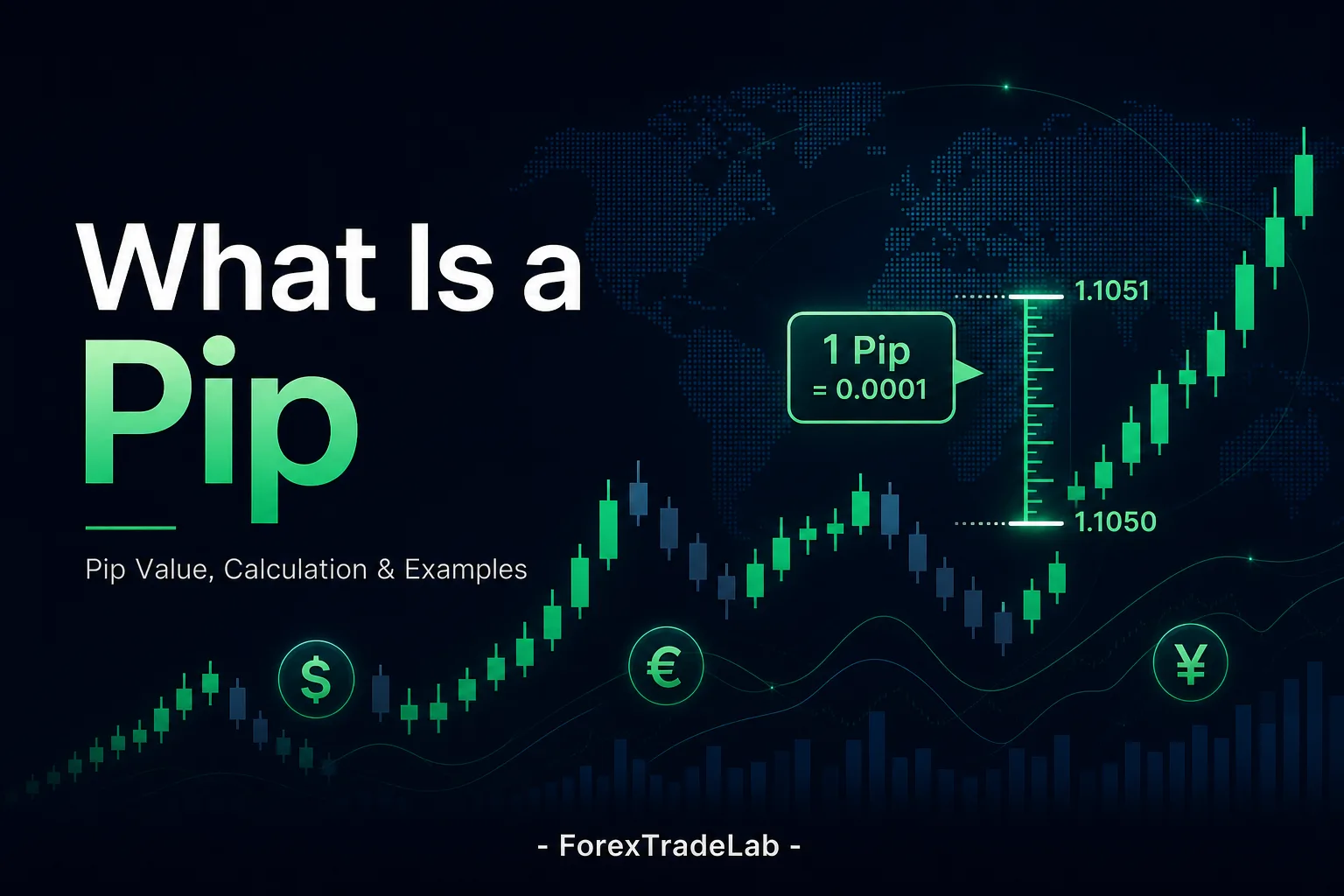
- A pip is a market convention, commonly 0.0001 for many pairs and 0.01 for many JPY pairs; verify the symbol’s tick size
- Pip value in quote currency = pip size × base units traded; convert that figure to the account currency at the applicable rate
- For a USD account trading EUR/USD, one conventional 100,000-unit lot has a $10 pip value before costs; this is not universal
- Spread, commission, financing, conversion, slippage, contract size, and product terms can all affect the cash result
- What Is a Pip in Forex?
- What Is a Pipette?
- Why Pips Matter in Forex Trading
- How to Calculate Pip Value
- Pip Value by Lot Size
- Pip Value by Currency Pair
- Practical Pip Calculation Examples
- How Pips Relate to Spread
- Common Mistakes with Pips
- Use Pips for Position Sizing, Not for Predictions
- Verify Platform and Instrument Conventions
- Pip-Quality Checklist
- Glossary
- Conclusion
What Is a Pip in Forex?#
A pip — short for Percentage in Point — is a market convention for describing a price change in a forex pair. It is widely used to discuss spreads, profit and loss, and risk, but the instrument’s tick size and contract specification ultimately govern what the platform can quote and trade.
Understanding pips is not optional — it is the first concept every forex trader must master before placing a single trade. Without a firm grasp of pips, you cannot accurately measure profit, calculate risk, or compare spreads between brokers. Think of pips as the "centimeters" of forex: just as you measure distance in standardized units, you measure every price movement in pips.
Standard Currency Pairs — 0.0001#
For the vast majority of currency pairs — EUR/USD, GBP/USD, AUD/USD, USD/CHF, NZD/USD, USD/CAD, and all non-JPY crosses — prices are quoted to four decimal places. One pip is a movement of 0.0001, which is the fourth decimal place.
| Price Movement | Pip Change |
|---|---|
| EUR/USD 1.0850 → 1.0851 | +1 pip |
| EUR/USD 1.0850 → 1.0860 | +10 pips |
| GBP/USD 1.2700 → 1.2650 | −50 pips |
| AUD/USD 0.6530 → 0.6548 | +18 pips |
| USD/CHF 0.8900 → 0.8875 | −25 pips |
| NZD/USD 0.5700 → 0.5732 | +32 pips |
Visual breakdown of an EUR/USD price:
  1  .  0  8  5  0
  ↑     ↑  ↑  ↑  ↑
  Unit  1st 2nd 3rd 4th decimal = 1 pip
Each decimal place is ten times larger than the one to its right: the third decimal (0.001) represents 10 pips, the second (0.01) is 100 pips, and the first (0.1) is 1,000 pips. Recognizing this hierarchy lets you gauge pip distances at a glance — if EUR/USD moves from 1.0800 to 1.0900, you know instantly that is 100 pips because the second decimal moved by one.
JPY Currency Pairs — 0.01#
Japanese yen pairs are the notable exception. Because the yen trades at a much larger numeric value per unit (e.g., 150 yen per dollar vs. 1.08 dollars per euro), JPY pairs use two decimal places. One pip equals 0.01.
| Price Movement | Pip Change |
|---|---|
| USD/JPY 150.00 → 150.01 | +1 pip |
| USD/JPY 150.00 → 150.50 | +50 pips |
| EUR/JPY 162.50 → 162.20 | −30 pips |
| GBP/JPY 190.00 → 190.75 | +75 pips |
| CHF/JPY 168.00 → 167.40 | −60 pips |
Visual breakdown of a USD/JPY price:
  1  5  0  .  0  0
              ↑  ↑
              1st 2nd decimal = 1 pip
The reason for this different convention is straightforward: if JPY pairs used four decimal places like EUR/USD, a single pip would represent an absurdly small value (0.0001 yen ≈ $0.0000007). Using two decimal places keeps the pip at a practical, tradable magnitude. The logic behind the pip concept remains identical across all pairs — only the scale changes.
How to Quickly Count Pips#
A useful shortcut for counting pips without a calculator:
- 4-decimal pairs (non-JPY): Subtract the two prices, then move the decimal four places right. Example: 1.0920 − 1.0850 = 0.0070 → 70 pips.
- 2-decimal pairs (JPY): Subtract the two prices, then move the decimal two places right. Example: 150.50 − 150.00 = 0.50 → 50 pips.
What Is a Pipette?#
A pipette — also called a fractional pip or point — is one-tenth of a pip. It is the fifth decimal place for standard pairs (0.00001) and the third decimal place for JPY pairs (0.001).
Why Pipettes Exist#
Many retail platforms quote a fractional pip, often displaying five decimal places instead of four. The extra digit permits finer price increments; it does not by itself guarantee a tighter all-in cost or better execution.
Consider a practical example: with 4-decimal pricing, the tightest possible EUR/USD spread is 1.0 pip (e.g., 1.0850 / 1.0851). With 5-decimal pricing, the broker can offer a spread of 0.8 pips (e.g., 1.08500 / 1.08508) — a 20% reduction in transaction cost that compounds significantly over hundreds of trades.
| Pair | 4-Decimal Quote | 5-Decimal Quote | Extra Digit |
|---|---|---|---|
| EUR/USD | 1.0850 | 1.08503 | 3 pipettes |
| GBP/USD | 1.2700 | 1.27006 | 6 pipettes |
| USD/JPY | 150.00 | 150.003 | 3 pipettes |
| AUD/USD | 0.6530 | 0.65307 | 7 pipettes |
Pips vs. Pipettes#
| Unit | Standard Pairs | JPY Pairs | Relationship |
|---|---|---|---|
| 1 Pip | 0.0001 | 0.01 | Base unit |
| 1 Pipette | 0.00001 | 0.001 | 1/10 of a pip |
| 10 Pipettes | 0.0001 | 0.01 | = 1 pip |
Who Uses Pipettes?#
Pipettes are most relevant to scalpers and high-frequency traders who profit from very small price movements. When a scalper targets a 3-pip profit, the difference between entering at 1.08500 and 1.08504 (4 pipettes) can meaningfully impact the trade's risk-reward ratio.
For swing and position traders holding trades for days or weeks, pipettes rarely affect decision-making — standard pip-level analysis is sufficient. However, even longer-term traders should understand pipettes because broker spreads are often quoted with fractional pips (e.g., "EUR/USD spread: 0.8 pips" means 8 pipettes).
Reading a 5-Decimal Price Correctly#
When you see a EUR/USD quote like 1.08537, break it down:
- 1.0853 = the price rounded to the nearest pip
- 7 = 7 pipettes beyond the last full pip
- Total from, say, 1.08500: 3 pips and 7 pipettes (or 3.7 pips)
Getting comfortable reading five-decimal prices prevents the most common beginner mistake: misreading pipettes as full pips and miscalculating risk by a factor of ten.
Why Pips Matter in Forex Trading#
Pips are far more than a unit of measurement. They are the foundation of every critical trading calculation:
1. Profit and Loss Measurement#
Every trade's result is first calculated in pips, then converted to monetary value. A trader who buys EUR/USD at 1.0850 and sells at 1.0920 has earned 70 pips. The dollar value of those 70 pips depends on lot size — but the pip count is universal. This separation of "how far the price moved" from "how much money was made" is what allows traders of all account sizes to communicate on equal terms.
2. Spread Measurement#
The spread — the difference between a broker's bid and ask price — is quoted in pips. When you see "EUR/USD spread: 1.2 pips," that means the bid-ask gap is 0.00012 (or 12 pipettes). Spread is your primary transaction cost in forex, and comparing spreads across brokers is only possible because they are expressed in the same unit: pips.
3. Risk Calculation#
Professional traders define risk in pips before converting to dollars. "I am risking 30 pips with a stop loss" is meaningful regardless of lot size or account currency — it standardizes risk discussions. You then multiply pips by pip value to determine dollar risk. This two-step process (pips first, dollars second) is at the heart of proper position sizing.
4. Universal Communication#
When traders worldwide discuss markets — "EUR/USD moved 80 pips today" — everyone understands the magnitude immediately. Pips eliminate confusion caused by different account sizes, lot sizes, and currencies. A 50-pip move means the same thing whether you are trading from New York, London, or Tokyo.
5. Strategy Benchmarking#
Trading strategies are evaluated in pips: "This system averages +15 pips per trade" is a standardized performance metric that works across all account sizes and lot configurations. This allows you to compare two strategies objectively without knowing anything about the trader's capital or leverage.
6. Volatility Assessment#
Daily volatility is often expressed in pips. When traders say "GBP/JPY averages 120 pips of daily range," they are conveying the pair's volatility in a way that directly translates to risk. Understanding average pip ranges per session helps you set realistic profit targets and stop-loss distances.
How to Calculate Pip Value#
Pip value tells you how much money one pip of movement is worth for a given trade. The formula depends on whether USD is the quote currency (second currency in the pair) or not.
Formula 1: USD Is the Quote Currency#
For pairs like EUR/USD, GBP/USD, AUD/USD, NZD/USD:
Pip Value = 0.0001 × Lot Size (in units)
This is the simplest case because the result is already in USD — no conversion needed.
Step-by-step: EUR/USD with a standard lot
- Pip size = 0.0001
- Lot size = 100,000 units
- Pip value = 0.0001 × 100,000 = $10.00 per pip
No exchange rate conversion is needed because the quote currency is already USD. This means the pip value for any XXX/USD pair is always fixed at $10 per standard lot, $1 per mini lot, and $0.10 per micro lot — regardless of the exchange rate.
Formula 2: USD Is the Base Currency#
For pairs like USD/JPY, USD/CHF, USD/CAD:
Pip Value = (Pip Size ÷ Exchange Rate) × Lot Size
Step-by-step: USD/JPY at 150.50 with a standard lot
- Pip size = 0.01 (JPY pair)
- Exchange rate = 150.50
- Lot size = 100,000 units
- Pip value = (0.01 ÷ 150.50) × 100,000 = $6.64 per pip
Step-by-step: USD/CHF at 0.8900 with a standard lot
- Pip size = 0.0001
- Exchange rate = 0.8900
- Lot size = 100,000 units
- Pip value = (0.0001 ÷ 0.8900) × 100,000 = $11.24 per pip
Notice how USD/CHF has a higher pip value than EUR/USD ($11.24 vs. $10.00). This is because the Swiss franc is worth more than the dollar (1 CHF buys more than 1 USD), so each pip of CHF movement translates to more dollars.
Step-by-step: USD/CAD at 1.3600 with a standard lot
- Pip size = 0.0001
- Exchange rate = 1.3600
- Lot size = 100,000 units
- Pip value = (0.0001 ÷ 1.3600) × 100,000 = $7.35 per pip
Since the Canadian dollar is worth less than the US dollar (it takes 1.36 CAD to buy 1 USD), the pip value is below $10.
Formula 3: Cross Pairs (Neither Currency Is USD)#
For pairs like EUR/GBP, EUR/AUD, GBP/CHF:
Pip Value = (Pip Size × Lot Size) × Quote Currency/USD Rate
Step-by-step: EUR/GBP with a standard lot (GBP/USD = 1.2700)
- Pip value in GBP = 0.0001 × 100,000 = 10 GBP
- Convert to USD = 10 × 1.2700 = $12.70 per pip
Step-by-step: EUR/AUD with a standard lot (AUD/USD = 0.6530)
- Pip value in AUD = 0.0001 × 100,000 = 10 AUD
- Convert to USD = 10 × 0.6530 = $6.53 per pip
Step-by-step: EUR/JPY with a standard lot (USD/JPY = 150.00)
- Pip value in JPY = 0.01 × 100,000 = 1,000 JPY
- Convert to USD = 1,000 ÷ 150.00 = $6.67 per pip
Step-by-step: GBP/CHF with a standard lot (USD/CHF = 0.8900)
- Pip value in CHF = 0.0001 × 100,000 = 10 CHF
- Convert to USD = 10 ÷ 0.8900 = $11.24 per pip
Note the conversion difference: for quote currencies traded as XXX/USD (like GBP/USD, AUD/USD), you multiply by the rate. For quote currencies traded as USD/XXX (like USD/CHF, USD/JPY), you divide by the rate.
Pip Value by Lot Size#
The lot size you trade directly multiplies the pip value. Here is a comprehensive reference table for the three most traded pairs:
EUR/USD (Quote Currency: USD)#
| Lot Type | Lot Size | Units | Pip Value |
|---|---|---|---|
| Standard | 1.00 | 100,000 | $10.00 |
| Mini | 0.10 | 10,000 | $1.00 |
| Micro | 0.01 | 1,000 | $0.10 |
| Nano | 0.001 | 100 | $0.01 |
USD/JPY at 150.00 (Base Currency: USD)#
| Lot Type | Lot Size | Units | Pip Value |
|---|---|---|---|
| Standard | 1.00 | 100,000 | ≈ $6.67 |
| Mini | 0.10 | 10,000 | ≈ $0.67 |
| Micro | 0.01 | 1,000 | ≈ $0.07 |
| Nano | 0.001 | 100 | ≈ $0.007 |
GBP/USD (Quote Currency: USD)#
| Lot Type | Lot Size | Units | Pip Value |
|---|---|---|---|
| Standard | 1.00 | 100,000 | $10.00 |
| Mini | 0.10 | 10,000 | $1.00 |
| Micro | 0.01 | 1,000 | $0.10 |
| Nano | 0.001 | 100 | $0.01 |
Notice that EUR/USD and GBP/USD have identical pip values because both are quoted in USD. The pip value for USD/JPY is lower and fluctuates because it must be converted from yen to dollars. This is a critical distinction: for USD-quoted pairs, you always know your pip value upfront; for all other pairs, you must calculate it.
The relationship between lot sizes is always a clean factor of ten: one standard lot = 10 mini lots = 100 micro lots. If you know the pip value for a standard lot, simply divide by 10 for mini and by 100 for micro. This makes mental math easy — if EUR/USD standard lot is $10/pip, then 0.35 lots is $3.50/pip.
Pip Value by Currency Pair#
Different currency pairs have different pip values because of varying exchange rates and pip sizes. Here is a comprehensive reference for one standard lot (100,000 units):
| Currency Pair | Pip Size | Pip Value (Standard Lot) | Notes |
|---|---|---|---|
| EUR/USD | 0.0001 | $10.00 | Fixed — USD is quote currency |
| GBP/USD | 0.0001 | $10.00 | Fixed — USD is quote currency |
| AUD/USD | 0.0001 | $10.00 | Fixed — USD is quote currency |
| NZD/USD | 0.0001 | $10.00 | Fixed — USD is quote currency |
| USD/JPY | 0.01 | ≈ $6.67 | Varies with JPY rate (at 150.00) |
| USD/CHF | 0.0001 | ≈ $11.24 | Varies with CHF rate (at 0.8900) |
| USD/CAD | 0.0001 | ≈ $7.35 | Varies with CAD rate (at 1.3600) |
| EUR/GBP | 0.0001 | ≈ $12.70 | Varies — convert GBP to USD (at 1.2700) |
| EUR/JPY | 0.01 | ≈ $6.67 | Varies with JPY rate (at 150.00) |
| GBP/JPY | 0.01 | ≈ $6.67 | Varies with JPY rate (at 150.00) |
| EUR/AUD | 0.0001 | ≈ $6.53 | Varies — convert AUD to USD (at 0.6530) |
| GBP/CHF | 0.0001 | ≈ $11.24 | Varies with CHF rate (at 0.8900) |
| AUD/JPY | 0.01 | ≈ $6.67 | Varies with JPY rate (at 150.00) |
| CAD/JPY | 0.01 | ≈ $6.67 | Varies with JPY rate (at 150.00) |
Key patterns to remember:
- When USD is the quote currency (XXX/USD), pip value is always exactly $10 per standard lot
- When USD is the base currency (USD/XXX), pip value varies and must be calculated
- For cross pairs (no USD), pip value varies and requires a two-step conversion
The highest pip value in the table above belongs to EUR/GBP ($12.70) because GBP is more valuable than USD. The lowest belongs to EUR/AUD ($6.53) because AUD is worth less than USD. This range — from roughly $6.50 to $12.70 per standard lot — shows why assuming $10 for every pair is a dangerous shortcut that can lead to serious position-sizing errors.
Quick reference rule: If the quote currency is stronger than USD, pip value is above $10. If the quote currency is weaker than USD, pip value is below $10. If the quote currency is USD, pip value is exactly $10.
Practical Pip Calculation Examples#
Example 1: Profit on EUR/USD (Long Trade)#
Setup: You buy 1 mini lot (0.10) of EUR/USD at 1.0850 and close at 1.0920.
| Step | Calculation |
|---|---|
| Entry price | 1.0850 |
| Exit price | 1.0920 |
| Pip movement | (1.0920 − 1.0850) ÷ 0.0001 = 70 pips |
| Pip value (mini lot) | $1.00 per pip |
| Profit | 70 × $1.00 = $70.00 |
Example 2: Loss on USD/JPY (Long Trade)#
Setup: You buy 1 standard lot (1.00) of USD/JPY at 150.00 and your stop-loss is hit at 149.60.
| Step | Calculation |
|---|---|
| Entry price | 150.00 |
| Exit price | 149.60 |
| Pip movement | (150.00 − 149.60) ÷ 0.01 = 40 pips loss |
| Pip value (standard lot at 150.00) | (0.01 ÷ 150.00) × 100,000 = $6.67 per pip |
| Loss | 40 × $6.67 = $266.80 |
Compare this to a 40-pip loss on EUR/USD with the same standard lot: 40 × $10 = $400. The same pip distance produces very different dollar outcomes depending on the pair — this is precisely why calculating pip value before every trade is essential.
Example 3: Scalping on GBP/USD (Short Trade)#
Setup: You sell 5 micro lots (0.05) of GBP/USD at 1.2710 and close at 1.2698.
| Step | Calculation |
|---|---|
| Entry price | 1.2710 |
| Exit price | 1.2698 |
| Pip movement | (1.2710 − 1.2698) ÷ 0.0001 = 12 pips |
| Pip value (0.05 lot) | $0.10 × 5 = $0.50 per pip |
| Profit | 12 × $0.50 = $6.00 |
This is a typical scalping trade — small pip target, quick execution, modest but consistent gains. Notice that even with 12 pips captured, the dollar profit is only $6 because of the micro lot size. This illustrates why scalpers often trade larger positions: a standard lot on the same trade would have yielded $120.
Example 4: Cross Pair — EUR/GBP (Long Trade)#
Setup: You buy 1 standard lot of EUR/GBP at 0.8550 and close at 0.8590. GBP/USD is 1.2700 at the time.
| Step | Calculation |
|---|---|
| Entry price | 0.8550 |
| Exit price | 0.8590 |
| Pip movement | (0.8590 − 0.8550) ÷ 0.0001 = 40 pips |
| Pip value in GBP | 0.0001 × 100,000 = 10 GBP per pip |
| Convert to USD | 10 × 1.2700 = $12.70 per pip |
| Profit | 40 × $12.70 = $508.00 |
Notice how the pip value for EUR/GBP ($12.70) is higher than EUR/USD ($10.00) because GBP is worth more than USD. The same 40-pip trade on EUR/USD would have yielded $400 instead of $508. Cross pairs can carry more dollar risk per pip than you might expect — always check the pip value before trading.
Comparing All Four Examples Side by Side#
| Trade | Pair | Lot Size | Pips | Pip Value | Dollar Result |
|---|---|---|---|---|---|
| Example 1 | EUR/USD | 0.10 (mini) | +70 | $1.00 | +$70.00 |
| Example 2 | USD/JPY | 1.00 (standard) | −40 | $6.67 | −$266.80 |
| Example 3 | GBP/USD | 0.05 (5 micro) | +12 | $0.50 | +$6.00 |
| Example 4 | EUR/GBP | 1.00 (standard) | +40 | $12.70 | +$508.00 |
This comparison highlights a key lesson: the dollar outcome of a trade depends on three variables — pip distance, lot size, and pip value per lot. Changing any one of them dramatically alters the result.
How Pips Relate to Spread#
The spread is the gap between a broker's bid (sell) price and ask (buy) price, and it is measured in pips. Understanding this relationship is essential because the spread is the first cost you pay on every trade.
How Spread Works in Pip Terms#
When EUR/USD is quoted at Bid: 1.08500 / Ask: 1.08520, the spread is:
(1.08520 − 1.08500) ÷ 0.0001 = 2.0 pips (or 20 pipettes)
The moment you open a buy trade, you are already 2 pips "in the red" because you bought at the ask but the market value is at the bid. Your trade must move at least 2 pips in your favor just to break even.
Spread Cost by Lot Size#
| Lot Type | Spread = 1.0 pip | Spread = 1.5 pips | Spread = 2.0 pips | Spread = 3.0 pips |
|---|---|---|---|---|
| Standard (1.00) | $10.00 | $15.00 | $20.00 | $30.00 |
| Mini (0.10) | $1.00 | $1.50 | $2.00 | $3.00 |
| Micro (0.01) | $0.10 | $0.15 | $0.20 | $0.30 |
A trader who executes 20 standard-lot trades per day with a 2-pip spread pays $400 daily in spread costs alone. Over a 250-trading-day year, that amounts to $100,000 — a staggering sum that underscores why even half-pip spread differences matter when choosing a broker.
Spread as a Percentage of Target#
| Profit Target | Spread = 1.0 pip | Spread = 2.0 pips | Spread = 3.0 pips |
|---|---|---|---|
| 5 pips (scalping) | 20% cost | 40% cost | 60% cost |
| 20 pips (day trading) | 5% cost | 10% cost | 15% cost |
| 50 pips (swing) | 2% cost | 4% cost | 6% cost |
| 200 pips (position) | 0.5% cost | 1% cost | 1.5% cost |
This table reveals why the spread-to-target ratio is crucial for scalping strategies. A 3-pip spread on a 5-pip target means 60% of the gross movement is consumed by transaction costs — making consistent profitability nearly impossible. The same spread on a 200-pip swing trade is a negligible 1.5%.
Why This Matters for Your Trading Style#
- Scalpers need the tightest possible spreads (below 1.0 pip on majors) because their profit targets are tiny
- Day traders should aim for spreads under 1.5 pips to keep costs manageable
- Swing traders can tolerate wider spreads because the pip target dwarfs the cost
- Position traders are least affected by spread but should still compare brokers for long-term savings
Common Mistakes with Pips#
Even experienced traders make errors when working with pips. Here are the most costly mistakes to avoid:
1. Confusing Pips with Pipettes#
With 5-decimal pricing now standard, it is easy to confuse the fifth decimal place (pipette) with a full pip. A move from 1.08500 to 1.08510 is 1 pip, not 10. A move from 1.08500 to 1.08501 is 1 pipette (0.1 pip). Misreading this by a factor of 10 can lead to wildly inaccurate risk assessments — you could end up taking ten times the risk you intended.
2. Forgetting the JPY Exception#
New traders who learn that "1 pip = 0.0001" sometimes apply this to JPY pairs, dramatically miscounting pip movements. In USD/JPY, a move from 150.00 to 150.10 is 10 pips, not 1,000. Always remember: JPY pairs use 0.01 as the pip increment.
3. Assuming All Pip Values Are $10#
While $10 per pip per standard lot is correct for USD-quoted pairs (EUR/USD, GBP/USD), it is wrong for other pairs. USD/JPY pip value fluctuates around $6–7, EUR/GBP pip value can be $12+, and exotic pairs vary even more. Applying a flat $10 assumption can cause significant position-sizing errors that compound over time.
4. Not Accounting for Pip Value Fluctuations#
For pairs where USD is not the quote currency, pip value changes as exchange rates move. A trade opened when USD/JPY pip value is $6.50 might close when it is $6.80. On large positions held for days or weeks, this drift can meaningfully affect realized P&L versus expected P&L.
5. Ignoring Spread in Pip Calculations#
Calculating "50 pips profit" without subtracting the spread overstates your actual return. If the spread is 2 pips, your net profit is 48 pips. This is especially critical for strategies with tight profit targets where even one pip of miscalculation can turn a winning system into a losing one.
6. Miscounting Pips on Gold and Indices#
Some traders apply forex pip rules to gold (XAU/USD) or indices, which use different pip definitions. In forex, pip definitions apply strictly to currency pairs. Gold, oil, and indices have their own tick sizes. If your broker offers these instruments, check their contract specifications separately.
Use Pips for Position Sizing, Not for Predictions#
Short Answer
A pip distance becomes useful only after it is converted into a cash risk and matched to a position size. Start with the cash amount you can lose, choose a technically justified stop, then calculate the size; do not choose a large lot and hope the stop fits.
Detailed Explanation
Pips make prices comparable, but they do not make two trades equally risky. A 30-pip stop on EUR/USD, a 30-pip stop on GBP/JPY, and a 30-pip stop on XAU/USD do not necessarily represent the same cash loss. Contract size, pip convention, account currency, and conversion rates all matter. That is why a trader who thinks only in pips can accidentally take very different risks from one ticket to the next.
A practical sequence is:
- Set the maximum cash risk for the trade based on your written risk plan.
- Put the stop at a level justified by the setup, volatility, and timeframe—not at a distance chosen to make the lot size look attractive.
- Determine the pip risk from entry to stop, including a buffer for spread or normal execution variation where appropriate.
- Calculate the position size:
position size = cash risk ÷ (stop pips × pip value per unit or lot). - Recheck the platform’s projected loss before sending the order.
Suppose a USD account limits a trade to $50 and the planned EUR/USD stop is 25 pips. If a micro lot is approximately $0.10 per pip, the maximum size is 20 micro lots, or 0.20 standard lots: $50 ÷ (25 × $0.10) = 20. This is an illustration, not a recommendation. If the executable entry is worse than expected or the stop fills through a gap, the actual loss can exceed the planned amount.
For USD/JPY, first find the pip value in account currency. With a 100,000-unit position, a 0.01-yen pip is 1,000 yen; dividing by the current USD/JPY rate converts that value to dollars. For EUR/GBP in a USD account, the pip value begins in pounds and must be converted using GBP/USD or an equivalent current rate. A pip value calculator reduces arithmetic errors, but the trader remains responsible for checking the symbol, units, account currency, and broker specification.
Example
Two traders both use a 40-pip stop. One trades one mini lot of EUR/USD, where the pip value is about $1, so the planned loss is about $40 before deviations. The other trades one standard lot of a pair whose pip is worth roughly $9; the planned loss is about $360. The stop looks identical on the chart, but the financial exposure is not.
Common Mistake
Using a fixed lot size for every pair because “0.10 lot feels safe” ignores changing pip values and stop distances. Fixed cash risk, rather than fixed volume, is usually the clearer control.
Professional Tip
Record both pips and account-currency results in a journal. Pips show whether the trade followed the intended market plan; cash results show whether position sizing matched the risk plan.
Verify Platform and Instrument Conventions#
Short Answer
Do not assume every symbol uses the standard forex pip convention. Confirm the contract size, tick size, point value, margin requirement, and swap method in your broker’s specification.
Detailed Explanation
In common five-decimal EUR/USD pricing, the final digit is often a pipette, or one-tenth of a pip. A move from 1.10001 to 1.10011 is one pip, even though the platform shows ten “points.” On a three-decimal USD/JPY quote, 0.001 is generally a pipette and 0.010 is one pip. Platform labels are not universal: some call the smallest displayed increment a “point,” while a trader may use “point” informally to mean a pip. Write the exact price difference in your plan if there is any doubt.
Metals, indices, shares, and cryptocurrencies may appear alongside forex in the same terminal, but their tick conventions are separate. A one-point move in an index is not a forex pip. The cash result may depend on contracts or lots rather than currency units. Do not transfer an EUR/USD pip formula to XAU/USD merely because both symbols quote against USD.
Account currency adds another layer. A EUR account holding GBP/JPY can have a pip value that changes in euros even if the trade size remains unchanged. The platform normally converts profit and loss continuously, but its displayed value should be understood before the order is placed. See what is a lot? and what is margin? for the related position and collateral concepts.
Example
A trader sees USD/JPY move from 150.125 to 150.135. That is 0.010 yen, normally one pip—not ten pips. Reading the final digit as a full pip would make the trader overstate the movement tenfold.
Common Mistake
Assuming “one point” in a mobile app always means one pip. Check the symbol’s price precision and contract details before calculating a stop or a target.
Professional Tip
Place a tiny permitted test position only after learning the calculation, then reconcile the platform’s realised result against your own calculation. Use this as a training exercise, not as proof of future execution quality. When the ticket asks for points rather than pips, use the pips versus MetaTrader points conversion before you trust the distance. When the ticket asks for points rather than pips, use the pips versus MetaTrader points conversion before you trust the distance.
Pip-Quality Checklist#
Before placing a trade, confirm:
- I know the pair’s pip size: normally 0.0001, or 0.01 for JPY pairs.
- I distinguished the displayed pipette from a full pip.
- I confirmed the contract or lot size.
- I calculated pip value in my account currency at the current rate.
- My cash risk equals stop pips times pip value times position size.
- I included spread, commission, and possible adverse execution in the plan.
- I checked that correlated positions do not multiply the total cash risk.
- I used the broker’s specification rather than a generic formula for non-forex instruments.
Glossary#
Pip: The conventional price increment: 0.0001 for most FX pairs and 0.01 for JPY pairs.
Pipette: One-tenth of a pip, often the final quoted digit.
Tick: The smallest price movement defined for a particular instrument; it may not equal a pip.
Lot: The quantity of the base currency in a forex trade; a standard lot is commonly 100,000 units.
Pip value: The account-currency profit or loss caused by a one-pip move at a chosen position size.
Position size: The number of units or lots traded.
Stop distance: The price movement between intended entry and protective stop.
Conclusion#
Pips make a quoted forex price movement easier to describe, but they must be converted into account-currency cash risk before they inform a trade decision.
Key takeaways:
- A pip is commonly 0.0001 for many pairs and 0.01 for many JPY pairs; confirm the symbol specification.
- A pipette is commonly one-tenth of a pip.
- Pip value depends on the pair, volume, contract size, exchange rate, and account currency.
- For a conventional 100,000-unit EUR/USD position in a USD account, one pip is $10 before costs; do not apply that example universally.
- Spread, commission, financing, conversion, and execution can all affect the cash result.
Use the platform’s live specification and a pip-value calculation to translate the planned stop into a cash amount, then decide whether that risk fits the account and trading plan.