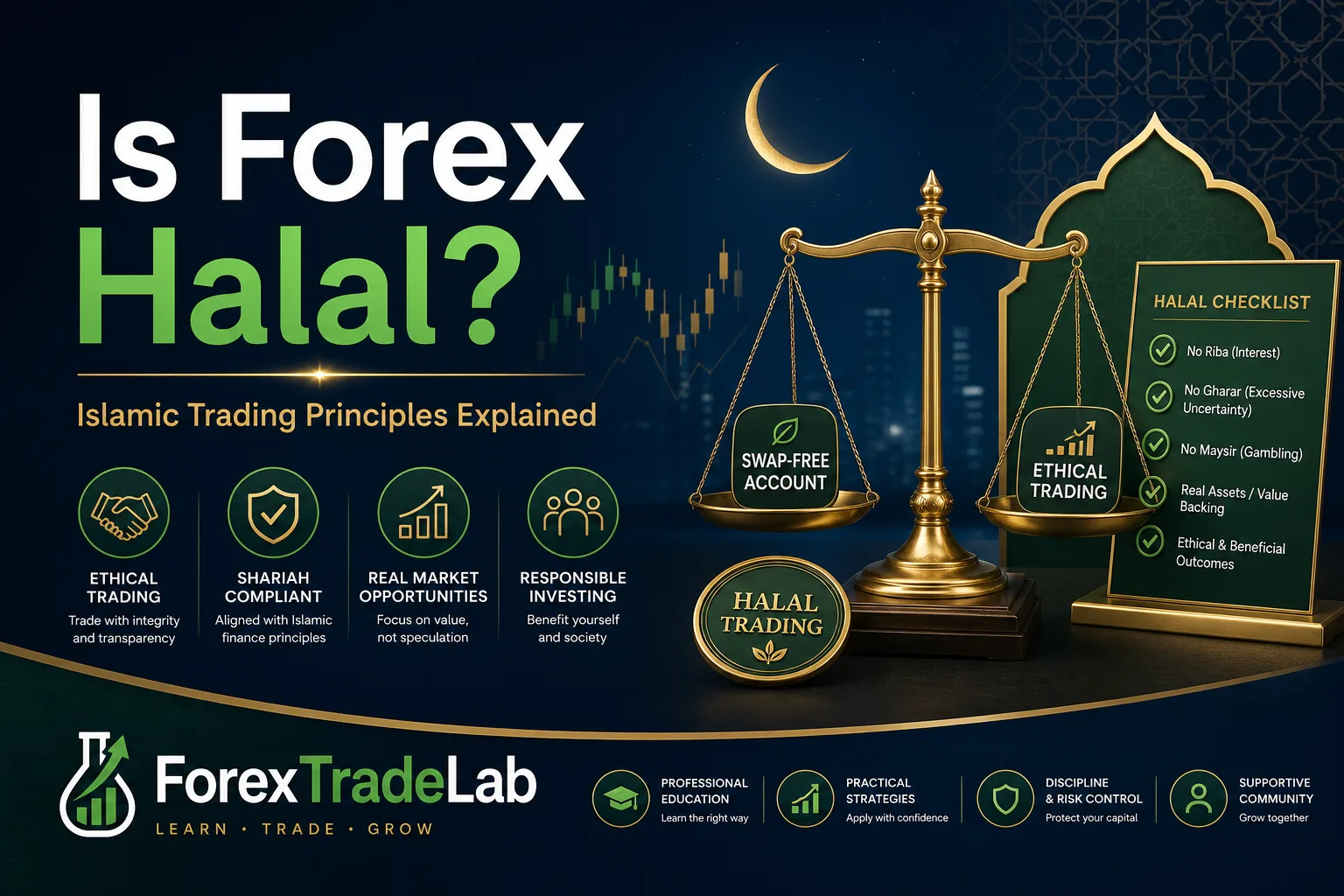
- No single answer covers every product sold as forex; the contract, settlement, possession, financing, fees and purpose all matter.
- A swap-free label removes neither the need for contract review nor ordinary trading risk.
- This page explains questions to research; it does not issue a fatwa.
- Use the exact documents from the broker entity and seek qualified independent scholarly advice.
Halal status: direct answer#
Short Answer
No universal ruling covers every retail forex contract; settlement, possession, interest, leverage, fees and speculation require independent scholarly assessment.
Detailed Explanation
A swap-free label addresses one possible charge but may not resolve ownership, constructive possession, deferred exchange or alternative-fee concerns.
Example
Two Islamic-labelled accounts may use different holding limits and administration fees, so a scholar needs the actual contracts.
Common Mistake
Assuming that removing overnight swap automatically makes every leveraged forex or CFD transaction permissible.
Professional Tip
Collect the complete product, settlement, leverage and fee documents and submit them to a qualified independent scholar.
Introduction#
“Is forex halal?” sounds like a question about one activity, but retail platforms use forex for materially different arrangements. One customer may exchange and receive currencies; another may enter a rolling leveraged contract; another may trade a CFD that only tracks a currency pair’s price. A careful religious assessment therefore begins with facts, not a platform label.
This guide explains how to identify those facts and present them clearly to a qualified independent scholar. It does not declare a product halal or haram, interpret a contract for you, or replace a fatwa. It also separates religious analysis from financial safety: even an arrangement a scholar accepts can expose a trader to severe losses.
For the broader research workflow, read Islamic forex trading. For the narrow account feature, see swap-free accounts. The mechanics of leverage and the foundation of what forex is are useful supporting topics.
Short Answer#
There is no sound one-word answer for every arrangement called forex. The relevant questions include what is being bought or sold, whether currencies are delivered, when settlement and possession occur, whether financing or interest-like rollover applies, how leverage is structured, what fees replace swap, and how the account is intended to be used.
The practical conclusion is limited but important: obtain the current legal documents for the exact broker entity and instrument, then seek a contract-specific view from a scholar with relevant Islamic-finance expertise. A search snippet, influencer statement, or “Islamic” badge cannot do that work.
Common mistake: asking whether “forex” as a broad market is halal while withholding the contract that defines the actual transaction.
How Forex Arrangements Differ#
Classical discussion of currency exchange (sarf) gives particular importance to the exchanged monetary units and possession. Modern retail products introduce electronic account records, intermediaries, margin, rolling contracts and derivatives. The legal and operational form therefore matters.
Exchange, price exposure, and settlement#
A deliverable exchange creates different rights from a CFD that settles only the price difference. “Spot” on a screen does not prove that the customer can take delivery or that the arrangement is treated as an immediate exchange. Ask what the customer legally owns after execution, whether either currency can be withdrawn, and when the broker records settlement.
Financing and rollover#
Conventional leveraged positions may receive or pay a broker-defined overnight swap after a cut-off. That feature raises an obvious research question, but removing the line item is not a complete answer. The alternative account may impose an administration charge, a holding limit, wider pricing, or another contractual treatment. Classification depends on substance and context, not the fee’s marketing name.
Leverage and conduct#
Leverage turns a small deposit into a larger notional exposure. A scholar may need to examine how margin is provided, what benefit the provider receives, and what rights and obligations arise. Purpose and conduct may also matter: a documented currency need is not factually identical to rapid, debt-funded speculation. This guide does not determine the religious consequence of either case.
Research Process#
- Identify the counterparty. Record the full legal entity, your jurisdiction, and its status on the relevant regulator’s official register.
- Name the product precisely. Obtain the customer agreement, product disclosure, contract specification, execution policy, margin rules, and fee schedule.
- Map the transaction. Write down what happens at order entry, execution, rollover, close, and withdrawal. Note delivery rights and the timing of settlement and account credits.
- List every economic transfer. Include spread, commission, conversion, swap, administration fees, markups, and charges triggered by holding time.
- Describe intended use. State the instruments, likely holding period, leverage, frequency, and whether borrowed or essential money would be involved.
- Ask for independent review. Give the document pack—not a paraphrased advertisement—to a qualified scholar. If opinions differ, compare the facts and reasoning each opinion considered.
Keep dated copies. A conclusion based on one entity, product, or fee schedule should be revisited when any of those facts changes.
Questions for a Qualified Scholar#
| Issue | Fact to provide | Why it changes the inquiry |
|---|---|---|
| Product form | Deliverable exchange, rolling spot, CFD, or other contract | The customer’s rights may differ substantially. |
| Settlement and qabd | Timing, account entries, withdrawal and delivery rights | Possession cannot be inferred from the trading screen alone. |
| Rollover and fees | Formula, trigger, recipient, purpose, and grace period | A changed label does not establish the nature of a charge. |
| Leverage | Margin agreement, financing relationship, and broker benefit | The legal relationship requires contract-specific analysis. |
| Purpose and conduct | Need, frequency, holding period, and source of funds | The real activity may matter alongside contract structure. |
Ask the adviser to identify which document and clause supports the conclusion. That makes later review possible. If the answer assumes facts the broker cannot confirm, the unresolved fact should remain visible rather than being converted into certainty.
Professional tip: ask the broker factual questions in writing—“Can either currency be withdrawn after this transaction?” is more useful than asking a salesperson for a religious ruling.
Risks and Limits#
Three limits should remain separate:
- Religious limit: this article cannot apply jurisprudence to your personal contract.
- Evidence limit: broker terms, instruments and fees can change after publication.
- Financial limit: a favourable scholarly assessment does not make leveraged trading suitable or profitable.
Price gaps, widening spreads, slippage, margin changes, platform failures and counterparty problems can produce losses beyond the amount expected at a stop. Regulation can provide protections, but it does not establish Sharia compliance or personal suitability. Religious language is also not evidence that a firm is authorised; verify the entity through the regulator rather than a copied badge.
Worked Example#
A trader is offered a “swap-free spot forex” account. Instead of treating the phrase as a conclusion, the trader reads the specification and discovers that the product is a rolling leveraged contract with no right to withdraw either currency. Overnight swap is absent for five days, after which a daily administration charge applies.
The trader prepares two separate reviews. For scholarly advice, the document pack identifies the contract form, settlement entries, lack of delivery, margin relationship, fee formula and intended holding period. For financial risk, the trader calculates spread, commission, possible administration charges, slippage and maximum cash loss.
This example does not decide whether the arrangement is permissible. It shows why a precise factual description can lead to a more reliable opinion than the words “spot” or “swap-free.”
Checklist#
- I know the exact legal entity and have checked its authorisation for my residence.
- I can state whether the product is deliverable currency, rolling spot, a CFD, or another contract.
- I have documented settlement timing, possession entries, and withdrawal or delivery rights.
- I have the complete formula for swap, administration charges, spreads, commissions, and conversion.
- I have described the leverage relationship and source of funds accurately.
- I have told the adviser my intended instruments, frequency, and holding period.
- I have kept the religious assessment separate from financial suitability and risk.
- I will seek fresh review if the entity, product, terms, fees, or my use changes.
Glossary#
Sarf: Currency exchange in Islamic jurisprudence; applying its requirements to a modern product needs qualified analysis of the actual transaction.
Riba: A jurisprudential concept commonly discussed in relation to prohibited increase or interest; this guide does not classify a specific fee.
Qabd: Possession, which may be actual or constructive depending on the facts and scholarly analysis.
Swap or rollover: A broker-defined credit or debit associated with holding an eligible leveraged position beyond a stated cut-off.
CFD: A contract for difference that generally settles price movement rather than delivering the underlying currencies.
Margin: Collateral supporting leveraged exposure; it is not a maximum-loss guarantee.
Gharar: Excessive uncertainty, a concept whose application requires the full contract and qualified interpretation.
Maysir: Gambling; applying the concept to particular conduct requires more than the general label “trading.”
Summary#
Forex cannot be classified responsibly from a market name alone. Product form, settlement, possession, financing, fees, leverage, purpose, and conduct all need clear factual description before a qualified scholar can assess a specific arrangement. Uncertainty should remain uncertainty when documents are missing.
Use the Islamic forex research guide to assemble the complete file and the swap-free account guide to inspect rollover terms. Then evaluate ordinary trading danger separately through risk management and broker due diligence.