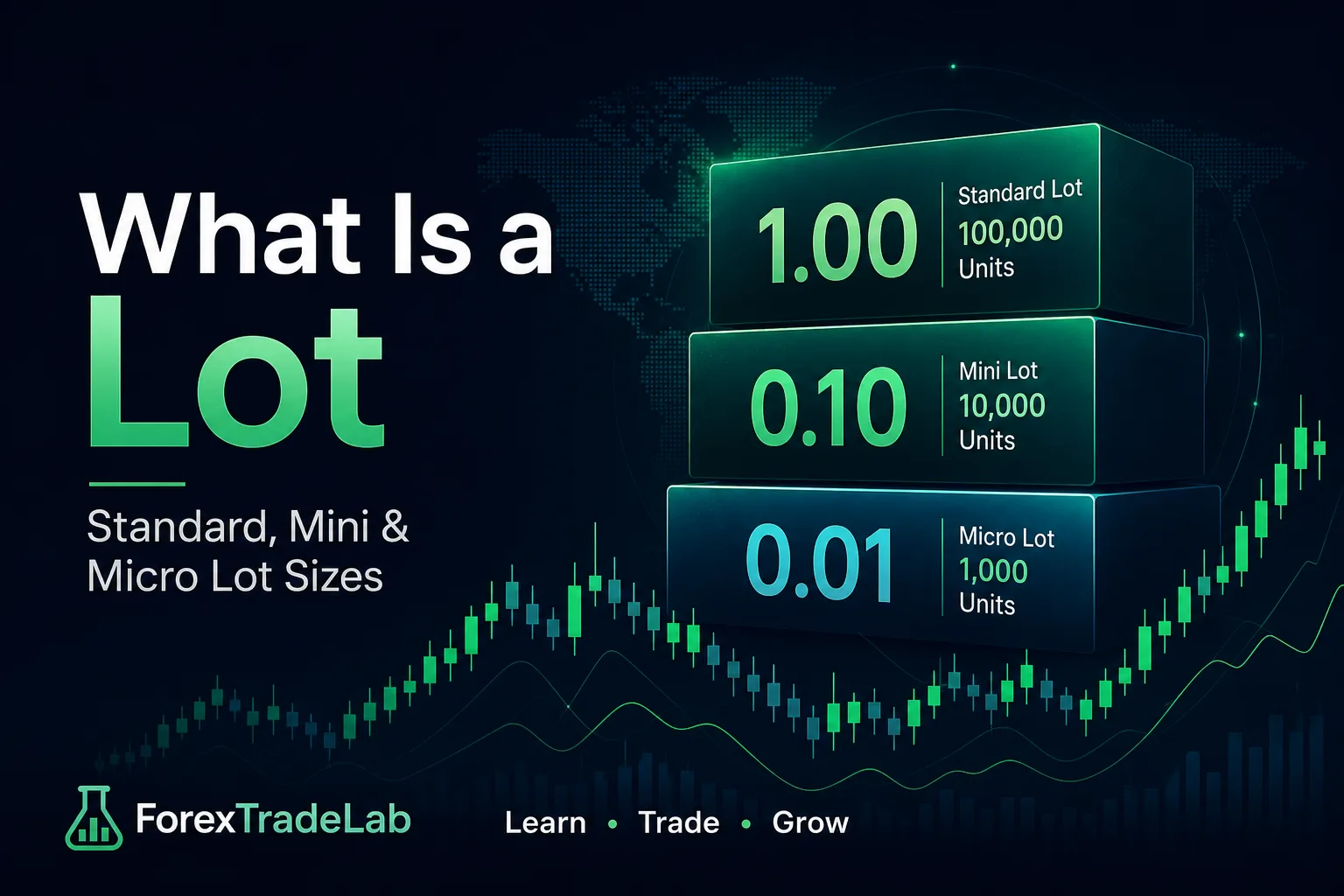
- A standard lot commonly represents 100,000 base units, but contract sizes vary by instrument and provider
- Cash risk depends on volume, the instrument’s live pip or point value, stop distance, costs, and account currency
- Margin is collateral, not a maximum-loss limit; leverage does not change the P&L of a chosen position
- Round calculated volume down to the broker’s permitted increment, or skip the trade if the minimum size exceeds the risk limit
Position size, lots, and cash risk#
Short Answer
A lot is a unit of quantity, not a risk setting. Cash risk comes from the lot size, the value of one pip for that instrument, and the distance between entry and the stop-loss.
Detailed Explanation
A 1.00 standard lot conventionally represents 100,000 base units for spot-FX sizing. In leveraged retail OTC forex, however, customers normally trade a contract with the dealer rather than take delivery of that currency. An FX CFD is a separate derivative contract. Both may use lots and pips, but contract size, counterparty, costs, margin rules, and protections depend on the product, legal entity, and jurisdiction.
The most useful order of decisions is the reverse of the order ticket. Do not first choose 0.10 lot, then search for a stop that makes it affordable. Decide what would invalidate the trade idea, measure that distance in pips, choose the maximum amount of account equity that may be lost if the stop is reached, and calculate the volume that fits those inputs. A lot is the output of that process.
For a USD-quoted major pair, a convenient approximation is that one standard lot has a pip value near $10, one mini lot near $1, and one micro lot near $0.10. Therefore a 0.20-lot position has a pip value near $2. If its stop is 35 pips away, the price loss at the stop is approximately $70 before trading costs. The same 0.20 lot with a 70-pip stop risks about $140. The position has not changed, but its cash risk has doubled because the invalidation distance changed.
The simplified calculation is volume = cash risk ÷ (stop distance × pip value per lot). Use the instrument’s actual contract specification and account-currency conversion when precision matters. JPY-quoted pairs use a different displayed pip convention, and crosses or non-USD accounts need conversion. The principle is unchanged: a wider logical stop requires a smaller lot if the cash-risk ceiling stays fixed.
Example
An account has $6,000 equity and a trader’s written policy permits $60 of planned risk. A EUR/USD setup needs a 48-pip stop. With an approximate micro-lot pip value of $0.10, one micro lot would risk $4.80. Dividing $60 by $4.80 gives 12.5 micro lots, or 0.125 standard lots. If the broker permits 0.01 increments, rounding down to 0.12 lot produces an estimated $57.60 loss before costs. Rounding up to 0.13 would exceed the limit.
Common Mistake
Using the same lot on every pair and every trade makes the dollar risk random. A 20-pip stop and an 80-pip stop should not normally carry identical volume merely because both are trades on the same account.
Professional Tip
Record planned loss in currency, not only as a percentage. “This trade risks $58 plus costs” is concrete enough to compare with every open position.
Pip value changes with the instrument#
Short Answer
The familiar $10-per-pip standard-lot figure is an approximation for selected USD-quoted major pairs. Pip value can vary with the pair, exchange rate, account currency, and contract specification.
Detailed Explanation
In EUR/USD, the quote currency is the U.S. dollar. A one-pip move on 100,000 units is commonly about $10, which makes examples simple for a USD account. In USD/JPY, a pip is normally the second decimal place rather than the fourth, and the pip value in dollars changes as USD/JPY changes. In EUR/GBP, the pip value is initially denominated in pounds and then converted to the account currency. The cash figure displayed by a platform may also reflect the account’s base currency and its conversion rate at that moment.
This is why a table of fixed pip values is educational but insufficient for execution. A trader who sizes GBP/JPY as though it had the same dollar pip value as EUR/USD may unintentionally take more or less risk than planned. Commodity CFDs, indices, and shares may use “lots” too, but their contract sizes, point values, and minimum volume increments are product-specific. Do not transfer a forex convention to another asset without reading its specification.
The correct sequence remains dependable across instruments: obtain the contract size, find the monetary effect of one price increment at one lot, select a stop, and calculate volume. The pip guide explains price increments; the lot calculator can handle the mechanical conversion when its symbol and account-currency inputs are correct.
Example
A trader has a $100 limit and a 50-pip stop. If the platform’s calculator shows that 0.10 lot is worth $0.92 per pip for the selected cross, that volume risks about $46 before costs. The trader can use roughly 0.21 lot only if the broker’s step size allows it and the calculated value remains valid. Assuming $1 per pip instead would produce a slightly different answer; the safe decision is to use the live specification and round down.
Common Mistake
Confusing a pip with a point is especially common on JPY pairs and CFDs. Read the symbol’s tick size and contract size instead of relying on the number of decimals shown on a chart.
Professional Tip
Recheck pip value after changing the account currency, symbol, or volume. A saved calculator setting is a reference, not a permanent truth.
Lots, leverage, and margin are different measures#
Short Answer
Lot size determines the quantity controlled. Leverage determines how much margin is required to control it. Neither figure alone tells you the loss at a stop.
Detailed Explanation
A 0.50-lot EUR/USD position represents 50,000 units of the base currency. Its approximate notional value depends on the exchange rate. If EUR/USD is 1.1000, the position is about $55,000 notional. At 1:100 leverage, simplified required margin may be about $550; at 1:30, about $1,833. The market result from a 40-pip movement is still approximately $200 either way, before costs. Leverage changed collateral capacity, not the pip value of the chosen lot.
Margin is therefore not a loss limit. It is collateral reserved under the broker’s rules while the position is open. A trader can meet a minimum-margin requirement and still be carrying a position that is unsuitable for account equity. Conversely, a trader with a high maximum leverage setting can use a small lot and low effective leverage. Read what leverage is and what margin is as connected concepts, but keep their jobs distinct in the trade plan.
Effective leverage is total notional exposure divided by current account equity. It is useful because several small lots can create a large portfolio exposure. An account with $5,000 equity holding $25,000 of combined notional exposure is using about 5:1 effective leverage, regardless of the broker’s advertised maximum. If losses reduce equity while the positions remain open, that effective leverage rises.
Example
An account with $4,000 equity opens 0.10 lot EUR/USD and 0.10 lot GBP/USD. Each ticket may look modest, but both can be vulnerable to broad U.S. dollar strength. Their gross notional exposure and their shared directional risk should be considered together. Available margin is not proof that the combined stop losses fit the account’s risk limit.
Common Mistake
Treating “free margin” as spare risk budget is unsafe. It must absorb floating losses, spread changes, financing, and any broker-specific margin adjustment.
Professional Tip
Write down three figures before entry: lot size, estimated cash loss at the stop, and estimated margin. If one is unknown, the order is not fully specified.
Position sizing across trading styles#
Short Answer
The strategy does not determine a default lot size. Its typical stop distance, volatility, holding period, and number of simultaneous positions determine how much volume fits a fixed risk budget.
Detailed Explanation
Scalping often uses short targets and stops, but it also faces spread, execution, and news sensitivity. A tight stop does not automatically justify a large lot because normal bid-ask noise can trigger it and transaction cost becomes a larger portion of the trade. Day trading can involve several independent attempts in one session; the total amount at risk across all open and planned trades matters more than the percentage assigned to a single ticket.
Swing and position trading often need wider stops because they are designed to survive daily fluctuations. A wider stop normally means a smaller lot for the same cash risk. Longer holding periods may also bring overnight financing, weekend gaps, and event risk. A position trader who chooses a small volume is not necessarily less confident in the analysis; the volume may be the only way to keep a realistic invalidation point inside the risk plan.
The same logic applies to strategy testing. A backtest that uses a fixed lot can overstate or understate the effect of drawdowns as account equity changes. A percentage-risk model may be more representative, but it still needs realistic assumptions for spread, commission, slippage, minimum volume, and rounding. No sizing method removes the possibility of loss.
Example
Two setups each have a $75 risk allowance. A short-term trade has a 15-pip stop and permits about $5 per pip, near 0.50 lot on a suitable major pair. A swing setup has a 75-pip stop and permits about $1 per pip, near 0.10 lot. Both risk approximately $75 before costs. Calling the first position “bigger” without mentioning its stop misses the relevant comparison.
Common Mistake
Increasing volume merely because a target is farther away confuses reward potential with risk control. The stop, not the hoped-for profit, is the starting input.
Professional Tip
Set a portfolio limit as well as a per-trade limit. Multiple positions can be individually compliant and collectively excessive.
Correlation and combined lot exposure#
Short Answer
Several small lots are not automatically diversified. Currency pairs that share a currency or react to the same macroeconomic driver can move together.
Detailed Explanation
Long EUR/USD, long GBP/USD, and long AUD/USD positions commonly share a short-U.S.-dollar component. Their charts and exact reactions differ, but a sharp dollar rally can hurt all three. Likewise, long EUR/JPY and long GBP/JPY can share meaningful yen exposure. The correct question is not simply how many trades are open; it is which currencies, factors, and events can cause them to lose together.
Combined risk should be expressed in cash. Add the planned losses at each stop, then consider whether stops could slip during the same event. Gross exposure helps reveal total activity, while net exposure shows partial offsets. A hedge can reduce directional exposure but introduce basis risk, transaction costs, and complexity. It should be understood rather than assumed to be protection.
Correlation is not fixed. Pairs that often move together can diverge after a country-specific policy surprise. That uncertainty is a reason to avoid treating historical correlation as a guaranteed hedge. A trader can reduce concentration by limiting the number of positions with the same currency bias, lowering every affected lot, or choosing not to add a new trade before a high-impact event.
Example
Three positions each have a planned $40 loss. If they express the same broad dollar view, the account may effectively have $120 at risk from one market theme, not three unrelated $40 risks. If the trader’s total-open-risk limit is $100, the third position requires a reduction elsewhere or should be declined.
Common Mistake
Calling positions diversified because their symbols differ ignores the currencies behind the symbols. The labels are different; the economic exposure may not be.
Professional Tip
In a journal, tag each position by its primary currency exposures and upcoming relevant events. This makes hidden concentration visible before it becomes a drawdown.
A repeatable lot-sizing workflow#
Short Answer
Use a short, repeatable calculation before every order: define the invalidation point, set cash risk, obtain current pip value, calculate and round volume down, then check total exposure and margin.
Detailed Explanation
First identify the entry and the point at which the trade thesis is no longer valid. The stop cannot be an arbitrary number selected to accommodate a desired lot. Second, choose a cash amount consistent with the account’s policy. Third, confirm the symbol’s pip or tick value and account-currency conversion. Fourth, divide the permitted loss by the loss per lot at that stop. Fifth, apply the broker’s minimum volume and increment rules, rounding down if the exact answer cannot be placed.
Then check the practical constraints. Include spread and commission in a conservative loss estimate. Check whether a scheduled data release, central-bank decision, market close, or thin-liquidity period could make a normal stop unreliable. Review existing positions for correlated exposure. Finally, confirm that margin remains a comfortable operational buffer. A trade can be correctly sized for price risk but still not be executable under a broker’s product rules.
This workflow is deliberately boring. It reduces the chance that excitement after a signal, frustration after a loss, or a large advertised leverage ratio will decide the volume. Consistency is more valuable than finding the visually impressive lot size.
Example
An account policy allows $50 risk. A USD/JPY setup has a 62-pip stop. The calculator shows $0.86 per pip at 0.10 lot. That volume would risk about $53.32 before costs, so the trader reduces it to 0.09 lot, estimates costs, and then checks whether two existing yen positions make the total risk too high. The final volume is a risk decision, not an estimate based on buying power.
Common Mistake
Rounding to the nearest allowed increment can round risk upward. When protecting a maximum-loss figure, round volume down unless a deliberate exception is documented.
Professional Tip
Create a pre-trade template with fields for equity, stop distance, pip value, lot size, risk including costs, total open risk, and event exposure. It turns the calculation into an auditable habit.
When the calculated lot is unavailable#
Short Answer
If the smallest permitted volume risks more than the amount your plan allows, the trade does not fit the account under those conditions.
Detailed Explanation
This is a useful constraint, not a calculation failure. A small account, wide logical stop, high-priced cross, or broker minimum of 0.01 lot can make the correct result smaller than the order ticket permits. Tightening the stop solely to force the trade into the minimum volume changes the trade thesis and can create a stop that ordinary volatility reaches.
Possible responses include waiting for a setup with a valid closer invalidation point, using an account or product with smaller contract increments where appropriate, reducing the account’s percentage-risk policy only if that remains practical, or continuing in a demonstration environment. Adding funds solely to justify an oversized trade is not risk management. The market will offer other opportunities.
Example
A $300 account permits a $3 risk, but its 70-pip setup would require a $0.043-per-pip position. If the broker minimum is $0.10 per pip, the smallest trade risks $7 before costs. Declining the order respects the policy.
Common Mistake
Forcing every chart idea into an order assumes every idea must be traded. Selectivity protects both capital and process quality.
Professional Tip
Test your broker’s minimum volume and increment rules before building a strategy around small-account sizing.
Conclusion#
Lot size describes quantity; it does not make a position safe or unsafe on its own. Translate the selected volume into cash risk using the live symbol specification, stop distance, costs, and account currency.
Key takeaways:
- A standard lot commonly represents 100,000 base units; mini and micro lots commonly represent 10,000 and 1,000, subject to the broker specification.
- Calculate volume from a defined cash-risk limit, stop distance, live pip value, contract size, and costs, then round down.
- Margin is collateral and does not cap a loss; leverage affects required collateral, not the P&L of an already selected position.
- If the broker’s smallest permitted volume exceeds the cash-risk limit, skip the trade or continue practising.
Position sizing is a control process, not a forecast of profitability. Keep records of the specification, calculation, costs, and total correlated exposure before each order.