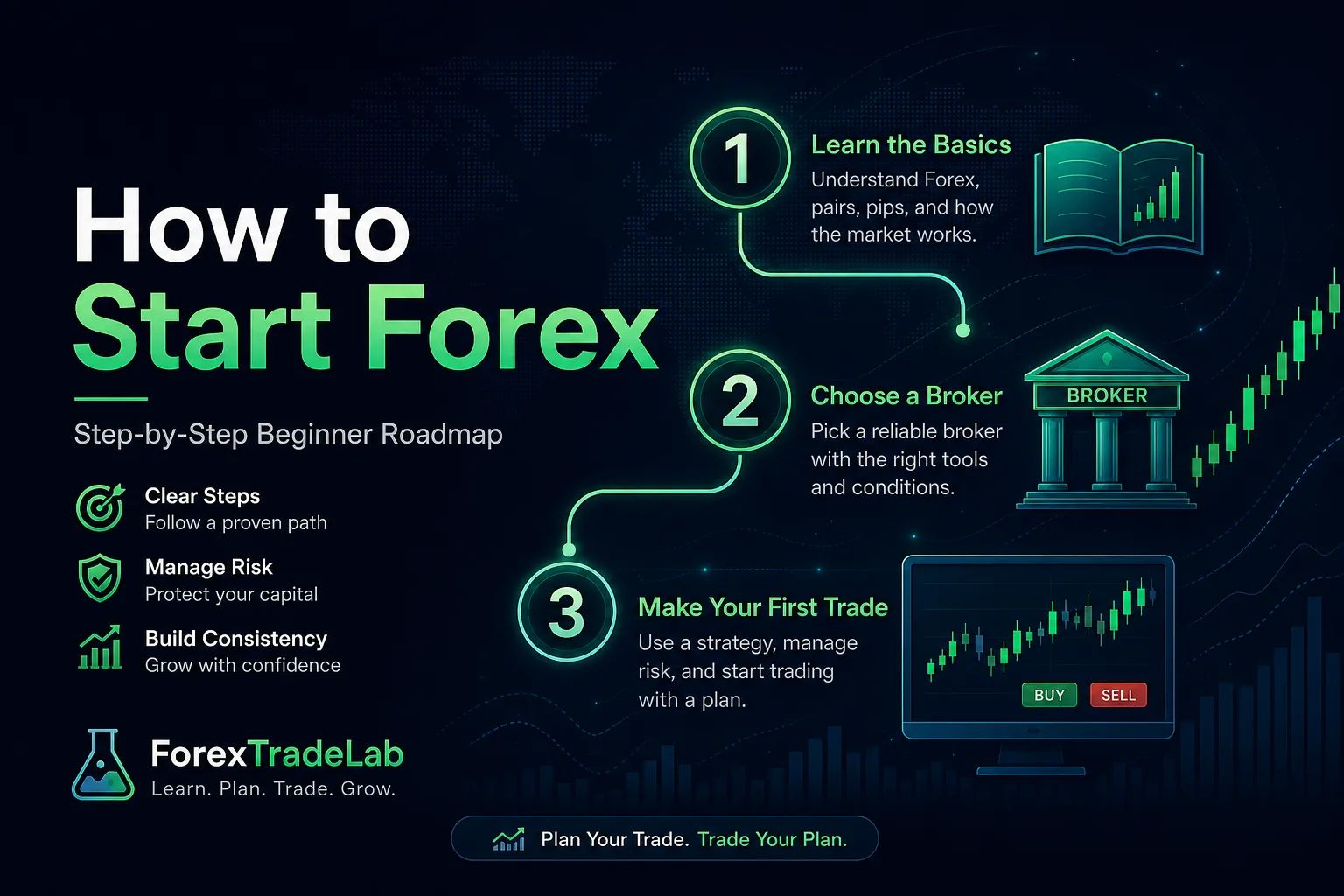
- Learn pairs, pips, lots, costs, margin and position sizing before funding
- Verify the exact broker entity and its permissions for your country; compare total costs and protections, not promotions
- Use demo for a pre-set practice sample; it cannot prove live results will match
- If live trading is appropriate, begin with a cash risk limit that fits your budget and review every result
- Step 1: Define What Forex Trading Is for You
- Step 2: Learn the Numbers Before Using Leverage
- Step 3: Choose a Broker Through Evidence, Not Marketing
- Step 4: Open and Secure the Account
- Step 5: Build a Demo Protocol
- Step 6: Write Rules That Can Be Tested
- Step 7: Move to Live Trading as a New Experiment
- Step 8: Review, Protect, and Improve
- Starting Forex: Final Checklist
- Quick Answers
Step 1: Define What Forex Trading Is for You#
Short Answer
Forex trading should be a controlled learning project, not a shortcut to income. Define how much time you have, what money you can afford to lose, and what evidence would justify continuing before you place a trade.
Detailed Explanation
Retail forex is speculative trading in changing exchange rates. It is not a savings account, a replacement for employment income, or a reliable way to pay an urgent bill. That distinction changes every early decision. A trader who needs this month's rent from a trade is likely to take excessive risk, avoid a planned loss, or add to a losing position. A trader who has separately funded necessities can assess a result without that pressure.
Set a practical objective for the first ninety days: learn one platform, execute one written method, calculate risk correctly, and collect a journal of decisions. Do not set “double the account” as the objective. Percentage-return targets encourage a trader to force setups and increase size when the market offers no clear opportunity. Process targets are measurable without rewarding reckless exposure.
Decide when you can trade. The foreign-exchange market operates across global sessions, but you do not need to watch it continuously. Someone available only in the evening should build rules around that period rather than copy a strategy designed for the London open. Choose a maximum number of trades per day and a maximum amount of screen time. A plan that fits your routine is more likely to be followed.
Read what forex is before choosing a strategy. It explains the basic relationship between the base and quote currencies. Then use the currency pairs guide to select one or two liquid instruments to observe. Starting with fewer variables makes it easier to identify whether a result came from the method, costs, news, or an execution mistake.
Example
Rina has $2,000 of savings beyond her emergency fund but decides that only $300 is available for a future live-learning account. She can review EUR/USD for one hour after work and cannot monitor trades overnight. Her first plan therefore permits only intraday EUR/USD trades during that hour, with a $3 maximum planned loss per trade. This is modest, but it is a real plan that matches her resources.
Common Mistake
Opening an account before deciding what a loss would mean financially. A broker's minimum deposit is a technical threshold, not a recommendation for suitable capital or position size.
Professional Tip
Write a one-sentence “stop condition”: for example, “I will pause live trading if I reach my weekly loss limit or break a risk rule twice.” Decide it while calm, not after a loss.
Step 2: Learn the Numbers Before Using Leverage#
Short Answer
You must be able to translate a chart idea into cash risk. Learn the pip value, lot size, stop distance, spread, margin requirement, and total exposure before submitting any order.
Detailed Explanation
The chart may display movement in pips, but your account experiences profit and loss in its base currency. A pip is a standard unit of movement for most currency quotes; the pip guide explains exceptions such as pairs quoted with different decimal conventions. A lot is the quantity controlled by a trade. A standard lot is commonly 100,000 units of the base currency, while a mini lot is 10,000 and a micro lot is 1,000. Details vary by instrument and provider, so confirm the contract specification in the platform. The lot-size guide provides the underlying vocabulary.
For a USD-denominated account trading EUR/USD, one micro lot commonly changes by about $0.10 per pip. That approximation is useful for learning, but it is not universal. Pip value changes when the account currency or quoted pair changes. Use the platform's contract specification or a position-size calculator and verify the result on the order ticket.
Leverage lets a small amount of margin control a larger notional position. It does not make a trade safer, improve the probability of an entry, or reduce the dollar loss from a given price move. If two traders hold the same position, they have the same market exposure even if their accounts offer different maximum leverage. Read what leverage means and the related margin material before treating margin availability as permission to use it.
The essential position-sizing sequence is:
- Choose a maximum cash loss for one trade.
- Put the stop where the trade idea is objectively invalidated, not where a preferred lot size happens to fit.
- Measure the entry-to-stop distance in pips.
- Determine the pip value for one unit, micro lot, or other available size.
- Divide cash risk by stop distance times pip value.
- Round down to an order size that the broker supports.
- Recheck that spread, commission, and potential slippage do not make the actual risk unacceptable.
Example
An account is $800 and its rule limits a planned loss to 0.5%, or $4. A EUR/USD setup requires a 20-pip stop. If one micro lot is approximately $0.10 per pip, one micro lot risks about $2 before costs. The maximum size under the rule is two micro lots: $4 divided by $2. If the stop needs to be 40 pips, the maximum size falls to one micro lot. The entry did not become worse; the required size changed because the invalidation point is farther away.
Common Mistake
Using the same 0.10-lot size on every trade. A fixed lot size creates different cash risk whenever the stop distance, pair, or account currency changes.
Professional Tip
Practise the calculation with a calculator before platform use. If the smallest available size risks more than your limit, do not take the trade; a wider account balance does not solve a bad calculation.
Step 3: Choose a Broker Through Evidence, Not Marketing#
Short Answer
Choose a provider only after verifying the exact legal entity, its permissions in your country, fees, product terms, and withdrawal conditions. Promotional spreads, bonuses, and social-media claims are not proof of safety.
Detailed Explanation
The broker-selection process deserves as much care as the strategy. A brand may operate several companies under different regulators. The legal entity assigned to a resident of one country may have different leverage limits, compensation arrangements, complaint routes, and protections from the entity advertised to another country. Read the account agreement, find the legal company name and registration number, and search the relevant regulator's official register.
For UK services, use the FCA Register. Australian residents can consult ASIC's professional registers. In the United States, use the NFA BASIC database and review CFTC materials. These resources do not make a trade safe, but they help verify whether a named firm and activity are authorised. If you cannot establish which entity will hold the account, do not send funds until the firm explains it through an official channel.
Next, compare the cost of a complete transaction. The advertised spread is only one part. Ask whether the account charges commission, overnight financing, currency conversion fees, deposit or withdrawal fees, inactivity charges, or different spreads during illiquid periods. Read the execution policy to understand market orders, pending orders, stop orders, and possible slippage. A “zero spread” account may still have a material commission; a commission-free account may charge through a wider spread.
Use the detailed broker choice guide as a checklist. It also helps distinguish useful questions—such as how a withdrawal is processed—from weak selection criteria such as a celebrity endorsement. Test customer support with a non-sensitive question and use a secure, official website address. Never share a platform password, one-time code, or remote access to your device with a person claiming to be an account manager.
Example
Two accounts both show EUR/USD at a narrow headline spread. Account A includes a per-lot commission and Account B embeds all cost in the spread. A trader estimates the total cost for the actual size and holding period they expect, then reads each entity's financing and withdrawal terms. The choice is based on the total cost and applicable agreement, not the smaller number in an advertisement.
Common Mistake
Assuming a regulator's name on a website applies to every customer. Check the company name in the terms sent to you and the register entry for your jurisdiction.
Professional Tip
Save PDFs or screenshots of the fee schedule, product specifications, and agreement date. This creates a reference when comparing a later charge or policy change.
Step 4: Open and Secure the Account#
Short Answer
Provide accurate identity information, use a unique password and multi-factor authentication where available, and verify every funding instruction inside the authenticated client portal.
Detailed Explanation
Account opening normally requires personal details, tax or residency declarations, a suitability questionnaire, and identity verification. Give truthful information. An inaccurate country, employment, income, or experience answer can create verification problems and may mean the account is offered under terms that do not fit your situation. A broker may request a government-issued identity document and proof of address; requirements depend on the jurisdiction.
Security is part of trading risk control. Use a password manager to create a unique password for the broker. Enable multi-factor authentication if offered. Keep the email account linked to the broker protected with its own unique password and multi-factor authentication, since email reset access can be as valuable as the trading password. Do not install software at the request of an unsolicited caller and do not act on funding details sent in a chat message.
Before funding, confirm the account currency. Depositing in a currency different from the account's base currency can create conversion costs. Understand whether card deposits are returned to the original card, what documentation may be required for withdrawals, and whether the payment method is in your own name. Small test withdrawals, performed in line with the broker's rules, can clarify the process before the account balance becomes larger.
Example
Before depositing, Daniel checks that the URL is the broker's official client area, verifies the receiving account details displayed after login, and uses a payment method in his own name. He stores the confirmation and does not rely on an email attachment containing payment instructions.
Common Mistake
Sending money to an individual, a personal bank account, or a cryptocurrency address supplied by an “agent.” Legitimate funding routes should be explained within the verified account environment and agreement.
Professional Tip
Set up platform and withdrawal notifications. Unexpected password resets, new-device logins, or withdrawal requests deserve immediate attention through the provider's official support channel.
Step 5: Build a Demo Protocol#
Short Answer
Use a demo account with a realistic balance and identical rules to your proposed live account. The purpose is to rehearse decisions and find weaknesses, not to produce an impressive virtual return.
Detailed Explanation
Open a demo account after you understand the terminology and broker conditions. Set the virtual balance near the amount you could plausibly allocate to live learning. A $100,000 practice balance can make a 1% loss feel abstract if you expect to begin live with $500. A realistic balance forces position-size decisions that resemble the ones you will actually face.
First, practise mechanics with no concern for profit: selecting an instrument, reading bid and ask, placing market and pending orders, attaching a stop-loss and take-profit, modifying an order, checking margin, finding the trade history, and exporting records. Then trade only your written setup. Do not add indicators, pairs, or new rules because a particular day is slow. The demo's value is a comparable sample.
Include normal market frictions in your observations. Record the spread when you enter and exit, planned versus filled price, commission, financing where relevant, time of day, and economic events. Demo conditions can differ from live liquidity and execution; this is a reason to be cautious in the transition, not a reason to abandon disciplined practice.
Example
A trader expecting to fund $500 creates a $500 demo, caps risk at $2.50 per trade, and takes no more than one setup a day. After each trade they save a chart image and record whether every checklist item was met. A 15% virtual gain is less important than discovering that they repeatedly enter just before a scheduled announcement.
Common Mistake
Resetting the demo after a drawdown. Resetting removes evidence about whether the method and loss limits can survive an ordinary losing sequence.
Professional Tip
Separate your journal into “valid trade, loss,” “valid trade, gain,” and “rule violation.” Only the last category requires an immediate process correction; a valid loss is expected in any uncertain market.
Step 6: Write Rules That Can Be Tested#
Short Answer
A usable trading plan states exactly when you trade, what creates an entry, where a stop goes, how size is calculated, how you exit, and when you do nothing.
Detailed Explanation
Avoid rules based only on impressions. “Trade strong trends” cannot be applied consistently because strength is undefined. Replace it with observable conditions: selected pair, timeframe, session, price structure, indicator setting if used, event filter, entry trigger, stop location, target or exit condition, and maximum holding period. You do not need a complex system. You need a system you can execute and review without changing its meaning after the result is known.
No-trade rules are equally important. They might exclude a period before a high-impact release, spreads above a tested threshold, the final minutes before rollover, a second correlated position, or any trade after reaching a daily loss limit. Consult official calendars and central-bank sources for dates and decisions; do not mistake a calendar for a prediction service. Volatility may rise around news and execution can be worse than expected.
Test the rules across enough observations to understand their behavior. Track the number of trades, win rate, average gain, average loss, costs, largest drawdown, and adherence. No small sample can prove future profitability. The goal is more limited and more useful: identify whether the rules are clear enough to execute and whether the risk profile is compatible with your limits.
Example
A rule says: trade only EUR/USD between 08:00 and 09:00 London time; enter after a defined breakout retests a level; skip if a high-impact euro or US release is scheduled within 30 minutes; place the stop beyond the retest swing; risk $3; exit at two times planned risk or at the session end. Another person may dislike the method, but its parts can be tested.
Common Mistake
Calling a strategy “tested” after ten trades or after looking backward at a chart. Historical observation can help form a hypothesis, but it does not show whether you can execute the rule in real time with costs and uncertainty.
Professional Tip
Freeze rule changes for a predetermined sample unless a safety issue appears. Mark ideas for later testing instead of mixing them into the current record.
Step 7: Move to Live Trading as a New Experiment#
Short Answer
If live trading is appropriate after sustained demo practice, begin with the smallest practical size and keep the same rules. Treat the first live trades as a test of execution and emotion, not as a signal to scale.
Detailed Explanation
Live trading adds real consequences. A small unrealised loss can create hesitation, a desire to close early, or an urge to move a stop. A small profit can create overconfidence and premature size increases. These reactions do not mean you are unsuited to trading; they mean the live environment supplies information that demo cannot fully reproduce.
Begin with an amount whose complete loss would not disrupt essential obligations. Use a position size so small that you can follow the plan even after several losses. For many beginners, this means micro-lot sizing where available, but the correct size comes from the risk calculation and instrument specification, not from a universal recommendation. Keep cash risk at or below the level already tested on demo. Do not deposit more to recover a loss or increase lots after a winning streak.
Compare live records to demo records. Were spreads wider? Did you enter later? Did you close early? Did a scheduled event cause slippage? Review the first twenty to fifty live trades separately from the demo sample. If rules were broken, reduce complexity or pause and return to simulation. If rules were followed but the method performs poorly after costs, do not solve it by increasing size.
Example
After a structured demo sample, Maya deposits $300 that she can afford to lose and risks $1.50 per trade. She notices that she closes profitable trades early because the cash amount feels important. Rather than increase size after a few wins, she records the behavior and practises holding to the original exit rule at the same small size.
Common Mistake
Treating demo profitability as a graduation certificate. It is evidence of a process under simulated conditions, not a promise about live returns.
Professional Tip
Use a “one change at a time” rule. When moving live, keep pair, setup, session, and risk constant; otherwise you cannot tell whether a difference came from live psychology, market conditions, or the new method.
Step 8: Review, Protect, and Improve#
Short Answer
A journal and scheduled review turn trades into evidence. Protect the account with daily and weekly loss limits, then improve only after identifying a repeatable issue.
Detailed Explanation
Every record should include the pair, date and time, direction, entry, stop, exit, quantity, planned cash risk, realised profit or loss, spread or commission, setup name, screenshot, and a statement of whether the plan was followed. Add emotional notes only when they affected an action. The journal should be factual enough that you can audit a trade several weeks later.
Schedule a weekly review away from active market hours. Count valid setups, rule violations, costs, average planned risk, and maximum drawdown. Look for concentration: perhaps one session creates most losses, one pair has higher costs, or most errors occur after the first loss of the day. A result may be random; a repeated execution error deserves a specific correction.
Account limits prevent a short period from becoming a crisis. A daily limit might stop new entries after a certain cash loss or number of failed attempts. A weekly limit may require a review before resuming. These limits do not guarantee profit; they preserve decision quality and capital when conditions or behavior deteriorate.
Example
A weekly journal review shows that three trades taken outside the selected session caused most of the week's loss. The trader does not change indicators or double the target. They add a platform alert for the permitted session and recommit to no trades outside it for the next sample.
Common Mistake
Reviewing only profit and loss. A profitable week can still contain dangerous behavior, such as removing stops or taking correlated trades, that has not yet produced a visible cost.
Professional Tip
Track “adherence rate”: the number of trades that followed every rule divided by total trades. Improve adherence before trying to optimise entries.
Starting Forex: Final Checklist#
Before a first live order, confirm all of the following:
- I understand the base and quote currency, bid, ask, spread, pip, lot, margin, and leverage.
- I have read the forex basics, pip guide, lot guide, and leverage guide.
- I verified the broker's exact legal entity and terms for my country using an official source.
- I understand total costs, including spread, commission, financing, conversion, and withdrawal terms.
- I can calculate cash risk from stop distance and position size without guessing.
- I have tested a written setup in a realistic demo account and retained the records.
- My plan contains entry, exit, no-trade, daily-loss, and weekly-review rules.
- The money allocated to live trading is separate from essential spending, debt payments, and emergency savings.
- My first live size is deliberately small enough to learn from, not large enough to chase an income goal.
Forex trading has no risk-free starting point. The responsible route is education, verification, realistic practice, conservative sizing, and ongoing review. If any item on this checklist is unclear, return to the relevant guide or demo process before funding another trade.
Quick Answers#
How do I start forex trading as a beginner?#
Learn the mechanics and costs, verify the broker entity, practise a written process in demo, then decide whether very small live risk is appropriate.
How do I choose a broker?#
Check the exact legal entity and its permissions in the relevant regulator register, then compare applicable costs, execution policy, funding and withdrawal terms, platform support and protections.
How long does it take to learn forex?#
There is no reliable fixed timetable. A pre-set study and demo sample helps you practise, but it cannot prove live results will match.
How much capital do I need?#
There is no universal minimum. The smallest available size, a logical stop, all costs and the cash loss limit must work together for the account.
What is a demo account?#
A demo account uses virtual funds to practise mechanics and a written process. Live fills, costs, liquidity and emotional pressure can differ.