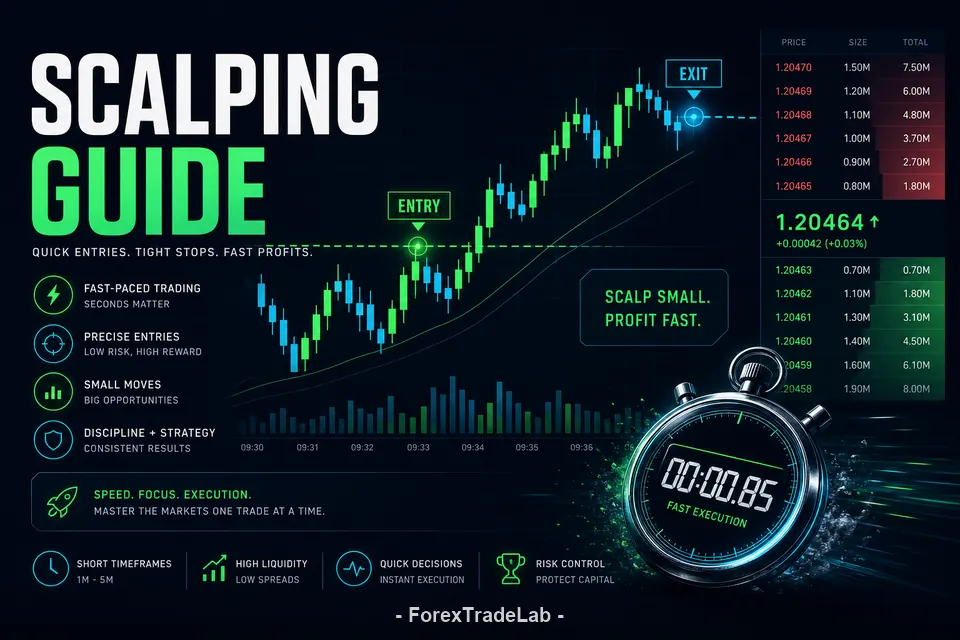
- Scalping is a trading style that seeks to capture relatively small intraday price movements through frequent, short-lived positions. It is not a single strategy.
- Read the written broker terms before funding an account
- Use defined cash risk and realistic cost assumptions
- Educational content, not personal investment, legal, or religious advice
Forex scalping: direct answer#
Short Answer
Scalping targets small intraday moves, making spread, commission, slippage and latency central to whether a tested edge survives.
Detailed Explanation
Frequent trades do not create expectancy. Testing must use realistic bid/ask data, rejected orders and the actual trading session.
Example
A one-pip spread consumes 20% of a five-pip gross target before commission or slippage.
Common Mistake
Choosing an account from its minimum advertised spread without calculating round-turn cost.
Professional Tip
Log requested and filled prices, spread, commission and hold time, then evaluate net expectancy.
Introduction#
Forex scalping is a very short-term trading style, not a promise of quick or easy profit. A scalper may trade a range, breakout, liquidity transition or mean-reversion setup, but the intended move is usually small enough that spread, commission, slippage and delay can decide whether the method has a net edge. Frequent decisions also magnify sizing errors and impulsive behaviour.
This guide develops a cost-aware process for defining, testing and reviewing a scalping setup. It does not recommend a broker, currency pair, direction or position size. For supporting concepts, see forex order types, what is spread, risk management, trading psychology and the contrasting swing-trading guide.
Short Answer#
Scalping is worth evaluating only when one precise setup shows positive expectancy after realistic trading costs and can be executed without breaching broker terms or personal risk limits. A fast chart does not create an edge.
For example, a six-pip target with an eight-pip stop looks like a gross reward-to-risk ratio of 0.75. If round-trip spread and commission average 1.2 pips and adverse slippage averages 0.4 pips, the effective win is about 4.4 pips while the effective loss is about 9.6 pips. That difference materially raises the break-even win rate.
The common mistake is measuring chart movement while ignoring executable bid and ask prices. Professional advice: learn the workflow on demo, then use the exact live account’s fee schedule and execution records when estimating viability.
How It Works#
Every market order crosses the spread, and every stop or limit depends on the broker’s order-handling rules. Commission adds another fixed hurdle. Slippage is variable: it may be modest in normal conditions and much larger when prices move quickly or liquidity thins. A five-pip candle therefore says nothing by itself about a five-pip strategy’s achievable return.
Scalpers often concentrate activity in liquid sessions, but session overlap can combine deeper liquidity with faster reactions to scheduled data. When a stop is only a few pips away, one delayed fill can dominate several ordinary outcomes. A news release is not automatically an opportunity merely because price moves quickly.
Account terms are part of the strategy. Minimum stop distances, order-size limits, trading hours and policies concerning EAs or latency-sensitive activity vary by entity and account. Read the current client agreement, product specification and execution policy before testing the method.
Practical Process#
- Define one setup using observable conditions: session, market context, entry trigger, invalidation, stop, target, maximum spread and expiry time. “Buy when momentum looks strong” is not reproducible.
- Replay or backtest the rules with bid/ask-aware costs. Record signals rejected because the spread was too wide, not only filled trades.
- Practise order entry, cancellation and emergency exit on demo. A demo can test procedure, but it cannot prove identical live fills.
- Set cash risk per attempt, a daily loss limit and a maximum number of attempts before the session. This prevents a sequence of immediate re-entries from disguising revenge trading.
- Journal requested and filled prices, spread, commission, slippage, setup quality and rule adherence. Review a meaningful sample, not one profitable morning.
The most useful process test is simple: before price moves, can the trader state exactly what action comes next and why? If not, hindsight is likely entering the record.
Decision Framework#
Judge a scalping method on four connected questions:
- Net expectancy: Do average net wins, average net losses and win frequency remain favourable after spread, commission and slippage?
- Execution distribution: What do actual costs look like during the precise sessions and events traded? An advertised minimum spread is not an average.
- Operational fit: Are connection stability, platform behaviour and broker rules compatible with the intended holding period?
- Behavioural fit: Can the trader obey loss, pause and trade-count limits under rapid feedback?
A one-minute chart displays more observations, not necessarily more independent opportunities. Prefer a small set of pre-trade gates: setup present, spread below the tested ceiling, no prohibited event window, risk within limit and systems functioning. If any gate fails, no trade is a valid outcome.
The mistake to avoid is using a high win rate as a complete verdict. A professional review places win rate beside net payoff, drawdown, worst slippage and rule violations.
Risks and Limits#
Scalping combines market risk with unusually concentrated execution and behavioural risk. Spread can widen beyond the model, stops can fill worse than their trigger, connectivity can fail and repeated losses can encourage oversized recovery attempts. Ten small wins can be erased by one uncontrolled loss.
The style may be unsuitable where internet access is unreliable, available attention is fragmented, capital cannot tolerate an ordinary losing sequence, or typical costs consume much of the target. Broker permission to scalp is not an endorsement of its profitability.
Past screenshots, backtests and demo statements do not establish future results. Market liquidity, broker terms and trader behaviour change. Keep trading capital separate from essential obligations and stop when the documented environment no longer matches the tested one.
Worked Example#
A EUR/USD setup targets six pips and uses an eight-pip stop. Historical live records for the chosen session show 1.2 pips of round-trip spread and commission and 0.4 pips of average adverse slippage. The estimated net win is therefore 4.4 pips; the estimated loss is 9.6 pips.
Ignoring other complications, the break-even win rate is 9.6 ÷ (9.6 + 4.4), or about 68.6%. A 70% gross win rate that looked excellent now leaves very little margin for worse fills, mistakes or regime change. The trader should not solve this by widening the target after entry; the rules must be retested.
This example is illustrative, not a forecast of EUR/USD costs. Use the relevant account’s observed distribution. If the full calculation cannot be stated before entry, the setup is not ready.
Checklist#
- The setup has objective entry, invalidation, target and expiry rules.
- The broker entity and current terms permit the intended activity.
- Spread, commission and realistic slippage are included in expectancy.
- Position size follows a cash-risk limit rather than confidence.
- Maximum spread, daily loss and trade-count limits are written down.
- Scheduled news and connection-failure responses are predefined.
- Requested and filled prices are captured in the journal.
- Results are reviewed by session and setup over a meaningful sample.
Glossary#
Scalping: Frequent, short-lived trading intended to capture small intraday moves.
Spread: The changing difference between bid and ask and an immediate trading cost.
Slippage: The difference between a requested or triggered price and the actual fill.
Net expectancy: The average result per trade after wins, losses and trading costs.
Invalidation: The observable condition showing that the setup’s premise no longer holds.
Daily loss limit: A predefined loss amount or condition that ends trading for the session.
Execution policy: The broker’s description of how orders and prices are handled.
FAQ#
The FAQ above addresses broker permission, timeframes, spreads, slippage, news, EAs, win rate and stop limitations. Its central message is consistent: no chart speed, automation or headline win rate removes the need for realistic net-cost testing and controlled cash risk.
Summary#
Scalping should be treated as an execution-sensitive research problem. Define one observable setup, calculate expectancy after all costs, impose hard session limits and compare planned prices with actual fills. Stand aside when spreads, events, systems or behaviour fall outside the tested conditions.
Continue with what is spread and forex order types before building the sizing and pause rules described in risk management and trading psychology.