Independent forex education Free professional tools Evidence-based broker reviews
EUR/USD 1.15703 ▲ +0.36%
GBP/USD 1.35342 ▲ +0.35%
USD/JPY 159.304 ▼ 0.14%
XAU/USD 4376.64 ▲ +0.58%
USD/CHF 0.81330 ▼ 0.11%
AUD/USD 0.70846 ▲ +0.35%
USD/CAD 1.38747 ▼ 0.41%
EUR/GBP 0.85484 ▼ 0.01%
EUR/USD 1.15703 ▲ +0.36%
GBP/USD 1.35342 ▲ +0.35%
USD/JPY 159.304 ▼ 0.14%
XAU/USD 4376.64 ▲ +0.58%
USD/CHF 0.81330 ▼ 0.11%
AUD/USD 0.70846 ▲ +0.35%
USD/CAD 1.38747 ▼ 0.41%
EUR/GBP 0.85484 ▼ 0.01%
ESC
Key Takeaways
  • IC Markets adds cTrader and TradingView while XM focuses on MetaTrader and its own app
  • Raw-spread comparisons must include round-turn commission and observed slippage
  • The assigned legal entity determines protection and leverage
  • Swap-free conditions require account- and instrument-specific confirmation

XM vs IC Markets: Which Broker Suits Your Style?
Regulated Global Broker

Open an Exness account through the official partner link

  • Standard account from $10
  • Pro, Raw and Zero accounts generally from $200
  • MT4, MT5 and Exness app
  • Over 98% of withdrawals processed automatically
  • FCA, CySEC, FSCA and FSA entities
  • Verify the legal entity before funding
CySEC FCA FSCA FSA
XM vs IC Markets: Which Broker Suits Your Style?
Share
Text size
18px

Overview#

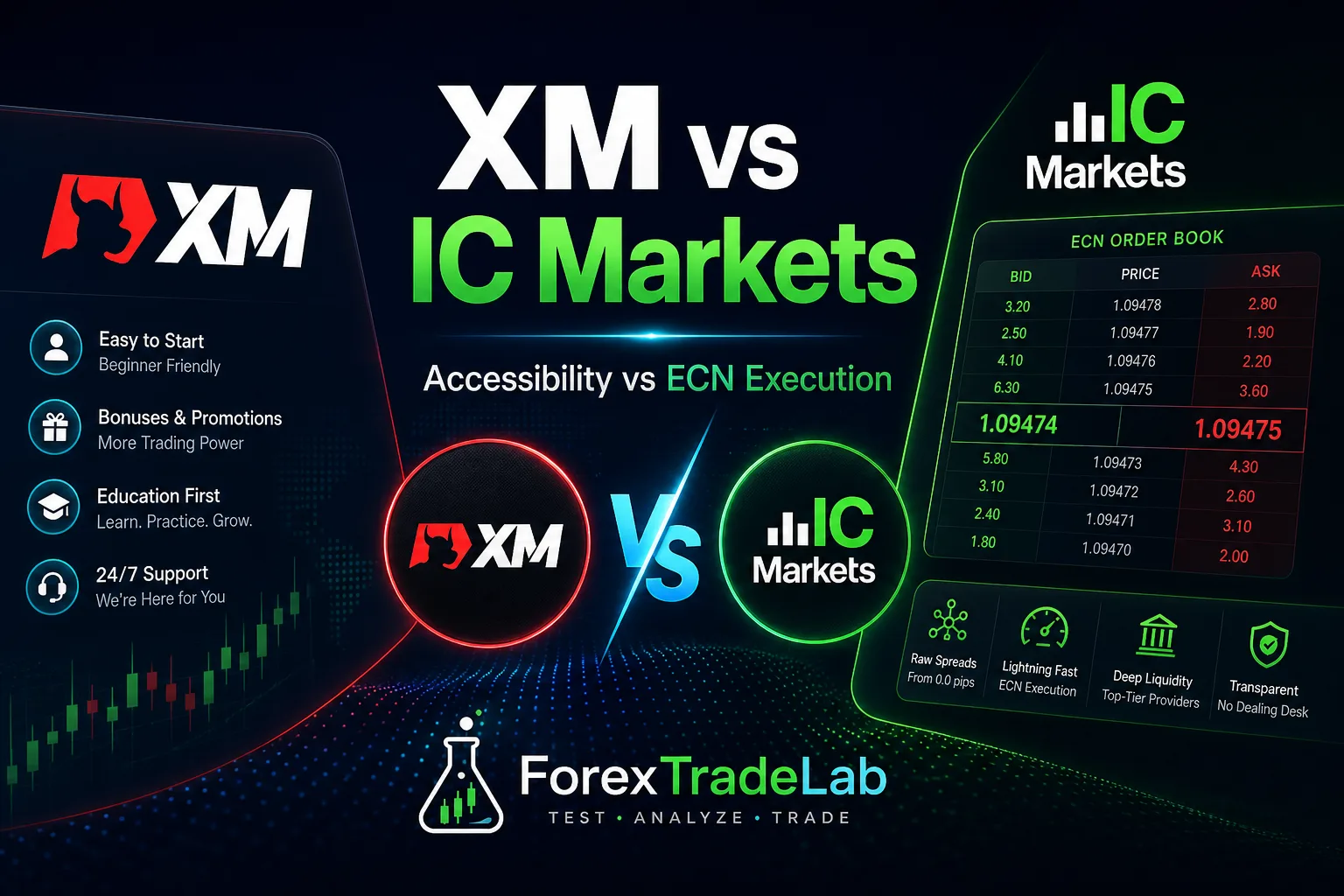
XM and IC Markets are both highly regarded forex brokers, but they serve different trader profiles. XM focuses on accessibility, education, and a well-rounded trading ecosystem for all levels, while IC Markets targets experienced traders and scalpers with raw ECN spreads and institutional-grade execution.

XM was founded in 2009 and offers MetaTrader accounts, its own app, educational resources and promotions where eligible. Terms depend on entity and country.

IC Markets was founded in 2007 in Sydney, Australia, and has established itself as one of the highest-volume forex brokers globally. IC Markets is known for its True ECN execution, ultra-tight raw spreads, and fast order processing, making it a top choice for scalpers, algorithmic traders, and high-frequency strategies.

💡 Key Takeaway: IC Markets emphasises raw pricing and additional third-party platforms; XM uses a different account and support model. This guide does not independently verify execution speed or service quality.

Quick Comparison Table#

Feature XM IC Markets
Founded 2009 2007
Regulation CySEC, DFSA, FSCA, FSC/FSA, CMA, BVI FSC CySEC, ASIC, FSA
Min. Deposit $5 $0
Spreads (EUR/USD) From 0.6 pips (Ultra Low) From 0.0 pips (Raw Spread)
Commission $0 (Standard/Ultra Low) $3.50/lot/side (Raw Spread)
Max. Leverage Up to 1:1000* Up to 1:1000*
Platforms MT4, MT5, XM App, XM WebTrader MT4, MT5, cTrader, TradingView
Islamic Account Yes (all account types) Yes (upon request)
Bonus Available in eligible jurisdictions No bonuses
Support Languages 30+ including Arabic 18+ including limited Arabic
Education Extensive (webinars, seminars) Basic
Instruments 1,400+ 2,200+
Review XM review -

Regulation#

Both brokers hold multiple licenses across several jurisdictions, ensuring strong protection for client funds.

XM's official regulation page lists 8 group licenses:

  • CySEC (Cyprus) — License #120/10
  • DFSA (Dubai, DIFC) — License #F003484
  • FSCA (South Africa) — License #49976
  • FSC (Belize) — Licence #8557558
  • FSA (Seychelles) — License #SD190
  • FSC (Mauritius) — License #GB23202700
  • CMA (Kenya) — License #233
  • BVI FSC — License #SIBA/L/25/1182

IC Markets' regulatory licenses:

  • CySEC (Cyprus) — License #362/18
  • ASIC (Australia) — License #335692
  • FSA (Seychelles) — License #SD018
Aspect XM IC Markets
Tier 1 Regulators CySEC ASIC, CySEC
Middle East DFSA (Dubai)
Client Fund Segregation Yes Yes
Negative Balance Protection Yes Yes
Compensation Scheme ICF (up to €20,000) ICF (CySEC entity, up to €20,000)
Review XM review -
💡 For Middle East Traders: XM's DFSA license is a significant advantage for traders based in the UAE and GCC region. DFSA is the financial regulator for the Dubai International Financial Centre, providing a strong local regulatory layer. IC Markets does not hold a DFSA license, which may matter if you prefer a broker with local Middle Eastern regulation.
💡 Multi-Entity Structure: XM Group operates through multiple regulated legal entities worldwide. The entity that serves you — and therefore the leverage limits, compensation schemes, and dispute channels — depends on your country of residence. For the full entity breakdown with license numbers, see our XM broker review.

Verdict on regulation: Both are well-regulated. IC Markets holds two Tier 1 licenses (ASIC, CySEC), while XM's official regulation page lists entities across CySEC, DFSA, FSCA, FSC/FSA, CMA Kenya and BVI FSC jurisdictions. XM has a clear edge in overall regulatory breadth, but your actual protection depends on the entity named in your client agreement.

Spreads and Fees#

This is where the two brokers differ most. IC Markets is built around raw ECN pricing, while XM emphasizes all-inclusive, commission-free accounts.

XM Spreads (typical):

Account EUR/USD GBP/USD USD/JPY Gold
Standard 1.6 pips 2.1 pips 1.6 pips 3.5 pips
Ultra Low 0.6 pips 0.7 pips 0.7 pips 1.5 pips
XM Zero 0.0 pips 0.2 pips 0.1 pips 2.0 pips

XM Zero charges $3.50/lot/side commission.

IC Markets Spreads (typical):

Account EUR/USD GBP/USD USD/JPY Gold
Standard 0.62 pips 0.83 pips 0.74 pips 2.0 pips
Raw Spread 0.02 pips 0.23 pips 0.14 pips 0.9 pips

IC Markets Raw Spread charges $3.50/lot/side commission on MT4/MT5 (or $3.00/lot/side on cTrader).

All-in cost comparison (EUR/USD, 1 standard lot round-turn):

XM Ultra Low XM Zero IC Markets Std IC Markets Raw
Spread cost $6.00 $0.00 $6.20 $0.20
Commission $0.00 $7.00 $0.00 $7.00
Total $6.00 $7.00 $6.20 $7.20
Review XM review XM review - -
💡 Illustrative Cost: Under the displayed assumptions, XM Ultra Low is $6.00 and IC Markets Raw is $7.20 per standard-lot round turn. These are not audited averages and exclude slippage, financing and changing spreads.

Non-trading fees:

  • Deposits/Withdrawals: Both offer free deposits. IC Markets may charge $20 for international bank wire withdrawals
  • Inactivity fee: XM charges $5/month after 90 days of inactivity. IC Markets has no inactivity fee
  • Swap rates: Comparable across both brokers; both offer swap-free options

Leverage#

XM IC Markets
Maximum leverage Up to 1:1000* Up to 1:1000*
Default leverage 1:888 (adjustable) 1:1000
Leverage on Majors Up to 1:1000* Up to 1:1000*
Leverage on Gold Up to 1:1000* Up to 1:1000*
Leverage on Crypto Up to 1:250 Up to 1:5
Leverage on Indices Up to 1:200 Up to 1:200
Review XM review -
💡 Leverage Comparison: Both XM and IC Markets can offer high leverage on eligible entities, but caps depend on entity, account type and instrument. Higher leverage increases loss risk and should not be treated as a quality signal.

Verdict on leverage: Both brokers can offer high headline leverage, but the safer comparison is entity terms, instrument caps and margin policy. Responsible traders rarely need the maximum available cap.

Account Types#

XM Account Types:

Account Min. Deposit Spread From Commission Key Feature
Micro $5 1.0 pips $0 Micro lots (1,000 units)
Standard $5 1.0 pips $0 Standard lots
Ultra Low $5 0.6 pips $0 Low spreads, no commission
XM Zero $100 0.0 pips $3.50/lot/side Raw spreads

IC Markets Account Types:

Account Min. Deposit Spread From Commission Key Feature
Standard $0 0.6 pips $0 All-inclusive spreads
Raw Spread (MT4/MT5) $0 0.0 pips $3.50/lot/side ECN raw spreads
Raw Spread (cTrader) $0 0.0 pips $3.00/lot/side cTrader raw spreads
💡 Account Access: The listed minimums and account structures differ. A low deposit does not establish suitability or support quality; test position sizing and platform workflow first.

Platforms#

Platform variety is an area where IC Markets has a notable advantage.

XM:

  • MetaTrader 4 (Desktop, Web, Mobile)
  • MetaTrader 5 (Desktop, Web, Mobile)
  • XM App (proprietary mobile app with account management)
  • XM WebTrader

IC Markets:

  • MetaTrader 4 (Desktop, Web, Mobile)
  • MetaTrader 5 (Desktop, Web, Mobile)
  • cTrader (Desktop, Web, Mobile)
  • TradingView integration
Feature XM IC Markets
MT4 Yes Yes
MT5 Yes Yes
cTrader No Yes
TradingView No Yes
Proprietary App XM App, XM WebTrader
Copy Trading Yes Yes (cTrader Copy)
VPS Free (conditional) Free (conditional)
Autochartist Yes Yes
Review XM review -

IC Markets' cTrader and TradingView integration are significant advantages for experienced traders who demand modern charting interfaces and Level II pricing data. XM's platform offering covers most traders' needs with MT4/MT5, and its proprietary app provides streamlined account management alongside trading.

⚠️ Platforms vs. Ecosystem: IC Markets offers more platform choices, but XM compensates with educational webinars, personal account managers, and eligible promotions. Platforms are tools — the question is whether you need advanced execution features (IC Markets) or a supportive environment that helps you grow as a trader (XM).

Islamic Accounts#

Both brokers offer swap-free accounts for Muslim traders, but with different approaches.

XM Islamic Account:

  • Available on all account types (Micro, Standard, Ultra Low, Zero)
  • No swap or rollover charges on overnight positions
  • No additional fees, markups, or hidden costs
  • Activated upon request through customer support
  • No time limit or instrument restrictions on swap-free status
  • Full Arabic support during setup and management

IC Markets Islamic Account:

  • Available on all account types (Standard, Raw Spread)
  • No swap charges on overnight positions
  • Activated upon request through customer support
  • Some instruments may have holding period conditions
  • Limited Arabic support for setup
💡 Islamic Account Comparison: XM provides a more transparent Islamic account experience with no hidden fees, no time restrictions, and dedicated Arabic support for setup and management. IC Markets' Islamic offering is functional but lacks the Arabic-language support and clarity that XM provides. For Muslim traders in the Middle East, XM's approach is more straightforward.

Customer Support#

Customer support is one of XM's strongest differentiators against IC Markets.

Aspect XM IC Markets
Live Chat 24/5 24/5
Email Yes Yes
Phone Yes Yes
Languages 30+ 18+
Arabic Support Full dedicated native team Limited
Response Time Under 1 minute (chat) Under 3 minutes (chat)
Personal Account Manager Yes No
Arabic Webinars Regular None
Seminars Global (including Middle East) Limited
Educational Content Extensive (200+ videos, guides) Basic (articles)
Review XM review -

XM's support strengths:

  • Dedicated Arabic-speaking customer support team
  • Regular live webinars in Arabic and multiple other languages
  • Personal account managers for active traders
  • Global seminar program with events in Arab countries
  • Over 200 educational videos and comprehensive trading guides

IC Markets' support strengths:

  • Responsive English-language support
  • Good technical documentation
  • Active social media presence
  • Reliable platform uptime
💡 Support Evidence Limit: Published language and education inventories differ, but this guide has no controlled response-time or case-resolution study. Test both services in the language you need.

Final Verdict#

XM and IC Markets are both excellent brokers serving different needs.

Choose XM if you:

  • Are a beginner or intermediate trader
  • Want to start with as little as $5
  • Value eligible bonuses to test live markets, subject to terms
  • Need full Arabic support — customer service, webinars, and education
  • Want a personal account manager
  • Value eligible promotions and loyalty credits
  • Want low-barrier live account access
  • Are based in the Middle East and value DFSA regulation
  • Appreciate a comprehensive educational ecosystem

Choose IC Markets if you:

  • Are an experienced scalper or algorithmic trader
  • Prioritize True ECN execution and ultra-fast order processing
  • Want access to cTrader or TradingView integration
  • Want to start with a raw ECN-focused broker
  • Trade primarily in English
  • Prefer a wider instrument selection (2,200+)
  • Don't need bonuses or educational resources

Our assessment: Neither broker is stronger overall. IC Markets may fit traders who require cTrader, TradingView or its raw-account structure; XM may fit traders whose available MetaTrader account and education format suit them. Verify entity, live all-in cost and execution before deciding.

💡 Practical next step: Run the same test orders on comparable demos and retain the account specifications, commission schedule and entity agreement.
⚠️ Risk & independence: CFDs are complex instruments and carry a high risk of losing money rapidly due to leverage. Figures in this comparison are illustrative and were last verified in June 2026. Terms, leverage, bonuses and available instruments depend on your country and legal entity. Confirm current conditions on each broker's official site before opening an account. See our risk disclaimer and how we review brokers.
## Evidence Limits and Verification Notes {#verification}

Short answer: Neither XM nor IC Markets is automatically the better broker. The suitable choice is the one that gives your country, entity, account type and strategy the clearest combination of protections, total cost and usable platform tools. Marketing claims such as “lowest spread”, “unlimited leverage” or “best for beginners” are not a substitute for the contract shown during onboarding.

A broker group can use one name while accepting clients through several licensed companies. That can change the regulator, leverage cap, negative-balance rules, complaint route, compensation arrangements, instruments and promotion eligibility. XM’s official materials identify separate group entities, including CySEC-, DFSA- and Belize FSC-regulated companies. Do not assume that a licence mentioned on a global site is the licence governing your account.

IC Markets Global’s account overview lists Standard, Raw Spread and cTrader Raw Spread options, with further Raw Pro variants displayed on current pages. It advertises an average EUR/USD Raw Spread of 0.1 pip and a $3.50-per-side commission for the named Raw Spread account; both figures are account- and instrument-specific. The global regulation page identifies Raw Trading Ltd as Seychelles FSA license SD018.

Example: A trader living in the UK may receive a different product and leverage limit from an otherwise identical trader opening an account from the Gulf or Africa. The account-opening agreement, not a comparison table, identifies the contracting party. Save a copy of that agreement and the cost schedule before sending funds.

Common mistake: Comparing XM’s headline leverage or bonus with IC Markets’s global headline leverage without checking whether either is available to the applicant. Higher leverage increases the speed at which margin is consumed; it does not make a small account safer or a strategy more profitable.

Professional tip: Search the broker’s legal documents for the exact company name, regulator and licence number, then confirm that number on the regulator’s own register. For a material amount of capital, test the complaints process and withdrawal requirements before you need them.

Compare the all-in trading cost#

A quoted “from” spread is a starting point, not an expected fill. For a short-term EUR/USD trade, calculate: opening spread cost + commission on entry and exit + expected slippage + any platform, conversion or financing cost. For a position held overnight, financing or the swap-free alternative can become more important than the entry spread.

Example: A raw account can display 0.0 pip at a quiet moment but charge a round-turn commission. A spread-only account may be cheaper for a lower-frequency trader if its typical spread is stable and there is no separate commission. Record the bid/ask, commission and execution result in a demo or very small live test during the hours you actually trade.

Common mistake: Treating “zero commission” as “zero cost”, or comparing a raw price with a standard-account price without adding the raw-account commission. Also avoid treating a single screenshot as evidence of normal execution around news, the market open or rollover.

Professional tip: Build a one-page cost log for ten proposed trades. Include the instrument, time, account type, spread in pips, commission, swap or administrative charge and slippage. The same log makes an evidence-based XM versus IC Markets decision possible.

Platform, product and strategy fit#

XM’s availability of MT4 and MT5 may suit traders who need familiar desktop tools or an existing expert-advisor workflow. IC Markets may offer a different proprietary terminal, social feature, platform integration or raw-pricing structure. Those differences matter only if they support a defined process. A copy-trading feed is not due diligence, and an algorithm cannot remove market, gap or execution risk.

Before funding, open a demo with the intended account type and check: the exact symbols, contract size, margin rate, stop-out level, order types, permitted strategy, minimum lot and margin treatment for hedged positions. If you intend to use an Islamic or swap-free arrangement, obtain the instrument list and any grace-period, administration-fee or long-hold rule in writing. “Swap-free” does not necessarily mean every instrument or every holding period is cost-free.

A fair conclusion#

XM may be a practical candidate for a trader who values its available entity, account terms, education or platform setup. IC Markets may be a practical candidate where its available legal entity, pricing model or platform better matches the trader’s tested requirements. That is a conditional conclusion, not a recommendation to deposit.

Use this checklist before deciding:

  1. Confirm the named contracting entity and regulator for your residence.
  2. Read the current account specification and costs-and-charges document for the exact account.
  3. Compare live all-in cost during your usual trading hours, not only advertised minimums.
  4. Confirm deposits, withdrawals, currency conversion and verification requirements.
  5. Test a demo and use a small amount only if the terms still fit your risk plan.
⚠️ Terms verified 25 July 2026: Broker products, legal entities, spreads, leverage, client classifications and promotions can change without this guide being updated immediately. CFDs are leveraged products; losses can be rapid. This comparison is educational, independent and not personal investment advice. Verify every live term on XM’s and IC Markets’s official website and in your account agreement.
### Decision scenario: choose by use case, not a winner label

Short answer: A comparison is useful only when it answers a specific trading requirement. It should not imply that one broker is safer, cheaper or more supportive for every reader. The regulatory entity, product set and actual account specification are decisive.

Scenario 1 — learning with a small account. First verify whether the relevant XM and competing account accept your intended deposit, use the platform you need and offer the education or support you expect. A low entry amount can help a trader practise risk controls, but it does not reduce the percentage risk of an oversized position. Use a demo first and set a fixed loss limit per trade.

Scenario 2 — active intraday trading. Compare the same instrument at the same time on the exact account types. Add the commission to raw pricing, inspect the order-execution policy, and test ordinary and volatile sessions. A broker’s minimum advertised spread is not a guarantee of the spread received during a news release.

Scenario 3 — holding positions overnight. Read the financing schedule. For a swap-free arrangement, check the eligible instruments, grace period and administrative or carry charges. The correct comparison is the expected cost over the planned holding period, not only the opening spread.

Scenario 4 — regulated retail protections. Check the contracting entity before considering leverage. A professional or offshore classification may offer different conditions but can change the protections available to a retail client. Ask support for written confirmation if the onboarding page is unclear.

Common mistake: Choosing on a promotion, influencer ranking or a single feature such as copy trading. Such features do not replace a documented execution, cost and risk-management plan.

Professional tip: Keep a dated screenshot or PDF of the account specification, funding page and legal agreement used for your decision. Recheck them before a material deposit, because terms and availability can change.

Decision Framework#

Short answer

Neither XM nor IC Markets is automatically the right choice because a headline spread, a famous brand, or a large maximum-leverage number says little about the account you will actually receive. A sound comparison starts with the legal entity offered to your residence, then works outward to the exact account, instrument, platform, funding route, and risk controls.

Detailed comparison#

The practical difference in this comparison is XM accessible account options with IC Markets execution-focused offering. IC Markets may appeal to active traders comparing all-in costs, order handling, and third-party platforms, while XM may appeal to a trader who wants a familiar MetaTrader route, structured educational material.

Rank the factors before looking at a “winner.” A day trader might place all-in transaction cost and order workflow first. A position trader may care more about overnight financing, swap-free rules, and the quality of contract specifications. A newer trader may put demo access, education, and responsive support above a fractional difference in a marketing spread. An investor using copied strategies must also assess provider selection, drawdown, allocation rules, and the possibility that a strategy can change after being copied.

Example

Assume two EUR/USD accounts show 0.2 pips and 0.0 pips respectively. On a standard lot, one pip is commonly about USD 10, so a 0.2-pip spread is roughly USD 2 before any other charge. If the 0.0-pip account charges USD 7 round turn in commission, the latter can cost more in quiet conditions. If execution, spread widening, or slippage differs, the answer can change again. The meaningful comparison is the observed total cost of your typical trade, not the smallest number in an advert.

Common mistake

Do not compare one broker’s minimum spread with another broker’s average spread, or compare different account tiers as if they were equivalent. Do not infer that a group licence applies to your account. Confirm the entity name in the application and client agreement.

Professional tip

Create a one-page scorecard before funding. Weight entity protection, all-in cost, platform fit, funding reliability, product availability, and support. Record the source URL and date for every figure; broker terms change, and official sites are the source to re-check immediately before opening or adding funds.

Test Real Trading Costs#

Short answer

Use a controlled demo comparison first, then—only if appropriate—a very small live test. Measure your own trading window and instruments. Published “from” prices are not an estimate of every trader’s cost.

Detailed explanation

A commission-free account can still be more expensive when its spread is wider. A raw account can be attractive for frequent, liquid-market trading but its commission changes the result. Gold, indices, shares, cryptocurrencies, and less-liquid currency pairs have different point values and may have very different pricing from EUR/USD.

Test at the time you normally trade. Log several market conditions: a liquid session, the session overlap, and a period near a scheduled economic release without deliberately trading the news. Compare the displayed quote, the fill, the time of the fill, and the post-trade commission. Keep position size identical. If your method holds overnight, read the financing schedule and triple-swap convention rather than assuming a swap-free label covers every symbol indefinitely.

Check Why it matters Evidence to keep
Symbol specification Contract size and margin alter risk Platform specification screenshot
Live quote and fill Widening and slippage affect realised cost Trade history export
Commission currency Affects all-in comparison Account fee schedule
Overnight rule Can dominate multi-day returns Swap or Islamic-account terms
Funding route Determines total cash movement Payment-method terms

Example

A scalper making twenty round trips can be more sensitive to one extra USD of transaction cost than a trader making one weekly position. Conversely, a swing trader who holds an index CFD for several nights may find that financing matters more than a tight entry spread. The “lower-cost broker” can therefore differ by strategy and instrument.

Common mistake

Never extrapolate a one-minute calm-market quote into a monthly cost forecast. Do not use a demo fill as proof of live execution quality.

Professional tip

Export account history monthly and calculate cost per round trip in account currency. This turns broker selection from a marketing comparison into an auditable decision.

Risk Controls and Leverage#

Short answer

Select position size from the amount you can lose at the stop-loss, then check whether the account’s margin rules support it.

Detailed explanation

Leverage reduces required margin; it does not reduce the loss created by an adverse price move. Entity-level restrictions may cap retail leverage, and brokers can apply lower leverage by instrument, account equity, market session, or during volatility. Stop-out levels, margin-call policies, negative-balance protection, and guaranteed-stop availability—where offered—must be read in the current legal documents. They are not interchangeable protections.

For a simple risk plan, choose a fixed percentage or cash amount that can be lost per trade. Divide that amount by the distance from entry to stop and the instrument’s value per point to estimate position size. Then reduce the size if correlated positions, event risk, or an uncertain stop execution would make the combined exposure excessive. This calculation is more useful than choosing XM or IC Markets based on a headline leverage ratio.

Example

With a USD 1,000 account and a 1% risk limit, the planned loss is USD 10. If a micro-lot’s 50-pip stop represents roughly USD 5, the position can be sized around two micro-lots before costs and execution uncertainty. A 1:500 setting does not change the USD 10 risk; it only changes margin required.

Common mistake

Do not treat negative-balance protection as a trading strategy or assume it applies uniformly to every client, product, or market event. Verify it for the entity serving you.

Professional tip

Set a personal maximum effective leverage below the broker maximum and review it after a losing streak, not after a winning streak.

Before You Deposit#

Use this final checklist: confirm the trading company and regulator in writing; search the regulator’s public register where available; download the client agreement, order-execution policy, risk disclosure, and fee schedule; verify the exact account currency and product list; understand margin call and stop-out mechanics; check the payment method’s name-match rules and third-party charges; and retain screenshots of live terms. Official broker pages, not review articles, are the final source because figures, promotions, and country availability change.

James Okonkwo
Written by
Platforms, Products & Broker Operations Editor
Fact-checked by
6+ years of market experience Facts last verified: Our editorial standards
Credentials & Written by

James documents platform setup, account types, fees, and promotion mechanics for major retail brokers. His pages are descriptive checklists for what to verify in your region—not a substitute for the broker’s legal terms.

Platforms and broker-operations editor at ForexTradeLab 6+ years documenting retail CFD platforms across multi-entity brands Focus: MT4/MT5 onboarding, fee tables, and regional promotion caveats Cross-checks public legal pages before publishing product explainers
MetaTrader & onboarding Fees, spreads & bonuses Product comparisons

Frequently Asked Questions

Add the live spread, round-turn commission, slippage and financing for the same instrument and session. The displayed arithmetic is illustrative, not an execution study.

IC Markets adds cTrader and TradingView to MT4 and MT5, while XM focuses on MetaTrader and its own app. Choose only after testing the required workflow.

No. Raw pricing and platform choice may suit some scalpers, but execution speed, slippage and strategy permission must be tested on the exact entity and account.

The agreement may name a CySEC, ASIC, Seychelles or another entity. Group-wide licence lists do not determine your protection.

No. Instrument eligibility, holding periods and administration charges may differ. Obtain current written terms from both entities.

No. Raw accounts commonly add commission, and spreads can widen. Compare observed round-turn cost.