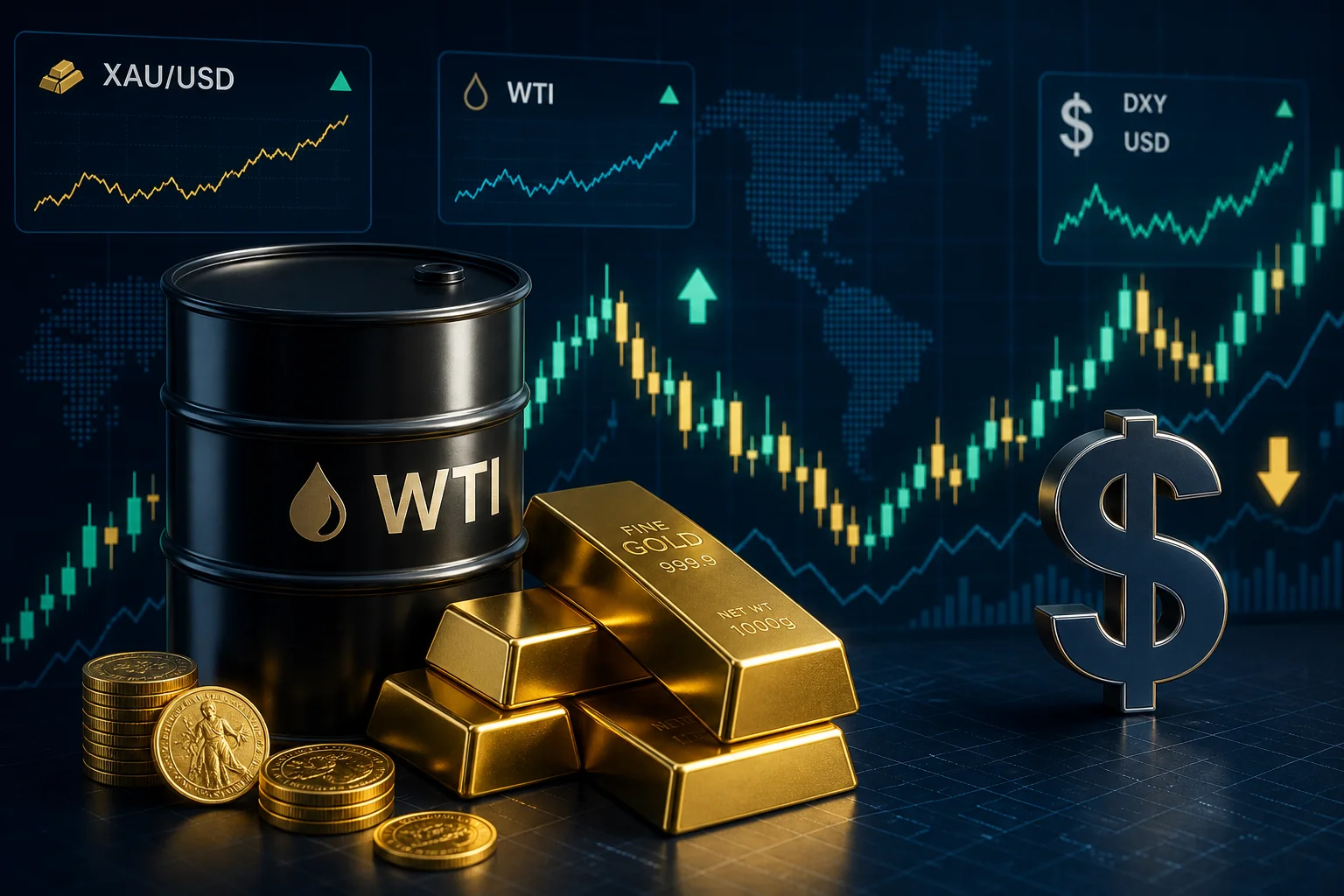
- The right broker for oil, gold and dollar trading publishes its legal entity, contract specifications, swaps and rollover rules clearly, not just the biggest bonus or leverage
- At about $4,125 gold (29 September 2026), 1 lot of XAU/USD is roughly $412,500 of exposure and moves $100 per $1, so micro lots matter
- Oil CFD contract sizes differ by broker, and Brent near $106–107 on 28 September 2026 amid the US–Iran and Hormuz standoff shows how quickly energy risk can reprice
- Retail caps under CySEC, FCA and ASIC entities are generally 1:30 on major FX, 1:20 on gold and 1:10 on oil, while offshore entities offer more leverage and less protection
- A demo test should include XAU/USD, a crude-oil CFD and one major USD pair for three to five days, including one news release
 Regulated Global Broker
Trusted by 20M+ traders — open your account in minutes
- Trade 1,400+ instruments
- Country-based bonus offers where eligible
- MT4 & MT5 available
- Easy deposits and withdrawals
- Leverage up to 1000:1, where available
- Copy Trading: auto-copy expert strategy managers

Open a free Exness demo
- Practice with virtual funds before you deposit
- Spreads from 0.0 by account type
- MT4, MT5 and the Exness app
- 800K+ active clients
- Automated withdrawals; arrival time still varies
- Confirm the legal entity before you fund
- Withdrawals are requested in the client area; arrival time varies
- Fund a live account only after the demo is clear
- Quick Decision Framework
- Short Answer
- Detailed Explanation
- Example
- Common Mistake
- Professional Tip
- Why Oil, Gold and Dollar Traders Need a Different Checklist
- 1. Regulation and the Legal Entity
- Short Answer
- Detailed Explanation
- Example
- Common Mistake
- Professional Tip
- 2. Leverage Caps and Margin
- Short Answer
- Detailed Explanation
- Example
- Common Mistake
- Professional Tip
- 3. Gold Trading Conditions
- 4. Oil Trading Conditions
- Short Answer
- Detailed Explanation
- Example
- Common Mistake
- Professional Tip
- 5. US Dollar Pair Conditions
- 6. Platform: MT4, MT5, Mobile and Web
- 7. Swap, Islamic Accounts and Overnight Costs
- 8. Deposit, Withdrawal and Local Access
- 9. A Simple Broker Test Before Depositing
- Broker Red Flags
- Final Checklist
- Glossary
- Final Thoughts
Affiliate disclosure: ForexTradeLab may earn a commission from qualifying partner links, without increasing your cost. This checklist does not rank brokers, and broker facts should be checked in our licensed-broker directory. Read our affiliate disclosure.
Market snapshot — 28–29 September 2026: spot gold traded near $4,125/oz on 29 September after an intraday low of $4,111 on 28 September, as Treasury yields jumped after the Fed's 16 September hike to 3.75%–4.00%. Brent crude traded near $106–107 on 28 September amid the US–Iran conflict and Strait of Hormuz standoff. Higher oil has fed inflation fears and Fed-hike bets, acting as a headwind for gold. Verify live prices before trading. Sources: Reuters, Federal Reserve.
Quick Decision Framework#
Short Answer
The right broker for oil, gold and dollar pairs publishes the legal entity that will hold your funds, plus contract details, swaps, rollover rules and micro-lot sizing for each instrument. The lowest advertised spread is only one part of cost, because EUR/USD, XAU/USD and crude oil behave very differently on the same platform.
Detailed Explanation
Gold (XAU/USD) needs checks on contract size, minimum lot, margin and spread behaviour around CPI, NFP and FOMC. Oil needs WTI versus Brent, contract size, expiry or rollover, weekend holding rules and spreads during EIA inventory releases. Regulation gives a framework for onboarding, complaints and client money; it does not guarantee profit. Micro lots matter because gold and oil can move far more in a session than a major currency pair.
Example
A beginner with $2,000 runs a five-day demo on XAU/USD, a Brent CFD and EUR/USD. At 0.01 lot, a $10 gold stop risks $10. On a Brent CFD where 1 lot is 1,000 barrels (sizes vary by broker), 0.01 lot is 10 barrels, so a $2 stop risks $20. Seeing both numbers side by side prevents the classic mistake of using one lot size everywhere.
Common Mistake
Choosing the broker with the biggest bonus or highest leverage, then discovering the oil contract expires, the gold lot is too large for the account, or weekend holding is restricted.
Professional Tip
Write down the legal entity, XAU/USD and oil contract specifications, swap table and withdrawal route before you deposit. If any of these is missing, treat the comparison as incomplete.
Why Oil, Gold and Dollar Traders Need a Different Checklist#
EUR/USD, XAU/USD and crude oil may sit on the same platform, but they do not trade the same way.
| Instrument | Main broker issue | Beginner risk |
|---|---|---|
| EUR/USD | Spread and execution quality | Overtrading because cost looks small |
| XAU/USD | Volatility, spread and 100-oz contract size | Stop too tight or lot size too large |
| Crude oil (Brent/WTI) | Contract size, rollover, margin and news gaps | Holding through EIA data or weekend geopolitics |
| USD/JPY | Slippage around yield and policy news | Underestimating fast moves |
That is why "low spread forex broker" is only one part of the decision. You need to check the full trading environment.
1. Regulation and the Legal Entity#
Short Answer
Start with the legal entity, not the brand. The company named in your client agreement decides your regulator, leverage cap, negative-balance rules and any compensation scheme.
Detailed Explanation
Most large brokers run several companies: a tier-1 entity (for example FCA, ASIC or CySEC) and one or more offshore entities. Our licensed-broker directory, re-verified on 29 September 2026, lists each broker's entities and licence numbers. Recent changes matter: IC Markets now trades as IC (ic.com); FXTM's UK entity stopped trading on 7 April 2026; and FOREX.com's UK business is run by StoneX Financial Ltd (FCA 446717).
Check:
- Which legal entity will open your account
- Which regulator supervises that entity, and the licence number
- Whether negative-balance protection applies
- Whether client-money segregation and any compensation scheme are explained
- Whether risk disclosures are clear and easy to find
Example
Two traders open accounts with the same brand. One, in the EU, is onboarded by the CySEC entity with retail leverage capped at 1:20 on gold and possible ICF compensation up to €20,000. The other is onboarded offshore with 1:500 leverage and no comparable compensation. Same logo, very different protection.
Common Mistake
Assuming the best licence on a broker's website footer applies to your account.
Professional Tip
Search the licence number on the regulator's own register and compare the company name letter-for-letter with your agreement. If a broker hides its entity, pushes only bonuses or promises profit, leave.
2. Leverage Caps and Margin#
Short Answer
Retail leverage caps differ by instrument. Under ESMA-style rules used by CySEC entities, and comparable FCA and ASIC rules, retail clients are generally limited to 1:30 on major FX, 1:20 on gold and 1:10 on oil and other commodities.
Detailed Explanation
Offshore entities often advertise 1:500 to 1:1000 or more. That lowers the margin you post but not your profit or loss per move. At about $4,125, one gold lot (100 oz) is about $412,500 of exposure, so margin is about $20,600 at 1:20, $4,125 at 1:100 and $825 at 1:500. Each $1 move is still $100.
Example
A Brent CFD at an illustrative $106.50 with a 1,000-barrel lot is $106,500 of exposure. At 1:10, margin is $10,650; at 1:100, $1,065. A $3 move is $3,000 either way. Always confirm the oil contract size in your broker's specification.
Common Mistake
Using high leverage to open more positions than the account can survive in a volatile week such as 28 September 2026, when gold fell about 4% intraday.
Professional Tip
Size from the stop, not from available margin: risk amount ÷ (stop distance × value per unit) = position size. See the gold lot size guide.
3. Gold Trading Conditions#
Gold is usually listed as XAU/USD. Before choosing a broker for gold, compare:
| Gold feature | What to check |
|---|---|
| Spread | Live spread during London and New York, not only the "from" spread |
| Contract size | Usually 100 oz per lot; at $4,125, $1 = $100 per lot |
| Minimum lot | Whether 0.01 lot (1 oz, $1 per $1 move) is available |
| Margin | Required margin and leverage cap for your entity |
| Swap | Long and short overnight charges, and the triple-swap day |
| Execution | How much spreads widen during CPI (next 14 October 2026), NFP (next 2 October 2026) and FOMC (27–28 October 2026) |
Gold sizing tip: test XAU/USD on demo with micro lots first. On 28 September 2026 gold dropped roughly $170 per ounce intraday — about $170 on a 0.01-lot position and $17,000 on a full lot.
For broker comparisons focused on gold, see best brokers for gold trading and the pillar gold XAU/USD trading complete guide.
4. Oil Trading Conditions#
Short Answer
Oil CFDs differ more between brokers than gold does. Check the benchmark (WTI or Brent), contract size, expiry or rollover, margin, weekend policy and spreads around EIA inventory data and OPEC+ headlines.
Detailed Explanation
Some brokers offer spot-style oil CFDs that roll automatically; others list dated contracts that expire. Contract size can be 100 or 1,000 barrels per lot, or something else, so the dollar value of a $1 move varies. In 2026 oil has been driven by the US–Iran conflict (since late February) and the Strait of Hormuz standoff, which pushed Brent near $106–107 on 28 September. Geopolitical headlines can gap oil over a weekend.
Check:
- Is the instrument WTI, Brent or another oil CFD?
- What is the contract size per lot?
- Does the contract expire, and is rollover automatic or manual?
- What is the spread during normal hours and during the weekly EIA report?
- What margin is required, and can you hold over the weekend?
- Are there daily trading breaks?
Example
Your broker lists "UKOIL" with 100 barrels per lot and a monthly rollover that adjusts your position price. Holding 0.10 lot (10 barrels) through rollover means a $1 move is worth $10, and the rollover adjustment may appear as a price change or a cash adjustment. Read how it is booked before you hold.
Common Mistake
Assuming oil has the same contract size as gold or that a "spot" oil CFD never rolls.
Professional Tip
Watch the EIA weekly petroleum report and OPEC+ calendar. Our oil inventory and OPEC watchlist and crude oil trading guide explain the drivers.
5. US Dollar Pair Conditions#
Most traders access the dollar through pairs such as EUR/USD, GBP/USD, USD/JPY, USD/CHF, USD/CAD, AUD/USD and NZD/USD. The checklist is simpler:
- Tight spreads on major pairs during liquid sessions
- Fast, stable execution around high-impact news
- Clear stop-loss and take-profit handling
- No hidden commission surprises
In late September 2026 the dollar story is about the Fed's hawkish turn, US 10-year yields near 5.2% and DXY near 101 (approximate, 28–29 September). If you are new, study one major pair first; trading six dollar pairs at once creates hidden correlation risk. See the US dollar DXY trading guide and gold and dollar correlation.
6. Platform: MT4, MT5, Mobile and Web#
| Platform question | Why it matters |
|---|---|
| Does the broker support MT4 or MT5? | Many traders already know these platforms |
| Are gold and oil on the same account type? | Some instruments are limited by account or entity |
| Is the mobile app stable during news? | Many beginners manage trades by phone |
| Are contract specifications visible? | You need lot size, margin and swap details |
| Can you set stops and targets quickly? | Risk control should be simple |
MT5 is often stronger for multi-asset trading, while MT4 remains familiar. The best choice is the one you can operate calmly under pressure.
7. Swap, Islamic Accounts and Overnight Costs#
Check the long and short swap on gold, oil overnight financing, the triple-swap day, whether swap-free Islamic accounts are available and whether swap-free status carries restrictions or admin fees. With the Fed funds target at 3.75%–4.00% after the 16 September hike, long-position financing on USD-quoted CFDs is not trivial for swing traders.
8. Deposit, Withdrawal and Local Access#
Before opening an account, check the minimum deposit, card, bank and e-wallet options, local payment methods, withdrawal processing times, whether withdrawals must return to the deposit method, and KYC document requirements. Broker research should cover the full journey: registration, verification, deposit, trading and withdrawal.
9. A Simple Broker Test Before Depositing#
Run this demo test for three to five trading days:
- Add XAU/USD, WTI or Brent, EUR/USD and USD/JPY to the platform.
- Watch spreads during London, New York and one news event (for example NFP on 2 October 2026 or a Wednesday EIA report).
- Open micro demo trades with a stop loss and take profit.
- Compare how margin changes across instruments.
- Hold one small demo trade overnight and read the swap.
- Close trades from desktop and mobile.
- Write down any cost or contract rule you do not understand.
If you cannot understand the cost structure in demo, do not rush into live trading.
Broker Red Flags#
- Promises of fixed profits
- Hidden legal entity details
- Pressure to deposit before risk is explained
- Unclear withdrawal rules
- Huge leverage advertised without risk education
- Missing contract specifications
- Gold or oil offered with hidden spreads and swaps
Final Checklist#
- I know which regulated entity will hold my account and its licence number
- I have checked that entity on the official register or the licensed-broker directory
- I know the leverage cap for gold and oil under that entity
- I can trade micro lots or small contract sizes on all three instruments
- I know the oil contract size, expiry and rollover method
- I have checked gold and oil spreads during active sessions and one news release
- I understand swaps, the triple-swap day and any swap-free conditions
- I have tested the platform on demo, including mobile
- I know how deposits and withdrawals work in my country
- I can state my maximum risk per trade before entering
Glossary#
- Legal entity: the specific company that contracts with you; it decides regulator and protection.
- XAU/USD: gold priced in US dollars per troy ounce; usually 100 oz per lot.
- Brent / WTI: the two main crude-oil benchmarks; brokers may offer either or both as CFDs.
- Rollover (oil): moving a position from an expiring futures-based contract to the next one.
- Swap: overnight financing charge or credit.
- Leverage cap: the maximum leverage a regulator allows retail clients per instrument class.
- Negative-balance protection: a rule that prevents a retail account from losing more than its balance.
Final Thoughts#
If the answers to the checklist are yes, you are in a much stronger position to choose a broker thoughtfully. If not, keep comparing and practising before you deposit. For the market context behind these instruments, read our forex oil, gold and dollar trading guide.
Risk warning: Forex, gold and oil CFDs are leveraged and can cause rapid losses, including more than a single stop distance when prices gap. Oil can gap on weekend geopolitical news, and gold moves $100 per lot for every $1. Choosing a regulated broker reduces operational risk but does not remove market risk. Educational content only; not financial advice.
Comments
Add a useful note for other traders. We review comments before publishing.