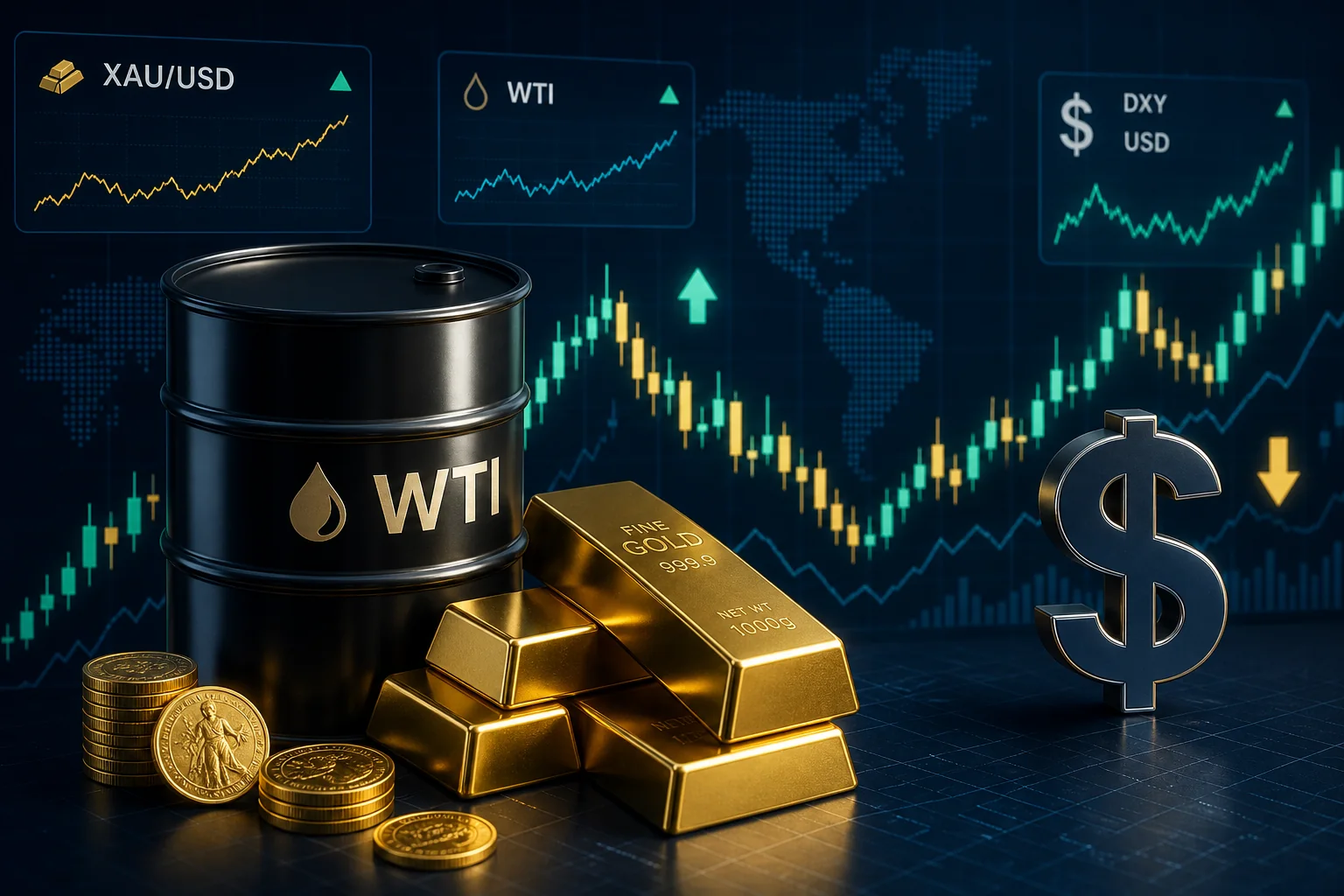
- Oil, gold and the US dollar often move through the same macro story: inflation, rates, risk sentiment and global growth
- Gold usually reacts strongly to US yields, the dollar index and geopolitical risk
- Oil reacts more to supply shocks, OPEC decisions, inventory data and demand expectations
- Before opening a broker account, compare spreads, swaps, lot sizes and platform execution for each instrument

Quick Decision Framework#
Short Answer
Oil, gold and the dollar should be watched as one macro tape, not three isolated charts. They often share US inflation, Fed policy, risk sentiment, global growth and geopolitical shocks. Gold leans on real yields, DXY and safe-haven demand; oil leans on supply, OPEC, inventories and growth.
Detailed Explanation
A stronger dollar can weigh on dollar-priced gold and oil even when the commodity story is unchanged. CAD is oil-sensitive; AUD is growth- and China-sensitive; USD is the funding and reserve currency in the triangle. Before you open a broker account to trade all three, compare that entity’s spreads, swaps, lot steps and session hours on each symbol — 0.01 gold is not 0.01 EUR/USD. Use the watchlist for context and instrument choice, not as a stacked three-way bet on one CPI print.
Example
CPI prints hot: the dollar jumps, gold dips, and oil wobbles with growth fears. A beginner who is long XAU/USD 0.05, long USOIL 0.10 and short EUR/USD 0.10 has three tickets and one inflation theme. Another beginner watches DXY, gold and WTI on the same morning, then takes only one ticket sized at 1%.
Common Mistake
Opening oil, gold and a dollar pair together because “they confirm each other,” which usually triples the same macro risk.
Professional Tip
Before the session, write one driver (inflation, OPEC, or risk-off) and allow only one live symbol from this trio. Check that symbol’s contract size and spread in the spec so 0.01 still fits 1% risk.
Quick Framework: Why Watch Them Together?#
Short Answer
Oil, gold and the dollar should not be watched as separate markets. They often share the same drivers: US inflation, Federal Reserve policy, risk sentiment, global growth and geopolitical shocks.
Common Mistake
Gold usually reacts strongly to US yields, the dollar index and geopolitical risk
Professional Tip
Oil reacts more to supply shocks, OPEC decisions, inventory data and demand expectations
Oil, gold and the dollar often respond to the same questions:
| Market question | Usually affects |
|---|---|
| Is US inflation rising or falling? | USD, gold, bond yields |
| Will the Fed cut or raise rates? | USD pairs, gold, stocks |
| Is global growth strong or weak? | Oil demand, commodity currencies |
| Is there geopolitical risk? | Oil supply, gold safe-haven demand |
| Is the dollar strengthening? | Gold, oil, EUR/USD, GBP/USD |
The mistake is looking at only one chart. A trader may buy gold because it broke resistance, but ignore that the dollar is also breaking higher after hot inflation data. Another trader may sell oil on a technical level, but ignore an OPEC supply headline.
The better habit is to build a small watchlist.
The Beginner Watchlist#
Use this as a simple daily screen:
| Instrument | What it tells you | Why it matters |
|---|---|---|
| XAU/USD | Gold priced in dollars | Safe haven, inflation and real-yield pressure |
| WTI or Brent crude | Oil benchmark | Energy demand, OPEC supply and geopolitical risk |
| DXY or USD pairs | Broad dollar strength | Helps explain pressure on commodities |
| EUR/USD | Most liquid USD pair | Shows dollar demand against a major currency |
| USD/JPY | Dollar plus yield sensitivity | Often reacts to US yields and risk sentiment |
| Economic calendar | Scheduled volatility | CPI, NFP, FOMC, inventories and central banks |
You do not need to trade every instrument. In fact, beginners usually do better by tracking several markets but trading only one or two at first.
How the Dollar Affects Oil and Gold#
Oil and gold are globally priced in US dollars. When the dollar rises, buyers using other currencies need more local currency to buy the same barrel of oil or ounce of gold. That can reduce demand and pressure commodity prices.
When the dollar falls, commodities can receive support because they become cheaper for non-dollar buyers.
This is not a perfect rule. Gold can rise with the dollar during extreme fear if both are treated as safe havens. Oil can rise with the dollar if a supply shock is strong enough. Correlations are useful, but they are not laws.
Practical habit: Before trading XAU/USD or oil, check whether the dollar is trending, ranging or reacting to news. If your trade idea fights a strong dollar move, reduce size or wait for confirmation.
Trading Gold: What Beginners Should Know#
Gold is popular because it moves cleanly during big macro stories. It reacts to:
- US inflation data
- Federal Reserve rate expectations
- Real yields and Treasury yields
- Dollar strength or weakness
- War, banking stress and geopolitical fear
- Central bank gold buying
The main risk is volatility. Gold can move far more in one session than a major forex pair. A stop loss that looks "wide" on EUR/USD may be too tight for XAU/USD.
Before trading gold on a broker platform, check:
- The typical XAU/USD spread during London and New York hours
- The minimum lot size, especially whether 0.01 lots are available
- Swap charges for overnight positions
- Whether gold execution changes around high-impact news
- Whether the platform shows contract size clearly
Trading Oil: What Beginners Should Know#
Oil is a commodity with a different personality from gold. It reacts heavily to supply and demand:
- OPEC and OPEC+ production decisions
- EIA crude inventory data
- Middle East and Russia-related supply risk
- Global growth expectations
- US shale production
- Seasonal demand, refinery maintenance and shipping routes
Oil can gap when markets reopen after weekend geopolitical news. It can also reverse sharply after inventory data if the market expected a different number.
Before trading crude oil CFDs, check:
- Whether the broker offers WTI, Brent or both
- Contract expiry or rollover rules
- Spread during inventory releases
- Margin requirement for oil
- Overnight financing and weekend risk
Trading the Dollar: What Beginners Should Know#
The dollar can be traded through major USD pairs such as EUR/USD, GBP/USD, USD/JPY and USD/CAD. Some platforms also show DXY or dollar index CFDs.
Dollar trading is mostly about expectations:
- Will the Fed keep rates high?
- Is inflation falling fast enough?
- Is the US economy stronger than Europe, Japan or the UK?
- Are investors moving into safe assets?
- Are yields rising or falling?
For beginners, EUR/USD is often easier to study than exotic pairs because spreads are usually tighter and liquidity is deep. USD/JPY is useful for learning the link between the dollar and yields, but it can move aggressively when Japanese policy headlines appear.
A Simple 15-Minute Daily Routine#
Before opening any trade, run this routine:
- Check today's high-impact calendar events.
- Look at DXY or a major USD pair to understand dollar direction.
- Check gold and oil on the 4-hour chart for trend or range.
- Mark the nearest support, resistance and news risk.
- Compare spread now versus normal spread.
- Decide your stop loss first, then calculate lot size.
- Skip the trade if the stop is too large for your account.
The goal is not to predict everything. The goal is to avoid entering blind.
Broker Checklist for Oil, Gold and Dollar Traders#
If you are choosing a forex broker because you want to trade oil, gold and USD pairs, compare more than the headline bonus or leverage.
Check these details:
| Broker feature | Why it matters |
|---|---|
| Regulation | Reduces operational and withdrawal risk |
| Minimum deposit | Helps you start with capital you can afford to risk |
| Micro lot support | Lets beginners reduce exposure |
| Gold and oil spreads | Commodities can be expensive if spreads are wide |
| Swap-free option | Important for traders avoiding overnight interest |
| Platform quality | MT4, MT5 and mobile execution matter during fast news |
| Deposit and withdrawal methods | A good trade plan still needs reliable account funding |
Beginner rule: Open a demo account first and test the exact instruments you plan to trade. Do not assume gold, oil and EUR/USD have the same spread, margin or volatility.
Common Mistakes#
New traders usually get hurt by simple mistakes:
- Trading oil and gold with the same lot size as EUR/USD
- Ignoring spreads around news
- Holding oil through rollover without understanding the contract
- Treating dollar correlation as guaranteed
- Opening several correlated trades at once, such as long gold and short USD pairs
- Choosing a broker only because of a bonus
The broker matters, but the plan matters more. A good broker cannot fix oversized trades, missing stop losses or emotional entries.
Final Thoughts#
Oil, gold and the US dollar are three of the most useful markets for learning macro trading. They teach you how inflation, interest rates, supply shocks and fear move prices.
If your goal is to open a forex broker account, use these instruments as a checklist. Can you trade micro lots? Are spreads transparent? Are swaps clear? Is the platform stable during news? Can you practice in demo first?
Answer those questions before you deposit, and you will make a more informed broker decision.
Comments
Add a useful note for other traders. We review comments before publishing.