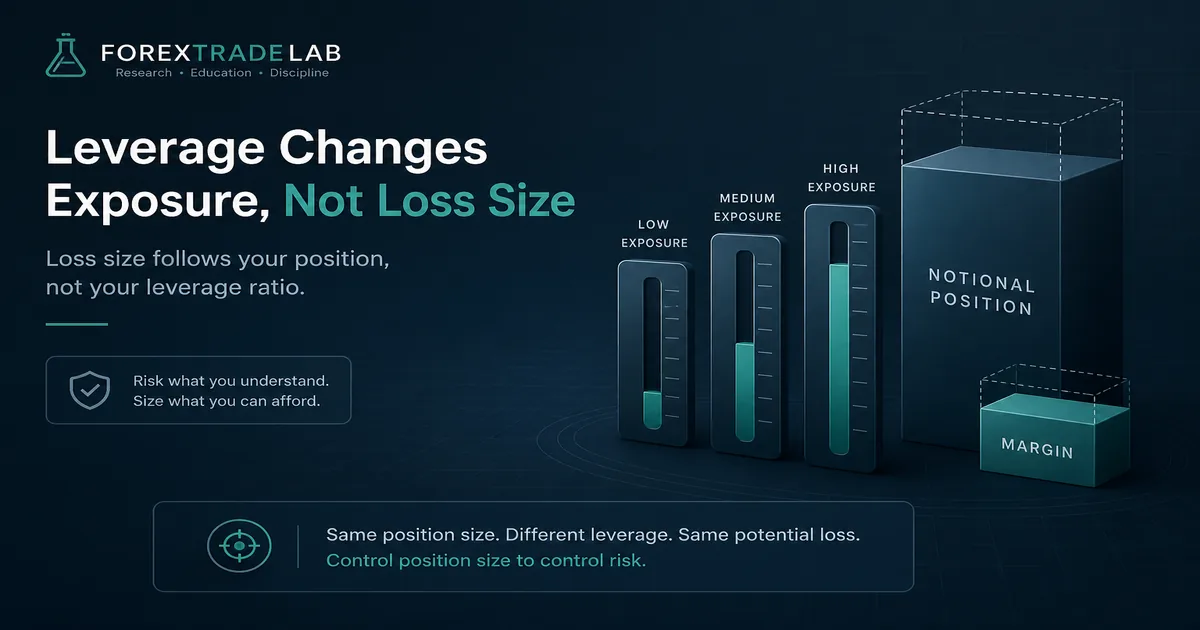
- For a fixed lot size and fixed stop distance, cash loss at the stop is the same at 1:100, 1:500 or higher leverage — only required margin changes
- High leverage becomes lethal when it enables a larger notional than your equity can survive
- Use the Leverage Loss Reality Table (LLRT) to separate margin used from cash loss at stop before you increase size
- ESMA-style retail caps (often 1:30 on major FX) limit how much notional you can post with the same cash; offshore marketing of 1:500 or unlimited does not remove market risk
- Size by risk percentage and stop distance, not by free margin shown on the platform

- Practical Answer Framework
- Short Answer
- Detailed Explanation
- Example
- Common Mistake
- Professional Tip
- Direct Answer: Loss Tracks Lot Size, Not the Leverage Sticker
- The Leverage Loss Reality Table (LLRT)
- LLRT Block A — Fixed lot (0.10), fixed 50-pip stop
- LLRT Block B — Same equity, lot sized to “use” similar margin comfort
- Why Unlimited-Style Marketing Does Not Rewrite P/L
- Entity Caps: ESMA-Style Retail vs Offshore Headlines
- Three Worked Scenarios (Clearly Hypothetical)
- Scenario 1 — Conservative fixed lot
- Scenario 2 — Same stop, leverage-enabled oversize
- Scenario 3 — Margin call path vs planned stop
- Practical Checklist: Use LLRT Before You Size Up
- Related Decision Guides (Priority Cluster)
- Key Takeaways
- Glossary
- Sources and Ethical Next Step
Affiliate & risk disclosure: ForexTradeLab may earn a commission from qualifying broker links. This does not change the price paid or replace independent checks. See the affiliate disclosure and risk disclaimer.
Practical Answer Framework#
Short Answer
With the same lot size and the same stop distance, your cash loss at the stop is essentially the same whether leverage is 1:100, 1:500 or marketed as unlimited — leverage mainly changes how much margin is locked. The real wipe-out risk appears when higher leverage lets you open an oversized lot that your account cannot survive if stopped. Always separate margin used from cash loss at stop using the Leverage Loss Reality Table (LLRT), and verify live entity leverage caps before trading.
Detailed Explanation
Educational 2026 guide to cash loss at a fixed stop under 1:100, 1:500 and unlimited-style leverage using the Leverage Loss Reality Table (LLRT): margin changes with leverage, but fixed-lot P/L does not — oversized lots do the damage.
Example
Hypothetical only — EUR/USD at 1.1000, 0.10 lot, 50-pip stop. Pip value ≈ $1 per pip on 0.10 lot, so stop loss ≈ $50 whether leverage is 1:100 or 1:500. Required margin falls from roughly $110 to roughly $22. The $50 cash risk did not change; only collateral did.
Common Mistake
Common Mistake: Reading free margin as permission to size up until the platform allows the order.
Professional Tip
Read Block A correctly: leverage did not change the cash loss.
Direct Answer: Loss Tracks Lot Size, Not the Leverage Sticker#
Short Answer: With the same lot size and the same stop distance, cash loss at the stop is effectively identical at 1:100, 1:500, or higher leverage. Leverage mainly changes required margin. Accounts are destroyed when high leverage enables an oversized lot that equity cannot survive.
Detailed Explanation: Retail platforms display leverage as a selling point. Traders then ask, “How much can I lose at 1:500?” as if the ratio itself writes the P/L. It does not. For a standard FX CFD, cash loss ≈ pip move × pip value × lots. Margin ≈ notional ÷ leverage. Raise leverage, and margin falls; the stop-loss cash amount for a fixed lot stays the same. Raise the lot because margin “looks free,” and cash loss scales with the lot — that is the blow-up path. For definitions, start with what leverage is and what margin is.
Example: Hypothetical only — EUR/USD at 1.1000, 0.10 lot, 50-pip stop. Pip value ≈ $1 per pip on 0.10 lot, so stop loss ≈ $50 whether leverage is 1:100 or 1:500. Required margin falls from roughly $110 to roughly $22. The $50 cash risk did not change; only collateral did.
Common Mistake: Reading free margin as permission to size up until the platform allows the order.
Professional Tip: Before every size increase, run the Leverage Loss Reality Table (LLRT) below: one row for fixed lot, one row for the lot your free margin would actually allow.
The Leverage Loss Reality Table (LLRT)#
Short Answer: LLRT is ForexTradeLab’s named comparison that forces three columns into one view: margin used, cash loss at stop, and % of equity at risk — for the same stop distance across leverage settings.
Detailed Explanation: Build LLRT with fixed assumptions first, then a second block where only lot size changes. Assumptions for the educational table below:
| Control | Educational assumption |
|---|---|
| Account equity | $1,000 (hypothetical) |
| Instrument | EUR/USD CFD |
| Spot used for margin math | 1.1000 |
| Contract size | 100,000 per 1.00 lot |
| Stop distance | 50 pips |
| Pip value | ≈ $10 per pip per 1.00 lot (USD account, USD quote convention) |
| Leverage settings compared | 1:100, 1:500, and an “unlimited-style” margin case treated as very high leverage for illustration only |
Margin formula used: Required margin ≈ (lots × 100,000 × price) / leverage for a USD-quoted major when account currency is USD (broker rounding and contract specs can differ).
Cash loss at stop: ≈ stop pips × ($10 × lots) for this EUR/USD educational case.
LLRT Block A — Fixed lot (0.10), fixed 50-pip stop#
| Leverage setting | Lots | Approx. margin used | Cash loss at 50-pip stop | % of $1,000 equity |
|---|---|---|---|---|
| 1:100 | 0.10 | ≈ $110 | ≈ $50 | 5.0% |
| 1:500 | 0.10 | ≈ $22 | ≈ $50 | 5.0% |
| Unlimited-style (illustrative very high leverage) | 0.10 | Near-minimal collateral (broker-dependent) | ≈ $50 | 5.0% |
Read Block A correctly: leverage did not change the cash loss. It only changed how much cash was locked as margin.
LLRT Block B — Same equity, lot sized to “use” similar margin comfort#
| Leverage setting | Lots opened (hypothetical) | Approx. margin used | Cash loss at 50-pip stop | % of $1,000 equity |
|---|---|---|---|---|
| 1:100 | 0.10 | ≈ $110 | ≈ $50 | 5.0% |
| 1:500 | 0.50 | ≈ $110 | ≈ $250 | 25.0% |
| Unlimited-style (illustrative) | 1.00+ | Can look “affordable” on screen | ≈ $500+ | 50%+ |
Read Block B correctly: the ratio did not invent a new P/L formula — it enabled a larger notional. That is how “1:500 destroyed my account” stories usually happen.
Example: A trader keeps a 50-pip stop but jumps from 0.10 to 0.50 lot because 1:500 made margin look identical. One stop is now five times the cash damage of Block A.
Common Mistake: Comparing leverage ratios while secretly changing lot size, then blaming “the leverage number.”
Professional Tip: Print Block A and Block B side by side in your journal. If Block B appears in your live history, you are sizing from margin, not from risk. Pair this with the risk-of-ruin formula guide.
Why Unlimited-Style Marketing Does Not Rewrite P/L#
Short Answer: “Unlimited” leverage (where offered) is a margin convenience label, usually conditional by entity, equity, instrument and market conditions — not a promise of unlimited profit or a special loss formula.
Detailed Explanation: Some offshore entities market very high or “1:Unlimited” leverage on eligible setups. That does not mean every reader qualifies, that eligibility is permanent, or that news/weekend rules cannot tighten margin. Exness is widely associated with conditional unlimited marketing on some offerings; live eligibility must be read in the Personal Area and contract terms — this article does not invent current Exness unlimited eligibility for any country or equity tier. See the careful overview in our Exness leverage guide. XM also publishes high maximum ratios on some international entities while EU-style entities remain capped; confirm in the XM leverage and margin guide.
Example: Hypothetical — two traders both see “high leverage available” in marketing. Trader A keeps 0.02 lot on a $500 account. Trader B opens 1.00 lot because margin is tiny. Same stop distance: Trader B’s cash loss is roughly 50× Trader A’s. The marketing word did not create that gap; lot size did.
Common Mistake: Treating “unlimited” as “I cannot be stopped out” or “negative balance is impossible without reading the entity’s protection rules.”
Professional Tip: Ask one operational question: If my stop is hit exactly as planned, what % of equity dies? If you cannot answer without opening the calculator, do not increase leverage.
Entity Caps: ESMA-Style Retail vs Offshore Headlines#
Short Answer: Regulator product interventions (for example ESMA-style retail CFD leverage caps, often 1:30 on major FX pairs in EU/UK retail regimes) limit how much notional the same cash can control. Offshore marketing of 1:500 or unlimited-style ratios raises the ceiling — it does not remove adverse-move risk.
Detailed Explanation: ESMA’s 2018 product intervention on CFDs constrained retail leverage by asset class; national authorities such as the FCA continue to warn that most retail CFD clients lose money. Caps are consumer-protection tools against rapid notional oversizing, not a certificate that 1:30 trading is “safe.” Conversely, international entities may advertise 1:500, 1:1000 or conditional unlimited-style leverage. Your assigned legal entity, not the brand homepage, decides the cap you actually get. Always confirm country, KYC status and Members Area / Personal Area settings before assuming a ratio from a review article.
| Regime type (educational) | Typical retail major-FX ceiling discussed in public materials | What it changes | What it does not change |
|---|---|---|---|
| ESMA-style EU/UK retail | Often 1:30 on majors | How large a position the same cash can open | Pip math on a given lot; need for stops and risk % |
| Many international / offshore entities | 1:500, 1:1000, or conditional very high / unlimited-style marketing | Margin required for a given lot | Market risk, slippage, gap risk, stop-out mechanics |
| Dynamic / tiered leverage | Max ratio can fall as equity or exposure grows | Effective margin as you scale | The need to size from equity risk |
Example: Hypothetical $2,000 account. At 1:30, usable notional is tightly constrained versus 1:500, where the same cash can post a much larger position — useful only if lot size stays disciplined.
Common Mistake: Opening an offshore account “for unlimited leverage” as a strategy upgrade instead of a risk-parameter change.
Professional Tip: Compare entity + stop-out + negative-balance rules + costs, not max leverage alone. Context: why leverage destroys retail accounts.
Three Worked Scenarios (Clearly Hypothetical)#
Short Answer: Three labeled educational scenarios — not live XM/Exness quotes and not trade recommendations.
Scenario 1 — Conservative fixed lot#
Detailed Explanation: Equity $2,000. Leverage 1:100 or 1:500. Lot 0.05. Stop 40 pips. Cash loss ≈ $200 (≈ 10% — already aggressive for many plans). Margin falls at 1:500, but the $200 planned loss does not.
Example: Switching to 1:500 “to reduce risk” while keeping 0.05 lot only frees margin — risk % is unchanged.
Common Mistake: Calling a 10% stop “safe” because margin level still looks high.
Professional Tip: Target 0.5–1% cash risk; rebuild lot from stop distance. Use the lot calculator when available.
Scenario 2 — Same stop, leverage-enabled oversize#
Detailed Explanation: Equity $1,000. Stop 30 pips. At 1:100 with 0.10 lot → ≈ $30 risk (3%). At 1:500, free-margin comfort tempts 0.50 lot → ≈ $150 risk (15%). Five stops are often survivable in the first plan and terminal in the second — see risk of ruin.
Example: A news spike that slips 10 extra pips pushes the 0.50 lot loss from $150 toward $200.
Common Mistake: Assuming the stop fills at the exact charted price in thin liquidity.
Professional Tip: Stress-test LLRT with a +10–20% stop buffer before calling a size “1% risk.”
Scenario 3 — Margin call path vs planned stop#
Detailed Explanation: High notional with tight free margin can hit margin call / stop-out before the trade thesis plays out — especially with correlated positions. Exposure exceeded the equity buffer.
Example: Hypothetical — three correlated long USD pairs totaling 1.2 lots on an $800 account at very high leverage. A 40-pip adverse dollar move is a designed wipe-out, not bad luck.
Common Mistake: Measuring risk per chart while ignoring portfolio correlation.
Professional Tip: Collapse correlated exposure into one LLRT row. Process: forex risk management guide.
Practical Checklist: Use LLRT Before You Size Up#
Follow this plain-bullet checklist every time leverage or lot size changes:
- Write equity, instrument, planned stop distance and max % risk in one line.
- Compute cash loss at stop for the intended lot (Block A thinking).
- Compute margin at your actual entity leverage — confirm live, do not assume review figures.
- Ask whether free margin is tempting a larger lot (Block B thinking). If yes, reject the size.
- Add a slippage/gap buffer to the stop distance for LLRT stress.
- Cap daily loss so a cluster of stops cannot finish the week in one session.
- Re-check entity leverage after deposits, withdrawals or equity-tier changes.
- Demo the exact lot for 20+ rule-following trades before live scaling.
- Review companion capital and process guides: gold capital fit, first withdrawal test.
Related Decision Guides (Priority Cluster)#
These sibling decision articles strengthen the same pre-trade discipline stack:
- How much capital to trade gold (XAUUSD)
- Islamic account fee trap: what replaces swap
- First withdrawal test before you scale
- Can ChatGPT choose a forex broker? Use this checklist
Broker-specific leverage deep dives: XM leverage & margin, Exness leverage.
Key Takeaways#
- Cash loss at a fixed stop is driven by lot × pip value × stop distance, not by the leverage sticker.
- Leverage mainly changes margin used; high leverage enables oversized lots that destroy accounts.
- Use LLRT Block A vs Block B to catch margin-driven sizing.
- ESMA-style caps and offshore high/unlimited marketing change ceilings, not market physics.
- Verify live entity terms; do not invent Exness unlimited eligibility from marketing copy.
- Size from risk % and stop distance; keep ruin math in view.
Glossary#
- Leverage: Borrowed buying power expressed as a ratio (for example 1:100).
- Margin: Collateral locked to open and maintain a leveraged position.
- Notional: Full face value of the position (lots × contract size × price).
- Cash loss at stop: Approximate account-currency loss if the stop fills as planned.
- LLRT (Leverage Loss Reality Table): ForexTradeLab framework comparing margin used vs cash loss at stop across leverage settings.
- Stop-out: Broker-forced closure when margin level hits the stop-out threshold.
- Negative balance protection: Entity rule that may prevent balance below zero; confirm per legal entity — never assume.
- Risk of ruin: Probability that sizing rules end the account before an edge can recover.
Sources and Ethical Next Step#
Public regulatory context draws on ESMA CFD product intervention materials and FCA CFD consumer warnings; FX market structure context draws on BIS survey publications. Educational math uses rounded EUR/USD examples only.
If leveraged CFD trading is appropriate for you, complete LLRT Block A and Block B on paper first, then verify the leverage your assigned legal entity actually grants. Soft next steps for research only — not leverage recommendations: review current XM terms for your entity or review current Exness terms for your entity. Prefer survival sizing over maximum advertised leverage.
Risk warning: CFDs are complex instruments and come with a high risk of losing money rapidly due to leverage. A large share of retail investor accounts lose money when trading CFDs. You should consider whether you understand how CFDs work and whether you can afford to take the high risk of losing your money. Hypothetical figures below are educational, not live quotes, trade signals or broker promises.
Comments
Add a useful note for other traders. We review comments before publishing.