
- Forex has no single exchange bell; session labels are local clocks that jump when DST starts or ends
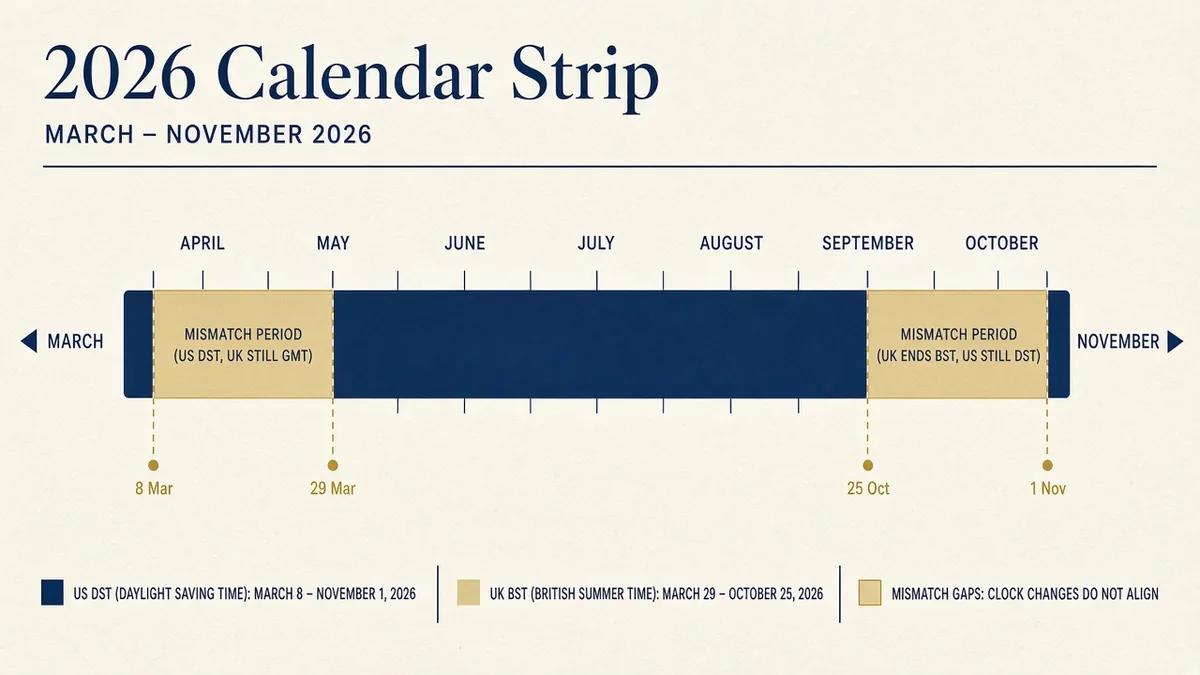
- In 2026 the US changed on 8 March and 1 November; the UK on 29 March and 25 October — those dates are not the same
- Mismatch weeks change the UTC overlap and the London wall-clock for US data
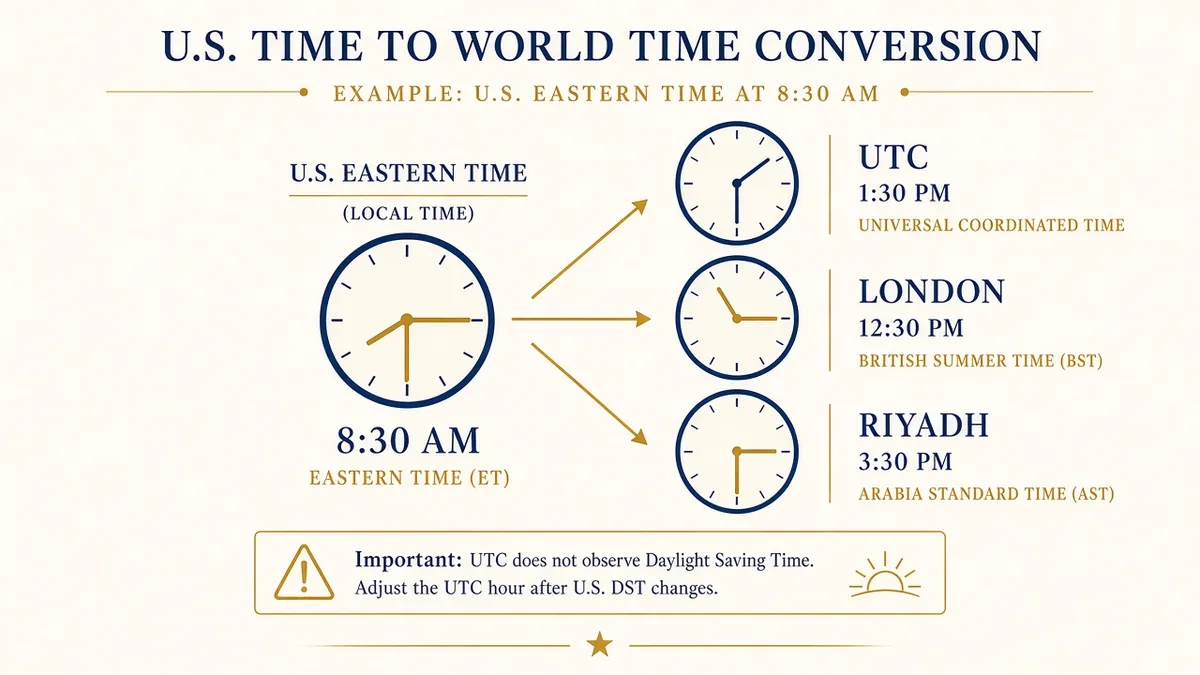
- NFP is 08:30 US Eastern; UTC is 13:30 in US winter and 12:30 in US summer — GCC clocks with no DST feel that shift as a one-hour jump
- The London 4pm WMR fix follows UK time, so it is 16:00 UTC in GMT weeks and 15:00 UTC in BST weeks
- Never reuse last season’s UTC screenshot; convert today, then check the broker server
 Regulated Global Broker
 Trusted by 20M+ traders — open your account in minutes
- Trade 1,400+ instruments
- Country-based bonus offers where eligible
- MT4 & MT5 available
- Easy deposits and withdrawals
- Leverage up to 1000:1, where available
- Copy Trading: auto-copy expert strategy managers
- Quick Decision Framework
- Short Answer
- Detailed Explanation
- Example
- Common Mistake
- Professional Tip
- Quick Answer
- 2026 Dates You Must Not Mix
- Short Answer
- Detailed Explanation
- Example
- Common Mistake
- Professional Tip
- Four Overlap Maps in UTC
- Short Answer
- Detailed Explanation
- Example
- Common Mistake
- Professional Tip
- News Times: NFP, CPI and the One-Hour Trap
- Short Answer
- Detailed Explanation
- Example
- Common Mistake
- Professional Tip
- The London 4pm Fix Also Moves in UTC
- Short Answer
- Detailed Explanation
- Example
- Common Mistake
- Professional Tip
- Broker Server Time, EAs and Sunday Open
- Short Answer
- Detailed Explanation
- Example
- Common Mistake
- Professional Tip
- GCC, Egypt and Other Home Clocks
- Short Answer
- Detailed Explanation
- Example
- Common Mistake
- Professional Tip
- Checklist
- Glossary
- Related Reading
- Suggested Future Articles
Affiliate & risk disclosure: ForexTradeLab may earn a commission from qualifying broker links. That does not change your price or replace entity checks. See the affiliate disclosure and risk disclaimer.
Educational only: Forex and CFDs are leveraged. Most retail accounts lose money. A clock conversion is not a strategy. Session bars below are teaching maps, not a promise of tighter spreads or profit.
Quick Decision Framework#
Short Answer
Daylight saving time remaps session names onto UTC. The market does not “open an hour later.” Your screenshot from last season becomes wrong.
Detailed Explanation
Spot FX is OTC. The BIS survey is about turnover, not a bell. Educators still use Sydney, Tokyo, London and New York as labels for where people are awake. Those labels are local civil clocks.
The United States and the United Kingdom do not change on the same Sunday. For a few weeks each spring and autumn, New York is on daylight time while London is still on GMT — or London has fallen back while New York has not. During those mismatch weeks, the UTC overlap you memorised is a different shape, and US data can print at a London wall-clock you did not expect.
Gulf traders add a third twist: Riyadh and Dubai do not spring forward. When the US moves, NFP’s Riyadh hour jumps even though the Kingdom’s clocks did not.
Example
You always fade “London open” at 07:00 UTC because a 2025 thread said so. After late March, 08:00 in London is 07:00 UTC. Your fade is now an hour into the London morning — a different liquidity regime than the open you thought you were trading. See London session and NY open.
Common Mistake
Saving one UTC table and treating it as annual law. Pair this page with broker server time so you do not “correct” a server that never moved.
Professional Tip
Keep three lines in the journal header: home, UK, US Eastern, plus UTC. If any line is blank, you are not ready for a news trade.
Quick Answer#
How does DST change forex hours? It changes translation, not the existence of the market.
- Find this week’s US and UK status.
- Convert session opens to UTC.
- Convert 08:30 Eastern for US data.
- Convert 16:00 UK if you track the London 4pm fix.
- Ask whether the broker server uses DST at all.
Related cluster: forex market hours, best time to trade, Asian session.
2026 Dates You Must Not Mix#
Short Answer
US and UK dates differ. In 2026 they already did, and they will again in October–November.
Detailed Explanation
Official calendars:
- United Kingdom (GOV.UK): clocks went forward 29 March 2026, go back 25 October 2026 (last Sunday in March and October).
- United States (NIST DST rules): second Sunday in March and first Sunday in November — 8 March 2026 and 1 November 2026 for most states. Arizona (most of the state) and Hawaii do not observe DST.
| Clock | Spring 2026 | Autumn 2026 |
|---|---|---|
| US (most states) | 8 March | 1 November |
| UK / EU pattern | 29 March | 25 October |
| Typical GCC (e.g. KSA, UAE) | No DST | No DST |
Mismatch windows in 2026
- 8–28 March: US on daylight time, UK still GMT.
- 25 October–1 November: UK back on GMT, US still on daylight time.
Those are the weeks when copied “NFP is always 13:30 London” notes fail.
Example
On 15 March 2026 a London trader who assumed “we have not changed yet so the US has not either” was already one hour off on every Eastern-timed release.
Common Mistake
Using a US app’s “markets open” widget as London time. It is Eastern unless you set it.
Professional Tip
Put 25 October 2026 and 1 November 2026 on the same calendar page as bank holidays. Thin books plus a clock error is a classic stop-slip week.
Four Overlap Maps in UTC#
Short Answer
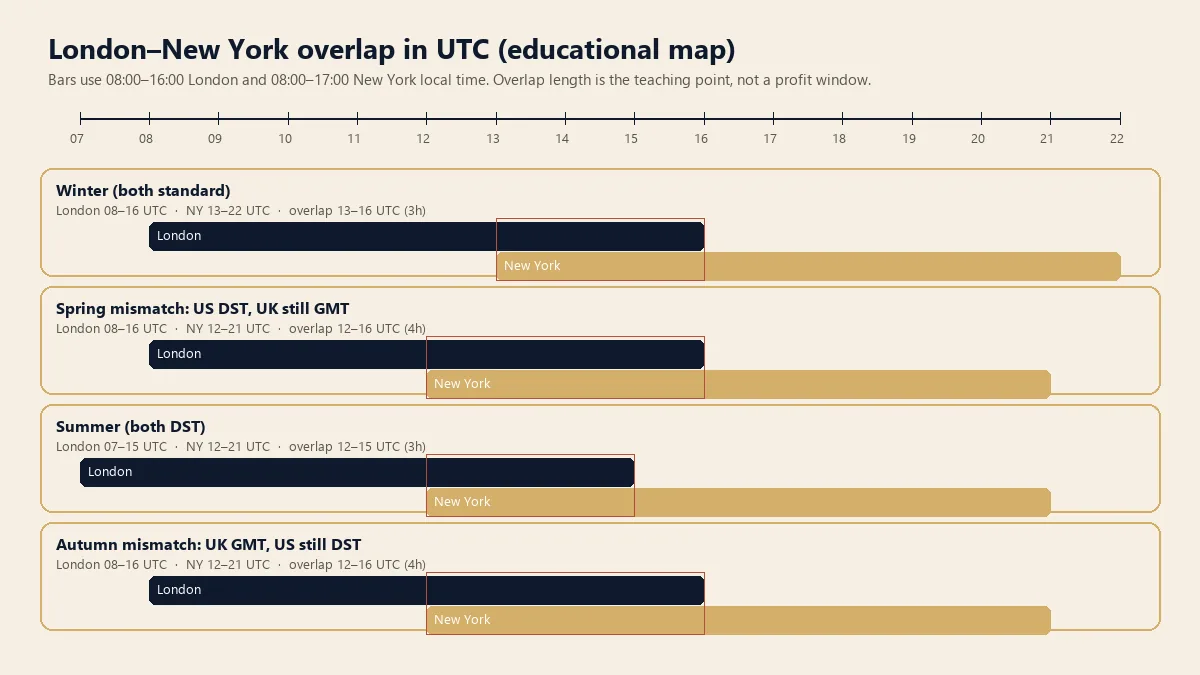
The popular 13:00–16:00 UTC overlap is a winter teaching map, not a law of nature.
Detailed Explanation
Assume, for teaching only, London 08:00–16:00 local and New York 08:00–17:00 local. Those are conventions, not BIS hours. Convert:
| Regime | London in UTC | New York in UTC | Overlap (UTC) |
|---|---|---|---|
| Winter, both standard | 08:00–16:00 | 13:00–22:00 | 13:00–16:00 (3h) |
| Spring mismatch (US DST, UK GMT) | 08:00–16:00 | 12:00–21:00 | 12:00–16:00 (4h) |
| Summer, both DST | 07:00–15:00 | 12:00–21:00 | 12:00–15:00 (3h) |
| Autumn mismatch (UK GMT, US DST) | 08:00–16:00 | 12:00–21:00 | 12:00–16:00 (4h) |
The lesson is shape, not a profit window. Overlap can be three or four hours on this map, and the start moves. Spreads can still widen inside any of those bars. Measure your book. See hours, liquidity and slippage.
Japan and China do not use DST. Tokyo’s UTC offset is stable. That is why Asian session guides still tell you to re-anchor when London and New York move around Asia.
Example
A system that buys EUR/USD only in “the last two hours of London” will, in BST, be trading 13:00–15:00 UTC, not 14:00–16:00 UTC. If the code used frozen UTC, the live behaviour changed in silence.
Common Mistake
Calling a four-hour overlap “better” and increasing lot size. Extra overlap is not extra edge. Size from risk.
Professional Tip
If an EA uses Hour()==13 on a UTC+3 server, DST in New York may not change that server at all. The bug is semantic: you thought 13 meant “NY open.” Test after each civil change.
News Times: NFP, CPI and the One-Hour Trap#
Short Answer
US releases stay on US Eastern. UTC and Gulf clocks move around that.
Detailed Explanation
Nonfarm payrolls, CPI and many US prints are 08:30 Eastern. Convert:
| US Eastern status | 08:30 ET in UTC | Typical London wall clock | Riyadh (UTC+3, no DST) |
|---|---|---|---|
| EST (winter) | 13:30 UTC | 13:30 GMT | 16:30 |
| EDT (summer) | 12:30 UTC | 13:30 BST (aligned) | 15:30 |
| Mismatch (EDT + UK GMT) | 12:30 UTC | 12:30 GMT | 15:30 |
The dangerous row is the mismatch: London muscle memory says 13:30, the print is 12:30. FOMC statements use 14:00 Eastern — same offset logic, different minutes.
Use the economic calendar and NFP guide as process pages. Do not trade the first tick because the clock was right. Spreads still blow out. Log them with the news spread and slippage sheet.
Example
A UAE trader (UTC+4, no DST) who always sets an alarm for 17:30 for NFP will miss the summer print at 16:30. The US moved. Dubai did not.
Common Mistake
Setting MetaTrader alerts in “server time” copied from a YouTuber whose broker is UTC+2 while yours is UTC+3. After DST, both of you can be wrong in different ways.
Professional Tip
Alarms should be set on UTC or Eastern, then displayed in home time. If the alarm is only “13:30,” write which 13:30.
The London 4pm Fix Also Moves in UTC#
Short Answer
The WMR 16:00 UK close follows London civil time.
Detailed Explanation
If you study month-end flow, DST is not optional homework. 16:00 UK = 16:00 UTC in GMT weeks and 15:00 UTC in BST weeks. On 25 October 2026 that UTC hour jumps when the UK falls back — while New York is still on daylight time until 1 November.
Example
A “stand aside 15:50–16:10 GMT all year” rule is late all summer.
Common Mistake
Editing the EA for NFP and forgetting the fix, or the reverse.
Professional Tip
One calendar object: UK_1600. Let software convert. Do not keep two mental offsets.
Broker Server Time, EAs and Sunday Open#
Short Answer
Many FX servers ignore US DST. Your candles may not jump when New York does.
Detailed Explanation
A common retail server is a fixed UTC+2 or UTC+3 book. New York daylight time then changes how local New York maps onto those candles, while the server clock looks unchanged. That is why “NY open is always the 16:00 candle” folklore dies twice a year.
Sunday open / Friday close labels on the chart also slide relative to US and UK civil clocks. Weekend gap risk is still the close-to-open jump from news while the book is shut — see weekend gap guide. DST is the labelling problem around that close.
Example
Your journal says “NY open, 15 October, 16:00 server.” If the server is UTC+3 and it is BST, 16:00 server is 13:00 UTC = 14:00 BST, which may be before New York’s 08:00. You labelled the wrong regime.
Common Mistake
Blaming the broker for “late news” when your alarm used last October’s UTC.
Professional Tip
After each clock change, take one screenshot of: calendar event in UTC, platform clock, and a world clock app. Store it in the trading journal.
GCC, Egypt and Other Home Clocks#
Short Answer
If your country has no DST, you still absorb US and UK jumps.
Detailed Explanation
Saudi Arabia and the UAE stay on a fixed offset (UTC+3 / UTC+4). Egypt has used DST in recent years — verify the current Egyptian calendar rather than copying a 2023 forum post. For Gulf-hour planning see best times for Arab traders.
Worked teaching offsets (NFP 08:30 Eastern):
| Your zone | US winter (EST) | US summer (EDT) |
|---|---|---|
| UTC+3 (e.g. Riyadh) | 16:30 | 15:30 |
| UTC+4 (e.g. Dubai) | 17:30 | 16:30 |
| UK GMT | 13:30 | n/a (UK is not GMT in US summer except mismatch) |
| UK BST | n/a | 13:30 when both are on summer time |
Example
A part-time trader in Jeddah who can only watch 20:00–22:00 local will see a different slice of the London–NY overlap in July than in January. The job did not change. The overlap’s local hour did. See after-work trading.
Common Mistake
Telling a Cairo friend to use your Dubai alarms. Different offsets, and Egypt may be on a seasonal clock.
Professional Tip
Write home-time overlap as a range that you recompute twice a year, not as a personality trait (“I am a London trader at 11:00”).
Checklist#
- US DST status for this Sunday confirmed (NIST rule or a current calendar)
- UK status confirmed on GOV.UK
- Home zone DST status confirmed (GCC: usually none)
- London 08:00 and NY 08:00 converted to UTC
- 08:30 Eastern converted for any US red folder
- 16:00 UK converted if you track the fix
- Broker server offset written (and whether it follows DST)
- EA or alert hours re-tested on demo
- First 24 hours after a change: smaller size or flat
- Screenshot of clocks stored in the journal
Next step: open the economic calendar in UTC, convert one upcoming US print into home time, and write both numbers in the journal before the week starts. A broker login does not fix a wrong alarm. Country eligibility still applies — XM availability is not a clock.
Glossary#
- Daylight saving time (DST) — Seasonal one-hour shift of civil clocks. Spelling: “saving,” not “savings.”
- GMT / BST — UK winter / summer time. BST is UTC+1.
- EST / EDT — US Eastern standard / daylight time (UTC−5 / UTC−4).
- Mismatch week — Period when the US and UK are not in the same DST state.
- UTC map — Session hours expressed in Coordinated Universal Time so journals compare across seasons.
- Server time — The clock the platform uses for candles; often a fixed offset, not New York.
- Overlap — Hours when two centres are both in their conventional local sessions.
Related Reading#
- London 4pm FX fix
- Forex market hours, liquidity and slippage
- Best time to trade forex
- Broker server time versus local time
- London session and NY open
- Asian session
- Best times for Arab traders
- NFP guide
- Economic calendar
- Bank holidays
- Weekend gap risk
- What is forex
Suggested Future Articles#
- Broker-server UTC+2 versus UTC+3: a candle-alignment workbook across the October UK change
- Egypt DST versus GCC fixed offsets: one NFP alarm sheet for two home clocks
- How gold XAU/USD hours on a 24-hour CFD book still need a DST map for US data
Risk warning: CFDs are complex leveraged products. A majority of retail client accounts lose money. Session maps are educational. Stops can slip. Confirm contract specifications with your broker and read the ForexTradeLab disclaimer.
Comments
Add a useful note for other traders. We review comments before publishing.