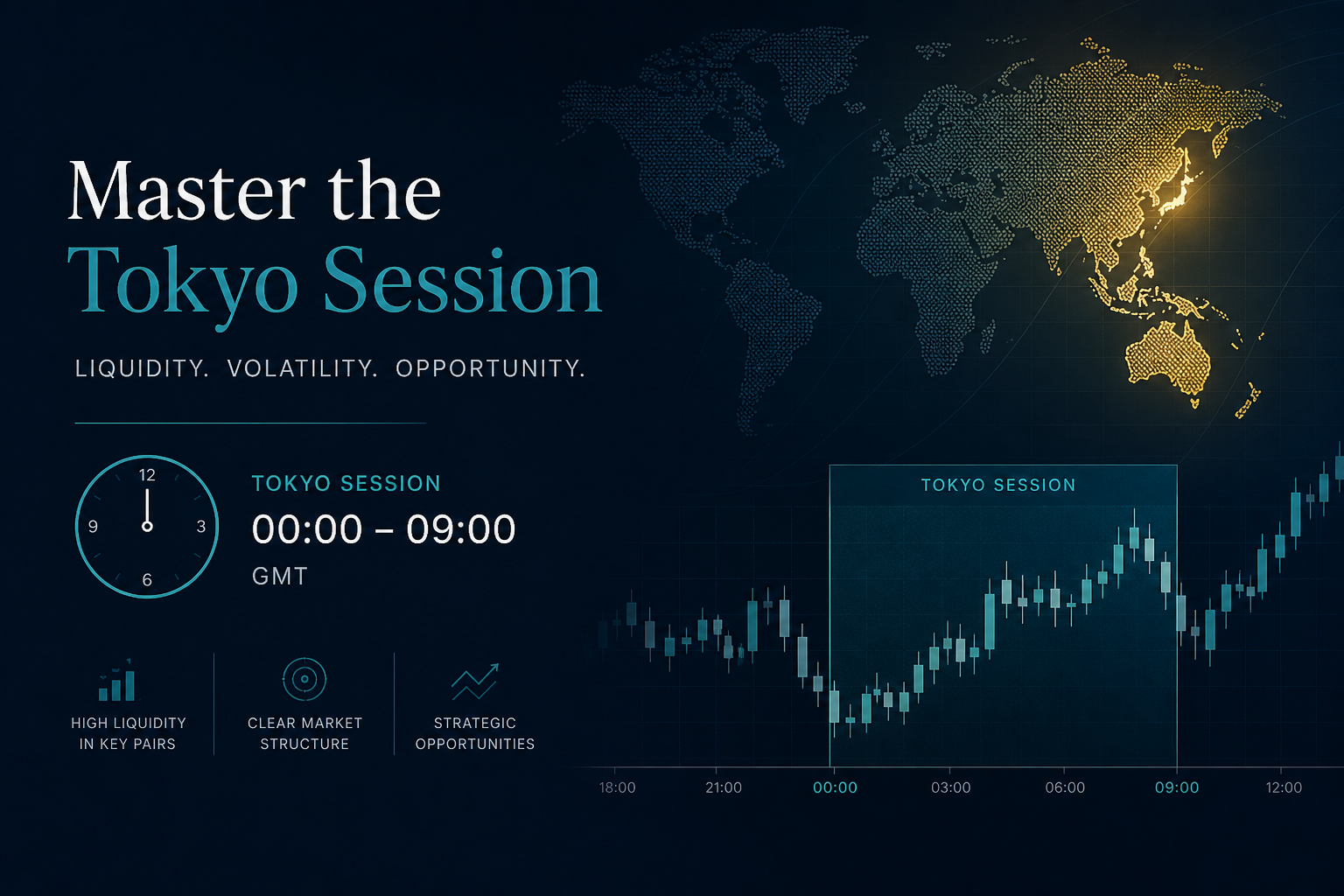
- The Asian session (roughly 00:00–09:00 GMT) is the home session for JPY, AUD, and NZD — not EUR/GBP breakout hours
- USD/JPY, AUD/JPY, AUD/USD, and NZD/USD often show their cleanest directional moves during Tokyo and early Sydney overlap
- Most EUR/USD and GBP/USD range during Asia; breakout systems built for London often lose money here
- BOJ, RBA, and RBNZ decision days can make Asia the most volatile window of the week for yen and commodity FX
- Arab traders in GMT+3/+4 can use pre-London Asia for JPY pairs, then switch mindset when Europe opens at 07:00 GMT

Quick Decision Framework#
Short Answer
For JPY and Antipodean pairs, the strongest Asian windows are usually 00:00–06:00 GMT (Tokyo core) and 22:00–00:00 GMT (Sydney open). EUR/USD and GBP/USD typically range in Asia—use mean-reversion or wait for London at 07:00 GMT unless tier-1 data hits overnight. Re-anchor those clock times in March and November when US and EU daylight saving shifts the overlaps.
Detailed Explanation
The practical Asian window is about 00:00–09:00 GMT, with Sydney starting near 22:00 GMT the previous calendar day and Tokyo most active around 00:00–06:00 GMT. This is the home session for JPY, AUD, and NZD, not for EUR/GBP London-style breakouts. USD/JPY, AUD/JPY, AUD/USD, and NZD/USD often show cleaner directional movement here; EUR/USD and GBP/USD usually compress. BOJ, RBA, and RBNZ days can flip Asia into the week's most volatile window for yen and commodity FX. Gulf traders (UTC+3/+4) can use Tokyo hours in the morning, then switch mindset when Europe opens.
Example
A breakout system built for London that buys EUR/USD at 03:00 GMT often dies in a quiet Asia range and pays the spread twice. The same hours on USD/JPY around a Bank of Japan day can be the week's largest move. Compare your broker's live spread at 03:00 GMT versus 08:00 GMT before assuming Asia scalping is cheap.
Common Mistake
Running a London breakout playbook on EUR/USD during Tokyo hours, then blaming the pair instead of the session.
Professional Tip
Mark 00:00–06:00 GMT and 07:00 GMT London on your platform calendar, then check one JPY or AUD pair and one EUR pair at 03:00 GMT. If EUR/USD is ranging and the spread is wider than your London print, stand aside on that pair until 07:00 GMT.
What Is the Asian Session?#
Short Answer
The Asian session is the first major liquidity cycle of the forex day, centred on Tokyo with earlier participation from Sydney. In GMT terms, treat 00:00–09:00 GMT as the practical window for Asia-led moves, with Sydney starting near 22:00 GMT the previous day.
Detailed Explanation
Unlike equities, forex has no single exchange open. Liquidity migrates with banking centres. When Tokyo desks are live, order flow in yen, Australian dollar, New Zealand dollar, and China-linked crosses tends to deepen. European and US banks are largely offline, so EUR/USD and GBP/USD often trade inside the range left from the prior NY close.
The Bank for International Settlements Triennial Survey consistently shows Tokyo among the top FX trading centres by turnover. That does not mean every pair is active — it means local currency pairs have a home session.
Example
On a quiet Tuesday with no BOJ speaker, AUD/USD might drift 25–40 pips between 00:00 and 06:00 GMT while EUR/USD moves 15 pips in a box. Same clock, different behaviour — because the audience of traders is different.
Common Mistake
Applying a London open breakout rule to EUR/USD at 01:00 GMT and calling the first 10-pip push a "trend day."
Professional Tip
Mark the Asia high and low before 07:00 GMT. London traders use that box as liquidity; Asia traders can fade false breaks inside the box on JPY pairs while majors range.
Asian Session Hours (GMT Reference)#
| Phase | Approx. GMT | What happens |
|---|---|---|
| Sydney open | 22:00 – 00:00 | AUD/NZD wake up; thin EUR/GBP |
| Tokyo core | 00:00 – 06:00 | JPY crosses most active; BOJ flow |
| Pre-London | 06:00 – 07:00 | Handoff; some position squaring |
| London open | 07:00+ | Volatility regime change for EUR/GBP |
Convert to your local time once and pin it on your calendar. Gulf (UTC+3): Tokyo core ≈ 03:00–09:00 local. Egypt (UTC+2): 02:00–08:00 local.
For server-time quirks (MT4/MT5 candle alignment), read broker server time vs local time.
Best Pairs to Trade in the Asian Session#
| Pair group | Why Asia matters | Typical behaviour |
|---|---|---|
| USD/JPY, EUR/JPY, GBP/JPY | Tokyo is yen home market | Trend or BOJ-driven spikes |
| AUD/JPY, NZD/JPY | Risk sentiment + carry | Correlated with equities mood |
| AUD/USD, NZD/USD | Sydney/Wellington flow | Data-driven on employment days |
| USD/CNH, USD/CNY (if offered) | Asia policy headlines | Gap risk on China news |
| EUR/USD, GBP/USD | Not home session | Range ~70% of nights |
If you trade gold, see XAU/USD trading hours — gold often wakes with London, not Tokyo, unless a global shock hits.
Volatility: Range vs Breakout Regimes#
Short Answer
Most nights, Asia ranges. Breakouts during Asia usually need a local catalyst (BOJ, RBA, China data) or a global headline (war headline, US emergency statement).
Detailed Explanation
Range regime signs:
- EUR/USD ATR on M15 below its 20-day median during 00:00–06:00 GMT
- Repeated touches of same high/low without follow-through
- Spreads on EUR/USD wider than London overlap
Breakout regime signs:
- BOJ/RBA/RBNZ on calendar (economic calendar guide)
- USD/JPY moves 50+ pips in first hour of Tokyo
- AUD employment surprise >2σ vs forecast
Example
After a Bank of Japan policy tweak, USD/JPY can move 100–200 pips while London is still asleep — making Asia the only session that matters for yen that day. Fading the move "because Asia is usually quiet" is how accounts get hurt.
Common Mistake
Shorting USD/JPY into a BOJ day because "price looks extended" without reading the statement.
Professional Tip
Keep a session tag in your journal: Asia-range, Asia-breakout, Asia-news. After 30 trades you will see which setups you actually profit from.
Simple Asian Session Playbooks#
1. Asia range fade (majors)#
When: EUR/USD or GBP/USD in clear box, no tier-1 news within 2 hours.
Rules:
- Mark Asia high/low from 00:00 GMT
- Sell near high / buy near low with stop beyond box
- Target mid-range or opposite side
- Flat or reduce before 07:00 GMT London open
Risk: One headline breaks the box — use 1% risk rule and accept stop-outs.
2. Tokyo trend follow (JPY)#
When: USD/JPY breaks prior day high/low on volume during 00:00–03:00 GMT with no immediate reversal.
Rules:
- Enter on retest of broken level
- Stop beyond retest swing
- Take partial profit before London if move exceeds 1R — London may reverse yen flows
3. Sit out#
When: Spreads wide, you cannot name the catalyst, or you are forcing trades.
See when not to trade forex checklist.
News That Moves Asia#
| Event | Source | Typical impact |
|---|---|---|
| BOJ policy decision | Bank of Japan | USD/JPY, cross-yen |
| Tankan survey | BOJ | JPY sentiment |
| RBA rate decision | RBA | AUD/USD, AUD/JPY |
| RBNZ decision | RBNZ | NZD/USD |
| Australia employment | ABS | AUD pairs |
| China PMI / trade | NBS / customs | CNH, AUD |
US NFP and FOMC land outside core Asia — but their aftershocks often replay during Sydney open. For NFP mechanics, see NFP trading guide.
Asian Session for Arab and GCC Traders#
Short Answer
Gulf traders can treat morning hours as Asia/JPY window and late morning to afternoon as London prep — without staying up all night.
Detailed Explanation
Many Arab beginners copy US YouTube "NY open" strategies at local midnight and burn out. A more sustainable split:
- 03:00–08:00 Gulf time: JPY and AUD focus if your schedule allows
- 10:00–14:00 Gulf time: London overlap (best times Arab traders)
- Avoid: Forcing EUR/USD scalps during dead Asia if spreads are wide on your account type
Swap-sensitive holders should confirm swap-free terms if positions cross the rollover cut-off during Asia.
Example
A Dubai trader (UTC+4) marks USD/JPY setup at 04:00 local, exits by 09:00, then reviews London plan for EUR/USD at 11:00 — two regimes, one day, no 3 a.m. screen time.
Costs and Execution in Asia#
Thin liquidity shows up in spread, slippage, and stop hunts. Before trading Asia live:
- Log spread at 03:00 GMT vs 12:00 GMT on your symbol
- Read forex all-in trading costs
- Use position size calculator logic — same % risk, possibly wider stop
Brokers like XM and Exness publish session spreads on major pairs; verify on your account type (Standard vs Raw) — marketing "from 0.6 pips" may not apply at 02:00 GMT.
Comparison: Asian vs London Session#
| Factor | Asian session | London session |
|---|---|---|
| Best pairs | JPY, AUD, NZD | EUR, GBP, CHF, XAU |
| Typical style | Range / local news trend | Volatility expansion |
| Spreads on EUR/USD | Often wider | Usually tighter |
| Beginner friendly? | Only with pair match | Generally easier for EUR/USD |
| Overlap edge | Sydney–Tokyo | London–NY |
Checklist Before Trading Asia Live#
- Converted session times to local clock for the next 4 weeks (DST checked)
- Identified whether tonight is range or news regime
- Picked symbols with home-session liquidity
- Spread logged on demo or micro lot at target hour
- Stop loss and lot size calculated (risk management guide)
- London open (07:00 GMT) marked — plan to reduce or exit if regime shifts
Glossary#
- Asian session: FX hours dominated by Sydney and Tokyo banking flow (~22:00–09:00 GMT span).
- Tokyo core: ~00:00–06:00 GMT when yen liquidity is deepest.
- Asia range: Overnight box on EUR/USD/GBP/USD often swept at London open.
- Cross-yen: Pairs quoted with JPY as quote currency (EUR/JPY, GBP/JPY).
- Handoff: Liquidity transition between sessions; spreads can wobble.
Key Takeaways#
- Match pair to session — JPY and AUD in Asia; EUR/GBP in London.
- Asia is usually range, not breakout, unless news says otherwise.
- Arab traders can use morning Asia without copying US midnight schedules.
- Log spreads and journal session tags — edge is often hidden in the clock.
- When in doubt, wait for London rather than force a trade in thin books.
Related Reading#
- Forex market hours, liquidity and slippage
- London session and NY open breakouts
- Forex weekend gap risk
- Forex correlation and concentration risk
- Open a forex account checklist
Qualified CTA#
If you want to test Asian hours with controlled risk, start on demo, then a micro or cent account on a regulated broker with transparent spreads. Compare XM vs Exness spread comparison for your symbols — but always verify live quotes at the hour you plan to trade. Read our affiliate disclosure and how we review brokers before opening an account.
Suggested follow-up articles: Forex trading during Ramadan sessions; PPI and GDP trading playbook; Asian–London handoff strategy template.
Comments
Add a useful note for other traders. We review comments before publishing.