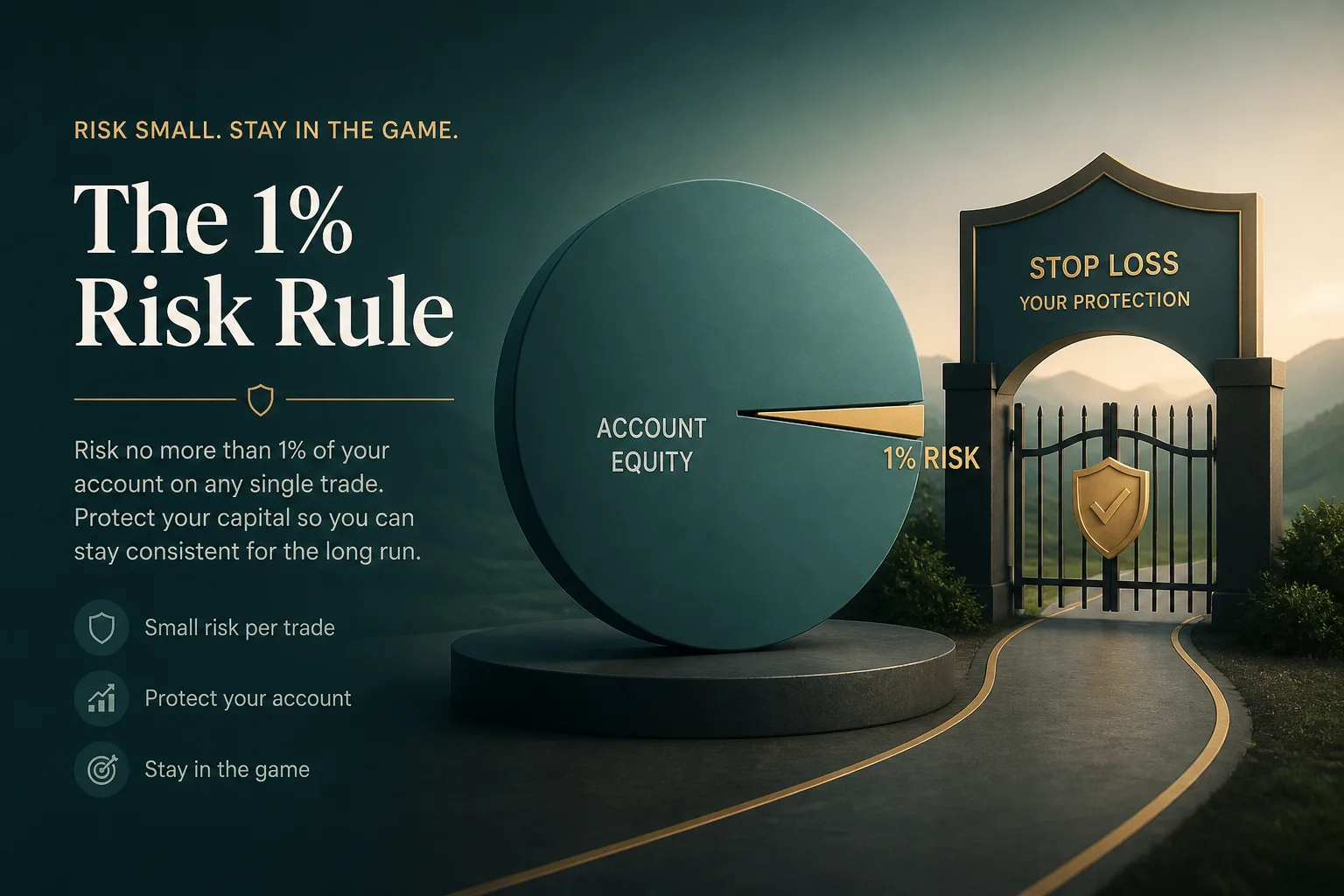
- 1% means cash at risk, not 1% of the chart or 1% leverage
- On $100, 1% = $1; on $500, 1% = $5; on $1,000, 1% = $10
- Lot size is derived from stop distance and pip/point value
- 0.5% is often wiser for gold or early live trading
- If minimum lot exceeds 1%, skip or stay on demo—do not inflate risk to force a trade

Affiliate disclosure: ForexTradeLab may earn a commission from partner broker links, at no added cost to you. Read our affiliate disclosure.
Quick Answer#
The 1% risk rule: plan that a full stop-out costs about 1% of equity (plus a buffer for costs).
| Equity | 1% cash risk | 0.5% cash risk |
|---|---|---|
| $100 | $1 | $0.50 |
| $500 | $5 | $2.50 |
| $1,000 | $10 | $5 |
Then size lots so stop × pip/point value ≈ cash risk.
1. What 1% Actually Means#
Short Answer
1% of account cash, not 1% price move and not “1% leverage.”
Detailed Explanation
The rule protects survival and psychology. Ten full losses at 1% ≈ ~10% drawdown (before compounding nuances)—painful but recoverable versus 5%–10% per trade. See risk management guide and drawdown explained.
Example
$800 equity → 1% = $8 planned loss if stopped.
Common Mistake
Risking 1% of “bonus credit” or of a profit fantasy target.
Professional Tip
Base 1% on withdrawable equity you can afford to lose, not on peak balance after one win.
2. From 1% Cash to Lot Size#
Short Answer
Lot size ≈ Cash risk ÷ (Stop × value per pip/point per lot unit) → round down.
Detailed Explanation
EUR/USD illustration at ~$0.10/pip for 0.01:
| Cash risk | Stop | Approx. max volume |
|---|---|---|
| $1 | 10 pips | ≈ 0.01 |
| $1 | 25 pips | ≈ 0.004 → may be below min |
| $5 | 25 pips | ≈ 0.02 |
| $5 | 50 pips | ≈ 0.01 |
Use lot calculator. Read how much 0.01 makes and lot size $100/$500.
Example
$500, 1% = $5, stop 40 pips → about 0.0125 → round down toward 0.01 if that keeps risk ≤ $5.
Common Mistake
Picking 0.01 first, then reverse-engineering a fake 1%.
Professional Tip
Stop comes from the chart; lot comes from the stop—not the reverse.
3. When 0.5% Is Smarter#
Short Answer
Use 0.5% for early live trading, gold, news weeks or after emotional mistakes.
Detailed Explanation
Gold’s minimum volume often forces larger cash risk—see gold 0.01 explainer. Tiny accounts face a cost floor—honest math.
Example
$200 account, gold min 0.01 risks $6 on stop → that is 3%. Options: skip gold, demo, or accept that live gold does not fit yet.
Common Mistake
Keeping “1%” in the bio while trading 3%–5% in practice.
Professional Tip
Write the percent you will actually obey on a sticky note beside the screen.
4. When Minimum Lot Breaks 1%#
Short Answer
Do not raise risk to match the minimum lot. Raise patience instead.
Detailed Explanation
Full playbook: when minimum lot is too big. Outcomes: demo only, wait for larger equity, choose a quieter major with tighter valid stop, or no trade.
Example
Platform min 0.01 risks $3.50; 1% budget is $1 → NOT FEASIBLE.
Common Mistake
“I’ll just this once” after three skips—then a normal loss feels huge.
Professional Tip
Skipping is rule-following, not fear.
5. Daily Caps and Correlated Risk#
Short Answer
1% per trade still fails if you open three correlated 1% risks.
Detailed Explanation
EUR/USD + GBP/USD + gold can be one USD bet. Add a daily loss limit (e.g. 2%–3%) and max trades/day. See correlation risk and overtrading.
Example
Three “1%” USD-long trades → ~3% same-theme risk.
Common Mistake
Stacking positions to “make 1% feel worth it.”
Professional Tip
Count theme risk, not only ticket count.
Practice path: Drill the rule on demo, then micro-live. For an XM workflow example, see 7-day after-deposit plan and XM availability.
Risk warning: Even 1% risk can produce long losing streaks. CFDs can lose more than planned if gaps or slippage occur. Read our risk disclaimer.

Comments
Add a useful note for other traders. We review comments before publishing.