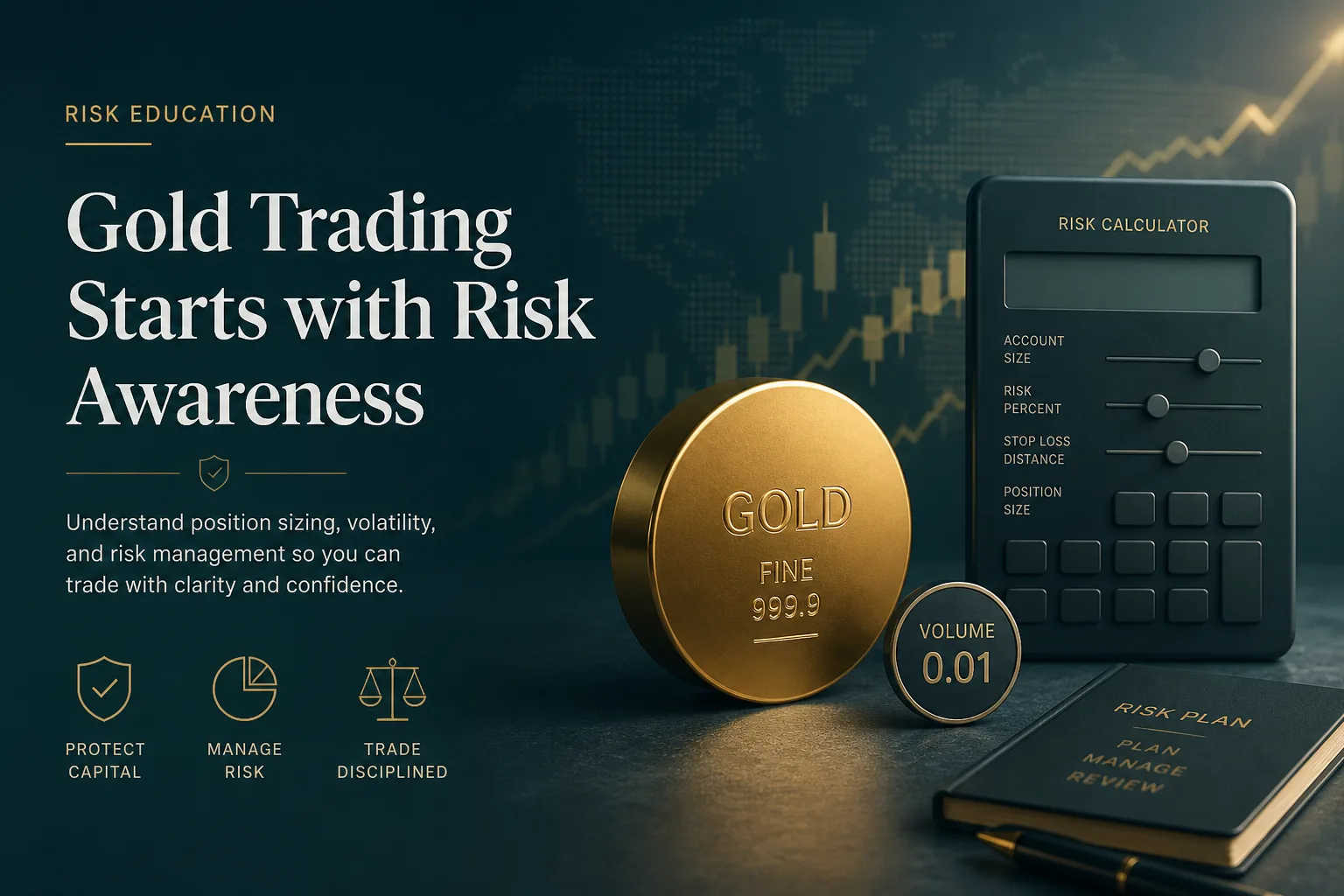
- Gold 0.01 is not EUR/USD 0.01 in dollar risk
- Many retail CFDs make 0.01 near 1 ounce—so ~$1 P/L per $1 move before costs
- Wide gold stops quickly breach 1% rules on $100–$500 accounts
- Always calculate stop × point value before clicking buy/sell
- If minimum volume exceeds your cash cap, choose demo only

Affiliate & risk disclosure: ForexTradeLab may earn a commission from qualifying broker links. This does not change the price paid or replace independent checks. See the affiliate disclosure and risk disclaimer.
Quick Answer#
Is 0.01 lot safe on gold? Only if stop × live point value ≤ your cash loss cap. The label “0.01” does not make XAU/USD gentle.
Educational illustration (verify live): if 0.01 ≈ 1 oz, then:
| Gold move | Approx. P/L at 0.01 |
|---|---|
| $1 | ≈ $1 |
| $5 | ≈ $5 |
| $10 | ≈ $10 |
| $20 | ≈ $20 |
1. Why Gold “Micro” Feels Different#
Short Answer
Same volume code, different dollar-per-move and typical stop width.
Detailed Explanation
EUR/USD at 0.01 is often ~$0.10/pip. Gold stops of several dollars are routine on higher timeframes. That combination blows small accounts. See how much 0.01 makes and gold lot size guide.
Example
Trader uses 0.01 “because it worked on EUR/USD,” then takes an $12 gold stop ≈ $12 on $150 equity.
Common Mistake
Assuming micro volume transfers risk between instruments.
Professional Tip
Recalculate every symbol from scratch—especially metals.
2. Calculator Inputs That Matter#
Short Answer
You need: account risk $, stop distance, contract/point value, minimum volume, estimated spread.
Detailed Explanation
Workflow:
- Set cash risk (e.g. 0.5%–1%).
- Measure invalidation stop on the chart.
- Read live specification / calculator point value at intended volume.
Planned loss ≈ stop × value + costs.- Round volume down; compare to minimum.
Tools: lot calculator, P/L calculator, pip value.
Example
$500 account, 1% = $5. Stop = $5 on gold. If value ≈ $1 per $1 at 0.01, then 0.01 risks ≈ $5 → borderline pass before spread. If stop is $12, 0.01 fails a 1% rule.
Common Mistake
Entering “0.01” in the calculator after already deciding to trade, instead of letting risk decide volume.
Professional Tip
Save a screenshot of specs + calculator beside the journal entry.
3. $100 and $500 Gold Fit Tests#
Short Answer
$100 often fails at minimum gold volume. $500 can pass only with tighter, structure-valid stops—or still fail.
Detailed Explanation
| Account | 1% cap | Stop $8 at ~$1/$1 on 0.01 | Result |
|---|---|---|---|
| $100 | $1 | ≈ $8 risk | Not feasible / demo only |
| $200 | $2 | ≈ $8 risk | Not feasible |
| $500 | $5 | ≈ $8 risk | Fails 1%; might pass at 1.5%+ (not ideal) |
| $1,000 | $10 | ≈ $8 risk | Pass arithmetic if costs OK |
See how much capital for gold, lot size $100/$500, when min lot too big.
Example
Honest line: “Want gold, have $100, min 0.01, stop $6 → DEMO ONLY.”
Common Mistake
Tightening stop into noise solely to force a pass.
Professional Tip
A skipped gold trade is a professional outcome.
4. Session, News and Spread#
Short Answer
Gold risk spikes around CPI, NFP, FOMC and thin rolls.
Detailed Explanation
Spread widening can turn a “$5 stop plan” into a worse fill. Prefer liquid hours; avoid first live gold trades into red-folder releases. See XAUUSD hours and gold news trading.
Example
Planned $5 risk becomes $7 after slippage in a data spike.
Common Mistake
Sizing from a calm Asian session, then holding into US data.
Professional Tip
If you cannot name the next high-impact USD event, do not hold gold overnight as a beginner.
5. XM Cluster Next Steps#
Short Answer
Same math on XM—confirm Ultra Low/Standard specs and calculator for your entity.
Detailed Explanation
Read XM gold account guide, XM market fit test, XM 0.01 P/L.
Education-first CTA: Practise gold sizing on demo first. If XM fits your country and risk plan, check XM availability and verify live XAU/USD specs before funding.
Checklist#
- Live XAU/USD point value noted
- Cash risk written
- Stop from structure
- Min volume compared to formula volume
- News calendar checked
- Majors practice completed first (recommended)
Risk warning: Gold CFDs move fast around US data. Stops can slip. Education only—not personal advice. Read our risk disclaimer.

Comments
Add a useful note for other traders. We review comments before publishing.