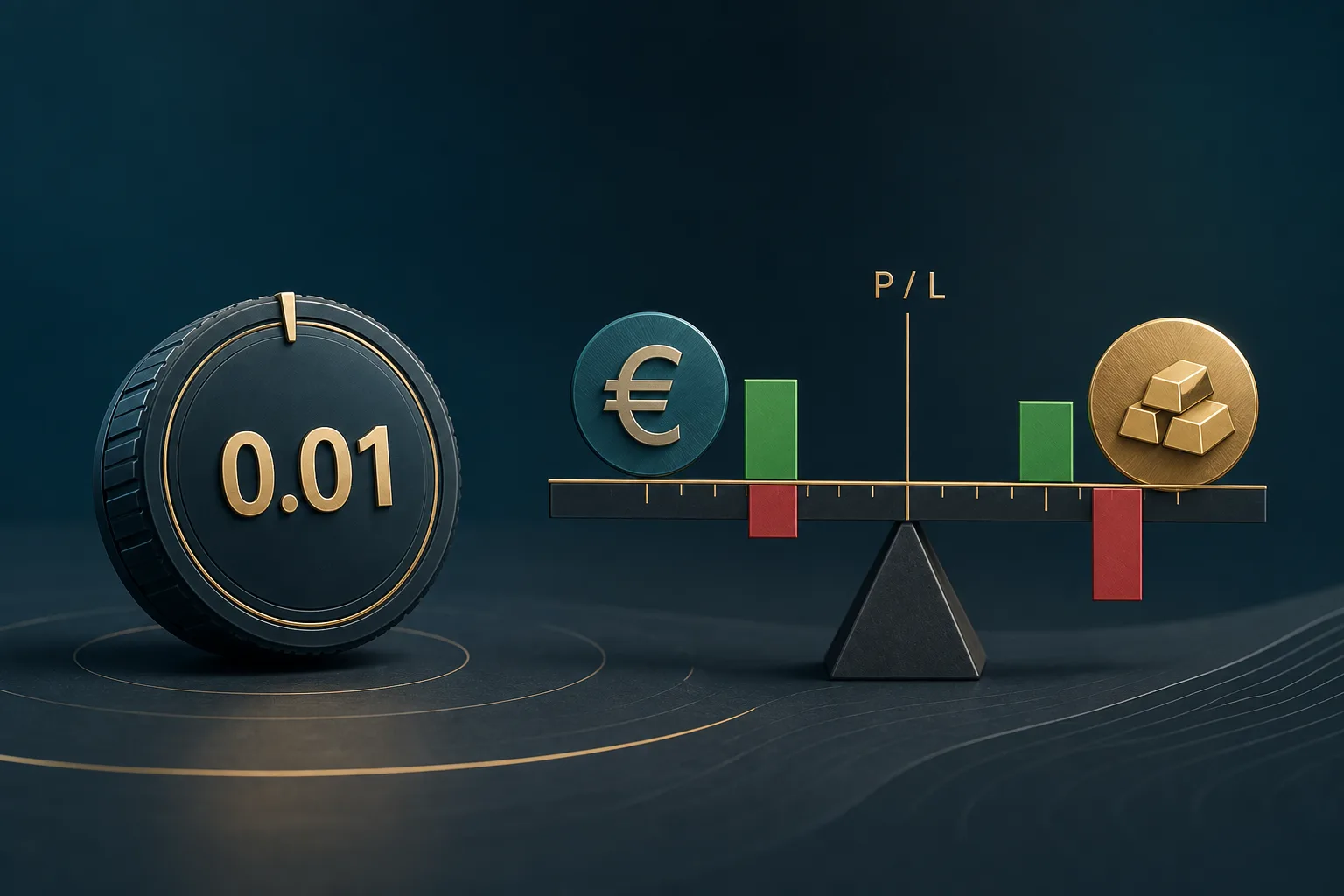
- On a typical USD account, 0.01 lot EUR/USD is about $0.10 per pip before costs
- A 20-pip move at 0.01 lot on EUR/USD is roughly $2 before spread and slippage
- Gold 0.01 lot is not the same dollar risk as EUR/USD—check the live XAU/USD point value
- 0.01 is a volume code, not a safety guarantee; stop distance and account size decide risk
- Always confirm pip/point value and margin in XM's calculator and MT4/MT5 specification before live orders

Open Exness — test spreads and fills on a small deposit
- Spreads from 0.0 on Raw/Zero where available
- Deep liquidity for active scalping styles
- Clients and trading volume worldwide
- Automated processing is available for eligible withdrawals
- MT4, MT5 and the Exness app
- Start from $10 — measure true cost first
Quick Answer#
How much does 0.01 lot make or lose on XM? On a common USD forex example, 0.01 lot EUR/USD ≈ $0.10 per pip before costs. So:
| Move | Rough P/L at 0.01 EUR/USD (before costs) |
|---|---|
| 10 pips | ≈ $1 |
| 20 pips | ≈ $2 |
| 50 pips | ≈ $5 |
| 100 pips | ≈ $10 |
Gold is different. Do not copy EUR/USD math onto XAU/USD. Use XM's All-in-One Calculator and the MT4/MT5 symbol specification for your entity.
1. What 0.01 Lot Actually Means#
Short Answer
0.01 is a volume code, not a profit target. In standard retail forex, 1.00 lot = 100,000 units of base currency, so 0.01 lot = 1,000 units (often called a micro lot).
Detailed Explanation
When you type 0.01 in MetaTrader volume, you are choosing how large the position is. Pip value, margin and stop-loss dollars all scale with that volume.
On XM, account names, leverage and minimum volume can differ by country and legal entity. Official educational material commonly treats a standard forex lot as 100,000 units; metals use their own contract rules. Read what a lot is and XM account types.
Example
On EUR/USD, 0.01 lot controls 1,000 euros of notional exposure under the standard convention—not “0.01 euros.”
Common Mistake
Thinking “0.01 is tiny, so I cannot lose much.” Tiny volume with a wide stop or a fast gold move can still damage a small account.
Professional Tip
Before your first live order, screenshot the symbol Specification and a calculator printout for pip/point value at 0.01. Keep both in your journal.
2. EUR/USD: 0.01 Lot Profit and Loss Table#
Short Answer: For a USD account using the standard pip convention, 0.01 lot EUR/USD ≈ $0.10 per pip. Multiply pip move × $0.10, then subtract costs.
Detailed Explanation:
| Pip move | Approx. gross P/L at 0.01 | What it means in practice |
|---|---|---|
| 5 pips | ≈ $0.50 | Often near a tight scalp; spread can eat most of it |
| 10 pips | ≈ $1.00 | Common small swing unit |
| 20 pips | ≈ $2.00 | Typical beginner stop or target block |
| 35 pips | ≈ $3.50 | Structure-based stop on a quiet day |
| 50 pips | ≈ $5.00 | Meaningful on a $100 account (5%) |
| 100 pips | ≈ $10.00 | Large for micro-capital psychology |
Gross P/L ignores spread, commission (if any), slippage and swap. A 10-pip “win” can shrink after costs; a stop can fill beyond the level you clicked.
Use the pip value calculator and profit/loss calculator to rehearse the same numbers you will check on XM.
Example: You buy EUR/USD at 0.01 lot with a 25-pip stop. Planned risk ≈ 25 × $0.10 = $2.50 before costs. If your written cash loss cap is $1, this trade fails the risk gate even though the lot looks “micro.”
Common Mistake: Counting only the target (“I can make $3”) and ignoring that the same volume loses $3 if price travels the same distance against you.
Professional Tip: Write planned loss in cash, not in pips. Pips hide risk; dollars do not. See the Market Fit Test.
3. Gold (XAU/USD): Why 0.01 Feels Different#
Short Answer: Gold 0.01 lot is not EUR/USD 0.01 lot. Point value and typical stop distances differ. Many beginners blow small accounts by treating gold micro volume as “safe.”
Detailed Explanation: Educational illustration only (verify live):
If your XM symbol treats 0.01 lot as 1 troy ounce, then a $1 move in gold is roughly $1 of P/L at 0.01 before costs. Under that assumption:
| Gold price move | Approx. P/L at 0.01 (illustrative) |
|---|---|
| $0.50 | ≈ $0.50 |
| $1.00 | ≈ $1.00 |
| $5.00 | ≈ $5.00 |
| $10.00 | ≈ $10.00 |
| $20.00 | ≈ $20.00 |
Gold can move several dollars around US data. A stop that looks “normal” on the chart can equal a large percentage of a $50–$200 account. Read gold lot size and the XM gold account guide.
Example: Account $100. Gold stop $8 away. If point value ≈ $1 per $1 at 0.01, planned loss ≈ $8 (8% of equity) before spread—too large for a first-week beginner rule of 0.5%–1% risk.
Common Mistake: Using the same 0.01 habit on gold that felt calm on EUR/USD.
Professional Tip: If gold’s minimum executable volume already breaches your cash loss cap, the honest result is demo only or do not trade gold yet—not a tighter fake stop. See how much capital for gold.
4. Spread, Slippage and the Break-Even Distance#
Short Answer: Your first profitable pip is not pip #1—it is the pip that covers the spread (and any commission).
Detailed Explanation: If EUR/USD spread is 1.2 pips at entry on Ultra Low-style pricing in your region, a 0.01 position needs roughly that much favorable movement before floating P/L turns green. During news, spreads widen and slippage rises.
That is why “how much does 0.01 make?” is incomplete without “at what session, on which symbol, with what stop?”
Compare account cost culture in XM vs Exness spreads and XM Ultra Low vs Standard.
Example: Target +10 pips at 0.01 ≈ +$1 gross. If round-turn friction is ~1.5 pips, net is closer to +$0.85 before slippage—fine for learning, useless as an income story.
Common Mistake: Trading only during high-impact news to “make 0.01 lots pay,” then blaming the broker for the spread spike.
Professional Tip: Measure one quiet London/NY overlap hour on demo: average spread, one market order fill, one stop fill. Journal those three numbers before live funding.
5. Is 0.01 Lot Safe on a Small XM Account?#
Short Answer: Sometimes for majors with tight, structure-based stops. Often too large for gold or wide stops on $50–$100 balances.
Detailed Explanation:
| Account | 1% cash risk | Max stop if EUR/USD ≈ $0.10/pip at 0.01 |
|---|---|---|
| $50 | $0.50 | ≈ 5 pips |
| $100 | $1.00 | ≈ 10 pips |
| $200 | $2.00 | ≈ 20 pips |
| $500 | $5.00 | ≈ 50 pips |
If your real chart stop is 30–40 pips, 0.01 may already be oversized on $100. Then either reduce risk elsewhere, stay on demo, or accept that live training must use only setups with stops that fit—or wait for more capital. Related: $50 forex risk guide and tiny account cost floor.
Example: $100 account, 1% rule = $1 risk. Chart needs 35-pip stop. Required volume ≈ 1 ÷ (35 × 0.10) = 0.0029 lots. If the platform minimum is 0.01, the trade is not feasible at minimum volume.
Common Mistake: Rounding up to 0.01 “because that is the smallest button” while violating the cash risk rule.
Professional Tip: Pass/fail language beats hope language: PASS, DEMO ONLY, or NOT FEASIBLE AT MIN VOLUME.
6. Pre-Trade Checklist for 0.01 on XM#
- Confirm country eligibility and legal entity on the live XM site.
- Complete KYC before expecting smooth deposits/withdrawals.
- Open the symbol Specification; note min volume and tick/point size.
- Run XM calculator: pip/point value, margin, swap at 0.01.
- Write cash loss cap; compute stop × value; add estimated spread.
- If loss > cap, do not place the trade.
- Prefer majors for first live micro tests; delay gold until math fits.
- Place stop and take-profit with the order; journal emotion after fill.
- Plan a small first withdrawal test before scaling.
Education-first next step: If your country, payment method and risk plan fit, review live XM terms, then practise the calculator workflow on demo before depositing. Check XM availability. Pair this page with how many lots with $100 on XM and the 7-day after-deposit plan.
Key Takeaways#
- 0.01 lot on EUR/USD is commonly ~$0.10 per pip on a USD account—verify live.
- Dollar risk = stop distance × value per pip/point + costs.
- Gold 0.01 can move account equity much faster than major forex.
- Minimum volume can make a “tiny” lot still too big for your cash cap.
- Calculators and specifications beat social-media lot tips.
Glossary#
| Term | Meaning |
|---|---|
| Lot | Standardised trade volume unit |
| Micro lot (0.01) | Often 1,000 units of base currency in forex |
| Pip | Small price increment on many FX pairs |
| Point / tick | Smallest price increment on a symbol (metals differ) |
| Spread | Difference between bid and ask |
| Margin | Collateral required to open leveraged exposure |
| Stop-loss | Predefined exit if price moves against you |
Affiliate disclosure: ForexTradeLab may earn a commission if you use a tracked broker link. This does not increase our rating or replace your own due diligence. Review the affiliate disclosure and verify current entity-specific terms before opening or funding an account.
Risk warning: CFDs are leveraged. You can lose money quickly. Examples below are educational approximations, not live quotes, guaranteed fills or income forecasts. Stop orders can slip. Never deposit rent, debt or emergency money. Read our risk disclaimer.

Comments
Add a useful note for other traders. We review comments before publishing.