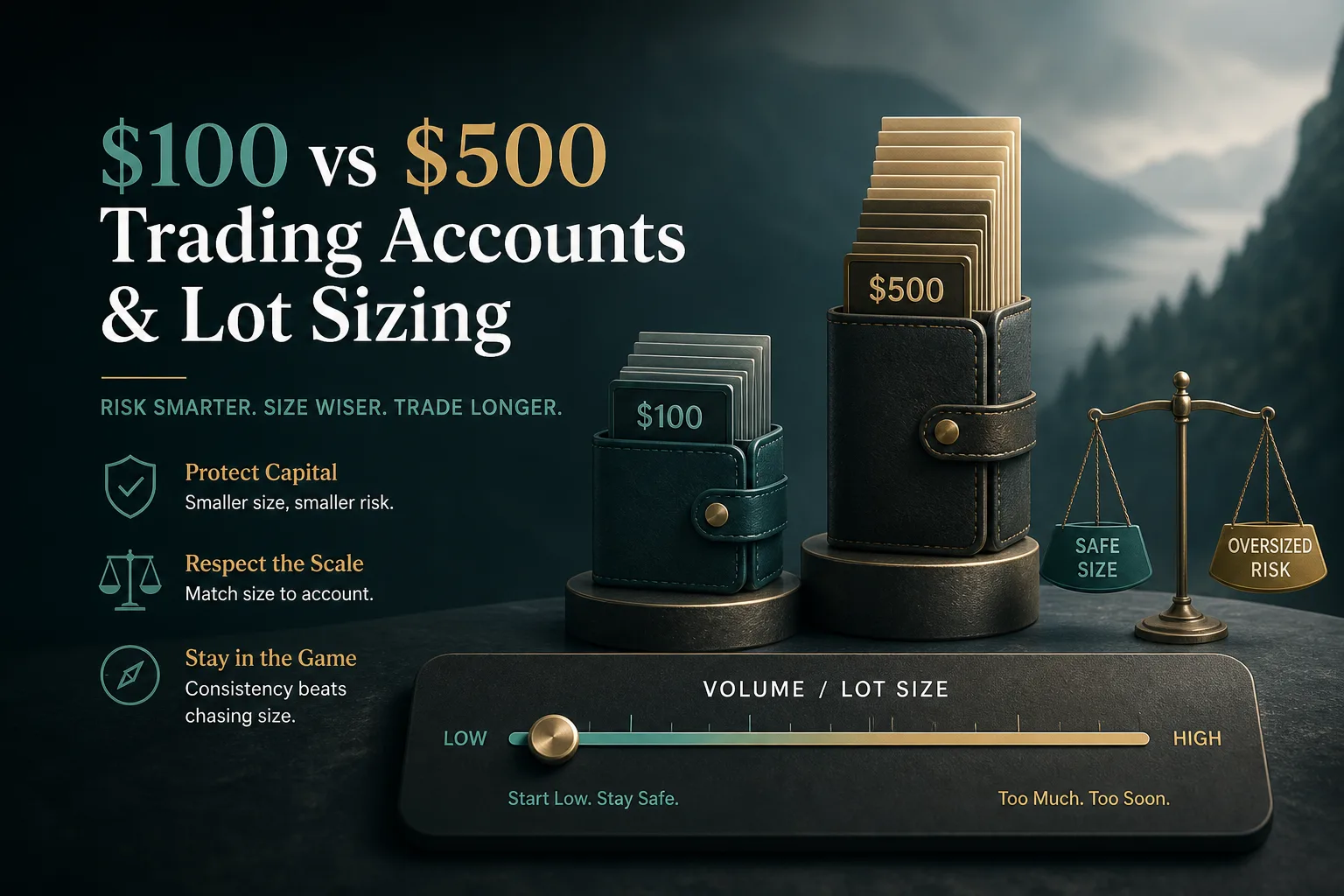
- Lot size comes from cash risk ÷ (stop × value per pip/point), then round down
- On $100, 0.01 often fits only tight stops under a 1% rule
- On $500, 0.01 is usually easier on majors—but gold can still fail
- Free margin is not a risk budget
- If minimum volume breaches your cap, the answer is demo only or no trade

Affiliate & risk disclosure: ForexTradeLab may earn a commission from qualifying broker links. This does not change the price paid or replace independent checks. See the affiliate disclosure and risk disclaimer.
Quick Answer#
Lot size for $100 or $500? Start from cash risk, not from “what margin allows”:
Lots ≈ Cash risk ÷ (Stop in pips × $ per pip at 1.00 lot) → round down to an executable step.
| Balance | 1% cash risk | At ≈ $0.10/pip (0.01 EUR/USD) |
|---|---|---|
| $100 | $1 | ≈ 10-pip stop max at 0.01 |
| $500 | $5 | ≈ 50-pip stop max at 0.01 |
1. Access Balance ≠ Risk Budget#
Short Answer
Funding $100 or $500 proves access—not that any lot is suitable.
Detailed Explanation
Treat these balances as training capital. Income targets push oversizing. See start with $100 realistic guide and $50 risk guide.
Example
Two $500 accounts: one risks $5 with fitting stops; one opens 0.10 because margin allows it.
Common Mistake
Equating “I could open it” with “I should.”
Professional Tip
Write two lines first: money you can lose entirely, and max $ loss per trade.
2. The Sizing Formula#
Short Answer
Cash risk first → chart stop second → volume third → margin buffer last.
Detailed Explanation
Use the lot calculator and position size guide. Round down. Never round up to force a trade. See when minimum lot is too big.
Example
$100, $1 risk, 35-pip stop, $0.10/pip at 0.01 → loss at min volume = $3.50 → not feasible under 1%.
Common Mistake
Shrinking a structural stop only to make 0.01 fit.
Professional Tip
Pass/fail labels beat hope: PASS, DEMO ONLY, NOT FEASIBLE.
3. Safe vs Dangerous Map#
Short Answer
On $100, treat 0.01 as a ceiling discussion. On $500, 0.01 is often workable on majors—0.10 stays dangerous for most beginners.
Detailed Explanation
| Volume | $/pip (EUR/USD approx.) | 20-pip stop | On $100 | On $500 |
|---|---|---|---|---|
| 0.01 | $0.10 | ≈ $2 | Conditional | Usually OK under 1% if stop fits |
| 0.02 | $0.20 | ≈ $4 | Often large | Conditional |
| 0.05 | $0.50 | ≈ $10 | Dangerous | Often large (2%) |
| 0.10 | $1.00 | ≈ $20 | Reckless | Usually too large for new traders |
Read how much 0.01 makes and 1% risk rule.
Example
Signal says “0.05 on any account.” On $100 that can be 4%–10%+ depending on stop.
Common Mistake
Copying lot size from a stranger’s account size.
Professional Tip
Ask: “What balance and stop was that lot built for?”
4. Gold Changes Both Answers#
Short Answer
Gold often fails the fit test on $100 and can still stress $500.
Detailed Explanation
If ~$1 per $1 at 0.01, a $10 gold stop ≈ $10 risk = 10% of $100 or 2% of $500. See gold 0.01 explainer and capital for gold.
Example
Honest journal: “$100 / gold / min 0.01 / stop $8 / risk ~$8 / rule 1% → DEMO ONLY.”
Common Mistake
Depositing specifically to “trade gold like influencers.”
Professional Tip
Master majors micro-trades before gold live.
5. Margin Myths#
Short Answer
Free margin is not a risk budget. Leverage changes collateral, not dollars lost per pip.
Detailed Explanation
Related: leverage loss reality and why leverage destroys accounts.
Example
Margin $4 for 0.05 lot ≠ safe if stop risk is $10.
Common Mistake
Maxing leverage because comparison sites rank “highest leverage.”
Professional Tip
Cap leverage in your written plan even when the platform offers more.
Practical Plan#
- Pick 0.5%–1% cash risk.
- Measure stop from structure.
- Calculate volume; round down.
- If below minimum → skip or demo.
- Majors first; one risk at a time.
- Test a small withdrawal before topping up (withdrawal test).
XM path: If you want a low-entry micro practice route, read how many lots with $100 on XM, the beginner capital plan, then check XM availability.
Risk warning: Small CFD accounts can be lost quickly. This is education, not a deposit recommendation. Read our risk disclaimer.

Comments
Add a useful note for other traders. We review comments before publishing.