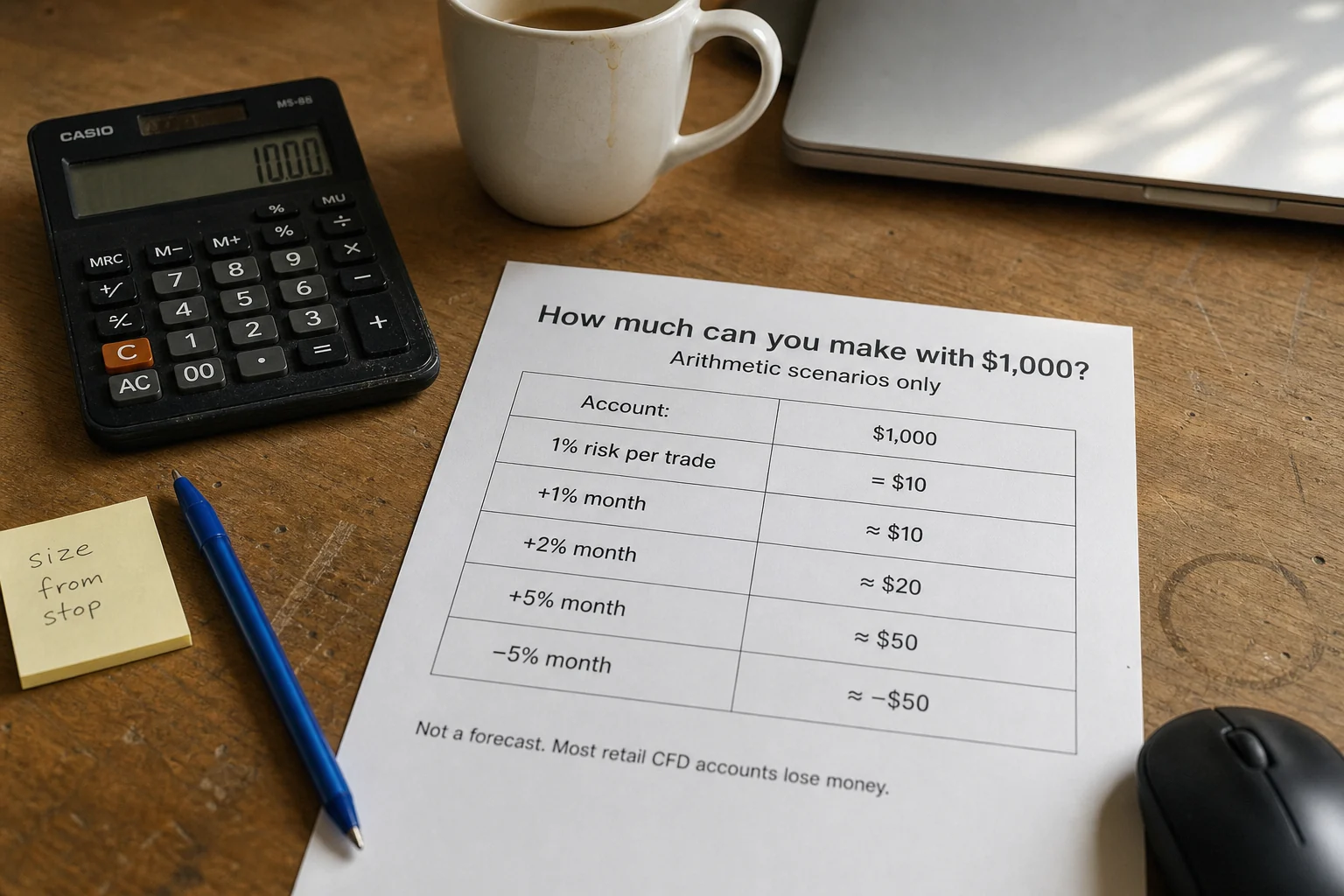
- $1,000 can support structured practice with micro lots; it cannot fund a dependable salary
- At 1% risk, max loss per trade is about $10 before costs
- Monthly dollar outcomes scale with return percentage—but no fixed monthly return is evidence-based
- Costs, drawdown and leverage misuse erase optimistic spreadsheet plans
- Treat $1,000 as risk capital you can lose entirely, then size trades from a written cash rule

Affiliate & risk disclosure: ForexTradeLab may earn a commission from qualifying broker links. This does not change the price paid or replace independent checks. See the affiliate disclosure and risk disclaimer.
Quick Answer#
How much can you make with $1000 in forex? There is no reliable income number. A $1,000 balance only changes how large a given percentage move is in dollars.
| Hypothetical month (scenario only) | Approx. change on $1,000 |
|---|---|
| −5% | −$50 |
| −2% | −$20 |
| 0% | $0 |
| +1% | +$10 |
| +2% | +$20 |
| +5% | +$50 |
These rows are arithmetic, not forecasts. Regulated CFD risk warnings commonly note that a large share of retail accounts lose money. Read the companion pieces on how much forex traders make and starting with $100.
Educational only: Not financial advice. Forex/CFDs are leveraged; you can lose your entire $1,000 quickly. Never trade money you cannot afford to lose. See our risk disclaimer.
1. What $1,000 Actually Buys You#
Short Answer
$1,000 is enough for structured live practice with micro lots on many retail platforms. It is not enough to plan a salary.
Detailed Explanation
At a 1% risk rule, your planned loss per trade is about $10 before spread, commission and slippage. That is workable for majors if you size volume from stop distance. It is still tiny relative to living costs in the US, UK, Canada, Australia or the GCC.
Compare capital tiers:
Example
You want a 40-pip stop on EUR/USD. At ≈ $0.10 per pip on 0.01 lot, risk ≈ $4. That fits under a $10 cash cap. A 0.05 lot at the same stop ≈ $20—already over a strict 1% rule.
Common Mistake
Depositing $1,000 and immediately targeting $50–$100 per day because “the account feels real.”
Professional Tip
Write the sentence: “This $1,000 is tuition I can lose.” If that feels false, do not fund live.
2. Risk Per Trade Math on $1,000#
Short Answer
Risk dollars first, then convert to lot size. Lot labels are not safety.
Detailed Explanation
| Risk % | Cash risk on $1,000 |
|---|---|
| 0.5% | $5 |
| 1% | $10 |
| 2% | $20 |
| 5% | $50 |
Rough EUR/USD guide (USD account, ≈ $0.10/pip at 0.01):
| Cash risk | Pip stop | Approx. volume |
|---|---|---|
| $10 | 20 pips | ≈ 0.05 lot |
| $10 | 40 pips | ≈ 0.02–0.03 lot |
| $10 | 100 pips | ≈ 0.01 lot |
Verify with the lot calculator, pip value calculator and position size guide.
Example
Five consecutive full losses at 2% ≈ $100 drawn from $1,000 (−10%) before recovery—common when beginners “feel confident.”
Common Mistake
Using high leverage to force a large lot so the $1,000 “works harder.” Leverage changes margin, not the honesty of a $50 stop loss. See what is leverage and why leverage destroys accounts.
Professional Tip
Cap open risk at one idea at a time. Correlated EUR/USD + GBP/USD doubles exposure. Related: correlation concentration risk.
3. Scenario Table: Not an Income Forecast#
Short Answer
Percentage × $1,000 = dollars. Markets do not owe you that percentage.
Detailed Explanation
Marketing pages often imply steady 5–10% per month. That is a spreadsheet fantasy for most retail accounts. Use scenarios only to set expectations, then measure real expectancy after costs.
| Scenario label | Month % | Dollar on $1,000 | How to read it |
|---|---|---|---|
| Hard loss month | −10% | −$100 | Survival test |
| Quiet loss | −3% | −$30 | Normal variance |
| Flat | 0% | $0 | Costs ate edge |
| Modest gain | +2% | +$20 | Possible, not promised |
| Strong month | +5% | +$50 | Rare streak—do not annualize |
| Fantasy claim | +20% | +$200 | Usually oversized risk |
Annualizing a lucky month (e.g. ×12) is how people invent “$200 × 12 = $2,400/year guaranteed” stories. Variance and drawdown break that. Study compounding realism and expectancy / R:R.
Example
A trader nets +$40 in month one (+4%), then −$80 in month two (−8% on the new balance path). The account can still end below $1,000 while the trader remembers only the first month’s “income.”
Common Mistake
Posting only winning months in a journal and asking “how much can I make” from the edited sample.
Professional Tip
Track R-multiples and max drawdown, not only “monthly $.” Use a trading journal template.
4. What the Data Says About Retail Outcomes#
Short Answer
Regulator-driven CFD disclosures consistently show that most retail accounts lose money. Capital size does not flip that base rate into a salary.
Detailed Explanation
Under European product-intervention rules, CFD providers disclose the percentage of retail accounts that lost money. ESMA’s framework and the familiar 74–89% warning band (where firm-specific history is unavailable) are about loss frequency—not a published median income for winners. FCA and ASIC regimes similarly emphasise retail CFD risk. Sources: ESMA CFD measures, FCA on CFDs, ASIC Moneysmart CFD warning.
Example
Two traders each fund $1,000. One follows a 1% rule and ends −8% after costs. The other uses 10% risk seeking “$100 days” and blows the account. Same starting capital; different ruin paths.
Common Mistake
Assuming “I only deposited $1,000 so losses stay small”—while stacking gold, news and overnight gaps. See weekend gap risk and NFP guide.
Professional Tip
Read your broker’s current retail loss-percentage warning for your legal entity before funding.
5. Costs That Shrink “What You Make”#
Short Answer
Gross pips ≠ take-home dollars. Spread, commission, slippage and swap cut results.
Detailed Explanation
On a $1,000 account, a few dollars of friction per week matter. Scalping thin targets with wide news spreads is a common way to turn a “profitable strategy” negative. Learn spread, swap/overnight financing and market hours / slippage.
Example
Ten round-trips where average friction is $1.50 each = $15 drained—equal to a full 1.5% of the account—before any edge.
Common Mistake
Ignoring swap on multi-day “swing” holds while celebrating open floating profit.
Professional Tip
Once per month, export history and sum commission + swap + estimated spread cost. That is your true hurdle rate.
6. Gold and Volatile Symbols on $1,000#
Short Answer
XAU/USD can fit a $1,000 account only if point value × stop stays inside your cash cap—often meaning smaller size than majors.
Detailed Explanation
Gold stops are frequently measured in dollars, not “20 EUR/USD pips.” Copying forex lot habits onto gold is a classic blow-up. See gold lot size, how much capital for gold and 0.01 lot forex & gold P/L.
Example
If 0.01 gold ≈ $1 per $1 move and your stop is $8, risk ≈ $8—fine under $10. If you open 0.03 with the same stop, risk ≈ $24—over a 1% rule on $1,000.
Common Mistake
“I use only 0.01 on gold, so I’m safe”—without checking the live contract.
Professional Tip
If minimum gold volume breaches your cash rule, trade majors only or stay on demo. Related: when minimum lot is too big.
7. Realistic Goals for a $1,000 Account#
Short Answer
Process goals beat dollar goals for the first 90 days.
Detailed Explanation
Useful goals:
- Keep per-trade risk ≤ written %;
- Complete ≥ 40 planned trades with journal notes;
- Test one withdrawal on the same method you deposited;
- Survive a −10% drawdown without revenge sizing;
- Know average spread on your main pair.
Poor goals:
- “Make $100/day”;
- “Double in 30 days”;
- “Quit my job in three months.”
For broker fit at this capital tier, review how to choose a broker, XM micro / small start paths and XM vs Exness beginner capital.
Example
Trader A targets process and ends month one at $970 (−3%) with clean rules. Trader B hits $1,180 then $820 chasing daily dollars. Trader A is closer to a durable skill path.
Common Mistake
Adding another $1,000 after one lucky week without a withdrawal test. See first withdrawal test.
Professional Tip
Scale capital only after rules survive a losing streak—not after a winning streak.
Checklist#
- Written cash risk per trade ($5–$10 typical education range)
- Lot size derived from stop × pip/point value
- Majors preferred until costs and sizing are proven
- Gold/news sized separately or avoided
- Costs logged monthly
- One withdrawal tested before scaling
- No salary claim attached to the $1,000
Next step: Size with the lot calculator, practise risk with the 1% risk rule examples, then compare $100/$500 lot sizing. If you evaluate XM availability in your country, use the XM path only after reading terms and risk warnings.
Glossary#
- Cash risk — Planned dollars you accept losing if the stop is hit (before extra slippage).
- Expectancy — Average result per trade after a large sample; not a single lucky week.
- Micro lot (0.01) — Common retail volume step; on EUR/USD often ≈ $0.10 per pip on a USD account.
- Scenario return — A hypothetical percentage used for illustration, not a promised rate.
- Drawdown — Peak-to-trough decline in account equity.
Related Reading#
- Can you make money in forex?
- Forex minimum capital
- Why most forex traders lose money
- Best leverage for beginners
- Margin call vs stop out
Suggested Future Articles#
- How much can you make with $5,000 in forex? (mid-capital bridge page)
- $1,000 forex 90-day process challenge template
- Cost drag calculator: spreads and swaps on a $1,000 account
Risk warning: CFDs are complex leveraged products. A majority of retail client accounts lose money. Examples above are educational approximations, not live quotes or performance guarantees. Confirm contract specs with your broker and read the ForexTradeLab disclaimer.
Comments
Add a useful note for other traders. We review comments before publishing.