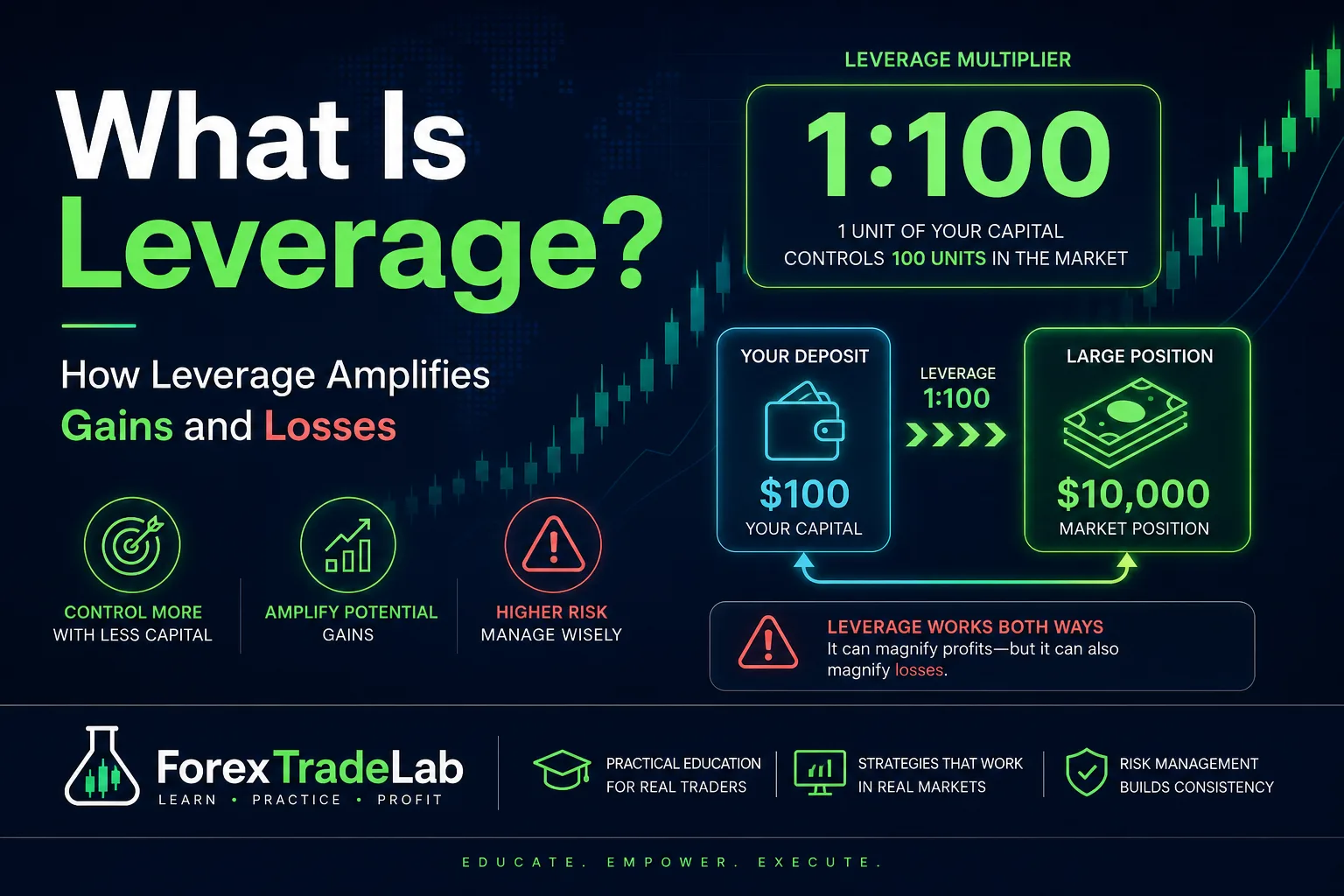
- Leverage does not create edge — it only magnifies how fast a normal losing streak becomes a margin call
- Retail loss rates stay 70–85% even where leverage is capped at 1:30 — proof that behavior, not access to 1:500, is the core problem
- At 5% risk per trade, a 10-trade losing streak is often terminal; at 1% it is usually survivable
- Higher leverage encourages larger notionals with the same stop distance — the hidden account killer
- Profitable retail traders typically use leverage as a sizing tool at 0.5–1% risk, not as a shortcut to bigger P&L

TL;DR — Leverage vs. Losing#
Detailed Explanation
Leverage does not create edge — it only magnifies how fast a normal losing streak becomes a margin call Retail loss rates stay 70–85% even where leverage is capped at 1:30 — proof that behavior, not access to 1:500, is the core problem.
Example
For example, use the article's figures and comparison criteria as a worked scenario, then replace them with the current terms, prices, and limits that apply to your account or market.
Short Answer
Forex leverage destroys retail accounts because it lets traders control positions far larger than their capital can survive losing. A normal 8–12 trade losing streak — inevitable over hundreds of trades — becomes a margin call or stop-out spiral when risk per trade is 3–10% instead of 0.5–1%. Regulators cap retail leverage (often 1:30 in the EU/UK) precisely because higher ratios correlate with faster, larger losses — not because the market is rigged, but because leverage turns ordinary variance into account-ending events.
Common Mistake
Choosing, ranking, or funding a broker from a headline number without confirming the current legal entity, account type, total cost, eligibility rules, and withdrawal terms.
Professional Tip
Save the dated official terms and regulator entry for the entity that would hold your account, then verify the same details in the live onboarding flow before depositing.
| What traders believe | What the data shows |
|---|---|
| "Higher leverage = more opportunity" | Higher leverage = faster path to stop-out on the same mistakes |
| "I'll only use 1:500 on perfect setups" | Perfect setups lose often enough to end accounts at 5%+ risk |
| "Regulators cap leverage to protect banks" | Caps follow retail loss studies (AMF, ESMA), not bank profits |
| "A tight stop makes leverage safe" | Slippage, gaps, and widened stops still happen — size must assume that |
If you read one companion piece first: Why most forex traders lose money. Leverage is how that article's "oversized positions" row actually happens in practice.
The Leverage Illusion#
Every broker login screen celebrates leverage: 1:100, 1:500, 1:1000. The number sounds like skill points in a video game. It is not.
Leverage is borrowed buying power. It lets you control a larger notional position with less of your own cash posted as margin. It does not:
- Improve your win rate
- Widen your edge
- Forgive a bad stop placement
- Shorten the learning curve
It only accelerates outcomes — wins and losses. For the 70–85% of retail accounts that lose money (CySEC, FCA, ASIC disclosures), acceleration overwhelmingly works in one direction.
What Regulators Already Know#
ESMA / FCA retail leverage caps#
Since 2018, ESMA product intervention measures cap retail CFD leverage by asset class — major FX pairs typically 1:30 in EU/UK retail regimes. The FCA publishes ongoing reminders that most retail CFD clients lose money.
That cap did not collapse retail participation. It also did not collapse the loss-rate band. Disclosures still cluster around 72–82% losing accounts. Why?
Because most damage was never "I had 1:500 and held overnight." It was:
- Risking 3–10% per trade on whatever leverage was available
- Treating margin as "room to be wrong" instead of "hard ceiling"
- Running multiple correlated positions that behave like one oversized bet
AMF France: average loss €10,887 over four years#
The AMF's multi-year CFD study remains one of the clearest public datasets on retail outcomes. Losing traders did not lose because forex is fake — they lost slowly and repeatedly, with leverage and frequency as multipliers.
For the full statistical picture: Forex trading success rate statistics 2026.
The Math Brokers Don't Put on the Homepage#
Same stop, different account fate#
Assume a $5,000 account and EUR/USD with a 30-pip stop (~$30 per 0.1 lot).
| Risk % per trade | $ risk | Approx. lot (30-pip SL) | 10-loss streak drawdown |
|---|---|---|---|
| 0.5% | $25 | ~0.08 lot | ~−4.9% |
| 1% | $50 | ~0.17 lot | ~−9.6% |
| 3% | $150 | ~0.50 lot | ~−26% |
| 5% | $250 | ~0.83 lot | ~−40% |
| 10% | $500 | ~1.67 lot | ~−65% |
A 10-loss streak is not a black swan. Over 200 trades at a 55% win rate, you will see stretches that feel like "everything is broken." At 1% risk, you survive and keep executing. At 5%+, you are often psychologically and mathematically finished before your edge can matter.
For ruin probability tables: Forex risk of ruin formula guide.
Leverage changes how big that lot feels#
At 1:30, controlling 1 standard lot ($100,000 notional) on EUR/USD might require roughly $3,300+ margin (varies by broker and rate). At 1:500, the posted margin is far smaller — so the same stop distance feels affordable at a lot size your equity cannot actually survive losing.
That is the trap: max leverage invites max notional, even when your risk plan says otherwise.
Five Ways Leverage Actually Blows Accounts#
1. Confusing "margin available" with "risk budget"#
Pattern: Trader sees $4,000 free margin, opens 0.5 lot because the platform allows it, stop is 40 pips — real risk is 4–8% of equity.
Fix: Size from risk %, not from margin meter. Use the lot size calculator before every entry.
2. Stacking correlated positions#
Pattern: Long EUR/USD, long GBP/USD, long AUD/USD — three trades, one dollar-bearish thesis, 3× effective risk.
Fix: Treat correlated exposure as one bet. See forex correlation and concentration risk.
3. Widening stops because "I have room"#
Pattern: Trade moves against you; stop widened from 30 to 60 pips because margin level still looks fine. Loss doubles; leverage delayed the pain, then concentrated it.
Fix: Stops only tighten after entry. Full context: Forex trading golden rules.
4. Margin call / stop-out cascade#
Pattern: Several open losers + high notional → margin level hits broker stop-out → platform closes worst prices, often across all positions.
Fix: Cap open risk, reduce size after drawdown, know your broker's stop-out level. Read Forex margin call and stop out.
5. Bonus and small-account pressure#
Pattern: $200 deposit + bonus + 1:500 marketing → trader needs "meaningful" dollars per win → oversize → one session erases the deposit.
Fix: Treat bonuses as trading conditions, not free capital. Start micro if equity is small: XM micro account guide and start forex with $100 — realistic guide.
Leverage vs. Skill: What the Profitable Minority Do#
| Behavior | Typical losing usage | Typical disciplined usage |
|---|---|---|
| Leverage ratio displayed | Chases max (1:500+) | Irrelevant — sizes by risk % |
| Risk per trade | 3–10% | 0.5–1% |
| Stop placement | After entry, sometimes moved | Before entry, rarely widened |
| Correlated trades | 3–5 "diversified" pairs, same thesis | Treated as one risk bucket |
| Response to losing streak | Increase size to recover | Reduce size or pause at daily cap |
Same market. Same leverage available. Different usage.
Deep dive on leverage mechanics: What is leverage in forex? and How to trade with leverage step by step.
Honest Self-Assessment: Leverage Edition#
Score 1 (never) to 5 (always):
- I choose lot size from margin available, not from a fixed risk %: ___
- I have traded 3+ correlated pairs without reducing size each: ___
- I widened a stop this month because the platform showed enough margin: ___
- I increased lot size after wins without updating a written plan: ___
- I don't know my broker's stop-out / margin-call level: ___
- My demo lot sizes are larger than I'd use live on the same balance: ___
Score:
- 6–12: Leverage usage likely under control
- 13–22: Common pre-blow-up pattern
- 23+: Pause live trading; reset sizing on demo
What to Do This Week (Practical)#
- Pick one risk number — 0.5% or 1% — and write it at the top of your journal.
- Calculate lot size before every trade — no exceptions.
- Demo trade 20 setups at live-intended size; track max drawdown.
- Read your broker's margin/stop-out rules in the legal docs, not the FAQ marketing line.
- Pair with 10 questions before entering a forex trade.
Practice sizing with zero ruin risk: Open a free XM demo account, set balance equal to your intended live deposit, and trade at your real risk % for 30+ trades before funding.
Affiliate disclosure: ForexTradeLab may earn a commission if you use a tracked broker link. This does not increase our rating or replace your own due diligence. Review the affiliate disclosure and verify current entity-specific terms before opening or funding an account.
Risk Warning: Between 70–85% of retail forex/CFD accounts lose money. Leverage increases both profit and loss potential. This guide is educational — not personal investment advice. Never trade capital you cannot afford to lose entirely.
Comments
Add a useful note for other traders. We review comments before publishing.