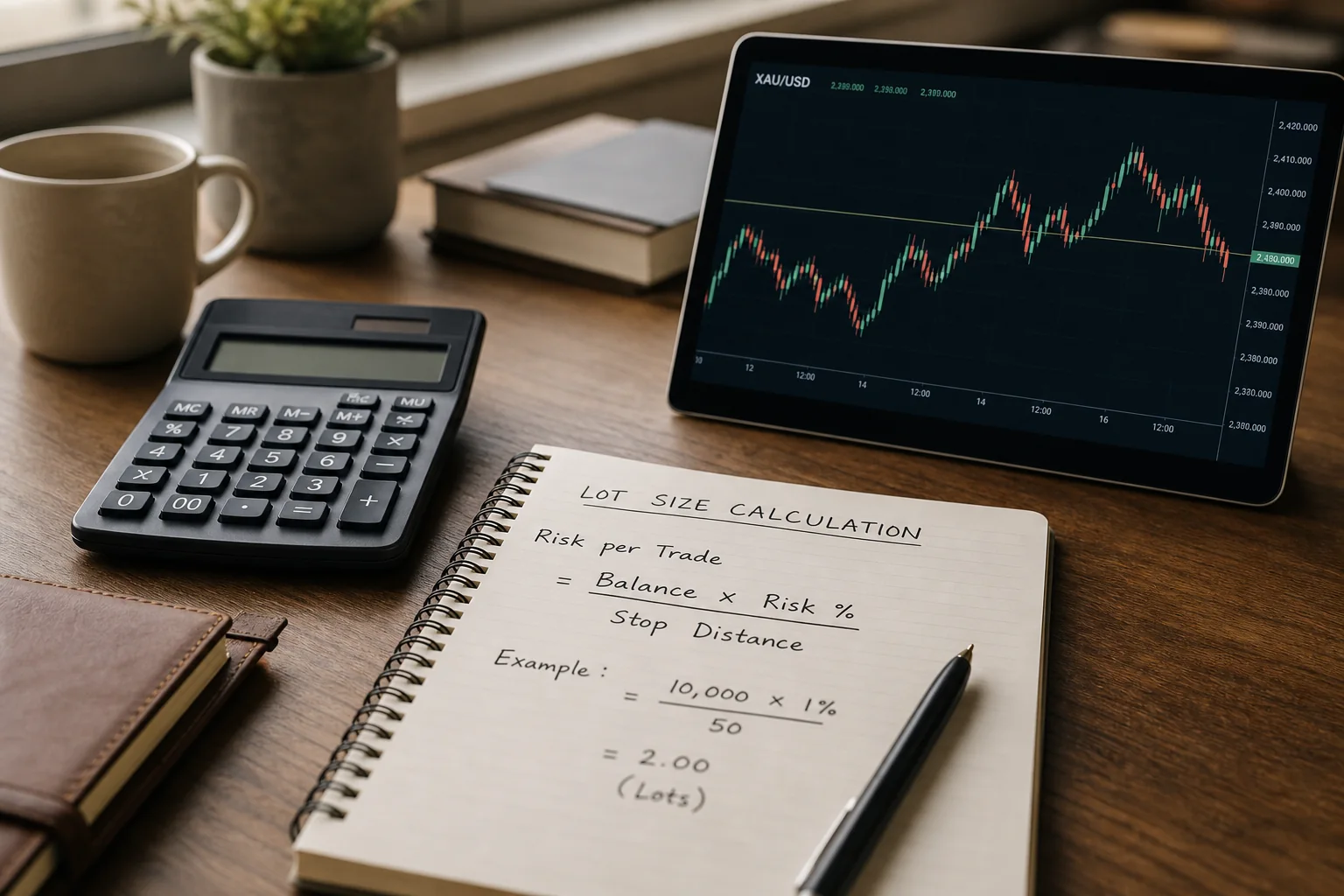
- Gold lot size = cash risk ÷ (stop distance in dollars × $100 per lot) on the common 100-oz contract
- At about $4,125 (29 September 2026), 1 lot is about $412,500 notional and 0.01 lot about $4,125
- Example: $5,000 account, 1% risk, $20 stop gives 0.025, rounded down to 0.02 lot and $40 risk
- Always round down to the broker step and check margin, about $206 per 0.01 lot at 1:20
- Broker pip labels differ ($0.01 or $0.10), so measure stops in dollars first

Affiliate & risk disclosure: ForexTradeLab may earn a commission from qualifying broker links. This does not change the price paid or replace independent checks. See the affiliate disclosure and risk disclaimer.
Quick Answer#
How do I calculate gold lot size? Use the gold position-size formula on the common 100-oz contract:
Lot size = cash risk ÷ (stop distance in dollars × $100 per lot)
Example at about $4,125 (29 September 2026): $5,000 account × 1% = $50 risk; stop $20 away → 50 ÷ 2,000 = 0.025 → round down to 0.02 lot → actual risk $40. Then check margin: 0.02 lot = 2 oz ≈ $8,250 notional ≈ $413 at 1:20. Confirm with the lot size calculator.
Gold market snapshot — 29 September 2026#
| Item | Figure |
|---|---|
| Spot XAU/USD | About $4,125/oz (Reuters via WAM) |
| 28 Sep 2026 | About −4% intraday to $4,111 as yields surged and Fed-hike bets rose (Reuters) |
| Record high | About $5,589, 28 Jan 2026 (Kitco) |
| 2025 close / 2026 YTD | $4,368 (LBMA PM) / about −5.6% |
| Fed funds range | 3.75%–4.00% after the 16 Sep 2026 hike (Fed) |
| Next events | NFP 2 Oct; CPI 14 Oct (8:30 a.m. ET); FOMC 27–28 Oct and 8–9 Dec |
| Central-bank buying / ETF holdings | 345 t in H1 2026 / record 4,189 t end-August (WGC) |
Verify the live price and your symbol specification before sizing; notional and margin change with price.
1. The Gold Lot Size Formula#
Short Answer
On a 100-oz contract, 1.00 lot moves $100 per $1, 0.10 lot $10, 0.01 lot $1. So lot size = cash risk ÷ (stop $ × 100).
Detailed Explanation
Position sizing reverses the P/L calculation. Instead of asking “what will this lot make?”, you fix the loss you accept and solve for volume.
| Volume | Ounces | Notional at $4,125 | Cash per $1 move | Margin 1:20 | Margin 1:100 |
|---|---|---|---|---|---|
| 1.00 lot | 100 | $412,500 | $100 | ≈ $20,625 | ≈ $4,125 |
| 0.10 lot | 10 | $41,250 | $10 | ≈ $2,063 | ≈ $413 |
| 0.01 lot | 1 | $4,125 | $1 | ≈ $206 | ≈ $41 |
Margin figures are illustrative; the leverage you receive depends on your legal entity (UK and EU retail clients are generally limited to 1:20 on gold).
Example
$10,000 account, 0.5% risk = $50; stop $8 → 50 ÷ 800 = 0.0625 → 0.06 lot, risking $48.
Common Mistake
Choosing the lot first (“I always trade 0.05”) and then placing the stop wherever the money runs out.
Professional Tip
Keep the formula on a sticky note: risk $ ÷ (stop $ × 100). If your broker uses a different contract size, replace 100 with the number of ounces per lot shown in the specification.
2. Step-by-Step Worked Example#
Short Answer
Mark the stop from structure, convert to dollars, apply the formula, round down, then check margin and reward.
Detailed Explanation
Illustrative levels only—not a signal:
- Account and risk: $5,000 × 1% = $50.
- Entry and stop: buy at $4,125, invalidation below $4,105 → stop = $20.
- Formula: 50 ÷ (20 × 100) = 0.025 lot.
- Round down: broker step 0.01 → 0.02 lot; actual risk = 20 × 2 oz = $40 (0.8%).
- Margin: 2 oz × $4,125 = $8,250 → ≈ $413 at 1:20, ≈ $83 at 1:100.
- Target: $4,165 (+$40) → +$80 at 0.02 lot, a 2:1 reward-to-risk before costs.
- Cost check: subtract spread and commission from your live quote before accepting the trade.
Example
If the same trader rounded up to 0.03 lot, risk would be $60 (1.2%)—a 50% overshoot of the plan.
Common Mistake
Rounding up “because 0.025 is closer to 0.03”. Always round down.
Professional Tip
Record entry, stop in dollars, formula result, rounded lot and actual risk in the journal—five numbers per trade.
3. Lot Size Tables by Account and Stop#
Short Answer
At 1% risk, the lot size halves every time the stop doubles. Any result below 0.01 means not feasible at minimum volume.
Detailed Explanation
Lot sizes at 1% risk on a 100-oz contract (rounded down to 0.01):
| Account | 1% risk | $5 stop | $10 stop | $20 stop | $40 stop |
|---|---|---|---|---|---|
| $1,000 | $10 | 0.02 | 0.01 | Not feasible (0.005) | Not feasible |
| $5,000 | $50 | 0.10 | 0.05 | 0.02 (0.025) | 0.01 (0.0125) |
| $10,000 | $100 | 0.20 | 0.10 | 0.05 | 0.02 (0.025) |
| $25,000 | $250 | 0.50 | 0.25 | 0.12 (0.125) | 0.06 (0.0625) |
A $20 stop is only about 0.5% of a $4,125 price, and gold moved about 4% (roughly $170) on 28 September 2026, so stops of $20–$40 are not unusual on higher timeframes.
Example
A $1,000 trader who needs a $20 stop cannot trade gold at 1% risk: 0.005 lot is below the 0.01 minimum. The options are a tighter valid setup, a lower-risk instrument, or no trade.
Common Mistake
Copying another trader’s lot size without their account size and stop distance.
Professional Tip
Print this table for your own balance and update it when price moves significantly, because margin (not risk) changes with price.
4. Pip and Point Conventions#
Short Answer
Brokers label gold increments differently: $0.01 may be a “point” or a “pip”, and some call $0.10 a pip. Measure stops in dollars first, then convert.
Detailed Explanation
| Convention | $20 stop equals | Value per unit at 1.00 lot |
|---|---|---|
| Tick / MT5 point = $0.01 | 2,000 points | $1 |
| Pip = $0.10 | 200 pips | $10 |
| Pip = $0.01 (ForexTradeLab lot calculator) | 2,000 pips | $1 |
In the ForexTradeLab lot calculator, gold uses a $0.01 pip worth $1 per standard lot, so a $20 stop is entered as 2,000 pips. The pip value calculator and margin calculator use the 100-oz contract.
Example
Enter a $20 stop as “200 pips” in a $0.01-pip calculator and it will size as if the stop were $2—ten times too large a position.
Common Mistake
Assuming every calculator shares your broker’s definition of a gold pip.
Professional Tip
Test any calculator once with a known case (1% of $5,000, $20 stop → 0.025 lot) before trusting it.
5. Non-USD Accounts (AED, SAR and Others)#
Short Answer
Convert the cash risk into US dollars first, because XAU/USD P/L is in dollars.
Detailed Explanation
The UAE dirham is pegged near 3.6725 per dollar and the Saudi riyal near 3.75, so conversion for Gulf traders is stable. For floating currencies, use the live rate and recheck when it moves.
Example
AED 10,000 account, 1% = AED 100 ≈ $27.23. Stop $10 → 27.23 ÷ 1,000 = 0.027 → 0.02 lot, risking $20 ≈ AED 73.
Common Mistake
Plugging an AED or SAR balance straight into a USD formula, overstating risk capacity by 3.67–3.75×.
Professional Tip
Keep a note of your account currency and conversion rate at the top of your sizing sheet.
6. Practical Gold Sizing Rules#
Short Answer
Stop first, risk second, lot third—then margin, costs and the calendar.
Detailed Explanation
| Rule | Why |
|---|---|
| Risk 0.5%–1% while learning | Gold volatility punishes oversizing |
| Define the stop before the lot | Stop distance controls position size |
| Round down, never up | Keeps actual risk at or below plan |
| Recalculate around US data | A calm-session lot may be too large into CPI (14 Oct) or FOMC (27–28 Oct) |
| Check contract specs | XAU/USD settings are not universal |
| Do not increase size after one win | Gold can reverse quickly |
Example
The classic mistake: “I only opened 0.05 lot, so it is small.” At $4,125, 0.05 lot is 5 oz (about $20,625 notional); an $8 stop costs $40—40% of a $100 account.
Common Mistake
Treating the lot size as a technical detail rather than the core risk decision.
Professional Tip
If the correct lot is smaller than your broker allows, skip the trade. Do not raise risk just to participate. See when the minimum lot is too big.
Key Takeaways#
- Gold lot size = cash risk ÷ (stop $ × $100 per lot) on the common contract.
- At about $4,125, 1 lot ≈ $412,500 notional; 0.01 lot ≈ $4,125 and $1 per $1.
- Always round down to the broker step and recompute actual risk.
- Margin is a separate check: about $206 per 0.01 lot at 1:20.
- Convert non-USD risk to dollars first; AED ≈ 3.6725 and SAR ≈ 3.75 per dollar.
Checklist#
- Contract size (ounces per lot) confirmed on the platform
- Broker’s gold pip/point definition noted
- Stop placed from structure and measured in dollars
- Cash risk written (0.5%–1% while learning)
- Formula applied and lot rounded down
- Actual risk recalculated after rounding
- Margin and free equity checked at your leverage
- Economic calendar checked for NFP, CPI and FOMC dates
Glossary#
- Lot: Standard contract size; usually 100 oz for XAU/USD.
- Cash risk: Dollars lost if the stop is hit, before slippage.
- Stop distance: Dollars between entry and invalidation.
- Notional value: Ounces × price.
- Margin: Collateral required; notional ÷ leverage.
- Volume step: Smallest lot increment the broker accepts, often 0.01.
- Pip / point (gold): Broker-defined price unit, $0.01 or $0.10.
- Reward-to-risk: Target distance ÷ stop distance.
Comments
Add a useful note for other traders. We review comments before publishing.