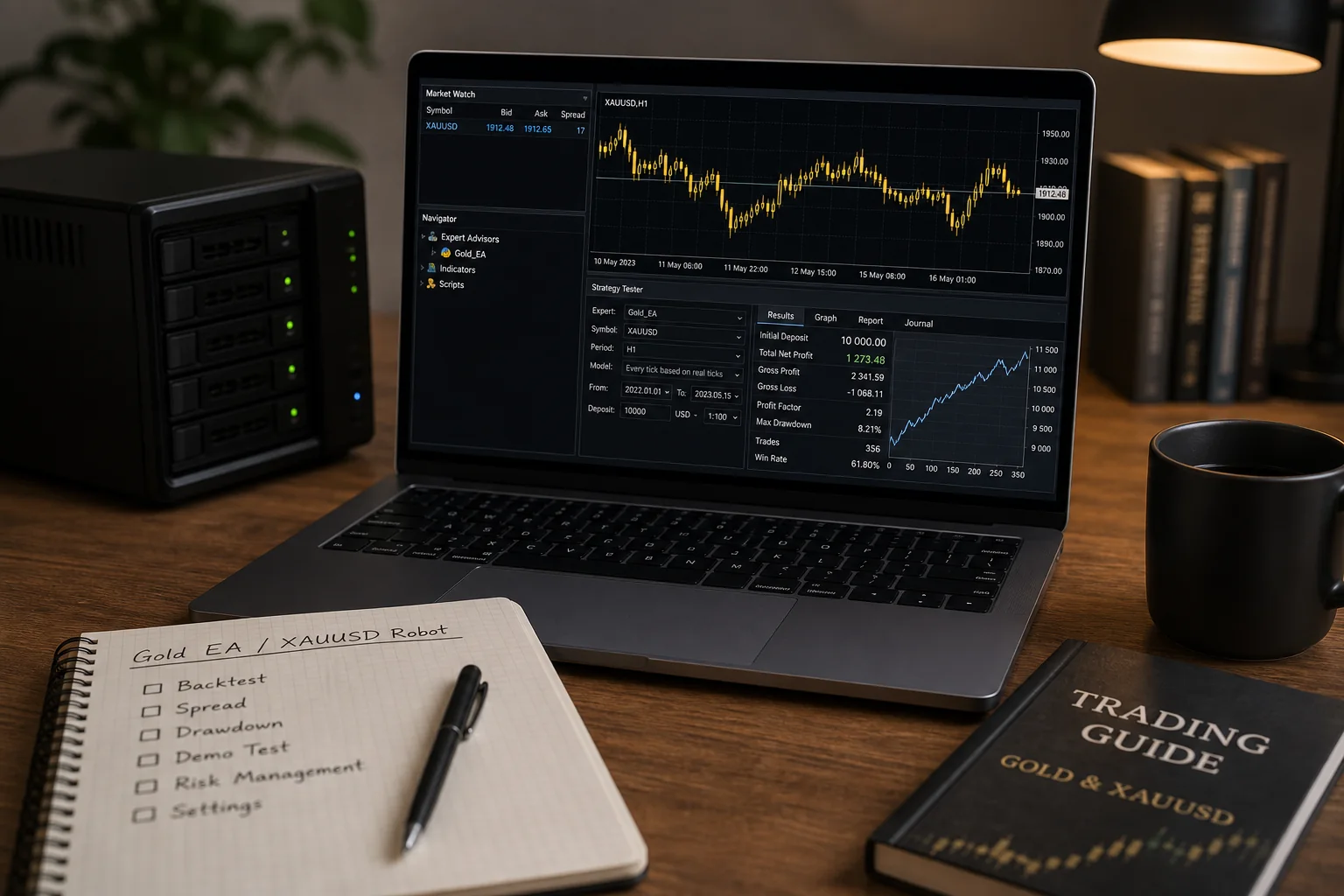
- A Gold EA automates entries, exits and risk rules, but no EA can guarantee profit
- At gold near $4,125, 1 lot is about $412,500 of exposure and every $1 move is $100 per lot, so small sizing errors become large losses
- Backtests with fixed spreads and no slippage can look excellent while live results fail; extra friction of $0.20 per trade on 400 trades at 0.10 lot costs about $800 a month
- Grid and martingale EAs can survive quiet months and then lose heavily in one trend day such as the roughly 4% fall on 28 September 2026
- Test on demo across CPI, NFP and FOMC weeks, then run the smallest live size with a hard weekly and monthly loss limit

Affiliate disclosure: ForexTradeLab may earn a commission from qualifying partner links, without increasing your cost. Read our affiliate disclosure.
Gold context (29 September 2026): spot gold was near $4,125/oz after a fall of about 4% intraday to $4,111 on 28 September, the lowest since 5 August, as Treasury yields jumped after the Fed's 16 September hike (Reuters). Days like that are exactly when poorly designed gold robots fail. Verify the live quote before trading.
Do Gold EAs work?#
Short Answer
Some Gold EAs can execute a defined XAU/USD strategy consistently, but no EA can guarantee profit. An EA is only as good as its rules, its risk limits and the broker conditions it runs under.
Detailed Explanation
A Gold EA (Expert Advisor) is a program for MetaTrader 4 or MetaTrader 5 that trades XAU/USD automatically. It removes hesitation and enforces rules, which is useful. But it cannot tell when the market regime changes, for example when US 10-year yields climb to about 5.2% (28 September 2026) and gold starts trending instead of ranging. Gold robots are especially sensitive to spread, slippage, news spikes and over-optimised backtests.
Example
An EA that buys dips inside a range performed well while gold drifted sideways. When gold fell about 4% on 28 September 2026, the same rules kept buying into a trend, and every "dip" became a larger loss.
Common Mistake
Judging an EA by its best month or by a seller's screenshot instead of by maximum drawdown and live history.
Professional Tip
Before buying or running any EA, write down one sentence: "This EA makes money when ___ and loses money when ___." If you cannot fill in the second blank, you do not understand the robot yet.
What a Gold EA can and cannot automate#
Short Answer
An EA can automate entries, exits, stop losses, take profits, trailing stops, position sizing, time filters and news filters. It cannot create an edge, predict news or protect you from risks its rules do not cover.
Detailed Explanation
| Can automate | Cannot do |
|---|---|
| Entry and exit rules | Invent a profitable strategy |
| Stop loss and take profit placement | Stop slippage during news |
| Position sizing from a risk percentage | Fix a spread that is wider than the target |
| Trading-hour and news-window filters | Adapt safely to a new market regime without rules for it |
| Trailing stops and break-even moves | Guarantee fills at the planned price |
Automation is not the same as edge. If the rules are weak, the robot simply loses faster and more consistently.
Example
An EA sizes each trade at 1% of a $5,000 account ($50) with a $5 stop on XAU/USD. The correct size is $50 ÷ ($5 × $100 per lot) = 0.10 lot. If the EA ignores the stop distance and always opens 0.10 lot, a $15 stop risks $150, three times the plan.
Common Mistake
Assuming "the robot has a stop loss" means the risk is controlled. A stop far from entry on a large lot still risks too much.
Professional Tip
Check the EA's input settings for a risk-percentage option. Prefer EAs that calculate lot size from the stop distance over EAs that use a fixed lot.
Why Gold EAs are riskier than forex EAs#
Short Answer
Gold moves more dollars per lot than most currency pairs and reacts sharply to US data, yields and geopolitics. At about $4,125, 1 standard lot controls roughly $412,500 of gold and every $1 move is worth $100.
Detailed Explanation
| Position | Ounces | Approx. notional at $4,125 | Value of a $1 move | Value of a $170 move |
|---|---|---|---|---|
| 0.01 lot | 1 oz | $4,125 | $1 | $170 |
| 0.10 lot | 10 oz | $41,250 | $10 | $1,700 |
| 1.00 lot | 100 oz | $412,500 | $100 | $17,000 |
The $170 column is roughly the size of the 28 September 2026 intraday fall (about 4% to $4,111). Gold also has spread widening around the 5:00–6:00 p.m. New York daily break, gaps at the Sunday open and session-dependent behaviour. A strategy that survives quiet periods can fail during CPI (next release 14 October 2026), the jobs report (2 October 2026) or an FOMC decision (27–28 October 2026).
Example
An EA running 0.10 lot on a $2,000 account holds a long position through the 28 September fall with no hard stop. A $170 adverse move equals $1,700, or 85% of the account, in one session.
Common Mistake
Running a forex EA on XAU/USD with the same lot settings. The dollar risk per lot is completely different.
Professional Tip
Use the gold lot size calculation guide or our 0.01 lot risk explainer to translate the EA's stop distance into dollars before switching it on.
Grid and martingale Gold EAs#
Short Answer
Grid and martingale EAs add positions as price moves against them. They often show smooth equity curves for months and then lose most of the account in one trending day.
Detailed Explanation
Here is a hypothetical doubling grid, for illustration only. It opens 0.01 lot, then doubles the size every $10 the price moves against it.
| Step | Price vs first entry | New lot | Total open lots |
|---|---|---|---|
| 1 | $0 | 0.01 | 0.01 |
| 2 | −$10 | 0.02 | 0.03 |
| 3 | −$20 | 0.04 | 0.07 |
| 4 | −$30 | 0.08 | 0.15 |
| 5 | −$40 | 0.16 | 0.31 |
| 6 | −$50 | 0.32 | 0.63 |
At −$60 from the first entry, the floating loss is 1×$60 + 2×$50 + 4×$40 + 8×$30 + 16×$20 + 32×$10 = $1,200 (each 0.01 lot is 1 oz). That is from a starting size of just 0.01 lot and a $60 move, far smaller than gold's roughly $170 fall on 28 September 2026.
Example
A martingale EA shows +3% a month for five months on a $5,000 account. A single trend day that forces it to step 6 or beyond can erase all of that gain and much of the deposit.
Common Mistake
Reading "95% win rate" as low risk. Grid systems win often by closing small profits and holding losers until they become very large.
Professional Tip
If you test a grid EA anyway, set a hard equity stop in the EA or platform (for example, close everything at −10% of the account) and a cap on the maximum number of open positions.
Red flags in Gold EA marketing#
Short Answer
Walk away from any EA that promises fixed daily profit, no losses, a 100% win rate or "set and forget" income, or that shows only screenshots or backtests.
Detailed Explanation
The US Commodity Futures Trading Commission (CFTC) warns that fraudsters tout automated trading algorithms and "AI bots" with unreasonably high or guaranteed returns. In the Mirror Trading International case the CFTC describes, a bot program promised at least 10% a month trading currencies, used MetaTrader demo accounts to fake balances, and took more than $1.7 billion in bitcoin from at least 23,000 people (CFTC advisory).
Avoid Gold EAs that show:
- fixed daily or monthly profit promises;
- no-loss or 100% win-rate claims;
- martingale or grid logic without a drawdown limit;
- screenshots without a verifiable live track record;
- backtests with unrealistic fixed spreads;
- no explanation of risk per trade;
- pressure to buy now or recruit friends.
Example
A seller shows a backtest turning $1,000 into $50,000 in a year on XAU/USD but refuses to share a live account statement. That combination is a warning, not a proof.
Common Mistake
Trusting a "verified" badge without checking what was verified: a demo account, a short period or a live account with real deposits.
Professional Tip
Ask for at least 12 months of live history, the maximum drawdown, the average risk per trade and the account type. If the seller talks more about lifestyle than risk, walk away.
Why backtests mislead#
Short Answer
Backtests usually assume fixed spreads, instant fills and clean data. Live gold trading has variable spreads, slippage, requotes and news gaps, and those costs add up fast for high-frequency EAs.
Detailed Explanation
| Backtest assumption | Live reality |
|---|---|
| Fixed spread | Spread widens at rollover, news and holidays |
| Instant fills | Slippage, especially in fast markets |
| Clean tick data | Gaps, missing ticks, different broker feeds |
| Parameters optimised on the same data | Over-fitting that fails on new data |
In MetaTrader 5, use the "Every tick based on real ticks" mode where available, and test on data the EA was not optimised on (out-of-sample).
Example
An EA makes 400 trades a month at 0.10 lot. If live spread plus slippage is just $0.20 worse per trade than the backtest assumed, the extra cost is 400 × $0.20 × $10 = $800 a month.
Common Mistake
Optimising dozens of parameters until the equity curve looks perfect. The more a backtest is tuned, the less it tells you about the future.
Professional Tip
Re-run the backtest with the spread doubled. If the strategy stops being profitable, it has no margin for real-world friction.
How to test a Gold EA safely#
Short Answer
Test on demo across different sessions and at least one CPI, jobs-report and FOMC week, measure maximum drawdown, then move to the smallest live size with hard weekly and monthly loss limits.
Detailed Explanation
| Step | Action |
|---|---|
| 1 | Run on demo first, on the broker you plan to use live |
| 2 | Test across the Asian session, London, New York and rollover |
| 3 | Include weeks with CPI (14 October 2026), jobs data (2 October) and FOMC (27–28 October) |
| 4 | Record maximum drawdown, not only profit |
| 5 | Use realistic spread and commission settings in backtests |
| 6 | Move to tiny live size (for example 0.01 lot) only after stable testing |
| 7 | Set a weekly and monthly maximum-loss stop |
Example
After six weeks on demo, the EA shows a 9% maximum drawdown. On a $1,000 live account at 0.01 lot, the trader sets a monthly stop at −5% ($50). The EA hits it in week two, so the trader pauses it and reviews rather than increasing size.
Common Mistake
Scaling an EA after one lucky week.
Professional Tip
Compare demo and live fills side by side for the same period. If live results are much worse, the gap is your real-world cost, and it will grow with size.
Broker conditions matter#
Short Answer
For a Gold EA, compare XAU/USD spread, commission, slippage, execution type, minimum lot, stop-level rules, swap and whether the broker allows your EA's style.
Detailed Explanation
Check these in the broker's contract specification and terms:
- XAU/USD spread at the hours your EA trades;
- commission per lot;
- slippage and execution model;
- minimum lot and lot step;
- minimum stop distance (stop level);
- swap or swap-free terms;
- VPS availability;
- whether scalping, hedging or high-frequency EAs are allowed.
Read next: Best Brokers for Gold Trading, XAU/USD Trading Hours and Gold VPS guide.
Example
An EA sets a $0.50 stop, but the broker's minimum stop level for XAU/USD is wider. Orders are rejected, and the EA trades without the stop it was designed around.
Common Mistake
Running the same EA at two brokers and expecting the same result. Different spreads, feeds and execution produce different trades.
Professional Tip
Do not invent or assume spreads. Record the live XAU/USD spread from your own platform at the times the EA trades and use those numbers in testing.
Gold EA checklist#
- The EA's logic is explained in plain language, including when it loses.
- Lot size is calculated from stop distance and a risk percentage.
- Every trade has a hard stop loss, and there is a total equity stop.
- No martingale or uncapped grid logic.
- A news filter is set for CPI, jobs data and FOMC.
- Demo test covered several weeks, including major US releases.
- Backtest was repeated with doubled spread.
- Live start at minimum size, with weekly and monthly loss limits.
- The broker's terms allow the EA's style.
Glossary#
- EA (Expert Advisor): an automated trading program for MetaTrader 4 or 5.
- Backtest: running a strategy on historical data to see how it would have performed.
- Out-of-sample test: testing on data not used to optimise the strategy.
- Drawdown: the fall from an account's peak equity to its lowest point before a new peak.
- Grid: a system that opens orders at fixed price intervals.
- Martingale: increasing position size after a loss or as price moves against you.
- Slippage: the difference between the requested price and the executed price.
- Stop level: the minimum distance a broker requires between the market price and a stop or limit order.
Related guides#
- Complete XAU/USD gold trading guide (pillar guide)
- Gold scalping strategy for XAU/USD
- XAU/USD news trading: CPI, NFP and FOMC
- AI forex trading guide
- Best automated forex trading platforms 2026
Bottom line#
A Gold EA can be useful if it automates a tested strategy with strict risk rules. It is dangerous if you buy it as a shortcut. With gold near $4,125 and moving over $100 in a single session in late September 2026, treat every XAU/USD robot as unproven until it survives demo, small live testing and difficult market conditions.
Risk warning: Automated trading can produce rapid losses. Gold CFDs are leveraged products. Gold EAs are not financial advice and do not guarantee profit. This article is educational only.
Comments
Add a useful note for other traders. We review comments before publishing.