
- The London 4pm fix is a published FX benchmark (WMR Closing Spot Rate) at 16:00 UK time, not a retail strategy
- The current trade-currency window is five minutes centred on 16:00 UK — about 15:57:30 to 16:02:30 UK local time
- 16:00 UK is 16:00 UTC in GMT weeks and 15:00 UTC during British Summer Time
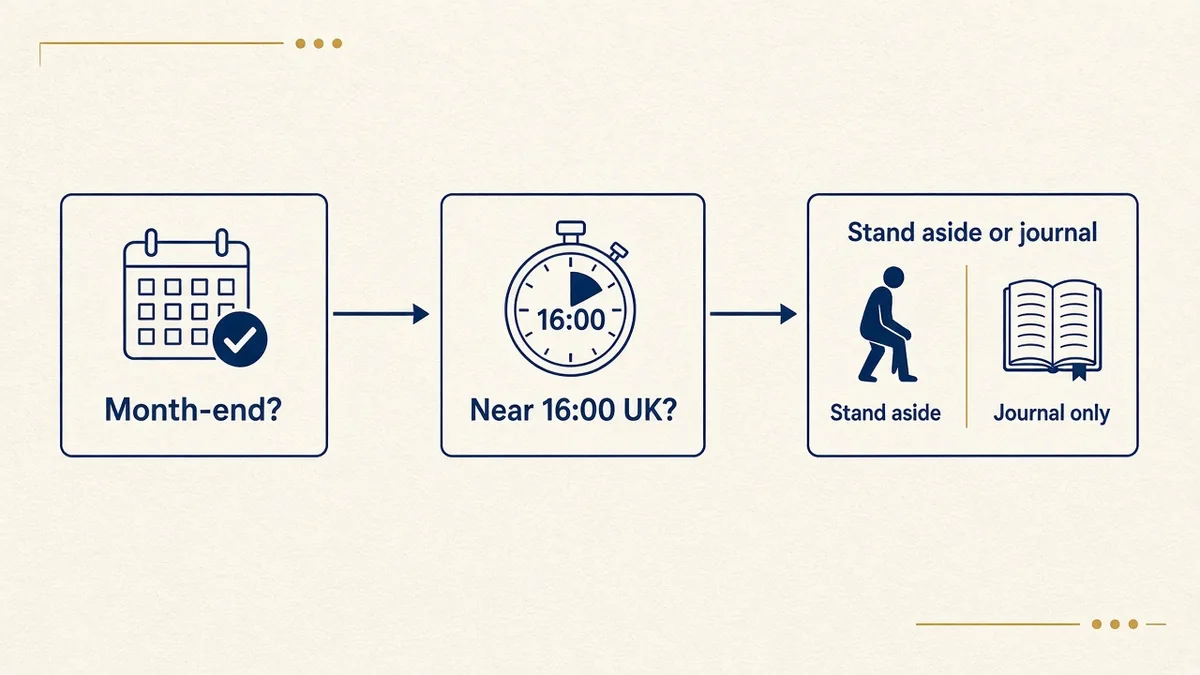
- Month-end and quarter-end often concentrate hedging and index-rebalancing flow around that window
- A spike on your MT4/MT5 candle is not the WMR rate and is not a permission to fade or chase
- Standing aside, or journaling spread and slippage, beats treating 16:00 as a breakout alarm
 Regulated Global Broker
 Trusted by 20M+ traders — open your account in minutes
- Trade 1,400+ instruments
- Country-based bonus offers where eligible
- MT4 & MT5 available
- Easy deposits and withdrawals
- Leverage up to 1000:1, where available
- Copy Trading: auto-copy expert strategy managers
- Quick Decision Framework
- Short Answer
- Detailed Explanation
- Example
- Common Mistake
- Professional Tip
- Quick Answer
- What the Fix Actually Is
- Short Answer
- Detailed Explanation
- Example
- Common Mistake
- Professional Tip
- The Five-Minute Window — Clock, Not Magic
- Short Answer
- Detailed Explanation
- Example
- Common Mistake
- Professional Tip
- UK Time Versus UTC — The Silent One-Hour Error
- Short Answer
- Detailed Explanation
- Example
- Common Mistake
- Professional Tip
- Why Month-End and Quarter-End Feel Different
- Short Answer
- Detailed Explanation
- Example
- Common Mistake
- Professional Tip
- What Retail Traders Should Do (and Not Do)
- Short Answer
- Detailed Explanation
- Example
- Common Mistake
- Professional Tip
- The 2013–2015 Conduct Cases — Why the Window Widened
- Short Answer
- Detailed Explanation
- Example
- Common Mistake
- Professional Tip
- Not Every “Fix” Is London 16:00
- Short Answer
- Detailed Explanation
- Example
- Common Mistake
- Professional Tip
- Checklist
- Glossary
- Related Reading
- Suggested Future Articles
Affiliate & risk disclosure: ForexTradeLab may earn a commission from qualifying broker links. That does not change your price or replace entity checks. See the affiliate disclosure and risk disclaimer.
Educational only: Forex and CFDs are leveraged. You can lose more than a small deposit quickly, and a majority of retail CFD accounts lose money. A 16:00 UK spike on a demo chart is not a live signal. Stops can slip when flow concentrates.
Quick Decision Framework#
Short Answer
The London 4pm FX fix is a published benchmark (the WMR Closing Spot Rate) at 16:00 UK time. It is used to value portfolios. It is not a retail breakout alarm.
Detailed Explanation
Spot FX is an OTC dealer market. The BIS Triennial Survey describes enormous daily turnover, but that turnover is not evenly spread across the clock. Some clocks matter because contracts and funds need a single rate. The industry’s most-used daily snapshot for many global portfolios is 16:00 in London.
LSEG publishes the WMR (historically WM/Reuters) methodology. For widely traded “trade currencies,” the calculation samples a five-minute window centred on 16:00 UK — from 2 minutes 30 seconds before the hour to 2 minutes 30 seconds after. Medians, validation checks and a published waterfall (executed trades first, order book if needed) are administrator details. You do not need to replicate the formula. You do need to stop treating the candle as a signal.
Month-end and quarter-end often add index rebalancing and equity-hedge flow into that same window. Academic and official work (including FCA Occasional Paper 46) studied volume around the window. Extra activity is a liquidity event. It is not a free forecast of the next hour.
Example
Illustrative. It is the last business day of the month. EUR/USD on your H1 chart prints a 12-pip range between 15:55 and 16:05 UK while the spread is wider than the London morning. That is a flow window. It is not proof that “the market chose up.”
Common Mistake
Shorting every 16:00 spike because a social post said “fix fade.” You cannot see the underlying hedge book. You are trading a cartoon of a benchmark.
Professional Tip
Write 16:00 UK in the journal, then write the UTC equivalent for that date. Pair this page with daylight saving and forex sessions so you do not log the wrong hour after the clocks move.
Quick Answer#
What is the London 4pm FX fix? A WMR Closing Spot Rate at 16:00 UK. Practical rules:
- The clock is UK local time, not your broker server and not a frozen UTC hour.
- The modern window is five minutes, not a single tick at 16:00:00.
- Month-end and quarter-end are different laboratories from a quiet mid-month Wednesday.
- Your retail fill is not the benchmark.
- If you have no written invalidation, stand aside.
Related cluster: forex market hours, liquidity and slippage, best time to trade forex, broker server time versus local time.
What the Fix Actually Is#
Short Answer
A reference rate for valuation and contracts — calculated by an administrator, not by your platform.
Detailed Explanation
Funds, custodians and many corporate processes need one FX rate to mark a book into a base currency. Equity index providers that publish global indices in US dollars need FX rates to convert local-market prices. That operational need created a daily “closing” snapshot in London, the city that still sits at the centre of much OTC FX activity.
The product name you will see in 2026 documents is usually WMR (WM Reuters / WM/Refinitiv lineage, now under LSEG). The Closing Spot Rates are the 16:00 UK set. WMR also publishes other hourly and half-hourly rates through the week. Those exist. They are not “the 4pm fix” in market slang.
The LSEG methodology PDF is the primary source for calculation times, holiday policy and the difference between trade currencies and quote-based currencies. If a YouTube thumbnail disagrees with that PDF, the PDF wins.
Example
A global equity fund that is long Japanese stocks and reports in USD may hedge some of the yen exposure using a rate linked to the London close. That hedge is inventory management. It is not a retail scalper’s pattern.
Common Mistake
Calling every 16:00 candle on gold or an index CFD “the fix.” Gold and equity index CFDs have their own session and contract rules. Do not import a spot-FX benchmark story onto a different product. See what is a CFD.
Professional Tip
If you cannot name who needs the rate (fund, index, corporate), you are not describing the fix. You are describing a clock.
The Five-Minute Window — Clock, Not Magic#
Short Answer
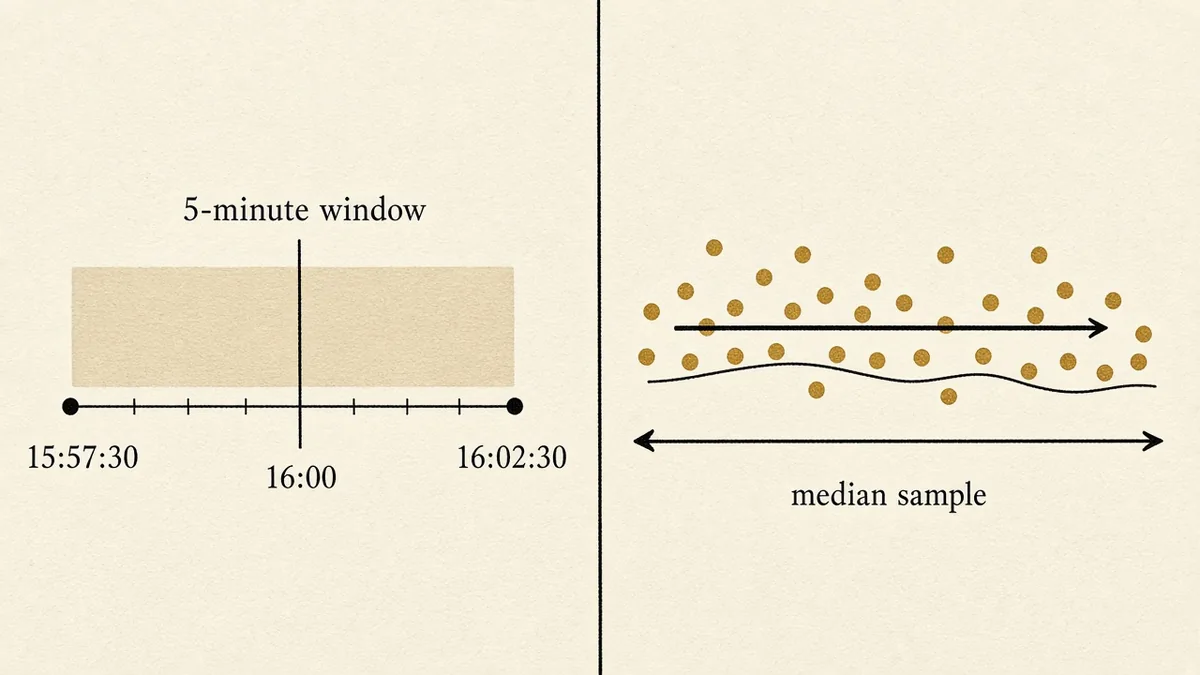
For widely traded currencies, samples run from 15:57:30 to 16:02:30 UK. The headline hour is the centre, not the only second that matters.
Detailed Explanation
Before 15 February 2015 the widely used window for traded currencies was one minute. After the FX benchmark-conduct cases of 2013–2015, the Financial Stability Board recommended a wider window to make a single burst of orders less able to dominate the median. WM implemented five minutes. The BIS 2015 remarks on FX benchmarks explain why a snapshot used in so many contracts needed a more robust sample.
Current published methodology for trade currencies still uses that ±2 minutes 30 seconds design around the calculation time, with a waterfall that prefers executed trades from named matching platforms and falls back to order-book samples if trade counts are too thin. Exact platform lists and validation rules belong in the live PDF, not in a retail memory slogan.
What a retail trader should take from this:
- Price can be busy for several minutes, not one print.
- A “16:00” H1 candle on many brokers is a whole hour that happens to contain the window.
- An M1 or M5 chart can show the window more honestly — and still not show the official median.
Example
Illustrative. UK is on GMT. You mark 15:57–16:03 UTC on EUR/USD M1. You see two-way range, a wider spread, then a quieter book. That is the laboratory. Fading the first M1 close because “the window started” is still a guess.
Common Mistake
Using broker server time as if it were London. Some books run UTC+2 or UTC+3 all year. 16:00 on that clock can be a completely different UK hour. Fix this with broker server time versus local time.
Professional Tip
Put UK time and UTC in the screenshot filename. Future-you will not remember whether that week was BST.
UK Time Versus UTC — The Silent One-Hour Error#
Short Answer
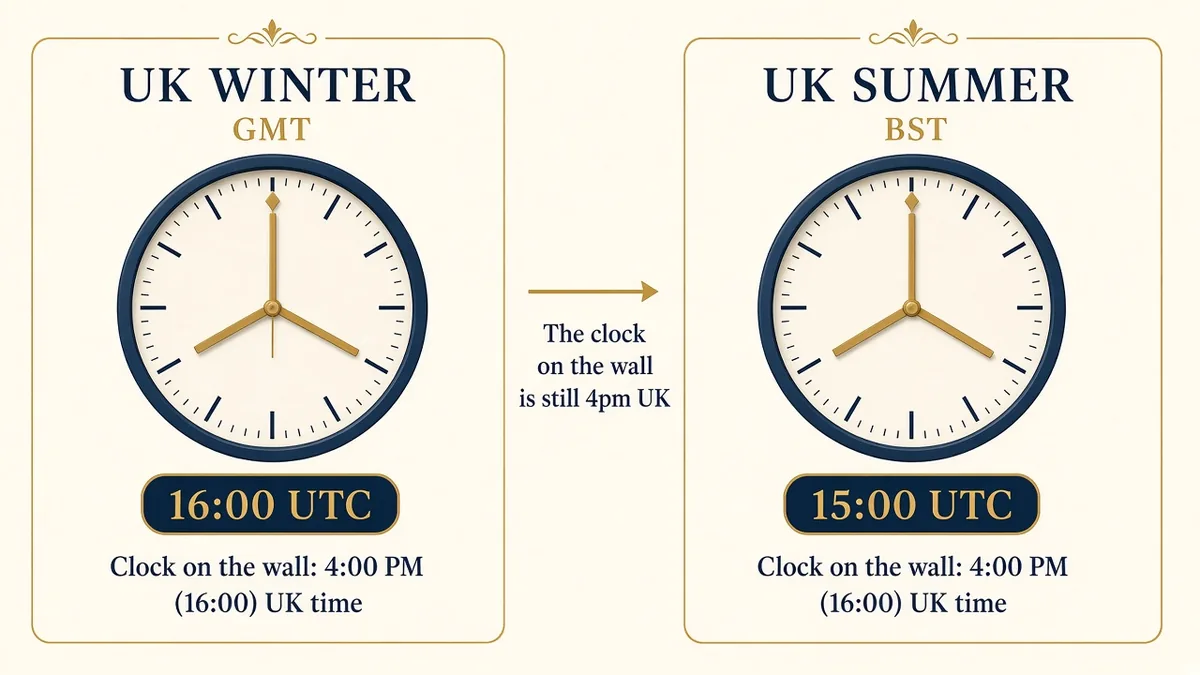
The fix is 16:00 on the London civil clock. UTC moves when the UK does.
Detailed Explanation
GOV.UK publishes the UK clock-change dates. In 2026 the UK went forward on 29 March and goes back on 25 October.
| UK civil clock | 16:00 UK equals | Typical label |
|---|---|---|
| GMT (winter) | 16:00 UTC | GMT weeks |
| BST (summer) | 15:00 UTC | British Summer Time |
If you stored “the fix is 16:00 GMT” from a 2019 blog, you will be one hour late all summer. That is how people “discover” a fake breakout that was actually the window you mis-timed.
Example
On a BST Monday, a trader in Riyadh (UTC+3, no DST) who waits for 19:00 Riyadh because “4pm London is +3” will actually be waiting for 19:00 BST, which is correct for the wall clock in London — if they meant 16:00 UK. The error is mixing GMT+3 with London in summer. 16:00 BST = 15:00 UTC = 18:00 Riyadh. One frozen offset ruins the log.
Common Mistake
Copying a UTC table from last March after the US and UK change on different Sundays. That mismatch is the subject of the DST session guide.
Professional Tip
For 2026, put 25 October on the calendar: UK falls back, the US is still on daylight time until 1 November. The fix’s UTC hour changes on the UK date, not the US date.
Why Month-End and Quarter-End Feel Different#
Short Answer
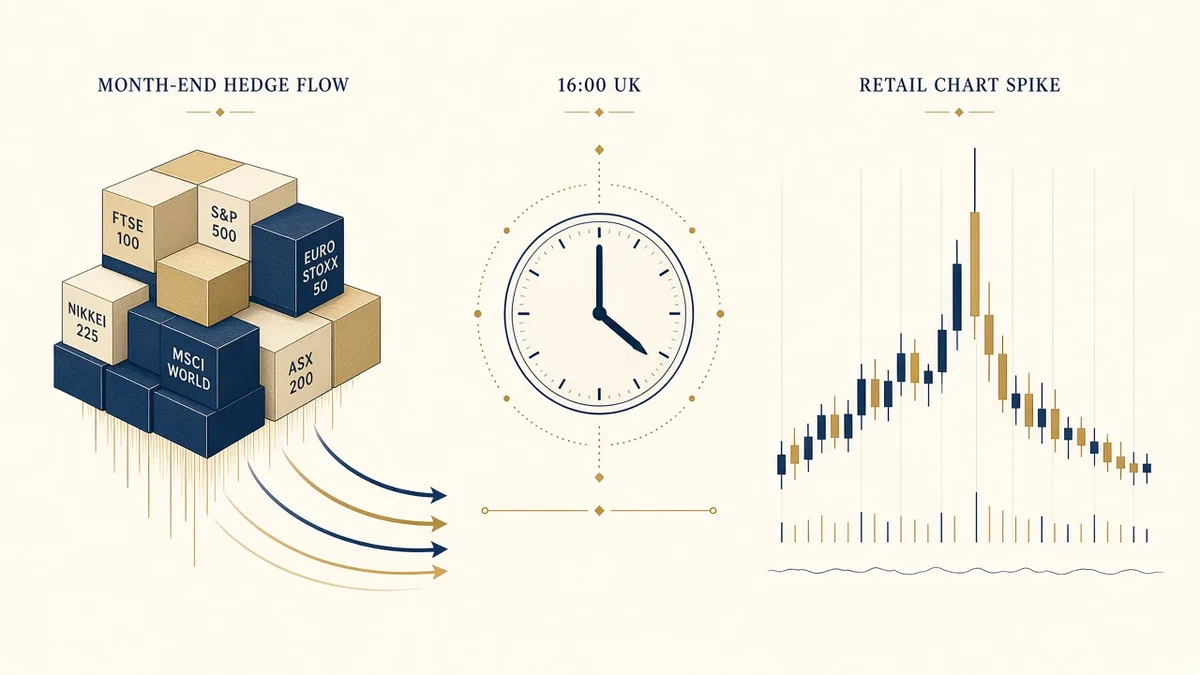
Benchmark-linked hedging and rebalancing often bunch near the same clock. More bunched flow, not a guaranteed trend.
Detailed Explanation
Portfolio managers who must match a published index or a month-end NAV have an incentive to transact near the rate that will be used to value the book. That is a structural reason for a volume bulge around 16:00 UK, and a larger bulge when many funds rebalance on the same calendar day.
The FCA paper is explicit that the 4pm fix is heavily used and that trading around the window is a distinct microstructure object. You should not invent a 2026 pip forecast from that. You should expect:
- Faster two-way prints
- Wider or jumpy spreads
- Slippage on stops that sat in the obvious place
- More false breaks on the M5/M15 that you then overfit
Quarter-end can stack index, CTA and corporate calendars. It is still not a direction.
Example
Illustrative. 30 September, 15:50 UK. You planned a London-close fade on GBP/USD with a 6-pip stop that worked on mid-month Tuesdays. Month-end spread is 1.5× the morning. The stop is now economically different. Cancel. The setup died when the cost changed, before price did.
Common Mistake
Treating every Friday as month-end. Month-end is the last business day, which can be Thursday. US and UK holidays also shift the last dealing day. See bank holidays and thin liquidity.
Professional Tip
In the journal, tag sessions ME (month-end), QE (quarter-end) or ordinary. If you later test a rule, those tags stop you mixing two markets.
What Retail Traders Should Do (and Not Do)#
Short Answer
Observe, convert the clock, log costs, stand aside by default. Do not build a “4pm system” from three screenshots.
Detailed Explanation
Retail CFDs are not the matching engines named in the WMR PDF. Your execution quality is your broker’s book, markup and last-look or internalisation policy — see how brokers make money as context, not as a conspiracy theory.
A professional retail process around the fix looks like this:
| Observation | Working diagnosis | Default action |
|---|---|---|
| Quiet mid-month, normal spread | Ordinary hour that happens to include 16:00 UK | Trade only if your non-fix setup is valid |
| Spread 2× a liquid hour | Book is charging for risk | No new scalp; optional journal |
| Month-end / quarter-end | Concentrated benchmark flow | Stand aside or cut size before 15:50 UK |
| Spike then reclaim on the close | Possible fake break in flow | Do not chase; apply false-break rules if you have them |
| You cannot name UK vs UTC | Clock error | No trade |
Stops still fill as stop-market style instructions in most retail FX books. In a fast window they can gap. That is fill physics, not proof the broker “hunted the fix.”
Example
A $2,000 account that normally risks 1% with a 15-pip EUR/USD stop should not keep the same lot when the live spread has already consumed 4 of those 15 pips. Recalculate with the lot calculator or skip.
Common Mistake
Adding a second position because “the fix will revert.” Averaging into a flow event is how small accounts donate the month.
Professional Tip
If you insist on studying the window, do it on demo for 20 dated sessions with a pre-drawn rule, then compare all-in cost using spread, commission, swap and slippage. Live size comes last, if ever.
The 2013–2015 Conduct Cases — Why the Window Widened#
Short Answer
The wider window is a integrity reform, not a retail edge.
Detailed Explanation
Public enforcement and the FSB review documented that sharing customer order information and trading to influence a narrow median created a conflict around a widely used snapshot. The reform package included a longer sample so that a short burst of orders would be less able to set the rate.
That history belongs in an EEAT article because it explains why 16:00 is famous and why the sample is five minutes. It does not license you to recreate 2013 chat-room behaviour, and it does not mean the 2026 window is “solved” into a mean-reversion ATM.
If you want the primary papers: FSB FX benchmarks, FCA OP46, BIS remarks.
Example
A one-minute median can be more sensitive to a last-second burst than a five-minute median. That is a statistics statement. It is not a 2026 trade.
Common Mistake
Telling new traders “the fix is rigged so fade it.” Conduct cases were about wholesale information and execution. Your CFD stop is a separate problem.
Professional Tip
Teach the reform as market-structure literacy. Then return to risk. Leverage still dominates any benchmark story. See the risk-management guide.
Not Every “Fix” Is London 16:00#
Short Answer
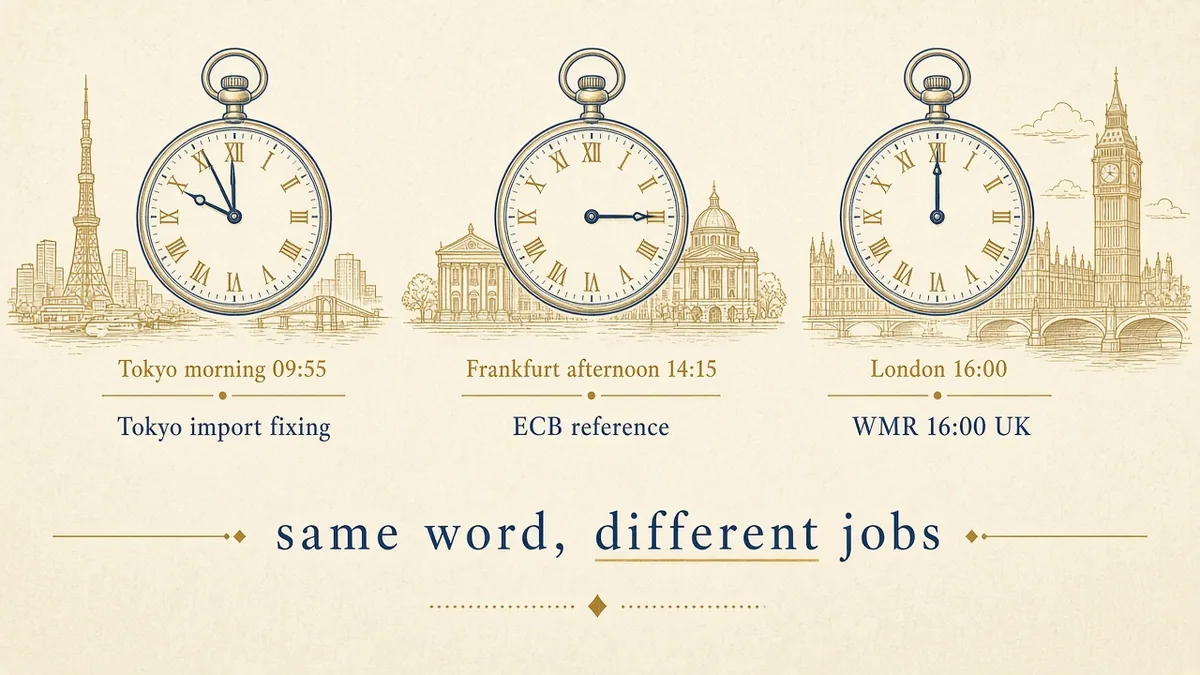
Tokyo, ECB and WMR hourly prints are different products.
Detailed Explanation
Japanese importers have long used a morning Tokyo fixing convention (often discussed around 09:55 JST) to set customer rates. The ECB publishes euro foreign-exchange reference rates around 14:15 CET as a central-bank reference set — a different job from WMR. WMR itself prints many hours besides 16:00 UK.
If a strategy PDF says “trade the fix” without naming which reference, which clock and which product, it is not a strategy.
Example
A USD/JPY burst at 00:55 UTC is not “the 4pm fix.” It may be Tokyo morning. Different participants, different clock.
Common Mistake
Stacking Tokyo, ECB and London into one indicator. You will always find a spike.
Professional Tip
One journal field: benchmark = WMR-1600-UK | ECB-1415-CET | Tokyo-local | none.
Checklist#
- UK date checked against GOV.UK clock changes
- 16:00 UK converted to UTC for this week
- Broker server mapped, not assumed equal to London
- Month-end / quarter-end tagged or ruled out
- Spread compared with a liquid London hour on the same pair
- No breakout entry on the first spike without a close rule
- Stop distance still converts to 0.5–1% cash via the lot calculator
- Product is spot FX, not a random gold or index CFD story
- Screenshot includes the UK clock, not only the platform clock
- Default if unsure: flat through 15:57–16:03 UK
Next step: on demo, mark 16:00 UK on ten dated sessions — five ordinary, five near month-end — and log only spread and range. Do not add a live lot to “collect data.” Eligibility still depends on country and entity — XM availability is not a fix strategy.
Glossary#
- WMR Closing Spot Rate — The 16:00 UK WMR benchmark set used as a widely referenced FX snapshot.
- Fix / fixing window — The minutes around a benchmark calculation when hedging and matching activity often rises.
- Trade currencies — WMR’s more liquid set, calculated with a trade-first waterfall in the published methodology.
- Median sample — A robust average of captured prints; less sensitive to one extreme tick than a last price.
- Month-end rebalancing — Portfolio adjustments on the last business day that can add FX hedge flow.
- UK local time — GMT in winter, BST in summer; the clock the 4pm fix follows.
- Retail book — Your broker’s quoted stream; not the WMR input platforms.
Related Reading#
- Daylight saving time and forex sessions
- Forex market hours, liquidity and slippage
- Best time to trade forex
- Broker server time versus local time
- London session and NY open
- False breakout guide
- Bid/ask mechanics
- All-in trading costs
- Bank holidays and thin liquidity
- What is forex
- Risk management pillar
Suggested Future Articles#
- Quarter-end versus month-end: a dated journal template with three screenshot slots
- How WMR hourly prints differ from the 16:00 close for swing traders who never intend to trade the window
- Mapping broker-server 16:00 candles on UTC+2 versus UTC+3 books to UK civil time
Risk warning: CFDs are complex leveraged products. A majority of retail client accounts lose money. Hypothetical clocks and ranges are educational. Stops can slip. Confirm contract specifications with your broker and read the ForexTradeLab disclaimer.
Comments
Add a useful note for other traders. We review comments before publishing.