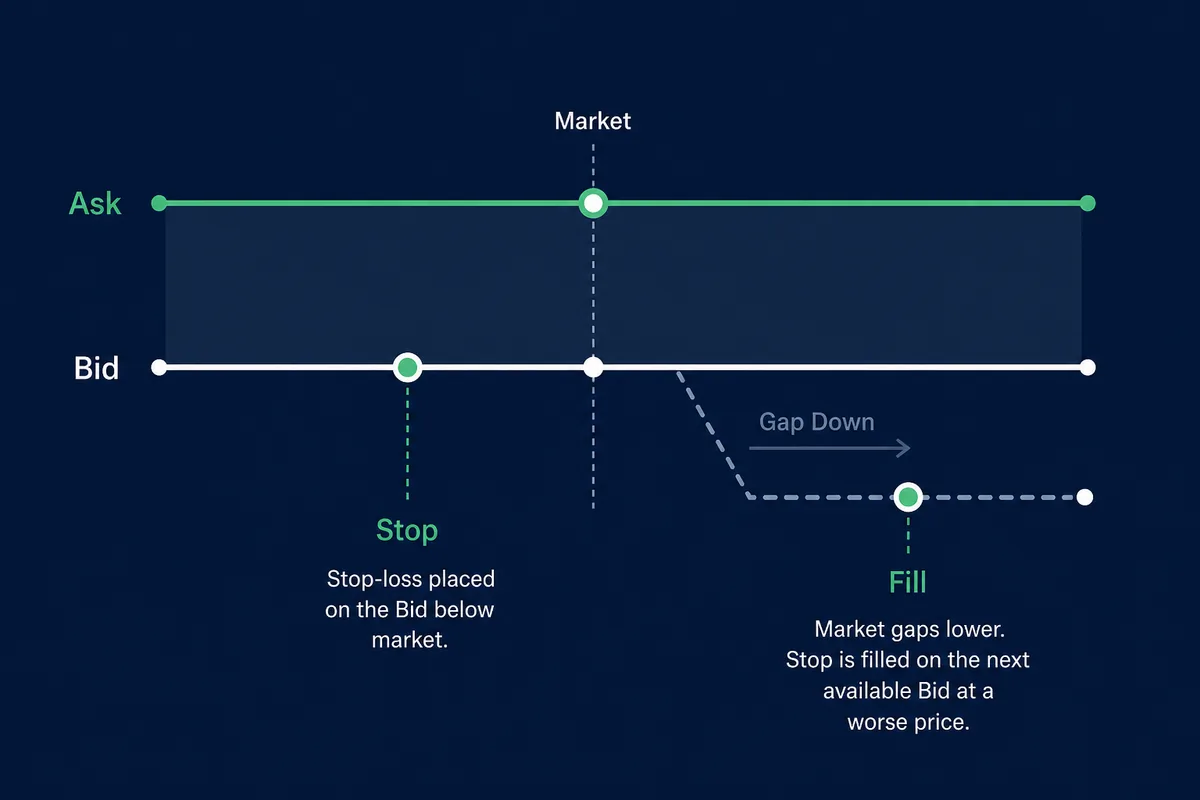
- A stop-loss is a trigger, not a guaranteed print at that exact price
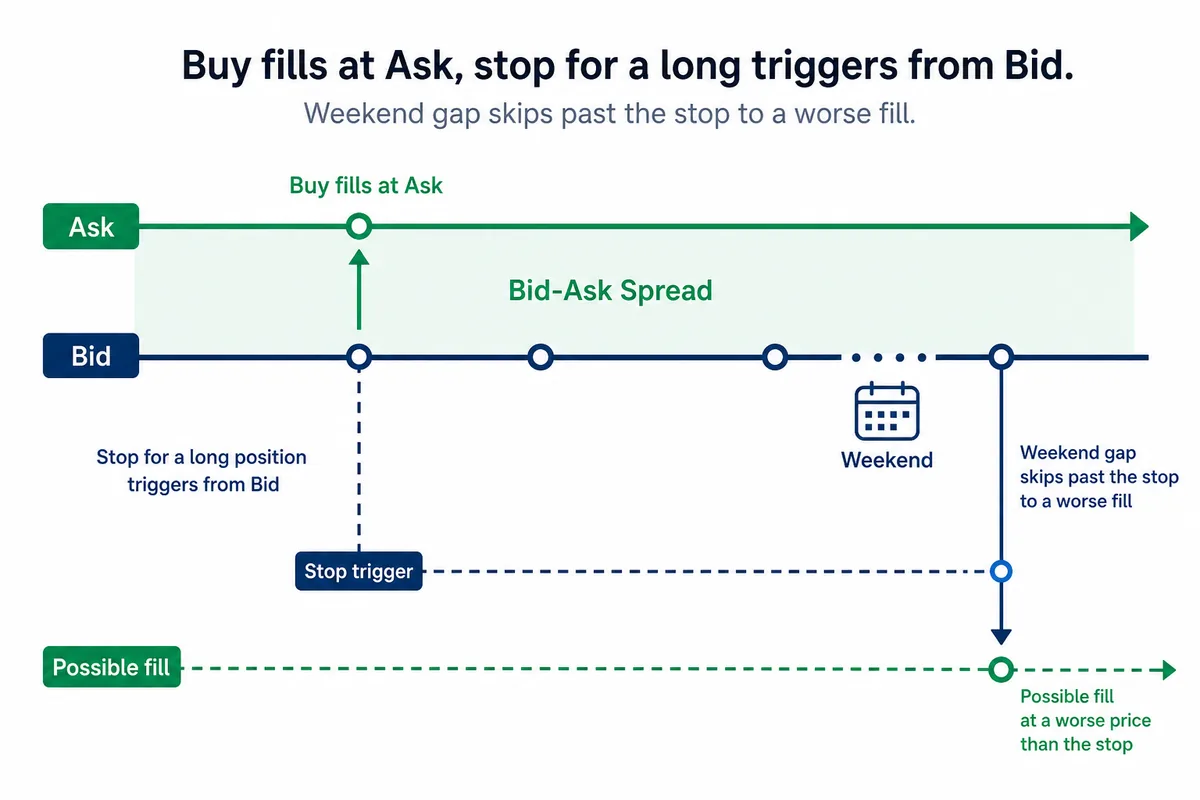
- Longs stop out against Bid; shorts against Ask — the spread is already in the path
- Gaps and news can skip your level; the fill is the next tradable price
- Invalid Stops is a rejection at placement, not a bad fill after the fact
- Stop-limit protects price and can leave you without an exit
- Stop-out from low margin is a different process from your SL ticket
- Quick Answer
- Cause 1 — You Stopped Against the Other Side of the Spread
- Short Answer
- Detailed Explanation
- Example
- Common Mistake
- Professional Tip
- Cause 2 — A Gap Skipped Your Price
- Short Answer
- Detailed Explanation
- Example
- Common Mistake
- Professional Tip
- Cause 3 — News Widened the Spread, Then Printed Through You
- Short Answer
- Detailed Explanation
- Example
- Common Mistake
- Professional Tip
- Cause 4 — You Used a Stop-Limit and It Never Became a Trade
- Short Answer
- Detailed Explanation
- Example
- Common Mistake
- Professional Tip
- Cause 5 — Stop-Out Closed You, Not Your Stop Ticket
- Short Answer
- Detailed Explanation
- Example
- Common Mistake
- Professional Tip
- Invalid Stops: The Error That Is Not Slippage
- Five-Cause Checklist
- Key Takeaways
- Glossary
- Checklist
- Future related articles
Affiliate & risk disclosure: ForexTradeLab may earn a commission from qualifying broker links. See the affiliate disclosure and risk disclaimer.
Risk warning: Fast markets can gap through stops. This is education, not a promise that any broker will fill at your exact price. Never size a position you cannot survive if the fill is several times worse than planned.
Quick Answer#
If the platform accepted your stop and later closed you at a worse price, you usually saw slippage on a market order after the trigger — not a “broken” stop.
If the platform refused the stop with Invalid Stops, the level was inside the symbol’s stops level band. That is a placement error. Read how to read contract specification.
If the stop never filled and price ran through, check whether you used a stop-limit, whether trading was closed, or whether stop-out closed you on margin first.
CFTC educational material on stop-loss orders is blunt: stops can fill at a worse price when the market moves fast. FINRA makes the same point for volatile sessions. Retail FX CFDs follow the same physics: trigger, then market.
Cause 1 — You Stopped Against the Other Side of the Spread#
Short Answer
A long stop sells the Bid. A short stop buys the Ask. Chart candles often follow Bid. Your number can look “wrong” even in a quiet market.
Detailed Explanation
Buying opens at Ask. The protective sell stop for that long is watching Bid. If Bid is 1.0840 and Ask is 1.0842, a stop at 1.0840 on a long is already sitting on the Bid. A slightly wider live spread can print a fill a few points through the line you drew on a Bid chart.
This is the same mechanics as why a new trade starts negative. It is not manipulation by default.
Example
Illustrative only. EUR/USD Bid 1.08500, Ask 1.08512. Long entry filled at 1.08512. Stop set at 1.08480. Trigger is Bid ≤ 1.08480. If news prints and Bid jumps to 1.08450, the market sell can fill near 1.08450, not 1.08480.
Common Mistake
Measuring “missed pips” on a Bid chart without opening the tick that shows Ask.
Professional Tip
In the journal, log Bid, Ask, spread, requested SL, fill. Four numbers end most arguments with yourself.
Cause 2 — A Gap Skipped Your Price#
Short Answer
If there is no Bid at your stop during the jump, the fill is the first Bid after the gap.
Detailed Explanation
Weekend FX is closed. Monday can open beyond Friday’s stop. Gold and index CFDs gap on cash-session opens too. Your stop does not “owe” you Friday’s price. It owes you an exit once the book is open.
Weekend gap risk is the dedicated map. Here the diagnostic is simple: if History shows a fill at the session open and the chart has an empty range, you have a gap fill, not a slow trail.
Example
Friday Bid close 2,640 on a gold CFD. Stop 2,635. Monday Bid open 2,618. The stop can trigger and fill around 2,618. The $17 gap is the story; the $5 stop distance was never a cap.
Common Mistake
Holding a tight gold stop over the weekend because “it is only five dollars.” Dollars per ounce times contract size is still in specification.
Professional Tip
If you cannot tolerate the open, you cannot tolerate the hold. Flatten before the break or size as if the next open is the stop.
Cause 3 — News Widened the Spread, Then Printed Through You#
Short Answer
At NFP, CPI or FOMC, Bid and Ask can jump together and apart. Your stop can trigger in a 20-point spread that was 1 point a minute earlier.
Detailed Explanation
This is not the same as a weekend gap. The session is open. Liquidity is thin. Market-makers and last-look books (where they exist) reprice. Your market stop competes with everyone else’s.
Use the economic calendar, the USD news playbook, and news spread/slippage logging. The second-wave approach in second-wave news trading exists because the first print is often untradeable.
Example
Spread on a gold CFD is 0.30 in London. At the US open it is 2.50 for twelve seconds. A long stop that was 1.00 below Bid can fill 2–3 dollars worse if Bid lurches and Ask/Bid both gap.
Common Mistake
Placing a scalp stop “just under the candle” one minute before a red-folder release.
Professional Tip
If you must be in a news trade, pre-define maximum acceptable fill in money. If the first quote after the print is beyond that, you already violated the plan — flatten by market and journal it, do not “hope the spread comes back.”
Cause 4 — You Used a Stop-Limit and It Never Became a Trade#
Short Answer
A stop-limit can miss. A stop can slip. They fail in opposite directions.
Detailed Explanation
Stop: trigger, then market, possible worse fill.
Stop-limit: trigger, then limit; if the market is already through the limit, no fill.
Investor.gov and FINRA describe this for securities; the CFD version is the same logic. Beginners pick stop-limit because it “protects price” and then watch a trend run with an unfilled ticket.
Example
Buy-stop-limit trigger 1.0900, limit 1.0902. Price gaps 1.0890 to 1.0910. Triggered, limit never valid, you are not in. For an exit stop-limit on a long, the same gap can leave you still in.
Common Mistake
Using stop-limit as the only emergency exit on gold.
Professional Tip
Emergency exits: stop (accept slippage) or a smaller position. Stop-limit is a entry precision tool more often than an account-safety tool.
Cause 5 — Stop-Out Closed You, Not Your Stop Ticket#
Short Answer
If margin level hit the broker’s stop-out, the platform may close positions under its rules. That close can look like a “bad stop” in History.
Detailed Explanation
Margin call vs stop-out vs liquidation is the full map. Diagnostic: if several tickets die in one second, equity is near used margin, and your SL was still far away, you likely hit stop-out.
Negative-balance rules do not restore a stop that never had room. See negative balance protection.
Example
Account $500, gold 0.10 lot, no SL. A $40 adverse ounce move (times ounces in the contract) can wipe free margin. The closer is the stop-out engine, not a 2,650 stop you forgot to attach.
Common Mistake
Reading “closed by system” as “the broker stole the last pip.”
Professional Tip
Keep free margin large enough that your SL hits first. If stop-out is closer than your SL, the SL is decoration.
Invalid Stops: The Error That Is Not Slippage#
MetaTrader 5 Help: stops level is a channel around the current price. SL, TP and pendings inside it return Invalid Stops and are not accepted.
That means you still have the position without the stop you thought you attached. The later disaster is unmanaged risk, not a slipped fill.
Open Specification. Convert stops level from points to price using Digits. Place the SL outside the band. Details: contract specification guide.
Guaranteed stop-loss (GSL) products, where offered, are a separate contract with a fee or wider spread. They are not the default MetaTrader stop. Read the entity’s terms; do not assume GSL from a YouTube clip.
Five-Cause Checklist#
- History fill exists and is worse than SL → slippage, gap, or spread (causes 1–3).
- No fill and price through the level → stop-limit, closed market, or rejected modify (cause 4 / freeze / hours).
- Invalid Stops at click time → specification stops level.
- Many positions closed together, SL still distant → stop-out (cause 5).
- Only then consider a formal complaint with timestamps, server, entity name, and screenshots — via the regulator of that entity, not a Telegram group.
Key Takeaways#
- Stops trigger; markets fill.
- Bid vs Ask explains quiet “one-pip” misses.
- Gaps and news explain violent misses.
- Stop-limit can fail by not filling.
- Stop-out is not your SL.
- Invalid Stops is a blocked ticket.
Glossary#
- Trigger: Price condition that activates the stop.
- Fill: Actual deal price after activation.
- Slippage: Difference between trigger (or last quote) and fill.
- Gap: Jump with no trades in between.
- GSL: Optional guaranteed stop product, if the entity offers it.
Checklist#
- Journal Bid, Ask, SL, fill, timestamp.
- Match order type (stop vs stop-limit).
- Check calendar for the minute of the fill.
- Confirm specification stops level if the SL never attached.
- Size so a worst-case open still leaves a solvent account.
Future related articles#
- How to read MetaTrader deal comments (
so / sl / tp) - How guaranteed stop-loss fees compare with ordinary slippage budgets
- How to screenshot a complete execution audit for a CySEC or ASIC complaint
Comments
Add a useful note for other traders. We review comments before publishing.