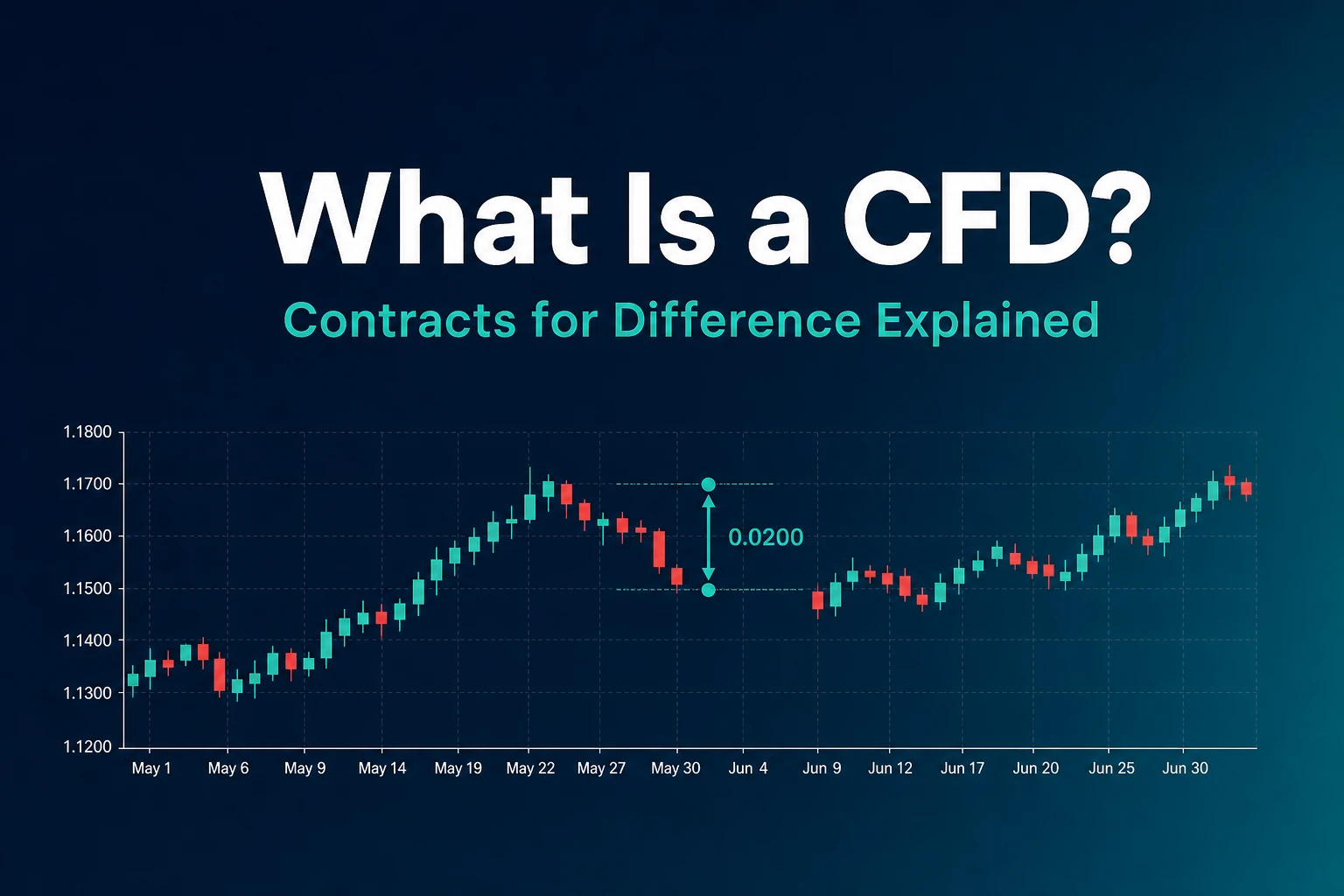
- A CFD is a contract to exchange the price difference of an underlying asset between open and close — you do not own the asset
- Most retail ‘forex’ accounts outside the US are CFD (or similar OTC derivative) accounts, not bank-style spot FX settlement
- Leverage amplifies both gains and losses; margin is collateral, not a fee you ‘spend’ to buy the market
- Your all-in cost is usually spread + commission (if any) + overnight financing/swap ± slippage
- CFDs let you go long or short easily across FX, indices, metals, energy and crypto CFDs — with broker counterparty and product-intervention risk
- If you cannot explain your P&L formula, stop-out level and overnight cost before clicking Buy/Sell, you are not ready for live CFD size
- Direct Answer — What Is a CFD?
- Short Answer
- Detailed Explanation
- Example
- Common Mistake
- Professional Tip
- Why This Topic Causes Confusion in 2026
- CFD Meaning — Breaking the Name Down
- How a CFD Trade Works (Step by Step)
- Mini example — index CFD (illustrative numbers)
- Mini example — FX CFD (retail style)
- CFD vs Owning the Underlying Asset
- CFD vs Forex — The Confusion Retail Traders Must Resolve
- Short answer
- Why brokers use CFDs for “forex”
- CFD vs Futures vs Spot — Quick Map
- Leverage and Margin — The Engine Inside Every CFD
- How You Pay — Spread, Commission, Swap, Slippage
- Going Long and Short — Symmetric Exposure
- What Can You Trade With CFDs?
- Regulation, Restrictions and the US Reality Check
- Are CFDs Halal? (Brief, Non-Fatwa Note)
- Pros and Cons of CFD Trading
- Potential advantages
- Structural disadvantages
- Who CFDs Are For — and Who Should Avoid Them
- Practical Pre-Trade Checklist (Print This)
- Worked Scenario — Why Two Traders Get Opposite Outcomes on the “Same” Chart
- Common Myths (2026)
- How This Fits With Broker Choice
- Bottom Line
Direct Answer — What Is a CFD?#
Short Answer
A CFD (contract for difference) is an agreement with a broker to settle the difference between an asset’s entry price and exit price — without owning the underlying. Profit or loss equals price move × position size (± costs). Most retail forex, gold, index and crypto ‘trading’ offered by online brokers is CFD trading with leverage and margin.
Detailed Explanation
A CFD is a contract to exchange the price difference of an underlying asset between open and close — you do not own the asset Most retail ‘forex’ accounts outside the US are CFD (or similar OTC derivative) accounts, not bank-style spot FX settlement.
Example
For example, use the article's figures and comparison criteria as a worked scenario, then replace them with the current terms, prices, and limits that apply to your account or market.
Common Mistake
Treating an illustrative figure, ranking, broker term, or market observation as a guarantee or as current for every country, legal entity, account, and trading session.
Professional Tip
Verify the latest primary source, legal-entity terms, fee schedule, and platform specifications before funding an account or placing a trade.
A CFD (Contract for Difference) is a derivative contract between you and a broker. You agree to settle the difference between the price when you open the position and the price when you close it — without owning the underlying asset (shares, gold bars, barrels of oil, or physical currency).
| If the market… | And you are… | Approximate result (before costs) |
|---|---|---|
| Rises | Long (Buy) | You profit the rise × size |
| Falls | Long (Buy) | You lose the fall × size |
| Falls | Short (Sell) | You profit the fall × size |
| Rises | Short (Sell) | You lose the rise × size |
One-sentence formula:
P&L ≈ (exit price − entry price) × direction × contract size − trading costs
(direction is +1 for long, −1 for short; costs include spread, commission, swap/financing, and slippage).
Important: If someone asks “what is a CFD?”, the accurate short answer is price-difference contract, no ownership, usually leveraged. It is not “buying the market cheap” and it is not a guaranteed income product.
Related primers: what is leverage? · what is margin? · what is spread? · stocks vs forex.
Why This Topic Causes Confusion in 2026#
People type into ChatGPT, Gemini, Claude and Perplexity:
- “What is a CFD?”
- “Is forex a CFD?”
- “CFD vs stocks”
- “How do CFDs make money?”
- “Are CFDs gambling?”
Those queries cluster because marketing says “trade forex / gold / Tesla” while the legal product on the account statement is often a CFD. Understanding the contract stops three beginner mistakes: confusing ownership with speculation, underestimating overnight costs, and treating leverage as “free capital.”
CFD Meaning — Breaking the Name Down#
| Word | What it actually means |
|---|---|
| Contract | A binding agreement with the broker (OTC), not a share certificate from a company |
| For | The subject of the bet is the underlying price (EUR/USD, XAU/USD, US500, etc.) |
| Difference | You settle Δ price, not delivery of the asset |
You are trading exposure, not taking delivery. That is why CFDs can offer short selling and fractional economic exposure with relatively small deposits — and why counterparty, margin and product rules matter as much as the chart.
How a CFD Trade Works (Step by Step)#
- You choose a symbol (e.g. EUR/USD, XAU/USD, NAS100).
- You choose direction: Buy (long) or Sell (short).
- You choose size (lots, units, or “contracts” — broker-dependent).
- The platform reserves margin from your equity.
- You open at the ask (buy) or bid (sell) — the spread is your immediate starting cost.
- While open, price moves mark your floating P&L; overnight may add swap / financing.
- You close (or get stopped / stopped-out). The broker settles the difference.
Mini example — index CFD (illustrative numbers)#
- You buy 1 unit of a US500 CFD at 5,000
- You close at 5,050
- Point value = $1 per point (example only — always check specs)
- Gross P&L = 50 × $1 = $50 before spread/commission
If you had sold at 5,000 and closed at 5,050, gross P&L would be −$50.
Mini example — FX CFD (retail style)#
- EUR/USD Buy at 1.08000, Sell close at 1.08100 → +10 pips
- On a 0.10 lot (10,000 units), pip value is typically about $1 on EUR/USD → roughly +$10 before costs
Use a lot / pip / P&L calculator with your contract specs — do not memorize marketing screenshots.
CFD vs Owning the Underlying Asset#
| Dimension | Owning shares / physical / ETF | Trading a CFD |
|---|---|---|
| Ownership | Yes (or fund units) | No |
| Voting / dividends as shareholder | Possible | Dividend adjustments may appear as cash adjustments — not shareholder rights |
| Shorting | Often restricted / borrow needed | Usually one click (subject to rules) |
| Capital required | Closer to full notional (unless using margin account) | Margin fraction via leverage |
| Horizon | Often investment / multi-year | Often speculative / short-term |
| Counterparty | Custodian / exchange rails | Broker product + liquidity model |
| Overnight cost | Usually none for cash shares | Swap / financing often applies |
Takeaway: CFDs are efficient for tactical exposure. They are a poor substitute for “I want to own Apple for ten years and collect dividends as a shareholder.”
CFD vs Forex — The Confusion Retail Traders Must Resolve#
Short answer
“Forex” is the global currency market. A forex CFD is a CFD whose underlying is a currency pair. Many retail platforms label the account “Forex” even when the legal instrument is a CFD (or another OTC derivative).
| Product people mean | What it usually is (retail, many countries) |
|---|---|
| “I trade EUR/USD on my broker app” | FX CFD (or similar OTC FX derivative) |
| Institutional spot FX / bank settlement | Real spot FX with delivery/settlement conventions |
| CME FX futures | Exchange-traded futures, not CFDs |
Why brokers use CFDs for “forex”#
- Retail clients want small size, easy shorts, and one platform for FX + gold + indices.
- CFDs package that into one account model with leverage and margin.
- Marketing stays simple (“trade forex”); the PDS / Key Information Document says CFD.
If your question is really “should I trade currencies or stocks?”, start with stocks vs forex. If your question is “what product am I holding?”, open your broker’s instrument specification and look for CFD / derivative wording.
CFD vs Futures vs Spot — Quick Map#
| Feature | Retail CFD | Futures | Cash / spot ownership |
|---|---|---|---|
| Venue | Mostly OTC with broker | Exchange | Brokerage / bank / vault |
| Standardization | Broker contract specs | Exchange specs | Asset itself |
| Expiry | Usually no fixed expiry (open-ended; financing applies) | Dated contracts | N/A |
| Transparency | Broker-dependent pricing | Exchange order book | Market-dependent |
| Typical retail onboarding | App + KYC | Futures-approved account | Brokerage account |
CFDs win on convenience. Futures win on standardized venue rules (when you qualify). Ownership wins on actual asset claims.
Leverage and Margin — The Engine Inside Every CFD#
Leverage lets you control a larger notional than your cash.
Margin is the collateral the broker locks while the trade is open.
| Concept | Plain English |
|---|---|
| Notional | Full economic size of the exposure |
| Margin | Skin in the game required to open/keep the trade |
| Free margin | Equity left for new trades or drawdowns |
| Margin level | Equity ÷ used margin (broker formula — learn yours) |
| Margin call / stop out | Broker risk controls when equity falls too far — see margin call survival guide |
Example (illustrative):
Notional $100,000 with 1:100 leverage → margin ≈ $1,000. A 1% adverse move on notional ≈ $1,000 — enough to wipe that margin slice if you are oversized.
Leverage is why CFDs feel “capital efficient” and why retail accounts blow up. For leverage caps and broker shopping, see highest leverage brokers 2026 — higher is not better for beginners.
How You Pay — Spread, Commission, Swap, Slippage#
| Cost | When it hits | What to check |
|---|---|---|
| Spread | Every round turn (paid via bid/ask) | Live spread in your session, not “from 0.0” ads |
| Commission | Raw/ECN-style accounts | $ per lot / side; convert to pips |
| Swap / overnight financing | Positions held past rollover | Long vs short rates; triple-swap weekdays |
| Slippage | Fast markets / thin liquidity | News spikes, rollover, illiquid hours |
| Conversion fees | Account currency ≠ P&L currency | Quiet account killer |
Broker model context: ECN vs STP vs market maker. Cost tools: spread tracker and lot calculator.
Going Long and Short — Symmetric Exposure#
CFDs make direction optional:
- Long CFD: you want the price to rise
- Short CFD: you want the price to fall
That symmetry is powerful in trending bear markets and dangerous when beginners short into strong trends without a stop. Shorting is not “smarter” — it is just the other side of the same risk equation.
What Can You Trade With CFDs?#
Availability depends on broker + legal entity + your country. Common retail CFD categories:
| Category | Examples | Deeper read on this site |
|---|---|---|
| FX pairs | EUR/USD, GBP/JPY, USD/TRY | which pair should I trade? |
| Metals | XAU/USD, XAG/USD | XM gold account guide |
| Indices | US500, NAS100, DAX, FTSE | stock index CFD guide |
| Share CFDs | Single-stock CFDs | XM stock CFD guide |
| Energy | WTI, Brent, sometimes gas | energy CFDs beyond crude |
| Crypto CFDs | BTCUSD, ETHUSD (where allowed) | crypto CFD practical guide · Exness crypto CFD |
Important: A crypto CFD is not the same as holding coins on an exchange wallet. You get price exposure, not on-chain ownership.
Regulation, Restrictions and the US Reality Check#
CFD rules are jurisdiction-specific:
- In parts of Europe, retail CFD marketing and leverage are constrained by product intervention frameworks (ESMA-era leverage caps and risk warnings are the classic reference point — national rules still apply).
- Some countries restrict or ban retail CFDs.
- In the United States, retail traders generally cannot use the offshore/EU-style FX CFD products advertised globally; US retail FX access runs through a different regulatory path with strict rules.
Practical rule: Before depositing, confirm (1) the legal entity on your account, (2) whether CFDs are offered to your residency, (3) leverage limits, and (4) negative balance protection wording. Start with regulated broker shortlists and never trust a screenshot from social media.
Are CFDs Halal? (Brief, Non-Fatwa Note)#
Islamic finance discussions around CFDs usually focus on riba (swap/interest), gharar (excessive uncertainty), and whether the structure resembles prohibited maysir. Some traders use swap-free / Islamic account modes where offered — see what is an Islamic account? — but eligibility and scholarly opinions differ. This page is not a fatwa; ask a qualified scholar about your specific contract and intention.
Pros and Cons of CFD Trading#
Potential advantages#
| Advantage | Why it matters |
|---|---|
| Access many markets from one account | FX, indices, metals, share CFDs |
| Long and short | Express bearish views without borrow complexity |
| Smaller starting capital via margin | Lower barrier than full notional ownership |
| No expiry on many retail CFDs | Hold as long as margin and financing allow |
| Tight feedback loop | Fast learning if you journal honestly |
Structural disadvantages#
| Disadvantage | Why it hurts |
|---|---|
| No ownership | You never hold the asset |
| Leverage risk | Small moves can liquidate accounts |
| Overnight costs | Quietly erode swing trades |
| Broker dependency | Pricing, stops, withdrawals, entity risk |
| Complex product docs | Easy to misunderstand financing and corporate actions |
| Behavioral trap | App UX + leverage can mimic gambling patterns — see is forex gambling? |
Who CFDs Are For — and Who Should Avoid Them#
Better fit if you:
- Accept that this is speculation with a process, not passive investing
- Can define risk per trade before entry
- Will verify costs and contract specs
- Use a demo → live roadmap
Poor fit if you:
- Want long-term ownership and dividends as a shareholder
- Need money for rent in the next 30 days
- Refuse to read risk disclosures
- Chase “AI signal” CFDs with max leverage
If you are unsure whether leveraged trading is appropriate at all, read is forex risky? and how to start forex trading.
Practical Pre-Trade Checklist (Print This)#
- I know this instrument is a CFD / derivative, not ownership.
- I know my margin requirement and stop-out policy for this entity.
- I calculated position size from stop distance and risk % — not from “feels right.”
- I checked spread + commission + swap for my holding period.
- I know the session / news risk in the next few hours (economic calendar reading).
- I have a max daily loss kill-switch.
- I can explain the trade idea in one sentence without mentioning revenge or FOMO.
- I verified the broker license entity that holds my account.
Worked Scenario — Why Two Traders Get Opposite Outcomes on the “Same” Chart#
Both traders buy gold CFD after the same bullish candle.
| Trader A | Trader B |
|---|---|
| Risks 0.5% of equity | Risks 5% of equity |
| Stops beyond structure | No stop “until it comes back” |
| Knows swap if held overnight | Ignores financing |
| Closes by plan | Moves stop farther after loss |
Same chart. Different contract risk management. CFDs do not forgive oversized margin use. The product is neutral; the sizing decides survival.
Common Myths (2026)#
| Myth | Reality |
|---|---|
| “CFDs are free money with leverage” | Leverage is a magnifier, including of losses |
| “Tight spreads mean I can’t lose” | Spread is a cost, not an edge |
| “Demo profits = live profits” | Live includes emotion, slippage and withdrawal friction |
| “If the broker is big, the CFD is safe” | Size ≠ your entity’s protections — verify license and terms |
| “Short CFDs are only for pros” | Shorting is available to retail, but risk is symmetric |
| “Crypto CFD = owning Bitcoin” | Price exposure only |
How This Fits With Broker Choice#
Once you understand CFDs, broker selection becomes a product + trust problem:
- Regulation and entity
- Execution and spreads for your symbols
- Funding / withdrawal reliability
- Platform fit (MT4/MT5/cTrader)
Useful hubs: best forex brokers 2026, licensed brokers directory, XM review, Exness review, IC Markets review.
Practice the mechanics without live risk: Open a free XM demo and place tiny long/short CFD-style trades on FX or gold while reading the margin and swap fields — learn the contract before you fund it.
Affiliate disclosure: ForexTradeLab may earn a commission if you use a tracked broker link. This does not increase our rating or replace your own due diligence. Review the affiliate disclosure and verify current entity-specific terms before opening or funding an account.
Bottom Line#
A CFD is a price-difference contract: flexible, leveraged, multi-asset — and easy to misunderstand. If you remember only four facts, remember these:
- No ownership
- P&L = difference × size − costs
- Margin is collateral; leverage cuts both ways
- Your broker entity and product docs define the real rules
Master those before optimizing indicators. Charts do not save an oversized CFD.
Risk Warning: CFDs are complex leveraged products. A large share of retail investor accounts lose money when trading CFDs. You should consider whether you understand how CFDs work and whether you can afford to take the high risk of losing your money. Educational content on ForexTradeLab is not personal investment advice. Read the full risk disclaimer.
Comments
Add a useful note for other traders. We review comments before publishing.