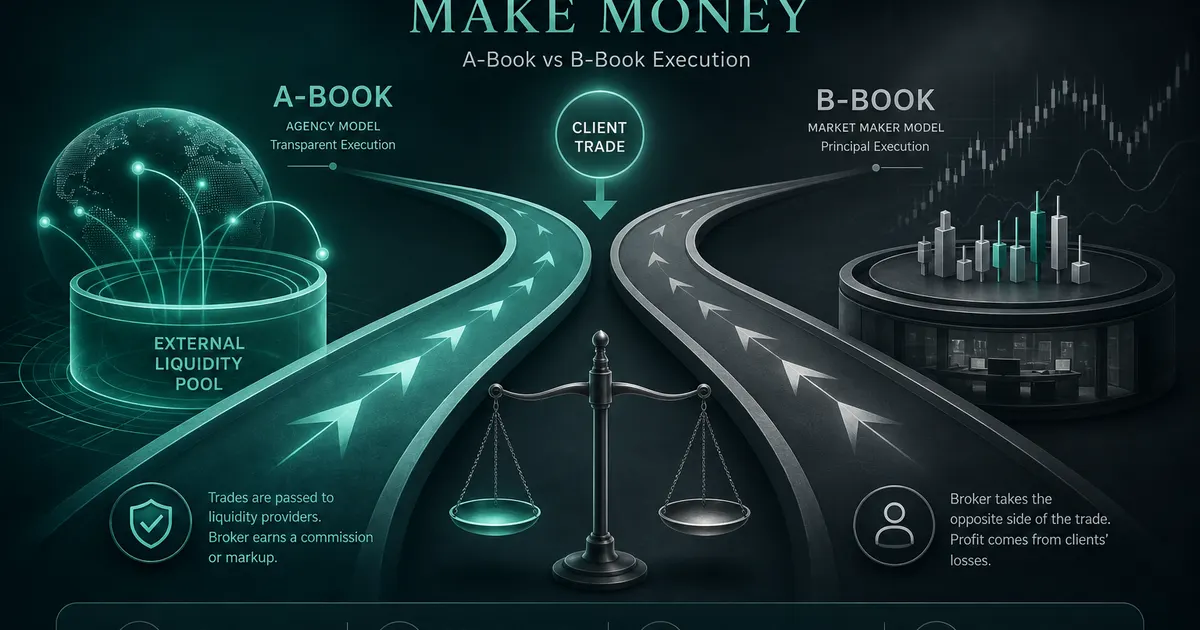
- Broker revenue usually starts with spread and/or commission — volume is the engine on agency books
- A-book routes risk externally; B-book internalizes client flow as counterparty
- Hybrids are common: some clients or symbols are hedged, others warehoused
- Swap, FX conversion and account fees can matter as much as the headline spread
- Regulation, segregation and withdrawal behaviour beat marketing labels like ECN or Raw
 Regulated Global Broker
 Trusted by 20M+ traders — open your account in minutes
- Trade 1,400+ instruments
- Country-based bonus offers where eligible
- MT4 & MT5 available
- Easy deposits and withdrawals
- Leverage up to 1000:1, where available
- Copy Trading: auto-copy expert strategy managers
- Quick Answer
- The Core Revenue Stack
- Short Answer
- Detailed Explanation
- Example
- Common Mistake
- Professional Tip
- A-Book: Agency-Style Execution
- Short Answer
- Detailed Explanation
- Example
- Common Mistake
- Professional Tip
- B-Book: Market-Maker Counterparty
- Short Answer
- Detailed Explanation
- Example
- Common Mistake
- Professional Tip
- Hybrid Desks Are the Real World
- Short Answer
- Detailed Explanation
- Example
- Common Mistake
- Professional Tip
- Other Ways Brokers Earn
- Short Answer
- Detailed Explanation
- Example
- Common Mistake
- Professional Tip
- Conflict of Interest: Practical Checks
- Short Answer
- Detailed Explanation
- Example
- Common Mistake
- Professional Tip
- Comparison Table: What the Model Implies
- Checklist Before You Trust the Marketing
- Mini Glossary
- Key Takeaways
- Bottom Line
Quick Answer#
Retail forex brokers mainly make money when you trade — through spread, commission, and related financing — not by “investing with you.”
How they handle your order still matters:
- A-book (agency / STP-style): broker hedges or routes flow externally and earns on costs/volume.
- B-book (market maker / dealing desk): broker is often your counterparty and can benefit when clients lose.
- Hybrid: both, depending on client, symbol, or risk limits.
Risk note: Understanding broker revenue does not make trading safer by itself. Leveraged FX and CFDs remain high-risk. Prefer regulated entities, clear costs, and withdrawal tests over slogans like “ECN” or “No dealing desk.”
The Core Revenue Stack#
Short Answer
Spread and commission are the main engines; swap and account fees fill the gaps.
Detailed Explanation
For most retail books, revenue clusters here:
| Revenue source | What it is | Who feels it |
|---|---|---|
| Spread | Bid/ask gap embedded in price | Every round-turn |
| Commission | Explicit per-lot fee (common on raw accounts) | Active traders |
| Swap / overnight financing | Holding credit or debit past cutoff | Swing / carry holders |
| Conversion fees | Deposit, withdrawal or P&L currency conversion | Multi-currency users |
| Inactivity / admin fees | Account maintenance charges | Dormant accounts |
Related explainers: what is spread, what is swap, fixed vs variable spread.
Example
You trade 2.00 lots EUR/USD on a raw account: 0.1 pip raw spread equivalent + $7 round-turn commission. That package is the broker’s clearest “meter” — more volume, more revenue on an agency-style book.
Common Mistake
Obsessing over “zero commission” while ignoring a wide all-in spread that costs more than a raw + commission account.
Professional Tip
Compare all-in cost per round-turn at your real size and session — not marketing banners. Use a spread tracker mindset and live quotes.
A-Book: Agency-Style Execution#
Short Answer
On A-book flow, the broker mainly profits when you trade volume, not when you lose.
Detailed Explanation
In a simplified A-book model the broker does not want to keep your market risk. Client orders are hedged with liquidity providers or routed in an STP/agency fashion. The broker’s economic interest leans toward:
- Tight-enough pricing to win volume
- Commission and/or markup
- Financing and ancillary fees
That alignment is why many active traders prefer agency-style handling — if fills, slippage and withdrawal behaviour support the claim.
Deeper taxonomy: ECN, STP and market maker types.
Example
A scalper sends 50 round-turns. On a clean A-book path, the broker earns mostly on commission/markup while external LPs absorb the directional risk.
Common Mistake
Assuming “A-book” printed on a landing page is a verified live fact for your entity and account type.
Professional Tip
Read the order execution policy for the legal entity on your client agreement — not the global brand advertisement.
B-Book: Market-Maker Counterparty#
Short Answer
On B-book flow, the broker often takes the other side and can profit when clients lose.
Detailed Explanation
In a simplified B-book (dealing desk / market maker) model, the broker internalizes client flow. If a client buys, the desk may be short to that client (and vice versa) unless it later hedges.
That creates a structural conflict of interest: client losses can improve desk P&L. Regulated market makers still exist and can operate within rules — the problem is abusive behaviour, not the existence of internalization.
Regulators such as the CFTC, FCA and ASIC CFD order repeatedly warn about misconduct and unauthorised firms. Labels do not replace licence checks.
Example
A beginner cluster loses steadily on wide stops and overtrading. A pure B-book desk capturing that flow may show strong trading revenue even if marketing talks only about “education.”
Common Mistake
Thinking every loss means the broker “hunted your stop.” Stops get hit in real markets too. Patterned requotes, freeze-ups only on your winners, or withdrawal friction are stronger red flags.
Professional Tip
Judge B-book risk by behaviour and entity quality, not by forum lore. Pair this with scam warning signs.
Hybrid Desks Are the Real World#
Short Answer
Most modern retail brokers mix A-book and B-book risk management.
Detailed Explanation
Hybrids may:
- Internalize small or toxic-looking flow
- Hedge large or correlated exposure
- Treat different symbols differently (FX vs gold vs indices)
- Change handling by client profile
So the useful question is rarely “Are you 100% A-book?” It is: What are my costs, fills, and entity protections in practice?
| Model | Broker prefers | Trader should watch |
|---|---|---|
| A-book lean | Your volume | Slippage, LP outages, commission clarity |
| B-book lean | Your flow quality / P&L profile | Spreads in stress, execution disputes |
| Hybrid | Risk limits | Inconsistent fills across symbols |
Example
Two clients at one brand: a high-volume raw account gets mostly hedged; a tiny bonus-driven account may be internalized. Same logo, different economics.
Common Mistake
Using one friend’s fill quality as proof of how your account is handled.
Professional Tip
When comparing brands, use a structured checklist like how to choose a broker and entity notes such as brand vs legal entity.
Other Ways Brokers Earn#
Short Answer
Financing, conversion and inactivity fees can rival spread on the wrong account.
Detailed Explanation
- Swap: overnight financing — see swap explained
- Swap-free admin fees: alternative holding charges on Islamic books — swap-free account guide
- Currency conversion: deposits/withdrawals not in account currency
- Platform or data extras: less common, still real on some offerings
Example
A swing trader on exotic pairs pays more in stacked swaps over a month than in spreads — the broker still earns, just on a different line item.
Common Mistake
Optimising only the entry spread while holding high-swap symbols for weeks.
Professional Tip
Build a monthly cost budget: spread + commission + swap + conversion. If you cannot estimate it, you cannot judge the broker.
Conflict of Interest: Practical Checks#
Short Answer
Verify entity, costs, execution policy and withdrawals — ignore slogan wars.
Detailed Explanation
Run this before and after funding:
- Which legal entity is on the agreement and licence register?
- Are spread + commission disclosed in numbers you can reproduce?
- Is there a published order execution / conflicts document?
- Can you complete a small withdrawal on the same method family you deposited with?
- Do fills degrade only around your profitable moments in a repeated pattern?
Related reading: licensed brokers hub, test support before depositing, fast withdrawal reality check.
Example
A site advertises “Institutional ECN.” The agreement names an offshore entity with vague execution wording and no clear commission schedule. Treat the slogan as marketing until documents match.
Common Mistake
Depositing first “to test” large size before a tiny withdrawal test.
Professional Tip
Keep screenshots of margin requirements, swap tables and withdrawal confirmations. Disputes are evidence games.
Comparison Table: What the Model Implies#
| Question | A-book lean | B-book lean | Hybrid |
|---|---|---|---|
| Main revenue story | Volume / costs | Client P&L + costs | Mix |
| Conflict intensity | Lower on direction | Higher on direction | Variable |
| What “good” looks like | Stable fills, clear commission | Fair spreads, clean withdrawals | Transparent policy + consistent behaviour |
| What “bad” looks like | Chronic positive slippage failures | Stop games, withdraw friction | Unpredictable symbol handling |
Checklist Before You Trust the Marketing#
- Licence and entity name match the client agreement
- All-in cost known for your lot size and session
- Execution / conflicts document located
- Small deposit → withdraw path tested
- Swap and conversion rules checked for your style
- No reliance on “ECN/STP” logos alone
- Risk plan assumes you can lose — model does not save you
Mini Glossary#
| Term | Meaning |
|---|---|
| A-book | Agency-style handling; broker hedges/routs risk externally |
| B-book | Market-maker internalization; broker as counterparty |
| Hybrid | Mix of internalization and hedging |
| STP | Straight-through processing toward liquidity |
| Markup | Broker add-on inside spread or financing |
| LP | Liquidity provider on the other side of hedged flow |
Key Takeaways#
- Brokers mainly earn from trading costs and related fees.
- A-book leans on your volume; B-book can lean on your losses.
- Hybrids are normal — demand evidence, not purity claims.
- Regulation and withdrawals beat buzzwords.
- Your edge still has to beat all-in costs.
Bottom Line#
Ask “How does this entity get paid on my account type?” Spread, commission, swap and execution model answer more honestly than any homepage slogan. Choose clear costs and verifiable protections — then trade a plan that survives those costs. A painful stop-loss wick is usually clustered liquidity or slippage, not automatic proof of a B-book “hunt” — see forex stop hunting explained.
Comments
Add a useful note for other traders. We review comments before publishing.