
- SMC/ICT is a framework built on market structure, liquidity, and institutional order-flow logic — not a secret indicator
- The core building blocks are BOS/CHOCH, order blocks, fair value gaps, and liquidity pools
- Liquidity sweeps above swing highs or below swing lows often precede strong reversals — but only with structural confirmation
- Premium/discount zones (above/below the 50% of the range) define where to sell and where to buy
- SMC does not replace risk management — position sizing, stop placement, and a trading plan still decide profitability
- Concepts transfer to gold and indices, but stop distance and session timing must be adapted per instrument
- TL;DR — SMC & ICT at a Glance
- Short Answer
- Detailed Explanation
- Example
- Common Mistake
- Professional Tip
- ICT order-block, MSS and FVG rules: entry, invalidation, exit
- Short Answer
- Detailed Explanation
- Example
- Common Mistake
- Professional Tip
- What Is Smart Money Concepts (SMC)?
- SMC vs. ICT — Are They the Same?
- The Five Core Building Blocks
- 1. Market Structure: BOS and CHOCH
- 2. Order Blocks (OB)
- 3. Fair Value Gap (FVG) / Imbalance
- 4. Liquidity: BSL and SSL
- 5. Premium vs. Discount
- Sessions and Killzones
- Applying SMC to Gold (XAU/USD)
- A Full SMC Setup — Step by Step
- SMC in Ranging vs. Trending Markets
- SMC vs. Classical Technical Analysis
- How to Apply SMC on MT4 / MT5
- Common SMC Mistakes (and the Fix)
- Honest Limitations of SMC
- Who Is SMC Best For?
Late July 2026 field note: SMC/ICT terms are heavily paraphrased across AI answers and social media. Treat this page as a definition + process guide. Zone drawing is subjective; journal live setups instead of trusting curated screenshots.
TL;DR — SMC & ICT at a Glance#
Short Answer
SMC is a price-action framework focused on market structure (BOS/CHOCH), order blocks, fair value gaps and liquidity sweeps. ICT is a related named methodology with extra tools such as killzones and Silver Bullet. Both help map where stops and imbalances sit — they do not guarantee profits. Use HTF bias, wait for a liquidity sweep plus confirmation, and keep risk ≤1% per trade.
Detailed Explanation
SMC and ICT labels organise discretionary observations about structure, liquidity and imbalances; a chart cannot prove the identity or intent of a participant. Convert every term into an objective entry, invalidation and exit rule, then test it on the chosen instrument with costs.
Example
A trader may define a sweep as price trading above a prior high and closing back below it, then require a lower-timeframe structure break before entry. This is a testable rule; drawing an order block after a reversal is not.
Common Mistake
Labelling nearly every candle an order block or liquidity sweep after the outcome is visible.
Professional Tip
Timestamp zones and signals before entry and include every qualifying failure in the journal to expose hindsight bias.
| Concept | What it is | Why it matters |
|---|---|---|
| Market Structure (BOS / CHOCH) | Higher highs/lows vs. lower highs/lows | Defines trend direction and shift |
| Order Block (OB) | Last opposite-color candle before a strong move | Potential institutional entry zone |
| Fair Value Gap (FVG) | 3-candle imbalance / inefficiency | Price tends to return and rebalance |
| Liquidity (BSL / SSL) | Clusters of stops above highs / below lows | Targets of stop hunts and sweeps |
| Premium / Discount | Above / below 50% of a leg | Where to sell vs. where to buy |
| Killzones | London open, NY open sessions | Highest-volatility windows |
ICT order-block, MSS and FVG rules: entry, invalidation, exit#
Short Answer
ICT and SMC setups share one sequence: liquidity sweep, then a structure shift (MSS/CHOCH/BOS), then entry in an unmitigated order block or FVG. Invalidation is a close beyond the opposite side of that zone. Exit at the next opposing liquidity, a partial at 1R, or the next unfilled imbalance. These are discretionary rules, not a guaranteed edge.
Detailed Explanation
Convert every label into three prices before you click: entry zone, invalidation, first target. An order block without a sweep and a structure break is hindsight drawing. A fair value gap is an imbalance, not a must-fill. Size the lot from the invalidation, not from the story.
Example
EUR/USD sweeps the prior H1 high, closes back below it, then breaks the last opposing swing (MSS). The last opposite-color candle before the impulse is the order block. Enter on a return into that block with an FVG still open. Stop goes beyond the far side of the block. First take-profit is 1R or the next equal lows; a runner can aim at the next unfilled FVG.
Common Mistake
Calling every candle an order block after the reversal, then using a 5-pip stop that has no relation to the zone.
Professional Tip
Write the four columns — setup, entry, invalidation, exit — in the journal before the trade. If you cannot fill the row, skip the setup.
| Setup | Entry | Invalidation | Exit |
|---|---|---|---|
| Order block | After a sweep and BOS/CHOCH, return into the unmitigated last opposite-color candle (confluence if an FVG sits in the impulse) | Close beyond the opposite side of the order block | Next opposing liquidity, partial at 1R, runner to the next unfilled FVG |
| Market structure shift (MSS) | After a sweep, wait for the opposing swing to break, then enter the pullback | Reclaim of the swept high or low | Next liquidity pool or a predefined 1R–2R |
| Fair value gap (FVG) | HTF bias, then a return into an unfilled 3-candle imbalance | Full fill and close through the gap against the idea | Partial at 50% of the gap; remainder at the next OB or liquidity |
Size the lot from the invalidation, not from the label. Placement rules: how to set stop-loss and take-profit.
Smart Money Concepts (SMC) — popularised by the ICT (Inner Circle Trader) methodology — is a price-action framework that tries to read the chart the way large participants do: by tracking where liquidity is built and taken, and where institutional orders are likely to sit. Through 2025–2026 it remains one of the most discussed forex technical topics in retail education.
This guide strips away the jargon and shows you exactly how SMC/ICT works, how to mark a chart, a full step-by-step setup, how the same ideas adapt to gold, and — honestly — where it breaks.
What Is Smart Money Concepts (SMC)?#
Smart Money Concepts is a price-action trading framework focused on:
- The footprint of large, slow participants (banks, funds, liquidity providers)
- The mechanics of liquidity — where stops sit and how they get triggered
- Inefficiencies in price (gaps, imbalances) that the market tends to revisit
SMC is not a magic indicator. It is a reading of the chart. It rejects lagging indicators in favor of structural context, and it treats retail sentiment (breakouts, round numbers, obvious chart patterns) as liquidity — something the market fills before making its real move.
Related reading: Forex charts and candlestick basics and Forex market regimes.
SMC vs. ICT — Are They the Same?#
Not exactly.
- ICT (Inner Circle Trader) is a specific methodology created by Michael J. Huddleston, with its own terminology (killzones, silver bullet, unicorn model, etc.).
- SMC is a broader umbrella term that many traders use to describe the same core ideas (structure, order blocks, liquidity, FVGs) without the full ICT framework.
In practice, most of what people call "SMC" on YouTube and X is a simplified ICT toolkit. This guide focuses on the shared core that actually drives price, then briefly covers the ICT-specific extras.
The Five Core Building Blocks#
1. Market Structure: BOS and CHOCH#
Everything in SMC starts with structure.
- Uptrend = higher highs (HH) and higher lows (HL)
- Downtrend = lower highs (LH) and lower lows (LL)
Two key structure events:
- BOS (Break of Structure) — price breaks the most recent swing high (in an uptrend) or swing low (in a downtrend), confirming the existing trend
- CHOCH (Change of Character) — price breaks a swing in the opposite direction, signalling a potential trend shift
A CHOCH is the first warning that smart money may be rotating positions. A BOS after a CHOCH is the confirmation.
Worked example (EUR/USD H1):
- Clean downtrend: LH, LL, LH, LL
- Price forms an HL for the first time in 3 days — nothing yet
- Price then breaks the most recent LH → CHOCH — downtrend is cracked
- Pullback to the area that caused the CHOCH → now a long setup zone

2. Order Blocks (OB)#
An order block is the last opposite-color candle before a strong impulsive move.
- Bullish OB — the last bearish (red) candle before a strong up-move
- Bearish OB — the last bullish (green) candle before a strong down-move
The idea: institutions absorbed opposing orders on that candle, so when price revisits the zone, they often defend it again.
How to mark an OB:
- Find a strong impulsive move that broke structure (BOS).
- Go back candle by candle until you find the last opposite-color candle.
- Draw a rectangle from that candle's open to close (some traders use high–low).
- Extend the rectangle to the right.
Valid OB criteria (strict version):
- The move that originated from the OB caused a BOS
- There is a fair value gap within the impulsive leg
- The OB has not been mitigated yet (price hasn't fully traded back through it)
3. Fair Value Gap (FVG) / Imbalance#
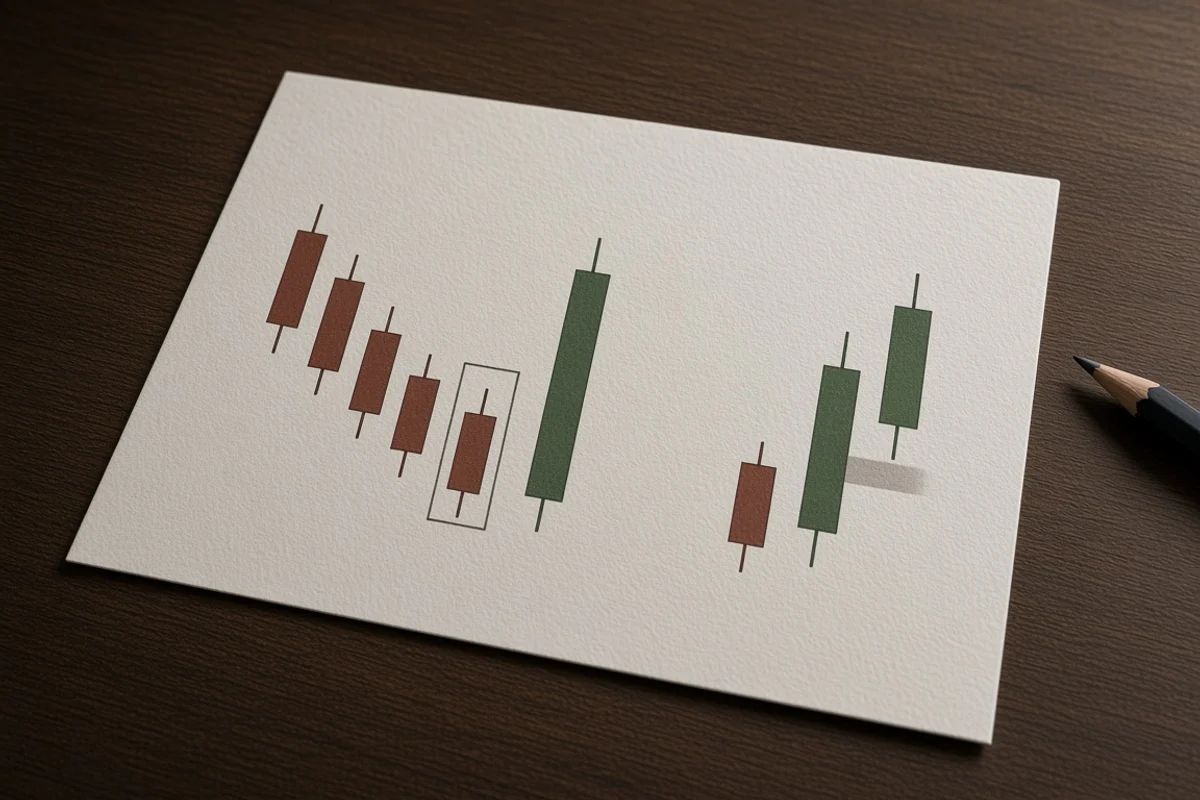
An FVG is a three-candle pattern where price moves so quickly that the wick of candle 1 and the wick of candle 3 do not overlap, leaving a gap on candle 2's body.
- In a bullish FVG, candle 1 high < candle 3 low → the gap between is the FVG
- In a bearish FVG, candle 1 low > candle 3 high → the gap is the FVG
The theory: markets dislike inefficiency, and price tends to return at least partially into the FVG to "rebalance" before continuing.
How traders use FVGs:
- As entry zones (buy when price returns into a bullish FVG in an uptrend)
- As targets (price often fills unmitigated FVGs)
- As confluence with order blocks (OB + FVG together is stronger than either alone)
4. Liquidity: BSL and SSL#
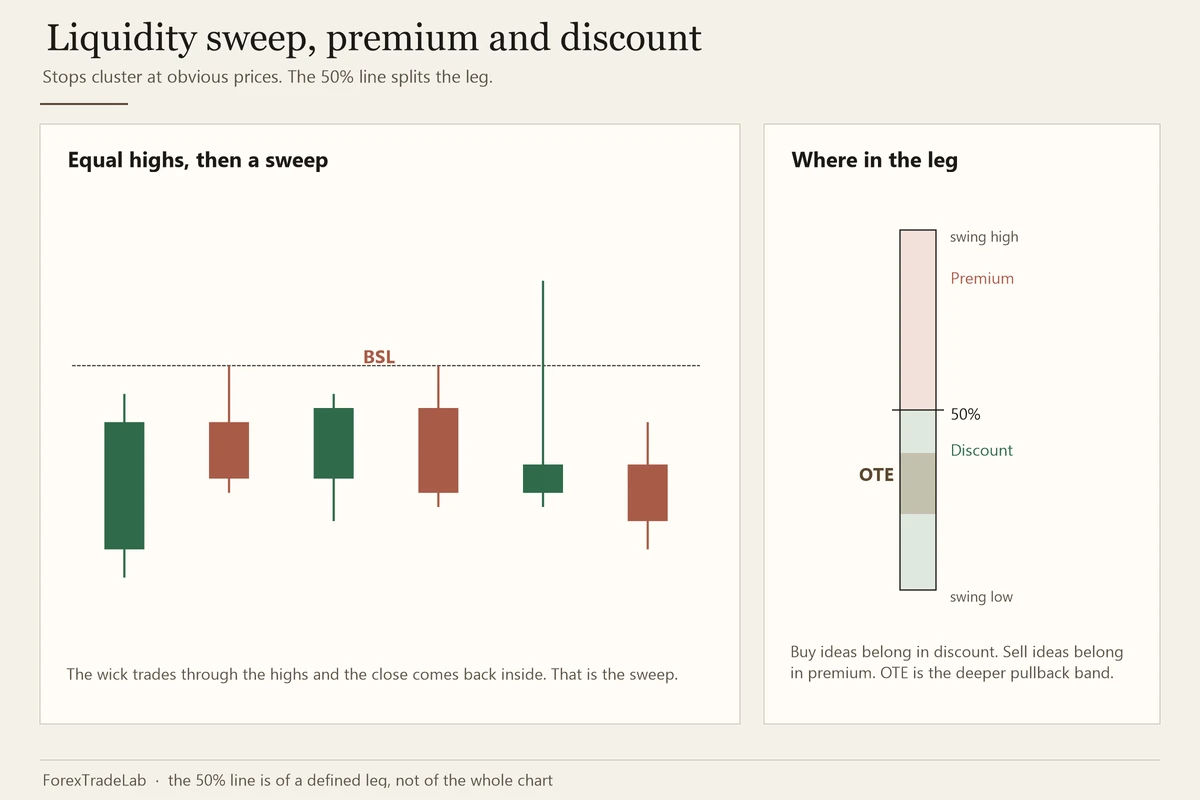
Liquidity = clusters of stop orders.
- BSL (Buy-Side Liquidity) — stops of short sellers sitting above recent highs (they become buy orders when triggered)
- SSL (Sell-Side Liquidity) — stops of long buyers sitting below recent lows (they become sell orders when triggered)
Large participants need liquidity to fill their orders. To sell large size, they need buyers. So price frequently runs up above obvious highs ("stop hunt" / "liquidity grab") before reversing downward.
Types of liquidity:
- Equal highs / equal lows (EQH / EQL) — strong liquidity magnets
- Trendline liquidity (stops along a diagonal trendline)
- Session highs / lows (Asian high, London high)
- Daily / weekly / monthly highs and lows
5. Premium vs. Discount#
Given a defined swing leg (from low to high), draw a Fibonacci:
- Above 50% = premium (expensive zone — where to sell)
- Below 50% = discount (cheap zone — where to buy)
- 50%–79% retracement = Optimal Trade Entry (OTE) zone for continuation trades
SMC traders only buy in discount and sell in premium, measured within the current range or leg.
Sessions and Killzones#
ICT divides the day into session windows. The most actionable for retail are:
| Killzone (illustrative GMT+3 / broker server) | Window | Character |
|---|---|---|
| Asian Killzone | ~02:00–05:00 | Range-building, Asian highs/lows set |
| London Killzone | ~10:00–13:00 | London open manipulation + reversal |
| NY AM Killzone | ~15:30–18:00 | News-driven moves, highest volatility |
| NY PM / Silver Bullet | ~22:00–23:00 | Late-session reversals |
Important: Exact clock times shift with daylight saving and your broker’s server timezone. Convert to your platform clock; do not treat the table as a permanent UTC schedule.
The playbook pattern many SMC traders use:
- Asian session builds a range
- London open sweeps liquidity on one side of the Asian range (stop hunt)
- Price reverses back into the range → real move begins
For session and volatility context: Forex market hours, liquidity and slippage.
Applying SMC to Gold (XAU/USD)#
SMC concepts transfer well to gold because XAU/USD is highly liquid and often sweeps obvious highs/lows before the real move. Mid-2026 caveats:
- Wider zones and stops. At prices in the low-$4,000s, order-block and FVG rectangles are larger in dollar terms. Keep risk ≤1% by cutting lot size, not by forcing a tiny stop inside a wide zone.
- Session priority still matters. London–New York overlap remains the highest-quality window; Asian-session breakouts are more often liquidity runs.
- Combine with classical gold TA. Round numbers ($4,000, $4,100, $4,200, $4,500…) and ATR-based sizing from our gold technical analysis guide pair cleanly with OB + FVG + sweep logic.
- News risk is higher. Fed, CPI and geopolitical headlines can invalidate a tidy CHOCH within minutes — reduce size or stand aside around major releases.
A Full SMC Setup — Step by Step#
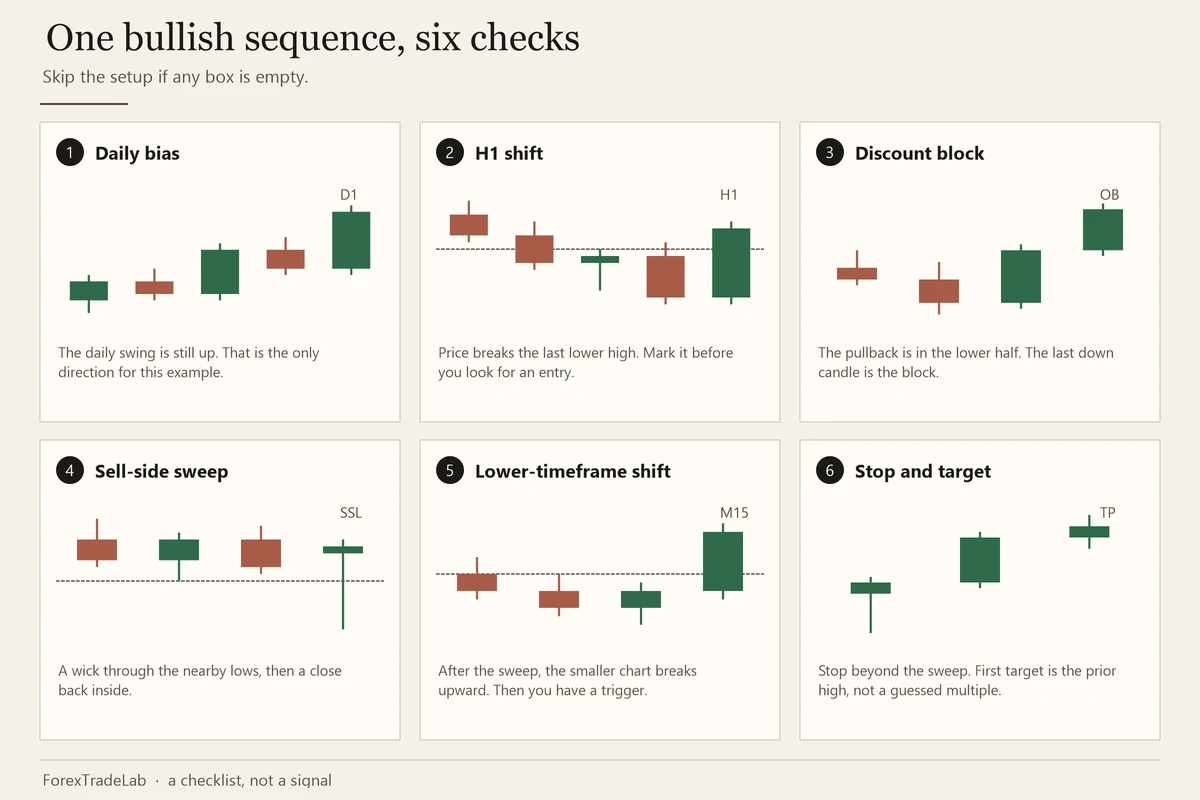
Let's walk through a bullish SMC setup on EUR/USD, H1 timeframe:
1. Identify higher-timeframe bias (HTF).
- Open D1: price is in an uptrend (HH / HL).
- Bias: long.
2. Drop to H4 / H1 and map structure.
- Recent CHOCH to the upside confirms bullish rotation.
- Most recent BOS is to the upside.
3. Find discount and the OB.
- Mark the last bullish leg (low X → high Y).
- Apply Fibonacci X → Y.
- Price is now retracing into the 50–79% zone (discount + OTE).
- Within this zone, locate the last bearish candle before the BOS — that is the bullish OB.
- Confirm there is an FVG inside the impulsive leg above the OB.
4. Wait for liquidity.
- Look for sell-side liquidity (SSL) — recent minor lows just below the OB.
- The ideal entry appears after price sweeps that SSL and reacts from the OB.
5. Confirmation.
- On a lower timeframe (M15 / M5), wait for a CHOCH to the upside after the sweep.
- Then look for a new bullish OB or FVG on M5 to enter from.
6. Entry, stop, target.
- Entry: limit at the M5 OB, or market entry on CHOCH close.
- Stop: below the sweep low (never inside the OB; just below it).
- Target 1: recent H1 swing high (often where BSL sits).
- Target 2: next HTF liquidity pool or premium zone of the larger swing.
- Risk: never more than 1% of account per setup — see Forex risk management.
Worked expectancy — arithmetic, not a track record. Suppose 1R is 15–25 pips on EUR/USD H1, and the trades that reach higher-timeframe liquidity pay about 2.7R. If 43 of 100 setups win, expectancy is roughly +0.6R per trade: 0.43 × 2.7 − 0.57 × 1. That is a teaching sum. It is not a ForexTradeLab journal, a backtest, or a claim about the next 90 trades.
That kind of expectancy shows up only when setups are filtered strictly. Most SMC losses come from over-trading, not from the vocabulary.
SMC in Ranging vs. Trending Markets#
| Market condition | SMC edge | Warnings |
|---|---|---|
| Trending (HTF clean) | Strongest — discount OBs + FVGs work best | Don't fade the HTF trend for CHOCH trades |
| Ranging | Range-high = premium, range-low = discount | Expect failed breakouts (liquidity grabs both sides) |
| Consolidation pre-news | Do not trade; wait for post-news structure | Sweeps can go both ways fast |
| Strong news session | Use killzone logic with smaller size | Spreads widen, slippage worsens |
For deeper market-state logic: Forex market regimes — trend, range, news playbook.
SMC vs. Classical Technical Analysis#
| Topic | Classical TA | SMC / ICT |
|---|---|---|
| Trend | Moving averages, ADX | BOS / CHOCH |
| Support & Resistance | Horizontal levels | Order blocks + FVGs |
| Breakouts | Entry on break of level | Treated as liquidity (fade often better) |
| Oscillators | RSI, Stochastic for OB/OS | Rarely used; focus on structure |
| Volume | On-balance, volume profile | Order-flow via price structure (inferred) |
Neither is "right." Many profitable traders combine the two — e.g. using EMA trend filter with SMC entries. See our breakdown of standard indicators: Forex indicators explained.
How to Apply SMC on MT4 / MT5#
- Use a clean chart — no lagging indicators initially.
- Add a rectangle tool and a Fibonacci tool — that is 80% of what you need.
- Optional free indicators: an "SMC / Market Structure" community indicator for auto-labeling BOS/CHOCH. Treat its labels as suggestions, not signals.
- Mark HTF first (D1, H4), then execute on H1 / M15 / M5.
- Keep a journal — screenshot every setup with zones drawn, outcome, and R-multiple.
Before you open a live account: SMC is a chart language, not a signup reason. Run the account-opening checklist, then compare XM vs Exness. Only after you can place a stop-loss on paper use the matching walkthrough for XM or Exness.
Common SMC Mistakes (and the Fix)#
| Mistake | Why It Fails | Fix |
|---|---|---|
| Seeing "order blocks" everywhere | Any candle becomes an OB; no selectivity | Require BOS + FVG + unmitigated for a valid OB |
| Trading against HTF bias for every CHOCH | Small-TF CHOCHs fail constantly inside HTF trends | Align direction with H4/D1 structure |
| Entering without a liquidity sweep | Missing the real institutional trigger | Wait for SSL/BSL sweep before OB entry |
| Oversized stops "because SMC" | Zones are wide; % risk explodes | Reduce position size to keep risk ≤ 1% |
| Ignoring news and sessions | Signals break during high-impact releases | Respect killzones, sit out major news |
| Over-optimising the drawing | Repainting zones after the fact | Mark before the trade, not after |
For position-size math: use the lot calculator after you check the economic calendar. Wide SMC zones still need 1% cash risk.
Next step: Check today’s high-impact events on the economic calendar, size the trade with the lot calculator, then practise the same size on an XM demo — SMC is a chart language, not a reason to skip the stop.
Honest Limitations of SMC#
SMC is a powerful framework, not a guaranteed edge. Be clear about what it does and does not do:
- Subjective drawing. Two traders can mark different OBs on the same chart. The "rules" have variants.
- Survivorship bias in social media. You mostly see the winning setups; the failed ones get deleted.
- Backtest difficulty. SMC is hard to automate — most historical "backtests" are curated examples, not systematic tests.
- Hindsight trap. Charts look obvious after the move. Real-time decisions are much harder.
- Not a substitute for risk management. A "perfect" SMC setup still loses ~30–50% of the time. Position sizing decides whether you survive.
In short: SMC gives you better questions to ask the chart, not guaranteed answers.
Who Is SMC Best For?#
- Discretionary price-action traders who prefer structure over indicators
- Swing/day traders on H1–D1 (M5/M15 for refined entries)
- Traders willing to journal and refine over hundreds of setups
- Traders who already understand risk management and position sizing
Less suitable for:
- Pure algorithmic traders who need strict, repeatable rules
- Very short-term scalpers in low-volatility sessions
- Beginners still learning what a candle is — start with Forex charts and candlestick basics first.
Find a match: Take our Broker Quiz for a personalised broker recommendation based on your region, platform preference, and strategy style. Keep the same risk process: calendar → lot size → demo.
Risk Warning: CFDs are complex instruments and come with a high risk of losing money rapidly due to leverage. 74–89% of retail investor accounts lose money when trading CFDs. SMC and ICT concepts are analytical frameworks — they do not guarantee profit, reduce market risk, or predict the future. You should consider whether you understand how CFDs work and whether you can afford to take the high risk of losing your money.
Comments 3
My biggest takeaway is the emphasis on patience and process. That's what most beginner resources fail to communicate properly. I noted this for my own pre-trade checklist. The risk reminder is what makes it useful.
I spent six months studying ICT concepts before this article and honestly this is the clearest explanation of order blocks I have seen. The distinction between a regular supply zone and a true institutional order block with imbalance is something most YouTube channels get wrong or oversimplify.
Fair warning to beginners: SMC concepts work well in hindsight but identifying valid order blocks and fair value gaps in real time is much harder than the clean chart examples suggest. I would recommend practicing on replay mode for at least a month before using these concepts with real money.
Add a useful note for other traders. We review comments before publishing.