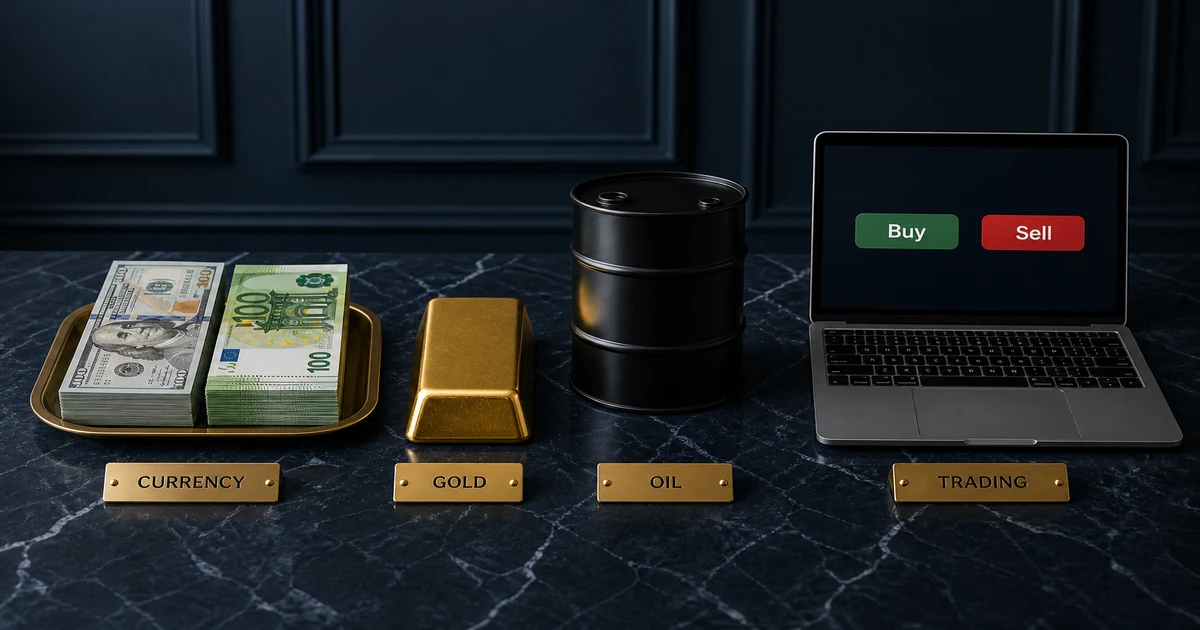
- A retail forex broker usually offers leveraged price contracts, not delivery of banknotes, bullion or barrels
- Buying EUR/USD is not the same as exchanging cash at a bank
- XAU/USD does not give you allocated gold you can withdraw
- Oil CFDs track a price, they do not fill a tank
- Researchers should map the goal first; intending traders should verify the legal entity, leverage cap and contract specification before clicking Buy or Sell
- With gold near $4,125, even a 0.01-lot XAU/USD position is about $4,125 of exposure and needs roughly $206 of margin at 20:1

Quick Decision Framework#
Short Answer
You can usually take a leveraged Buy or Sell position on EUR/USD, XAU/USD and oil symbols through a retail forex or CFD broker. That is not collecting banknotes, allocated bullion or physical barrels. Bank exchange, jewellery shops and commodity delivery are different products with different ownership, tax, custody and loss profiles.
Detailed Explanation
A retail forex broker is typically selling a leveraged price contract. The Bank for International Settlements measured $9.6 trillion of average daily OTC FX turnover in April 2025; that figure describes the interbank and dealer market, not delivery to your account. Buying EUR/USD is not exchanging cash at a bank. XAU/USD does not give you allocated gold you can withdraw. Oil CFDs track a price; they do not fill a tank. Researchers should map the goal first; intending traders should verify the legal entity, leverage cap and contract specification before clicking Buy or Sell.
Example
Someone who wants travel euros should use a bank or authorised exchange. Someone who clicks Sell on XAU/USD is taking a leveraged price bet that can lose more than a jewellery-shop purchase of a small bar, and cannot withdraw metal.
Common Mistake
Treating a platform ticket as ownership of dollars, gold or crude because the symbol name matches the real-world asset.
Professional Tip
Open the instrument specification and confirm contract type (CFD or rolling spot), notional size, leverage and settlement. If the goal is physical currency, metal or fuel, use a product that actually delivers.
Quick Answer#
Can you buy and sell dollars, euros, gold and oil through a forex broker? You can usually click Buy or Sell on EUR/USD, XAU/USD and oil CFDs. That is not the same as exchanging cash at a bank, taking home a gold bar, or owning a barrel of crude.
A retail forex broker is typically selling a leveraged price contract. The Bank for International Settlements measured $9.6 trillion of average daily OTC FX turnover in April 2025. That figure describes the interbank and dealer market. It does not mean your platform ticket delivers currency, metal or fuel.
Market snapshot — 29 September 2026#
| Item | Level (verify live) | Source |
|---|---|---|
| Gold spot (XAU/USD) | ≈ $4,125/oz; intraday low $4,111 on 28 Sep, lowest since 5 Aug | Reuters |
| Gold record high | ≈ $5,589 on 28 Jan 2026 | Kitco |
| Brent crude | ≈ $106–107 on 28 Sep amid the US–Iran/Hormuz standoff | Reuters |
| Fed funds target | 3.75%–4.00% after a 25 bp hike on 16 Sep | Federal Reserve |
| Next US catalysts | NFP 2 Oct; CPI 14 Oct; FOMC 27–28 Oct | BLS, Federal Reserve |
For EUR/USD, open the latest Federal Reserve H.10 release or the ECB reference rates rather than relying on a figure quoted in an article.
Affiliate disclosure: ForexTradeLab may earn a commission if you open an account through some broker links on this site. That does not change the conclusion here: a broker ticket is not a purchase of the physical asset. See our affiliate disclosure.
Risk warning: Retail forex and CFDs are complex, leveraged products. You can lose money quickly. ESMA’s 2018 CFD measures for EU retail clients included leverage caps, a margin close-out rule, negative-balance protection on an account basis, a ban on trading incentives, and a standardised loss-percentage warning. This page is education, not personal advice. Read our disclaimer and affiliate disclosure.
Who This Article Is For#
Short Answer
It is for two groups who type the same keywords: researchers mapping how markets work, and intending traders who already want to click Buy or Sell.
Detailed Explanation
Searches such as “buy dollars,” “sell euros,” “gold trading,” “oil broker,” and “forex trader” mix two jobs. One job is understanding the global price of USD, EUR, gold and crude. The other job is opening a broker account and placing a leveraged order. Mixing them is how people fund the wrong product.
ForexTradeLab’s what is forex pillar explains the market. The long vs short guide explains the buttons. This article sits in front of both: which product are you actually requesting?
Example
A saver needs $2,000 for a tuition invoice. A trader wants exposure if EUR/USD falls 80 pips. Both may search “buy dollars.” Only the first person needs a bank or licensed money service. The second person is looking at a speculative contract.
Common Mistake
Treating a broker signup bonus as proof that the platform “sells gold and oil” the way a refinery or a bullion desk does.
Professional Tip
Write one sentence: “I need delivery / I need a price bet.” If you cannot choose, stay on research. Do not deposit to “feel committed.” Use the should I start forex scorecard before any live funding.
The Four Products People Confuse#
Short Answer
Bank FX, physical gold, physical oil and a retail CFD can share the same headlines and still be four different legal objects.
Detailed Explanation
| Goal you typed | Typical real product | What you receive | Main extra risk |
|---|---|---|---|
| “I need dollars or euros to spend or transfer” | Bank or licensed FX conversion | Credit in an account, cash, or a payment | Conversion margin, transfer rules, capital controls |
| “I want gold I can hold or store” | Jewellery, coin, allocated bar, or some ETFs | A good or a claim on metal | Spread, storage, authenticity, ETF structure |
| “I need actual crude or fuel” | Physical supply contract or a listed future with delivery mechanics | Fuel, storage, or a cleared future | Logistics, quality, expiry, margin on futures |
| “I want to trade the price through a forex broker” | Spot FX or CFD on EUR/USD, XAU/USD, WTI/Brent | Mark-to-market P&L vs the broker | Leverage, gap risk, counterparty, overnight financing |
The IMF’s explainer on exchange rates describes why a currency’s price matters for trade and capital flows. That macro story is real. It does not convert a CFD into a bank transfer.
ASIC’s CFD investor page is explicit: a CFD is an agreement to exchange the difference in an asset’s price. You do not own the underlying.
Example
The latest Federal Reserve H.10 release publishes an official noon-buying-rate reference for the euro in dollars. Check the current figure there; your broker’s tradable bid/ask will differ from it by spread and timing. Neither quote ships €100 notes to your door.
Common Mistake
Assuming “Buy gold” on MetaTrader means the broker allocated a bar in a vault in your name.
Professional Tip
Open the symbol specification: contract size, profit calculation, swap/financing, and expiry. If delivery is absent, you are not buying the commodity.
Dollars and Euros: Bank Desk vs EUR/USD#
Short Answer
A bank converts one currency balance into another. Buying EUR/USD on a broker expresses a view that the euro will rise against the dollar after costs.
Detailed Explanation
In the global dealer market the dollar remains the vehicle currency. The BIS 2025 survey found the US dollar on one side of 89.2% of OTC FX trades; the euro’s share was 28.9%. That is why EUR/USD is the pair researchers and beginners meet first — see currency pairs and the US dollar and DXY guide.
A conversion at a bank or licensed money changer:
- Debits one currency and credits another
- Charges a spread or fee you can often see on the receipt
- Leaves you with spendable balances (subject to local rules)
A retail EUR/USD position:
- Uses margin
- Can be long or short
- Is closed in account currency P&L
- Can be stopped out if equity falls
The ECB euro foreign exchange reference rates are a public benchmark, not your executable retail price.
Example
You convert $1,000 to euros at a bank to pay a landlord in Lisbon. You now have euros to send. If instead you Buy 0.10 lot EUR/USD on a CFD account, you have a leveraged euro-up view. A move against you can erase far more than a bank conversion margin.
Common Mistake
Using a trading account as a “cheaper bureau de change.” Overnight financing, leverage and stop-out make that comparison false.
Professional Tip
If the invoice is real, use a regulated payment or banking channel. If the thesis is “the euro will strengthen,” study how to start forex trading on demo first.
Gold: Jewellery and Bars vs XAU/USD#
Short Answer
Physical gold is a good. XAU/USD at a forex broker is almost always a dollar-priced gold contract, not allocated bullion.
Detailed Explanation
Gold is widely quoted in US dollars per troy ounce. That quoting convention is why a stronger dollar can pressure gold even when jewellery demand is unchanged — a point developed in our gold trading guide and gold vs dollar article.
Retail XAU/USD typically:
- Uses a contract size in ounces (check the spec; do not guess from forex lots)
- Offers leverage that can exceed what a cash gold purchase implies
- Pays or charges overnight financing unless a swap-free schedule says otherwise
- Does not let you withdraw coins from the platform
Under ESMA’s EU retail CFD framework, gold was grouped with a 20:1 opening leverage cap, tighter than 30:1 for major FX pairs and looser than 10:1 for commodities other than gold. Your entity may differ. Offshore marketing that advertises much higher gold leverage is a risk flag, not a gift.
The maths at about $4,125 gold (29 September 2026), using the common 100-ounce standard lot — confirm the contract size in your broker’s specification:
| Volume | Ounces | Notional | P&L per $1 move | Margin at 20:1 |
|---|---|---|---|---|
| 1.00 lot | 100 | ≈ $412,500 | $100 | ≈ $20,600 |
| 0.10 lot | 10 | ≈ $41,250 | $10 | ≈ $2,060 |
| 0.01 lot | 1 | ≈ $4,125 | $1 | ≈ $206 |
On 28 September 2026 gold fell about 4% intraday, roughly $170, to $4,111. That single session would have cost about $170 on 0.01 lot and about $1,700 on 0.10 lot without a stop.
Example
A family buys a 10-gram coin to gift. They own the coin. A trader Buys XAU/USD 0.01 on a Friday and holds through the weekend. They own about one ounce of leveraged price exposure plus weekend-gap risk. Same metal in the headline; different balance-sheet object.
Common Mistake
Treating a winning gold CFD week as “I stored wealth in gold.” You stored a P&L versus a broker.
Professional Tip
If the goal is savings metal, research allocated storage or a regulated gold product with a prospectus. If the goal is a gold price trade, size from stop distance and cash risk, not from “gold is safe.” See gold lot size, the 0.01-lot gold risk calculator and the complete XAU/USD trading guide.
Oil: Barrels vs WTI and Brent CFDs#
Short Answer
A retail oil symbol is a price of WTI or Brent, not a cargo.
Detailed Explanation
International crude is commonly invoiced in US dollars. That invoicing habit links oil, the dollar, and many currency pairs — see the crude oil WTI vs Brent guide and what drives oil and fuel prices. Brent traded near $106–107 on 28 September 2026 amid the US–Iran standoff around the Strait of Hormuz — exactly the kind of headline market where retail oil CFDs can gap.
A physical or futures user cares about grade, location, expiry and delivery. A forex-broker oil CFD user cares about:
- Which benchmark (WTI vs Brent)
- Contract size per 0.01 lot (often not 100,000 “forex units”)
- Gap behaviour around EIA inventories and OPEC headlines
- ESMA-style 10:1 retail leverage on commodities other than gold, where that rule applies
Can you trade oil, stocks and Bitcoin on XM covers one broker’s CFD framing: you trade the price, not the barrel.
Example
A distributor hedges with exchange-traded futures and a credit line. A retail trader Sells “OIL” after a spike. The distributor has a commercial inventory problem. The retail trader has a leveraged bet that can gap through a stop.
Common Mistake
Copying an EUR/USD micro-lot habit onto oil because both appear in the same Market Watch window.
Professional Tip
On demo, record the cash result of a 50-point oil move at minimum volume. If that number exceeds 1% of planned live equity, oil does not fit yet. Use the XM market fit test for forex, gold and oil logic on any broker’s spec.
What Buy and Sell Mean on the Ticket#
Short Answer
Buy is long the instrument’s price. Sell is short that price. Neither button ships the asset.
Detailed Explanation
For EUR/USD, Buy means you want the euro up versus the dollar. Sell means the opposite. For XAU/USD and oil CFDs, Buy means you want the dollar price of gold or crude higher.
Costs start immediately: spread, sometimes commission, then financing if you hold past rollover. A stop-loss reduces but does not cap gap risk. Details sit in forex order types and bid vs ask.
Example
An illustrative Brent quote (not a live broker price): Bid 106.40 / Ask 106.52. A Buy fills near 106.52, a Sell near 106.40. Price must rise more than the spread before the position is ahead. That is a cost, not a “broker cheat” by itself.
Common Mistake
Clicking Sell because “the video said the dollar is king” without stating which instrument and which invalidation price.
Professional Tip
Write the pair or symbol, direction, stop, and cash risk in one line before the ticket. If the line is empty, the click is entertainment.
Broker Reality: You Still Need Due Diligence#
Short Answer
Access to USD, EUR, gold and oil symbols is not a safety rating.
Detailed Explanation
The CFTC forex fraud advisory exists because unsolicited “currency trading” pitches remain common. The FCA’s investment-suitability questions apply before any app deposit.
Check, in order:
- Legal company name and licence on the official register
- Whether your country is accepted by that entity
- Client-money wording and negative-balance terms
- Instrument list and contract specifications
- Withdrawal method that matches your name
Use how to choose a reliable forex broker and the licensed brokers directory. Brand familiarity is not a register search.
One brand can sit on several legal entities. The ForexTradeLab XM profile, re-verified on 29 September 2026, lists XM-branded entities under CySEC (120/10), DFSA (F003484), FSCA (49976), CMA Kenya (233), FSC Mauritius (GB23202700, for UAE accounts), FSA Seychelles (SD190) and FSC Belize (8557558). The FCA 705428 and ASIC 443670 licences belong to the separate Trading.com brand, and XMTrading is a separate brand again. Leverage, gold and oil symbols and client protections follow the entity you actually sign with — see the broker brand vs legal entity checklist.
Example
Two sites both show XAU/USD and “WTI.” One is an authorised entity with a public licence number. The other is a clone domain. The product names match. The counterparty risk does not.
Common Mistake
Choosing the broker with the highest gold leverage as if that were a quality score.
Professional Tip
Run a small withdrawal test after a tiny deposit, where rules allow, before scaling. See first withdrawal test.
Researcher Path vs Intending-Trader Path#
Short Answer
Researchers collect official rates and definitions. Intending traders add demo proof and a loss cap. Do not skip the first path to “save time.”
Detailed Explanation
Researcher path (no deposit required)
- Read BIS turnover and currency-share facts
- Watch Fed H.10 and ECB reference rates
- Compare physical vs CFD in the table above
- Study economic calendar drivers for USD, EUR, gold and oil
Intending-trader path (still demo first)
- Complete the start forex honesty checklist
- Practise one symbol only (EUR/USD is the usual first instrument)
- Add gold or oil only after you can size from the spec
- Fund only money you can lose
Example
A journalism student writes a briefing on dollar invoicing of oil. They need EIA and BIS links, not a live WTI ticket. A second reader wants to Sell gold this Sunday. They need a go/no-go on weekend gaps, not a macro essay alone.
Common Mistake
Opening live “just to see real spreads” with rent money.
Professional Tip
If you are still deciding whether forex is appropriate at all, stop here and use the scorecard. Intention is not a trading edge.
Checklist#
- Goal written: delivery of an asset versus a price bet
- Product named: bank FX, bullion, future, ETF, or CFD
- Official sources opened: BIS, Fed H.10 or ECB rates, ESMA/FCA/ASIC/CFTC as relevant
- Symbol specification read: size, margin, financing, expiry
- Broker legal entity verified on a public register
- Leverage cap understood for FX vs gold vs oil on your entity
- Demo journal for at least 20 rule-following trades if you intend to go live
- Loss cap in account currency, not in “pips I can tolerate emotionally”
- No use of money needed for essentials
- Affiliate terms ignored as a substitute for due diligence
Mini Glossary#
| Term | Meaning |
|---|---|
| Vehicle currency | The dollar’s role as one side of most FX trades |
| Reference rate | A published benchmark (Fed H.10, ECB); not always your fill |
| CFD | Contract for difference: cash P&L on a price, not ownership |
| XAU/USD | Gold priced in US dollars per ounce |
| WTI / Brent | Two crude benchmarks; retail CFDs track price, not cargo |
| Margin close-out | Broker rule that closes positions when equity is too low |
| Delivery | Actual transfer of currency, metal or oil — usually absent on retail FX CFDs |
Key Takeaways#
- Buy and Sell on a forex broker do not deliver dollars, euros, gold bars or oil barrels.
- Bank conversion, physical metal and commercial oil are separate products.
- The dollar’s 89.2% share of FX turnover explains why EUR, gold and oil screens all sit next to USD — it does not make retail CFDs safe.
- Researchers should stay on official data until the product type is clear.
- Intending traders should verify the entity, the spec and a written risk cap before the first live click.
Related Reading and Future Cluster Pages#
Pillar and cluster links:
- What is forex
- How to choose a broker
- Gold trading
- Why the US dollar dominates forex, gold and oil
- EUR/USD vs GBP/USD vs XAU/USD for beginners
- Risk management
- Complete gold XAU/USD trading guide — gold pillar
- XM gold account guide for XAU/USD
- XM gold spread: measuring your real cost
- XM swap-free gold trading
- XM market fit test for forex, gold and oil
- XM licensed-broker profile
Suggested future articles (not written yet): physical gold vs gold ETF vs XAU/USD three-way; bank FX fees versus CFD spread on a $2,000 conversion; WTI CFD expiry versus continuous oil symbols.
Bottom Line#
ForexTradeLab will not pretend a broker ticket is a vault, a tanker, or a bureau de change. If you need spendable USD or EUR, use a licensed payment channel. If you need metal you can hold, use a bullion or jewellery channel you can audit. If you still want to speculate on those prices, treat it as leveraged trading: demo, size, and a broker you can verify. Continue with why the dollar sits under gold and oil when the product type is clear.
Comments
Add a useful note for other traders. We review comments before publishing.