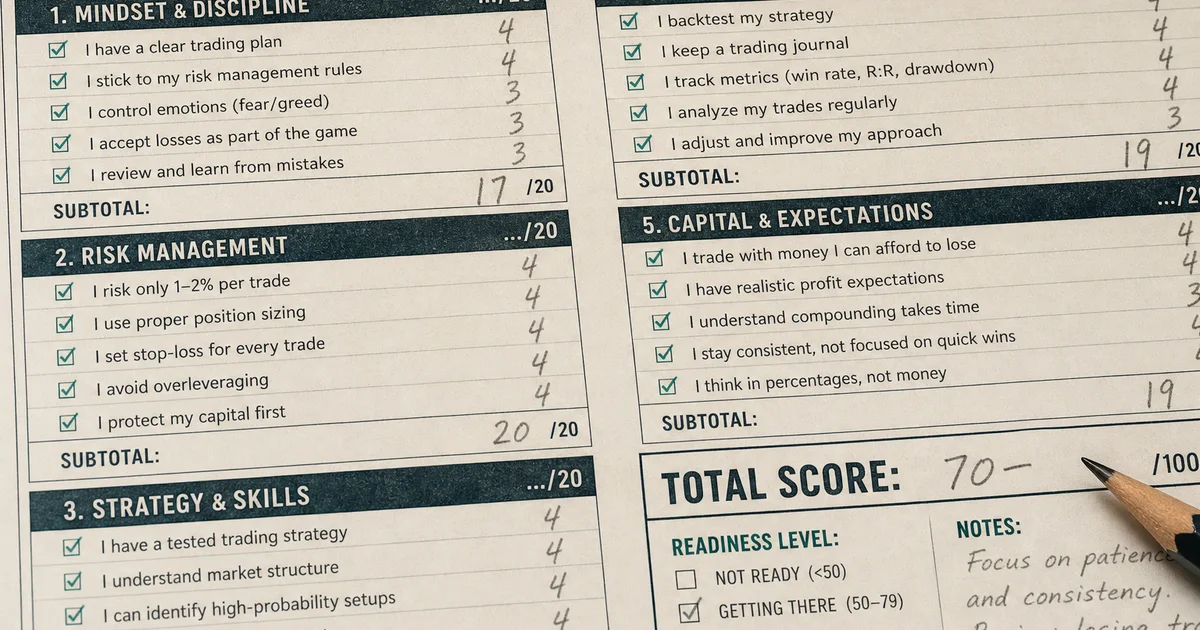
- Intention is not readiness — score capital, time, legality, knowledge, psychology, and goals before you deposit
- Retail forex/CFDs are leveraged; most retail accounts lose money according to broker risk disclosures
- If you cannot explain pip, lot, leverage, margin, spread, and stop-loss in one sentence each, stay on education and demo
- Demo practice with a journal is cheaper than learning the same lessons with real money
- Go-live only after written criteria — excitement after a viral clip is not a criterion
 Regulated Global Broker
 Trusted by 20M+ traders — open your account in minutes
- Trade 1,400+ instruments
- Country-based bonus offers where eligible
- MT4 & MT5 available
- Easy deposits and withdrawals
- Leverage up to 1000:1, where available
- Copy Trading: auto-copy expert strategy managers
- Quick Answer
- Why This Scorecard Exists
- Short Answer
- Detailed Explanation
- Example
- Common Mistake
- Professional Tip
- How the Scorecard Works
- Short Answer
- Detailed Explanation
- Example
- Common Mistake
- Professional Tip
- Pillar 1 — Capital Honesty (0–20)
- Short Answer
- Detailed Explanation
- Example
- Common Mistake
- Professional Tip
- Pillar 2 — Time and Attention (0–15)
- Short Answer
- Detailed Explanation
- Example
- Common Mistake
- Professional Tip
- Pillar 3 — Legal and Broker Access (0–15)
- Short Answer
- Detailed Explanation
- Example
- Common Mistake
- Professional Tip
- Pillar 4 — Core Knowledge Gate (0–20)
- Short Answer
- Detailed Explanation
- Example
- Common Mistake
- Professional Tip
- Pillar 5 — Psychology and Process (0–20)
- Short Answer
- Detailed Explanation
- Example
- Common Mistake
- Professional Tip
- Pillar 6 — Goal Realism (0–10)
- Short Answer
- Detailed Explanation
- Example
- Common Mistake
- Professional Tip
- Knowledge Gate — Eight Sentences You Must Own
- Short Answer
- Detailed Explanation
- Example
- Common Mistake
- Professional Tip
- Red Flags — Automatic “Wait”
- Short Answer
- Detailed Explanation
- Example
- Common Mistake
- Professional Tip
- What to Do After You Score
- Short Answer
- Detailed Explanation
- Example
- Common Mistake
- Professional Tip
- Checklist — Before Any Live Deposit
- Mini Glossary
- Key Takeaways
- Bottom Line
Quick Answer#
Should you start forex trading? Only if all of these are true:
- You can lose the planned deposit without harming rent, debt, or emergency savings.
- Forex/CFD access is legal for you with a broker entity you can verify.
- You can explain pip, lot, leverage, margin, spread, and stop-loss in one sentence each.
- You will practice on a demo account with written rules before any live deposit.
If any item fails, your honest answer today is not yet — stay on education and demo. Intention is not readiness.
Risk note: Forex and CFDs use leverage. You can lose money quickly. Broker risk disclosures commonly state that a large majority of retail CFD accounts lose money. This page is educational, not personal advice. Read our disclaimer.
Why This Scorecard Exists#
Short Answer
People with trading intent often skip the filter and jump to funding. This scorecard slows that jump.
Detailed Explanation
Searches like “should I start forex trading” usually come from people who already feel pulled in — a friend, a short video, or a bonus offer. The how to start forex trading guide covers the process. This article covers the gate: whether starting live (or even opening a rushed demo with a live deposit planned for “tomorrow”) is a good decision for you right now.
The global FX market is enormous — the BIS Triennial Survey (2025) reported about $9.6 trillion in average daily OTC FX turnover. Size does not make retail trading easy. Liquidity and 24-hour access raise the cost of impulsive decisions.
Example
Two people both “intend to start.” Person A can explain position sizing and has two free evenings weekly. Person B cannot define a lot size and plans to fund with next month’s rent buffer. Same intention. Different score. Different next step.
Common Mistake
Treating broker signup speed as proof you are ready. Account opening is a product funnel, not a readiness exam.
Professional Tip
Score yourself before you open any live account page. Motivation bias inflates scores after you see a deposit button.
How the Scorecard Works#
Short Answer
Score six pillars out of the points shown. Total is out of 100. Match your band. Do not average with a friend’s opinion.
Detailed Explanation
| Pillar | Max points | What you are measuring |
|---|---|---|
| Capital honesty | 20 | Money you can lose completely |
| Time and attention | 15 | Repeatable weekly focus, not one weekend binge |
| Legal and broker access | 15 | Lawful access + entity you can verify |
| Core knowledge | 20 | One-sentence fluency on six terms |
| Psychology and process | 20 | Rules, journaling, loss acceptance |
| Goal realism | 10 | Learning vs income fantasy |
Bands
| Total | Band | What to do next |
|---|---|---|
| 0–39 | Wait | Education only. No live deposit. Re-score in 2–4 weeks. |
| 40–69 | Demo only | Open demo, journal, use tools. No live funding yet. |
| 70–100 | Consider live later | Still require written go-live criteria after consistent demo behaviour. |
Example
Scores: Capital 12, Time 10, Legal 15, Knowledge 8, Psychology 10, Goals 4 → total 59 → demo only. Funding this week would ignore the score.
Common Mistake
Giving yourself full Knowledge points because you “watched a few videos.” Points require one-sentence explanations you can write without looking up.
Professional Tip
Write your scores on paper. Screenshots of this page do not create accountability; ink does.
Pillar 1 — Capital Honesty (0–20)#
Short Answer
Only score high if the deposit is money you can lose 100% without harming essentials.
Detailed Explanation
| Score | Criteria |
|---|---|
| 0–5 | Deposit would touch rent, debt minimums, or emergency fund |
| 6–11 | Some spare cash, but a full loss would delay bills or savings goals |
| 12–16 | Dedicated “risk capital” sized so a full loss is uncomfortable but survivable |
| 17–20 | Risk capital clear, written budget, and position size planned at ≤1% risk per trade |
Broker minimum deposits (sometimes from about $5) are not a readiness signal. Tiny accounts often hit a cost floor from spread and minimum lot size before skill matters. Practical context: forex minimum capital and start with $100 — realistic guide.
Example
$300 you can lose, with a written rule of 1% risk per trade ($3 risk) → healthier than $2,000 borrowed “to make it back faster.”
Common Mistake
Funding with a bonus mindset: “I’ll withdraw profits and leave the bonus.” Bonuses have conditions; losses do not wait for your plan.
Professional Tip
Before any deposit, run the lot size calculator with your real equity, stop distance, and 1% risk. If the lot size is too small to place, your capital plan and your market choice conflict.
Pillar 2 — Time and Attention (0–15)#
Short Answer
Forex rewards repeated, calm practice — not one intense Sunday.
Detailed Explanation
| Score | Criteria |
|---|---|
| 0–4 | No weekly block; plan is “when I feel like it” |
| 5–9 | Irregular evenings; phone trading during work stress |
| 10–12 | 3–5 focused hours weekly protected for study + demo review |
| 13–15 | Consistent schedule, session awareness, and post-trade review habit |
You do not need to watch every London–New York overlap. You do need enough time to learn platform basics, check the economic calendar, and journal without rushing.
Example
Two evenings × 90 minutes beats seven random 10-minute chart peeks from a bus seat.
Common Mistake
Confusing screen time with practice. Scrolling live prices is not a training plan.
Professional Tip
Put a recurring calendar block labelled “demo + journal.” If you cannot keep it for two weeks, your Time score is lower than you think.
Pillar 3 — Legal and Broker Access (0–15)#
Short Answer
High scores require lawful access and a legal entity you can verify — not a logo you recognise.
Detailed Explanation
| Score | Criteria |
|---|---|
| 0–4 | Unsure if forex/CFDs are allowed; considering unregulated “VIP” apps |
| 5–9 | Aware of restrictions but have not checked the broker’s entity for your country |
| 10–12 | Can name regulator and licence path; still need to confirm client agreement entity |
| 13–15 | Verified entity + licence on the regulator register; read risk disclosure |
Use the CFTC forex fraud advisory mindset globally: pressure, guaranteed returns, and unverifiable firms are red flags. On ForexTradeLab, pair this with how to choose a broker, licensed brokers, and brand vs legal entity checklist.
Example
Same brand logo, different country redirect, different regulator and protections. Your score depends on your entity, not the homepage banner.
Common Mistake
Assuming “regulated somewhere” equals protection where you live.
Professional Tip
Before deposit, ask support (and keep the answer): which legal entity holds my account, and which regulator licence number applies?
Pillar 4 — Core Knowledge Gate (0–20)#
Short Answer
If you cannot explain six terms in one sentence each, you are not ready to size a live trade.
Detailed Explanation
Award up to ~3 points per term only if you can write a clear sentence without searching:
| Term | One-sentence target |
|---|---|
| Pip | Smallest usual price increment used to measure move size on many pairs |
| Lot | Standardised position size unit that scales pip value |
| Leverage | Controls larger notional with smaller margin — multiplies gains and losses |
| Margin | Collateral set aside to open/maintain a leveraged position |
| Spread | Difference between bid and ask — a core entry/exit cost |
| Stop-loss | Pre-planned exit that defines invalidation and caps planned loss |
Also know that many retail products are CFDs, not ownership of the currency itself.
Example
Weak: “Leverage helps you make more money.” Strong: “With 1:100 leverage, $100 margin can control about $10,000 notional — and a 1% adverse move can erase that margin if risk is unmanaged.”
Common Mistake
Memorising definitions but never connecting them to position size. Knowledge without sizing is trivia.
Professional Tip
Use the pip value and profit/loss calculators on a demo idea before you click buy/sell. If the numbers surprise you, your Knowledge score is incomplete.
Pillar 5 — Psychology and Process (0–20)#
Short Answer
Process beats prediction. Score high only if you accept losses and journal behaviour.
Detailed Explanation
| Score | Criteria |
|---|---|
| 0–5 | Plan is “I’ll feel the market”; revenge trades after losses are likely |
| 6–11 | Want rules but have not written them; journal is optional |
| 12–16 | Written entry/invalidation/size rules; journal most trades |
| 17–20 | Can follow rules for a defined demo streak; stops revenge trading |
Retail risk disclosures exist because emotional overtrading and oversized positions are common. Your edge, if any, starts as behavioural control, not a secret indicator.
Example
After three losses, do you cut size and stop for the day — or double the next lot “to recover”? That answer alone can move 10 points.
Common Mistake
Believing demo calm will automatically transfer to live. Live money changes decision quality; that is why demo-to-live roadmaps use small first deposits.
Professional Tip
Write a one-page “pre-commitment contract”: max trades/day, max daily loss, max risk/trade, and a kill switch. Sign it before demo week one.
Pillar 6 — Goal Realism (0–10)#
Short Answer
Learning and capital preservation score higher than “replace salary in 90 days.”
Detailed Explanation
| Score | Criteria |
|---|---|
| 0–3 | Guaranteed income, copy-paste signals, or “small capital huge returns” as primary goal |
| 4–6 | Mixed: wants income but accepts a long learning curve |
| 7–8 | Primary goal is skill + process; income is optional and distant |
| 9–10 | Written learning milestones; no income deadline tied to rent |
Example
Goal “complete 20 rule-following demo trades and explain my average loss in R-multiples” beats goal “make $500/week by next month.”
Common Mistake
Using forex to fix a debt emergency. That goal structure selects for oversized risk.
Professional Tip
If your primary motivation is a social-media lifestyle claim, subtract points until the claim is replaced with a skill milestone.
Knowledge Gate — Eight Sentences You Must Own#
Short Answer
Pass this gate in writing before any live deposit.
Detailed Explanation
Write these without notes:
- What a currency pair price represents.
- What a pip is on your intended pair.
- How lot size changes profit and loss.
- How leverage can liquidate an account.
- Why spread is a cost even when “price hasn’t moved.”
- Where your stop goes and why.
- What you will do after a full stop-out.
- Which broker legal entity holds your account.
If you stall on two or more, you are in Wait or Demo only, regardless of motivation.
Example
Sentence 7 might be: “I stop trading for the day, journal the mistake, and do not change size to recover.”
Common Mistake
Skipping sentence 8 because “the brand is famous.”
Professional Tip
Keep the eight sentences in your trade journal header for the first month.
Red Flags — Automatic “Wait”#
Short Answer
Any of these overrides a high score until fixed.
Detailed Explanation
- Deposit money needed for essentials
- Broker cannot show a verifiable licence for your entity
- You cannot state risk per trade in account currency
- You plan to start live the same day you first heard of pips
- Guaranteed profit, recovery of past losses, or “AI signals never lose” is the pitch that convinced you (CFTC fraud patterns apply widely)
Example
Score 78 on paper, but the deposit is this month’s tuition → Wait. Capital honesty failed in reality.
Common Mistake
Ignoring red flags because “everyone starts somehow.”
Professional Tip
If a friend pressures you to fund today, treat social pressure as a negative psychology score, not as evidence.
What to Do After You Score#
Short Answer
Match the band. Do not invent a fourth band called “I’ll be careful with live money.”
Detailed Explanation
Wait (0–39)
Read what is forex, advantages and risks for beginners, and risk management. No deposit.
Demo only (40–69)
Follow how to start forex trading and open a demo. Use calculators. Journal. Re-score after 20 rule-following trades.
Consider live later (70–100)
Still complete demo go-live criteria. Then use a small first deposit and the first deposit guide. Prefer regulated broker research over bonus banners.
| Band | Allowed now | Not allowed yet |
|---|---|---|
| Wait | Guides, tools, education | Live deposit |
| Demo only | Demo + journal + tools | Live deposit |
| Consider live later | Demo proof + tiny live after criteria | Large deposits, high leverage “to grow fast” |
Example
Score 72, but only 8 consecutive rule-following demo trades → stay demo until 20. The score opens the door; behaviour walks through it.
Common Mistake
Raising leverage on a small live account because demo felt “too slow.”
Professional Tip
Link your next action to a URL and a date: “Demo journal review — Sunday 18:00.” Vague intention returns you to day zero.
Checklist — Before Any Live Deposit#
- Scorecard total written with date
- Band is not Wait
- Six core terms explained in one sentence each
- Eight-sentence knowledge gate completed
- Risk capital identified (can lose 100%)
- Max risk per trade ≤ 1% of equity (calculated, not guessed)
- Broker legal entity and licence verified
- Demo streak: ≥ 20 trades following written rules
- Pre-commitment contract signed (max daily loss, kill switch)
- Affiliate/bonus terms read without treating them as edge
Mini Glossary#
| Term | Meaning |
|---|---|
| Readiness | Evidence you can follow a risk process — not excitement |
| Risk capital | Money you can lose without harming essentials |
| Knowledge gate | Minimum explanations required before live sizing |
| Demo streak | Consecutive rule-following practice trades |
| Go-live criteria | Written conditions that unlock a first deposit |
| Legal entity | The specific company that holds your client agreement |
Key Takeaways#
- Should I start forex trading? Only after capital, legality, knowledge, and process clear a sober score — not after a viral clip.
- Intention without a knowledge gate is how accounts fund expensive lessons.
- Demo practice is part of starting, not a delay tactic.
- High scores still require written go-live criteria before live money.
- If your score says wait, waiting is the professional move.
Bottom Line#
ForexTradeLab’s job is not to rush you into a deposit. It is to help you decide with clear rules. Run the scorecard once in writing. If you are in Wait or Demo only, that is a successful use of this page. When you are ready for process steps, continue with how to start forex trading and keep risk education open in risk management.
Comments
Add a useful note for other traders. We review comments before publishing.