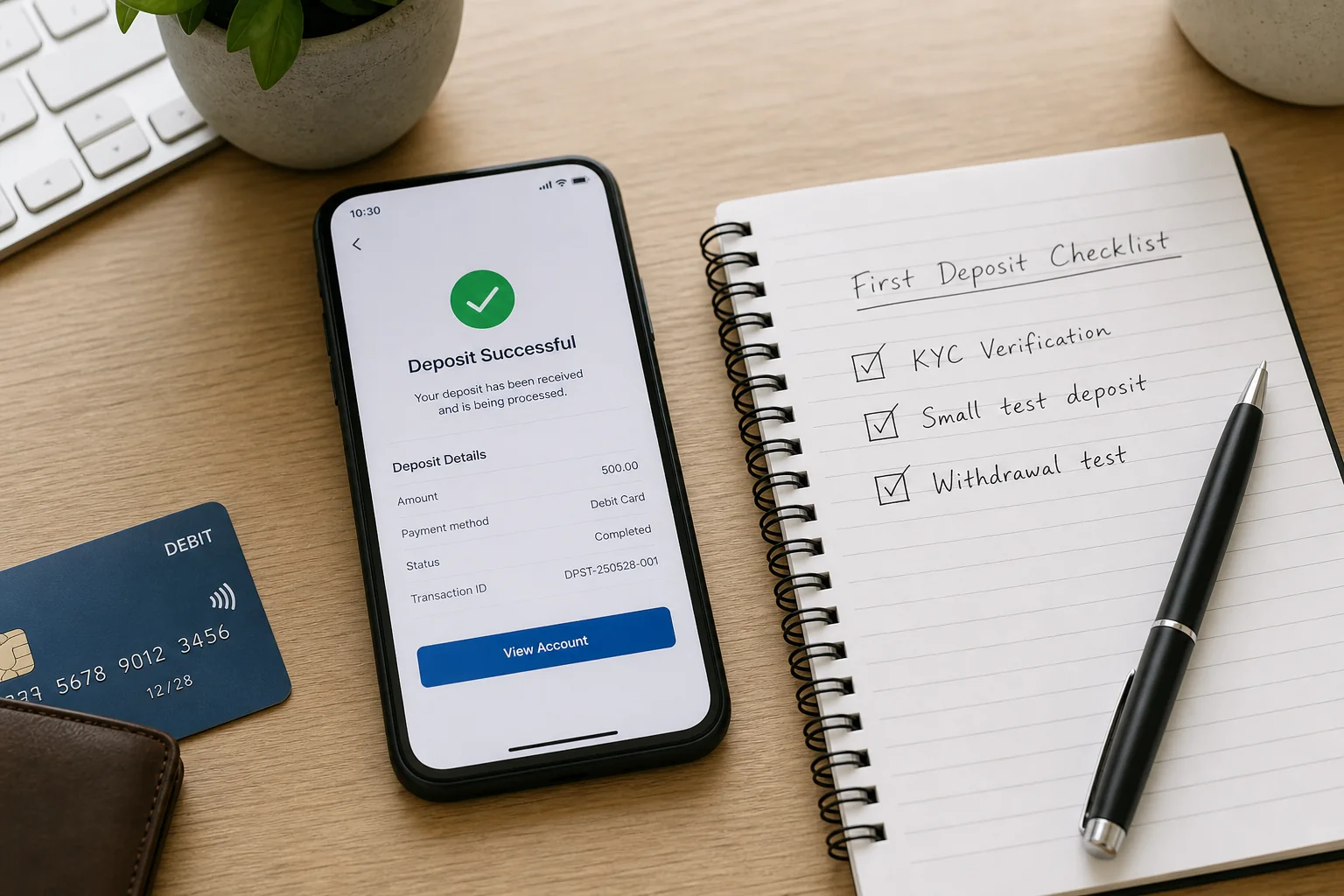
- Complete KYC before making a meaningful first deposit
- Use a payment method in your own name that can also receive withdrawals
- Start with a small test amount before increasing capital
- XM often fits beginners who want low entry, education and eligible promotions
- Exness often fits traders who prioritize automated withdrawal processing and a clean payment loop

Affiliate disclosure: ForexTradeLab may earn a commission from qualifying partner links, without increasing your cost. Read our affiliate disclosure.
Quick Decision Framework#
Short Answer
The first deposit should be small: $10–$50 to test payments and the platform, or about $100 for a structured training balance. Do not send serious money until KYC is approved, the method is in your own name, and one small withdrawal has arrived.
Detailed Explanation
Complete KYC before a meaningful fund. XM often fits beginners who want low entry, education and eligible promotions; Exness often fits traders who want automated withdrawal processing and a clean payment loop. Use a rail that can also receive payouts. The first deposit is a process test, not a vote of confidence in a strategy. After the small cycle works, you can decide whether to add training capital — still sized so a full loss is tolerable.
Example
An eligible beginner verifies on XM, deposits $30 from their own card, places at most a 0.01-lot ticket, withdraws $20 and waits for arrival before adding $70 more. Another beginner wires $1,000 on day one to Exness because withdrawals are “instant,” then sits on a document hold. Same two brands, opposite process.
Common Mistake
Depositing the largest amount the page allows because a bonus tile scales with the deposit, before any payout has been tested.
Professional Tip
Approve KYC, fund the smallest amount your rail allows, withdraw most of it, and only then choose XM or Exness as a home based on the loop you actually measured.
The first deposit is not the real start of trading#
Short Answer
For most beginners, the first forex deposit should be small: $10 to $50 for a payment and platform test, or around $100 for a more structured training account. Do not deposit serious money until KYC is approved, the payment method is in your own name, and you have tested one small withdrawal.
Common Mistake
Use a payment method in your own name that can also receive withdrawals
Professional Tip
Start with a small test amount before increasing capital
The first forex deposit is where many beginners become careless. They treat the transfer as a commitment to "start making money" when it should be treated as a controlled test.
Your first deposit has four jobs:
| Job | What you are testing |
|---|---|
| KYC | Can the broker verify your identity and address without friction? |
| Payment route | Can money move from your own account to the broker cleanly? |
| Platform behaviour | Can you place and close tiny trades without panic? |
| Withdrawal route | Can money come back through the same or permitted method? |
If one of these fails, you want to learn it with a small amount, not after depositing serious capital.
First-deposit checklist before sending money#
Do this before clicking deposit:
- Confirm your country is accepted by the broker.
- Check the exact legal entity shown in the signup or client agreement.
- Complete KYC with ID and proof of address.
- Use a payment method in your own name.
- Make sure the same method, or an allowed alternative, can receive withdrawals.
- Read any bonus conditions before accepting a campaign.
- Decide your maximum risk per trade before opening the platform.
For country access, see XM and Exness restricted countries.
How much should your first deposit be?#
There is no universal amount. The correct number depends on your income, experience and emotional control.
| First deposit | Best use | What not to do |
|---|---|---|
| $10 | Platform and payment test | Do not expect income |
| $50 | Micro-risk emotional practice | Do not over-leverage to make it feel bigger |
| $100 | Structured beginner training | Do not trade random instruments |
| $500 | Serious learning account | Do not increase lot size after one win |
For most new traders, $10 to $50 is enough to test the broker. $100 is better if you want to practise position sizing and record 20 trades. Anything larger should wait until you know the deposit and withdrawal route works.
XM first deposit: when it makes sense#
XM is often comfortable for a first deposit because the entry point is low in many regions and the beginner ecosystem is strong. The practical appeal is not only the $5 minimum. It is the combination of account types, MT4/MT5 familiarity, education, support and eligible promotions where available.
XM may fit your first deposit if:
- You are new and want a guided learning path.
- You want to start very small.
- You plan to use Micro or Standard-style account sizing.
- You value education, webinars and platform tutorials.
- You see a promotion in your country and understand the terms.
Use the XM Members Area as the source of truth. If a payment method is not shown there, assume it is not available for your account.
Read next: How to fund your XM account and XM minimum deposit and withdrawal.
Exness first deposit: when it makes sense#
Exness is attractive when the trader cares most about payment clarity and withdrawal speed. Exness is known for automated withdrawal processing on its side, although final receipt still depends on the payment provider and country.
Exness may fit your first deposit if:
- You want to test withdrawal quickly.
- You prefer a broker without deposit-bonus complexity.
- You are comfortable comparing Standard, Standard Cent, Pro, Raw Spread and Zero account paths.
- You understand leverage and will not use high leverage recklessly.
- Your country and payment method are clearly supported.
Do not assume every payment method is instant. A broker can process a request quickly while a bank, card network or wallet still takes time.
Read next: Exness deposit guide and Exness withdrawal guide.
a lower-risk first-deposit workflow#
Use this route:
| Step | Action |
|---|---|
| 1 | Open and verify the account |
| 2 | Deposit a small amount |
| 3 | Place 3 to 5 tiny trades on major pairs only |
| 4 | Record spread, commission, swap and execution |
| 5 | Request a small withdrawal |
| 6 | Wait until funds arrive |
| 7 | Only then decide whether to add more |
This may feel slow, but it prevents the most expensive beginner mistake: trusting a broker, payment route or your own discipline before testing them.
Bonus or no bonus?#
A bonus is not automatically bad, but it changes the rules.
If XM shows a bonus in your region, read:
- whether the bonus is withdrawable or only trading credit;
- how profits generated with the bonus are treated;
- what happens if you withdraw early;
- whether accepting the bonus affects account behaviour.
Exness usually does not use the same broad deposit-bonus model, which can make the first deposit cleaner for traders who do not want campaign conditions.
The safer rule: do not increase lot size because a bonus appears.
Bottom line#
The first forex deposit should prove three things: the broker can verify you, the payment route works, and you can trade tiny without losing discipline. If a card fails at the cashier, diagnose the decline before you retry larger amounts — see why bank cards get declined on forex deposits.
Choose XM if you want a beginner-friendly environment with low entry and education. Choose Exness if you value payment-speed testing and a cleaner withdrawal-first workflow. In both cases, start small, test withdrawal and scale only after the process works.
Risk warning: Forex and CFDs are leveraged products and can cause rapid losses. This guide is educational only and is not financial advice.
Comments
Add a useful note for other traders. We review comments before publishing.