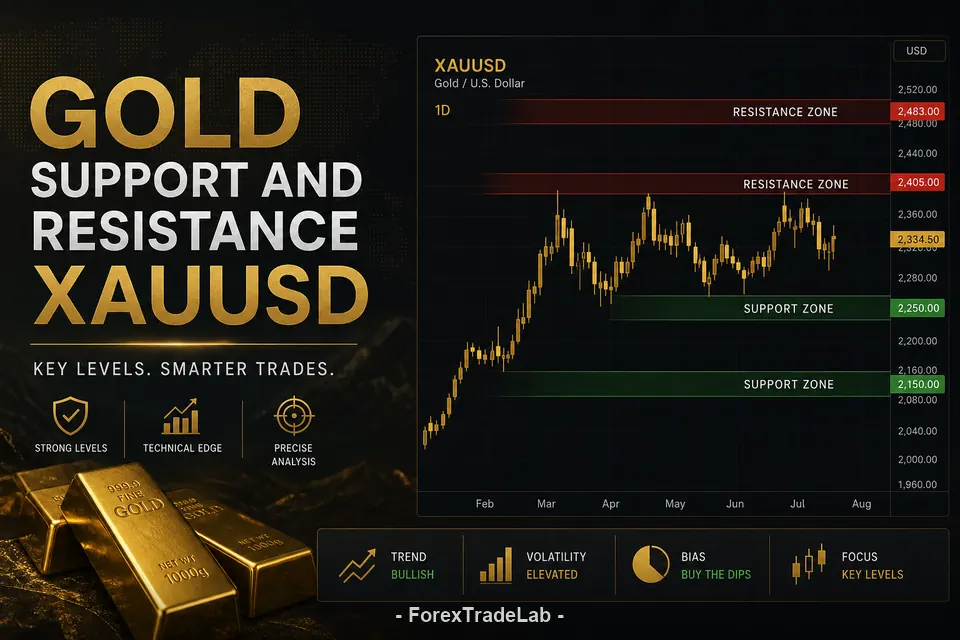
- Treat gold levels as zones sized from ATR — an illustrative $80 daily ATR implies zones about $16-$20 wide
- With spot near $4,125 on 29 Sep 2026, the key round numbers are $4,000, $4,100, $4,200 and $4,500
- The strongest illustrative confluence zones are $4,090-$4,115 ($4,100 plus the $4,111 low) and $4,480-$4,520 ($4,500 plus early-September trade near $4,510)
- Keep 6-8 active zones and pair every level map with the US calendar: jobs 2 Oct, CPI 14 Oct, FOMC 27-28 Oct
- Gold market snapshot — 29 September 2026
- Why Support and Resistance Dominates Gold Trading
- Short Answer
- Detailed Explanation
- Example
- Common Mistake
- Professional Tip
- The Five Layers of Support and Resistance on XAU/USD
- Short Answer
- Detailed Explanation
- Example
- Common Mistake
- Professional Tip
- Zones, Not Lines: The Right Mental Model
- Short Answer
- Detailed Explanation
- Example
- Common Mistake
- Professional Tip
- Confluence: The Key to High-Probability Levels
- Short Answer
- Detailed Explanation
- Example
- Common Mistake
- Professional Tip
- How to Build a Clean XAU/USD Level Map
- Short Answer
- Detailed Explanation
- Example
- Common Mistake
- Professional Tip
- Using Levels in Entries, Stops and Targets
- Short Answer
- Detailed Explanation
- Example
- Common Mistake
- Professional Tip
- When Support Becomes Resistance (Polarity Flips)
- Short Answer
- Detailed Explanation
- Example
- Common Mistake
- Professional Tip
- Macro Context: Levels Are Not Magic
- Short Answer
- Detailed Explanation
- Example
- Common Mistake
- Professional Tip
- Common Mistakes in Gold Level Trading
- Example: A Week in XAU/USD Levels
- Pre-Trade Checklist
- Glossary
- Key Takeaways
- Related Gold Guides
Affiliate disclosure: ForexTradeLab may earn a commission from partner broker links, at no added cost to you. This does not change our analysis. Read our affiliate disclosure.
Gold support and resistance are the price zones on the XAU/USD chart where buying or selling pressure has repeatedly appeared — and where it is likely to appear again. This guide shows how to map them in five layers and rebuilds the worked level map around the real late-September 2026 structure. It is part of the technical cluster of our complete gold (XAU/USD) trading guide.
Gold market snapshot — 29 September 2026#
| Item | Latest verified figure |
|---|---|
| Spot XAU/USD | About $4,125/oz on 29 Sep 2026 (01:40 GMT print $4,124.57) |
| Recent low | $4,111 on 28 Sep 2026, the lowest since 5 August, after an intraday drop of about 4% |
| September context | Traded near $4,510 earlier in the month; about −7% month to date |
| Record high | About $5,589/oz spot on 28 Jan 2026 (LBMA PM record about $5,405 on 29 Jan) |
| 2025 close and 2026 YTD | $4,368 (LBMA PM, 31 Dec 2025); about −5.6% year to date |
| Fed funds target range | 3.75%–4.00% after a 25 bp hike on 16 Sep 2026 |
| Next US catalysts | Jobs report 2 Oct; CPI 14 Oct (8:30 a.m. ET); FOMC 27–28 Oct |
| Central-bank buying | 345 t in H1 2026 (Q2: 288.9 t, a Q2 record) |
| Gold ETF holdings | Record 4,189 t (WGC, August 2026 data) |
Verify live before trading — these figures move daily. Sources: Reuters via WAM and Business Recorder, Kitco, World Gold Council, Federal Reserve, BLS.
Why Support and Resistance Dominates Gold Trading#
Short Answer
Gold respects support and resistance unusually well because a very broad mix of participants — retail traders, institutions, central banks and algorithms — watch the same round numbers and swing points. That shared attention turns those prices into decision zones.
Detailed Explanation
Every strategy, from naked price action to indicator systems, eventually asks: where will price react? On XAU/USD three structural factors give clean answers:
- Global participation: the same key levels are watched across time zones and account sizes.
- Psychological anchors: round prices near the market — currently $4,000, $4,100, $4,200 and $4,500 — act as natural decision points.
- Range behaviour between moves: gold trends hard and consolidates hard, leaving crisp swing highs and lows such as the $4,111 low of 28 September 2026.
This article is a companion to our gold technical analysis guide; here we go deep on levels only.
Example
On 28 September 2026 spot fell about 4% intraday to $4,111 before steadying near $4,125 on 29 September. That low now sits $11 above the $4,100 round number — two layers in almost the same place, which is exactly how a confluence zone forms.
Common Mistake
Assuming a level “must” hold. Levels mark where to pay attention, not where price is obliged to turn.
Professional Tip
Write each level with its reason next to it (for example, “$4,100 — round number + 28 Sep low”). If you cannot name a reason, delete the line.
The Five Layers of Support and Resistance on XAU/USD#
Short Answer
Build every gold level map from five layers: round numbers, recent daily swings, the weekly open and prior week’s range, monthly and quarterly references, and session highs and lows. The best zones are where several layers overlap.
Detailed Explanation
Layer 1: Round psychological numbers
- $50 increments near live price (for example $4,050, $4,100, $4,150, $4,200) are watched universally.
- $100 increments ($4,000, $4,100, $4,200, $4,500) are stronger and often act as medium-term pivots; $5,000 is a larger reference above.
Keep the nearest three $50 increments on your chart, and never place stops or targets exactly on the round number.
Layer 2: Recent daily swing highs and lows
Mark the last 3–5 major swing points on the daily chart. They are where orders stacked up last time, they often flip polarity once broken, and the most recent swing is usually the most relevant. In the current structure these include the $4,111 low (28 Sep) and the early-September area near $4,510. If two swings are within about $10–15 of each other, merge them.
Layer 3: Weekly open and previous week’s range
- Weekly open: mid-week retests often produce clean reactions.
- Previous week’s high and low: the boundaries of the most recent agreed range. Breaks matter; failed breaks matter more.
Read these from your own platform — broker server time changes where the week “starts”.
Layer 4: Monthly open, quarterly high and low
For swing and position traders, monthly and quarterly levels are the market’s institutional memory. The October 2026 monthly open prints on 1 October; keep it on daily and weekly charts only. Quarterly context matters too: the Q2 2026 LBMA PM average was $4,506.3, close to the $4,500 round number.
Layer 5: Session highs and lows
- Asian range: usually narrow; London breakouts from it often extend.
- London high/low: key references for the New York session.
- New York high/low: frequently retested in the following Asian session.
- LBMA Gold Price auctions: 10:30 and 15:00 London time — useful timestamps for intraday reactions.
Our gold scalping strategy guide shows how to use session levels for intraday entries.
Example
Layering the current chart: round number $4,100 + swing low $4,111 = one zone; round number $4,500 + early-September trade near $4,510 + a Q2 average near $4,506 = another zone. The first is nearby support; the second is major resistance about $375–$385 above spot.
Common Mistake
Using only one layer — usually round numbers — and ignoring where the market actually turned.
Professional Tip
Colour-code layers (for example, round numbers grey, swings blue, weekly levels orange). Confluence becomes visible at a glance.
Zones, Not Lines: The Right Mental Model#
Short Answer
Treat every key gold price as a zone whose width comes from ATR. For daily-timeframe levels, about 20–25% of the daily ATR is a practical width.
Detailed Explanation
Gold does not move in pixels; volatility and liquidity create zones. To size them:
- Read the ATR(14) on the daily chart.
- Use about 20–25% of that ATR as the zone width for daily-timeframe levels.
- For 4H or 1H levels, use about 10–15% of the daily ATR.
This does not prevent losses, but it reduces the chance of being stopped by normal noise around a valid level.
Example
With an illustrative daily ATR of $80 (always read the live figure), a daily zone is $16–$20 wide, so $4,100 becomes roughly $4,090–$4,110. A 4H level uses $8–$12 of width. In a week like late September 2026, when spot moved about 4% in a day, ATR can be far larger — widen zones accordingly.
Common Mistake
Using a fixed $5 zone copied from calmer periods. Zone width must scale with current volatility.
Professional Tip
Recalculate zone widths every Sunday. If ATR has doubled, your zones — and your stops — should roughly double too, and your lot size should shrink.
Confluence: The Key to High-Probability Levels#
Short Answer
A single level is roughly a coin flip. The edge comes from confluence — two or three independent level types stacking in the same zone.
Detailed Explanation
Three strong confluence patterns on gold
- Round number + daily swing: a $50 or $100 level that lines up with a recent swing high or low.
- Weekly open + 50/200 EMA: static and dynamic references meeting.
- Previous week’s low + Fibonacci 61.8%: a deep retracement landing on a recent boundary.
Rule of thumb: one layer = “maybe”; two layers = “worth watching”; three layers = “serious zone”. None is a guarantee.
Example
Fibonacci on the September decline (about $4,510 to $4,111, a $399 swing) puts the 50% retracement near $4,311. That sits beside the $4,300 round number, so $4,290–$4,320 becomes a two-layer resistance zone if price rebounds. See the full arithmetic in our gold Fibonacci strategy guide.
Common Mistake
Counting the same information twice — for example, a $4,100 round number and a $4,105 “level” you drew only because it was near $4,100.
Professional Tip
Rank zones A, B and C by the number of independent layers, and trade only A-zones until your journal proves B-zones work for you.
How to Build a Clean XAU/USD Level Map#
Short Answer
Run a fixed routine on Sunday and again on Thursday: weekly chart first, then daily swings, then round numbers, then pruning, then confluence tagging. Finish with no more than 6–8 active zones.
Detailed Explanation
- Step 1 — Weekly chart: identify the multi-month trend and the swings that define it. In 2026 that means the record near $5,589 (28 Jan) and the decline to $4,111.
- Step 2 — Daily chart: mark the latest 3–5 swings as zones; add the previous week’s high, low and weekly open.
- Step 3 — Round numbers: mark every $50 level within about 10% of price (roughly $3,713–$4,538 at $4,125) and highlight the $100 levels.
- Step 4 — Clean up: remove levels older than three months unless they are major pivots; merge zones within about $10–15.
- Step 5 — Tag confluence: highlight zones where two or more layers overlap.
Example
A 10% band around $4,125 spans roughly $3,713–$4,538. That band contains $4,000, $4,100, $4,200 and $4,500, the $4,111 low and the early-September area near $4,510 — but not the $5,589 record, which belongs on the weekly chart only.
Common Mistake
Skipping the clean-up step and carrying late-summer levels near $4,600 onto a chart trading at $4,125.
Professional Tip
Screenshot your Sunday map and compare it with Friday’s price action. Over a few months this is the fastest way to learn which layers matter on your timeframe.
Using Levels in Entries, Stops and Targets#
Short Answer
Enter only after confirmation at a zone, place stops beyond the far edge of the zone plus an ATR buffer, and target the next zone in the trade direction — accepting the trade only if the reward is at least about twice the risk.
Detailed Explanation
Entries: never enter just because price touched a level. Wait for a reversal candle (see our gold candlestick patterns guide), a failed break that closes back inside the zone, or a momentum shift on a lower timeframe.
Stops: always beyond the zone, never at it. Use about 1× the entry-timeframe ATR as a buffer.
Targets: first target is the next zone; second target is 2–3× risk or a Fibonacci extension (127.2% or 161.8%). Moving the stop to breakeven after the first target is one way to protect gains — follow a written plan.
Example
Hypothetical long at the support zone: a 4H bullish pin bar closes at $4,120 inside $4,090–$4,115 territory. Stop $4,085 (below the zone edge with a $5 buffer); risk $35 per ounce. First target: the lower edge of the $4,190–$4,210 zone at $4,190 — reward $70, or 2R. Risk is $35 on 0.01 lot, $350 on 0.1 lot and $3,500 on 1 lot. A $10,000 account risking 1% ($100) can hold 0.02 lot (risk $70). Note that this is a counter-trend long against the September decline — size conservatively. Educational only; use the gold lot size calculator guide for your own numbers.
Common Mistake
Placing the stop exactly at $4,100 or $4,099 — the most obvious liquidity pocket on the chart.
Professional Tip
If the next opposing zone is closer than 2× your stop distance, skip the trade even if the setup looks perfect.
When Support Becomes Resistance (Polarity Flips)#
Short Answer
A broken support level often becomes resistance on the retest, and a broken resistance often becomes support. The retest after a decisive candle close is one of gold’s cleaner setups.
Detailed Explanation
- A level acts as support (or resistance) more than once.
- Price closes decisively through it — a candle close, not just a wick.
- Price returns to the broken level.
- The old support now caps price (or old resistance now holds it).
Mark every broken level and wait for the retest instead of chasing the break.
Example
Hypothetical: if gold rebounds, fails twice at $4,200, then later closes a daily candle above about $4,210, the $4,190–$4,210 zone becomes potential support on the first pullback. A daily close back below $4,190 would invalidate the flip. This is an illustration, not a forecast.
Common Mistake
Treating a wick through the level as a break. Without a close beyond the zone, there is no flip.
Professional Tip
Polarity flips work best when the break happens during the London–New York overlap with a clear macro driver behind it.
Macro Context: Levels Are Not Magic#
Short Answer
Strong zones still fail when the macro backdrop shifts. Levels tell you where to trade; the dollar, yields and the US calendar tell you whether to trade.
Detailed Explanation
In September 2026 the Fed raised rates 25 bp to 3.75%–4.00% on 16 September, US 10-year yields climbed to about 5.2% (28 Sep, the highest since 2007), and the 10-year TIPS real yield was about 2.8% (25 Sep). Those moves pushed gold from early-September trade near $4,510 through the $4,200 area to the $4,111 low. Before trading any level:
- Check the dollar index (about 101.2 on 29 Sep). See our gold and dollar correlation guide.
- Check US releases: jobs report 2 October, CPI 14 October at 8:30 a.m. ET, FOMC 27–28 October.
- Check real yields and risk sentiment.
For the broader driver list, see what moves gold prices and our Fed, dollar and central-bank analysis.
Example
A trader planning to buy the $4,090–$4,115 zone on the morning of 2 October should expect the jobs report to decide whether the zone holds; many professionals wait until after the release.
Common Mistake
Placing resting limit orders at a zone through a top-tier release without accounting for slippage and gaps.
Professional Tip
Flag every zone that price might reach during a scheduled release, and require a post-release confirmation candle before acting there.
Common Mistakes in Gold Level Trading#
- Too many levels. If your chart is a ladder, you have no chart. Prune aggressively.
- Acting on the first touch. Gold can pierce a level and reverse. Wait for confirmation.
- Treating lines as prices, not zones. Pixel-perfect thinking gets you stopped by normal noise.
- Ignoring the higher timeframe. A clean 15-minute level inside a strong daily trend against you is a weak bet.
- Not updating the map. Levels near $4,600 from late summer do not describe a $4,125 market.
Example: A Week in XAU/USD Levels#
Illustrative Sunday prep for the week of 28 September 2026, built from real anchors (not a signal):
- Price: about $4,125 (29 Sep).
- Weekly chart: decline from the $5,589 record (28 Jan 2026).
- Recent daily swings: $4,111 low (28 Sep, support); early-September trade near $4,510 (resistance).
- Round numbers in play: $4,000, $4,100, $4,200, $4,500.
- Fibonacci: September decline 50% ≈ $4,311, 61.8% ≈ $4,358.
- Weekly and monthly opens: read from your platform.
Five zones stand out:
- $3,990–$4,010 (major support below): $4,000 round number; the 127.2% extension of the September leg sits near $4,002.
- $4,090–$4,115 (nearby support): $4,100 round number + $4,111 swing low. Price is currently testing just above it.
- $4,190–$4,210 (first resistance): $4,200 round number.
- $4,290–$4,320 (resistance band): $4,300 round number + 50% retracement near $4,311.
- $4,480–$4,520 (major resistance): $4,500 round number + early-September trade near $4,510.
The plan writes itself: with the daily trend down, favour short setups on rebounds into zones 3–5; consider counter-trend longs only at zone 2 with confirmation, small size and a nearby target; treat a daily close below zone 2 as an opening toward zone 1.
Pre-Trade Checklist#
- Weekly and daily trend written down before marking levels
- Nearest $50 and $100 round numbers marked around live price
- Latest 3–5 daily swings drawn as zones, not lines
- Zone widths recalculated from the current daily ATR
- No more than 6–8 active zones; each labelled with its reason
- Confluence zones graded A, B or C
- Stop beyond the far edge of the zone plus an ATR buffer
- Next opposing zone at least 2× the stop distance away
- US calendar checked (jobs 2 Oct, CPI 14 Oct, FOMC 27–28 Oct)
Glossary#
- Support: a zone where buying has repeatedly halted declines.
- Resistance: a zone where selling has repeatedly capped rallies.
- Confluence: two or more independent levels in the same zone.
- Polarity flip: broken support turning into resistance, or the reverse.
- Weekly open: the first price of the trading week on your platform.
- ATR (Average True Range): average candle range, used to size zones and stops.
- Swing high / swing low: a turning point where price reversed.
Key Takeaways#
- Combine five layers: round numbers, daily swings, weekly open and range, monthly/quarterly references and session extremes.
- Treat every key price as an ATR-sized zone, not a line.
- Confluence is the edge; with spot near $4,125 the key illustrative zones are $4,090–$4,115 and $4,480–$4,520.
- Keep 6–8 active zones, not 20.
- Pair every level map with the dollar, real yields and the US calendar.
Comments 2
The round number psychology on gold is stronger than any other instrument I trade. $2,300, $2,350, $2,400 — these levels see massive order clustering. I place limit orders $2-3 above round support and below round resistance and the fill rate is excellent.
The section on dynamic support using the 50 and 200 EMAs on the daily chart is solid. One addition I'd suggest — the 21 EMA on the H4 is incredibly respected during trending markets for gold. It acts as a pullback entry level almost mechanically during strong trends.
Add a useful note for other traders. We review comments before publishing.