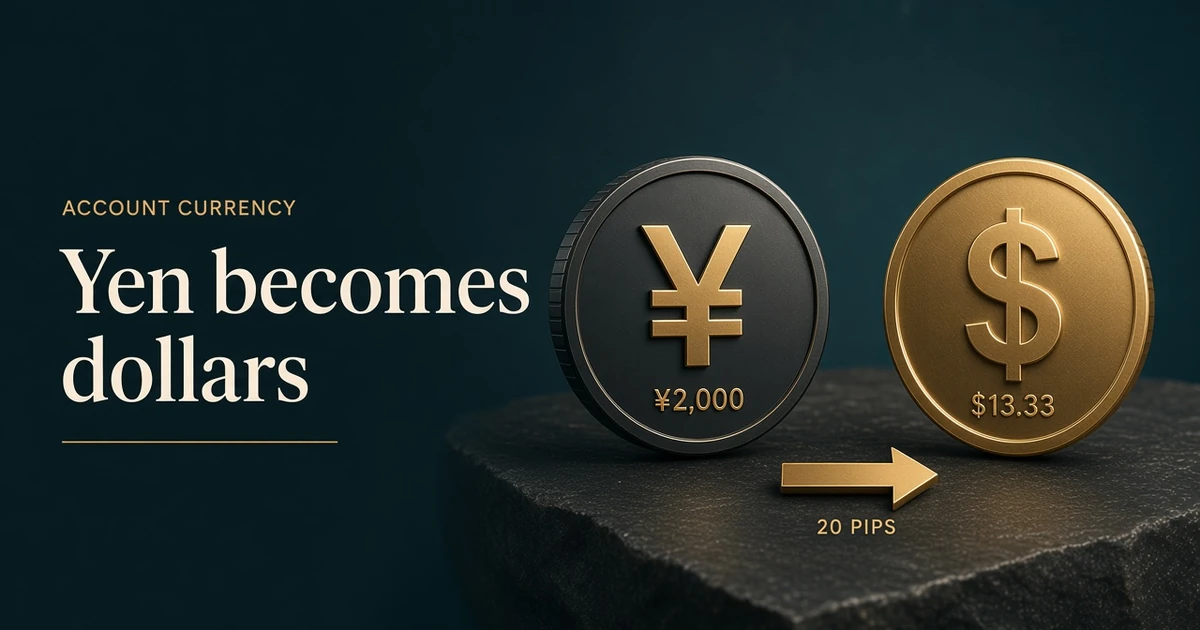
- Profit is calculated in the profit currency, then converted into the deposit currency
- 0.10 lot at about $1 a pip is an EUR/USD habit on a US-dollar account, not a market rule
- At an illustrative USD/JPY of 150, 0.10 lot is about $0.67 a pip, so 20 pips is about $13.33
- On EUR/GBP in a US-dollar account the same habit understates the dollar risk, because the pound profit is converted at the cable rate
- A cent account prints about 100 times the dollar figure; read the deposit currency before you trust the column
- What the profit column is actually counting
- Short Answer
- Detailed Explanation
- Example
- Common Mistake
- Professional Tip
- USD/JPY pays yen, then dollars
- Short Answer
- Detailed Explanation
- Example
- Common Mistake
- Professional Tip
- A pound or euro account adds one more rate
- Short Answer
- Detailed Explanation
- Example
- Common Mistake
- Professional Tip
- Where the dollar habit gets the risk wrong
- Short Answer
- Detailed Explanation
- Example
- Common Mistake
- Professional Tip
- Gold, cents, and a profit column that ticks on its own
- Short Answer
- Detailed Explanation
- Example
- Common Mistake
- Professional Tip
- Checklist
- Mini glossary
- Key takeaways
- What to do with the next ticket
Affiliate disclosure: ForexTradeLab may earn a commission from partner links, at no extra cost to you. See the affiliate disclosure.
What the profit column is actually counting#
Short Answer
The trade pays you in the quote currency. The column on the terminal then shows that amount in the deposit currency. A calculator that stops one step earlier will not match the screen.
Detailed Explanation
On EUR/USD the quote currency is the US dollar, so a US-dollar account skips the second step and the habit feels universal. It is not. OrderCalcProfit is documented as a result in the deposit currency of the account you are logged into. The symbol's profit currency is a separate field, SYMBOL_CURRENCY_PROFIT, in the symbol constants.
The hand version is two lines:
result in the profit currency = price change × contract size × lots
result in the account = that amount, converted at the live rate
For a long, the price change that matters is current bid minus the open price. For a short, it is open price minus the current ask. Contract size on a typical forex symbol is 100,000 units of the base currency per 1.00 lot. Read it anyway. Gold will not be 100,000.
Official rate pages, such as the Federal Reserve H.10 and the ECB reference rates, are where published fixes live. The numbers below are round illustrations so the division is visible. They are not those fixes, and they are not a quote you can trade.
Example
A long EUR/USD on a US-dollar account, 0.10 lot, price higher by 10 pips. Profit currency is USD. One standard lot is about $10 a pip, so 0.10 lot is about $1 a pip, and 10 pips is about $10. The screen and the habit agree. That agreement is the special case.
Common Mistake
Typing the same $1 into a USD/JPY ticket, a cross, or a euro account, then treating the difference as a platform error.
Professional Tip
Before the first order of the day, read two words in the specification: profit currency, and the deposit currency shown on the account. If they differ, the conversion is part of the trade.
Risk warning: Forex and CFDs are leveraged. A pip-value mistake changes how much cash a stop actually risks. Outcome warnings at regulated CFD brokers commonly show that most retail accounts lose money. This page is arithmetic, not a trade idea. Read the risk disclaimer.
USD/JPY pays yen, then dollars#
Short Answer
At an illustrative 150.00, 0.10 lot of USD/JPY is about 100 yen a pip, which is about $0.67. Twenty pips is about $13.33. The EUR/USD habit calls that same trade $20.
Detailed Explanation
USD/JPY quotes dollars in yen. A pip is 0.01 yen. One standard lot is 100,000 dollars of face value, so one pip on 1.00 lot is 1,000 yen. Divide by the rate to reach dollars:
1,000 / 150 = $6.67 per pip on 1.00 lot.
On 0.10 lot that is about $0.67 a pip. The yen figure does not care that your account is in dollars. The account does.
| What you assumed | 0.10 lot, +20 pips, rate 150.00 |
|---|---|
| Profit in yen | 2,000 JPY |
| Profit in USD, after dividing by 150 | $13.33 |
| EUR/USD habit ($1 a pip) | $20.00 |
| Gap | $6.67 |
As USD/JPY rises, each yen buys fewer dollars, so the dollar value of one pip falls. At an illustrative 155 the same 2,000 yen is about $12.90. Re-read the pip value when the rate has moved a long way. Do not memorise $6.67.
The pair's own price is the conversion rate in this particular case. That is why a frozen USD/JPY position on a US-dollar account does not tick from some other pair. The next section is the case where it does.
Example
You planned a $10 loss and used $1 a pip, so you chose a 10-pip stop on 0.10 lot. The real exposure at 150 is about $6.67. The stop is safer than you thought, and the target is smaller than you thought. The plan is still the wrong plan, because the next pair can err in the other direction.
Common Mistake
Calling USD/JPY "a dollar pair, so the pip is $10." The dollar is the base. The profit currency is the quote, and the quote is yen.
Professional Tip
Write the yen amount in the journal first, then the dollars. If you cannot say the yen figure, the dollar figure was a guess. The pip calculator will do the division once the account currency is set to USD.
A pound or euro account adds one more rate#
Short Answer
If the profit currency and the deposit currency differ, the terminal converts. Ten US dollars of EUR/USD profit is about £7.87 at an illustrative GBP/USD of 1.2700, not £10.
Detailed Explanation
Three illustrations, all at 0.10 lot. Standard contract size. No commission, no spread.
| Trade | Profit currency result | Account | Account result |
|---|---|---|---|
| EUR/USD, +10 pips | $10 | GBP, cable at 1.2700 | 10 / 1.2700 = £7.87 |
| EUR/GBP, +10 pips, rate 0.8600 | £10 | EUR | 10 / 0.8600 = €11.63 |
| EUR/GBP, +20 pips, then convert the pounds at cable 1.2700 | £20 | USD | 20 × 1.2700 = $25.40 |
The third row is the one that bites. The EUR/USD habit says 0.10 lot is $1 a pip, so 20 pips is $20. The position paid pounds. At 1.2700 those pounds are $25.40, about 27% more dollar risk than the habit. A stop you called "1%" is closer to 1.27%.
The other direction is milder and still wrong. A euro account on EUR/USD earns dollars, then divides by the EUR/USD rate. At an illustrative 1.0850, $10 is about €9.22. People who wanted a €10 risk have sized a little small. People who wanted a $10 risk on EUR/GBP have sized too big. Same habit, opposite error. Which currency the pair pays decides the sign.
Choosing the deposit currency at signup is a separate decision from this arithmetic. The account-currency write-up for one broker's USD, EUR and GBP options is XM account base currency. The pair list, including which symbol is a cross, is currency pairs.
Example
Equity €1,000, 1% rule, so about €10 of planned loss. You buy 0.10 EUR/USD with a 10-pip stop because "that is $10, and $10 is roughly €10." At 1.0850 the stop is about €9.22 before costs. Close enough to survive, too rough to copy onto EUR/GBP, where the same shortcut runs the other way.
Common Mistake
Converting the balance into dollars once, at a rate from last week, and then treating every later pip as a dollar pip. The terminal converts the profit, at the rate now.
Professional Tip
Set the profit and loss calculator to the deposit currency before you compare it with the terminal. A tool left on USD will "disagree" with a euro account for the same reason the habit does. The field-by-field use of that tool is the calculator handbook.
Where the dollar habit gets the risk wrong#
Short Answer
Undersizing is an annoyance. Oversizing is the account problem. It shows up when the profit currency is stronger than the dollar habit assumes, or when contract size is not a forex lot.
Detailed Explanation
Use the converted pip value inside the 1% rule. Cash at risk is stop distance times pip value in the deposit currency. The lot calculator is built for that order of operations. A lot chosen first, with a pip value borrowed from another symbol, inverts it.
The spread is a second, smaller leak, and it is also in the profit currency before it is converted. A 1.2-pip spread on the EUR/GBP example is £1.20 on 0.10 lot, then dollars or euros after the same conversion. Costs in one currency and a target in another is how a "2R" on the chart becomes less than 2R in the account. Measuring that leak from the fill, rather than from the candle, is the subject of when a break-even stop is actually flat.
Example
USD account, EUR/GBP, 0.10 lot, 20-pip stop, cable at the illustrative 1.2700.
- Habit: 20 × $1 = $20.
- Converted: £20 × 1.2700 = $25.40.
- On a $1,000 account the habit says 2.0%. The ticket says 2.5% before spread and commission.
Common Mistake
Averaging the error away. "Sometimes I'm light, sometimes I'm heavy, so it nets out." The heavy trades are the ones that do the damage, and they cluster on the same crosses.
Professional Tip
Keep a one-line pip value on the journal for each symbol you actually trade, dated, in deposit currency. Refresh it when the conversion rate has moved enough to matter. A month-old yen pip value is a stale input.
Gold, cents, and a profit column that ticks on its own#
Short Answer
Gold does not inherit the forex pip. A cent account multiplies the display by about 100. A profit in yen, held in a euro account, can change while USD/JPY is frozen, because the euro-dollar rate moved.
Detailed Explanation
Gold. If the specification says contract size 100 and profit currency USD, a $1 move on 1.00 lot is $100, so 0.01 lot is about $1 per $1 of price. Many gold CFDs are built that way. Some are not. The row wins. Copying "$0.10 a pip" from 0.01 EUR/USD onto 0.01 XAU/USD is how a small account meets a large stop. The micro-lot version of this warning is what 0.01 lot makes or loses, and the field names are in how to read the contract specification.
Cent accounts. Deposit currency USC means the column is in cents. The USD/JPY illustration that is $13.33 can print as about 1,333. Nothing in the arithmetic changed. The unit did. Screenshot culture treats the larger integer as dollars. The account-type comparison is cent, micro and standard.
A frozen pair. Take the 2,000 yen of open profit from the first example and an account in euros. Dollars first: 2,000 / 150 = $13.33, with USD/JPY held at 150. Euros next, through EUR/USD:
| EUR/USD, illustrative | Euro value of the same 2,000 yen |
|---|---|
| 1.0800 | $13.33 / 1.0800 ≈ €12.35 |
| 1.1000 | $13.33 / 1.1000 ≈ €12.12 |
USD/JPY did not move. The euro column moved by about €0.23. On a small scratch that is noise. On a large yen profit during a fast EUR/USD hour, it is a real change in what the account can withdraw. The terminal is marking the conversion, not rewriting the trade.
Margin currency is a third label on the same specification screen, and it is not the profit currency. A page that separates those two fields is still worth writing. Do not use margin currency as the unit of the profit column.
Example
You are flat on the idea, up 2,000 yen, and the euro profit dips while you are looking at a USD/JPY chart that has not printed a new pip. Check EUR/USD before you assume the broker adjusted the fill.
Common Mistake
Reading a cent-account profit as dollars and then risking a size that matches the fantasy balance. The profit-claim checks show the same unit trick in other people's screenshots. It works on your own terminal too.
Professional Tip
If the profit currency has no conversion pair in Market Watch, show that pair. A missing conversion symbol is a reason for a profit figure to look stuck or absurd. The specification still tells you which currency you are missing.
Checklist#
- Profit currency copied from the symbol specification.
- Deposit currency copied from the account, including USC if it is a cent account.
- Contract size copied. Forex 100,000 is a convention, not a promise.
- Result computed in the profit currency before any dollar habit.
- Conversion rate written down, and labelled as today's rate.
- Pip value in deposit currency pasted from the calculator, not from memory of EUR/USD.
- Stop distance times that pip value, compared with the cash you meant to risk.
- Spread and commission converted with the same rate, then subtracted.
- A second look whenever the conversion rate has moved enough to change the cash risk.
- Gold and indices kept on their own line. They do not borrow the forex pip.
Mini glossary#
| Term | Meaning in this article |
|---|---|
| Profit currency | The currency the symbol pays. Usually the quote currency on FX. |
| Deposit currency | The currency of the account. The column is in this unit. |
| Quote currency | The second code in the pair. EUR/USD pays dollars. |
| Conversion rate | The live price that turns profit currency into deposit currency. |
| Cent account | A deposit currency in cents. The integer is about 100 times the dollar figure. |
| Dollar habit | "0.10 lot is about $1 a pip." True for EUR/USD in a US-dollar account. |
Key takeaways#
- The terminal converts. A calculator that stops in the quote currency is not wrong. It is unfinished.
- At an illustrative 150, twenty pips on 0.10 USD/JPY is about $13.33, not $20.
- The same dollar habit on EUR/GBP in a US-dollar account runs heavy: about $25.40 where the habit says $20, on the 20-pip illustration.
- A euro or pound account divides or multiplies by one more rate. Ten dollars is not ten pounds.
- Gold uses contract size. Cent accounts use cents. A frozen pair can still tick if the conversion pair moves.
What to do with the next ticket#
Read the profit currency, run the two-line sum, and only then type a volume. The pip guide and the lot guide are the vocabulary. The cash ceiling is risk management. If you are still opening the first account, the sequence is how to start.
When you do compare a live specification, the numbers on XM have to be the ones for your entity and your deposit currency. A page that looked right in dollars can be a different risk in euros. Eligibility depends on your country and the legal entity in the agreement.
The page still worth writing next is the one that separates margin currency from profit currency on a single specification screen, so the collateral figure and the profit figure stop being treated as one number.
Comments
Add a useful note for other traders. We review comments before publishing.