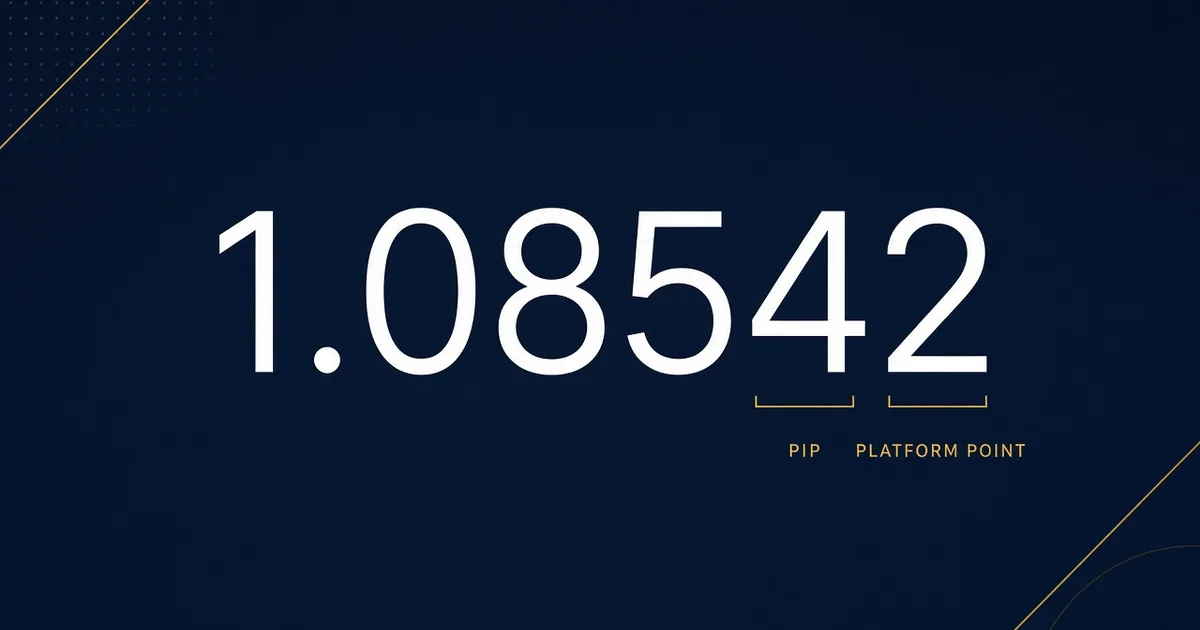
- A MetaTrader point is the last quoted digit, defined by the symbol Digits setting
- On five-digit forex quotes, 10 points equal 1 pip; a 20-point distance is 2 pips
- The Market Watch spread column and the deviation field use points, not pips
- Type an absolute stop price when the ticket is in price mode
- Do not copy the 10-points-per-pip rule onto gold, oil or indices

Quick Answer#
On MetaTrader, a point is the last digit of the price. A pip is the usual forex step: 0.0001 on most pairs and 0.01 on many yen pairs.
When the platform shows one extra digit — EUR/USD at 1.08542, or USD/JPY at 150.123 — 10 points = 1 pip. A stop, trailing stop, spread or deviation of 20 points is 2 pips, not 20.
Risk warning: Forex and CFDs are leveraged. A unit mistake can make the real loss about ten times larger or smaller than the plan. This page is education, not a signal to open a trade. Read the risk disclaimer.
The cash value of a pip still depends on the pair, the contract size and the account currency. Start with what a pip is if that conversion is new, then come back here for the platform unit.
Three Words, Three Jobs#
Short Answer
Pip is the market word. Point is the platform word. Pipette is the extra fractional digit.
Detailed Explanation
Traders say pip because it is comparable across a conversation: “the stop is 20 pips away.” MetaTrader does not store that word as a symbol property. It stores Digits and Point. In the MQL5 symbol model, SYMBOL_POINT is the value of one point in the quote currency, and SYMBOL_DIGITS is how many decimal places the price uses. The smallest tradable step, the tick size, is a separate field and can be larger than one point.
A pipette is the name traders give to one-tenth of a pip. On a five-digit EUR/USD quote, one pipette and one MetaTrader point are the same size: 0.00001.
Example
1.08542 on EUR/USD:
| Digit | Place | What it is |
|---|---|---|
| 4 | Fourth decimal (0.0001) | 1 pip if this digit changes by 1 |
| 2 | Fifth decimal (0.00001) | 1 point, and 1 pipette |
A move from 1.08542 to 1.08552 is 1 pip and 10 points. A move from 1.08542 to 1.08543 is 0.1 pip and 1 point.
Common Mistake
Calling every small price change a pip because a video used the words interchangeably. Some educators say “point” when they mean pip. The platform does not.
Professional Tip
Write the stop in the journal as both a price and a pip distance: “stop 1.08342, 20 pips.” If a tool later asks for points, convert at the keyboard, not from memory in a fast market.
The 10× Table#
Short Answer
Count the digits. If there is one more digit than the pip, multiply pips by 10 to get points.
Detailed Explanation
| Quote style | Example | 1 point | 1 pip | Points in 1 pip |
|---|---|---|---|---|
| 5-digit forex | 1.08542 | 0.00001 | 0.0001 | 10 |
| 4-digit forex | 1.0854 | 0.0001 | 0.0001 | 1 |
| 3-digit yen | 150.123 | 0.001 | 0.01 | 10 |
| 2-digit yen | 150.12 | 0.01 | 0.01 | 1 |
Most retail forex symbols in 2026 use the five-digit and three-digit rows. Four-digit pricing still exists on some feeds. Read Digits in the specification for the symbol you are about to trade. Do not inherit the setting from a screenshot of a different broker.
Example
You want a 20-pip stop.
- Five-digit EUR/USD: enter 200 points, or a price
0.00200away. - Three-digit USD/JPY: enter 200 points, or a price
0.20away. - Four-digit EUR/USD: enter 20 points, or a price
0.0020away.
Common Mistake
Using 200 points on a four-digit feed. That is 200 pips, ten times the planned distance, and the cash risk scales with it.
Professional Tip
If Digits is 5 or 3, the mental shortcut is “add a zero.” 15 pips → 150 points. 8 pips of spread → the column can show 80. Then look at the actual column, because the shortcut is only as good as the digit count.
Why the Spread Looks Huge#
Short Answer
A spread of 8 to 15 in Market Watch is often under 2 pips, not 8 to 15 pips.
Detailed Explanation
MetaTrader prints the spread as a point count: ask minus bid, in points. On EUR/USD quoted to five digits, a spread of 8 is 0.00008, which is 0.8 pips. A spread of 12 is 1.2 pips. The same digits on a three-digit USD/JPY quote mean the same pip count: 12 points is 1.2 pips.
That display causes two opposite errors. New traders think the broker is charging 12 pips and refuse a normal major. Other traders see “1 pip” in an advertisement and never notice that the live column says 28 during news, which is 2.8 pips on a five-digit quote.
Spread is a cost, not a forecast. Compare it with bid and ask and the spread guide. Around data and at the daily rollover, the point count can jump even when your analysis is unchanged.
Example
EUR/USD bid 1.08542, ask 1.08554. The difference is 0.00012 = 12 points = 1.2 pips. A buy that is closed instantly can show a loss of about that spread before any further move.
Common Mistake
Comparing a broker’s “from 0.0 pips” headline with another broker’s Market Watch point count as if both numbers were pips.
Professional Tip
Screenshot the spread in points, divide by 10 when Digits is 5 or 3, and write the pip figure in the journal. Compare that pip figure at the same hour for a week before you decide a market is “too expensive.”
Stops: Price Mode and Points Mode#
Short Answer
If the field contains a price, edit the price. If the label says points, use the 10× rule.
Detailed Explanation
Classic MetaTrader order tickets ask for a stop-loss price. You calculate it yourself. Newer tickets, mobile apps and some web terminals can switch the same field into points, meaning a distance from the entry. Expert Advisor inputs and the desktop Trailing Stop command are widely specified in points. Mixing those modes is how a planned 20-pip stop becomes a 2-pip stop.
There is a second constraint. Brokers publish a minimum stop distance, often called Stops level, in points. A stop that is mathematically correct can still be rejected as invalid if it sits inside that distance, or inside the spread during a fast quote. The rejection is a platform rule, not proof that the market “hunted” you. Placement logic belongs in how to set a stop-loss and take-profit. This page only fixes the unit.
Example
Buy EUR/USD at 1.08542 with a 20-pip stop.
- Price mode: stop =
1.08542 − 0.00200=1.08342. - Points mode on a five-digit symbol: distance = 200.
The same plan entered as 20 in points mode sits at 1.08542 − 0.00020 = 1.08522, only 2 pips away. A 1.2-pip spread leaves almost no room.
Common Mistake
Dragging a stop on the chart until the tooltip “looks like 20,” without checking whether the tooltip is in pips, points or price.
Professional Tip
Say the cash amount before you click. On a USD account, 0.01 lot of EUR/USD is about $0.10 per pip before commission, conversion and slippage, because one standard lot is about $10 per pip and 0.01 is one-hundredth of that. Twenty pips is about $2. Two pips is about $0.20. If the ticket’s projected loss does not match the sentence, the unit is wrong. Confirm the contract size in the specification; this dollar figure is an illustration for a USD-quoted pair, not a universal pip value. Use the pip value calculator and the lot calculator when the quote currency is not your account currency.
Yen Quotes Use the Same Zero#
Short Answer
On USD/JPY shown as 150.123, 10 points is still 1 pip. The pip itself is 0.01, not 0.0001.
Detailed Explanation
Yen pairs look different because one pip is the second decimal, not the fourth. The platform logic does not change. Three digits means the last digit is a tenth of a pip. A 30-pip stop is 0.30 in price and 300 points.
Pip value in dollars is a separate question. A 0.01 move on 100,000 USD/JPY is 1,000 yen, then converted into the account currency at the current rate. Do not assume it is $10. The pip guide shows that conversion. This article only stops the digit error that comes first.
Example
Sell USD/JPY at 150.123. A 20-pip stop is 0.20 above entry: 150.323, or 200 points.
Common Mistake
Subtracting 0.0020 from a yen price because that is the EUR/USD habit. On USD/JPY, 0.0020 is 0.2 pips, not 20.
Professional Tip
Keep one sticky note for non-yen pairs (0.0001, times 10 for points) and one for yen pairs (0.01, times 10 for points). The “times 10” survives. The pip size does not.
Deviation, Trailing Stops and EA Inputs#
Short Answer
Several ticket fields that never say “pip” are still in points.
Detailed Explanation
Three places catch the same mistake:
- Deviation on a market order is the slippage you will accept, commonly in points. On a five-digit quote, deviation
20allows about 2 pips. Deviation2allows 0.2 pips and can produce requotes or rejections in a moving market. Deviation200allows about 20 pips, which is a wide permission, not a tight one. - Trailing Stop on desktop MetaTrader is set in points. A menu value that looks like a modest pip trail can be ten times tighter than you think once fractional pricing is on.
- Expert Advisor inputs named
StopLoss,TakeProfitorTrailingare often point distances. A downloaded setting of30can mean 3 pips. Test that reading on demo and reconcile one closed trade with your own pip count before any live size. This is a unit check, not a recommendation to run an EA.
None of these fields choose a good trade. They only translate the distance you already chose. Position size still comes from cash risk, as in the risk management guide.
Example
A five-digit EUR/USD ticket with deviation 30 accepts about 3 pips of slippage. If you wanted a 3-pip cap, 30 is consistent. If you wanted 30 pips, the field should be 300, and you should ask whether that cap still matches the plan.
Common Mistake
Raising deviation “just to get filled” during news without converting the new number into pips. The fill can then be far past the price you thought you accepted.
Professional Tip
For the first month, leave market orders on demo and type stop prices instead of point distances. Add point-mode tools only after ten journal rows show the same pip count you intended. The trailing stop guide covers management after the unit is correct.
Gold and Indices Are Not Forex Digits#
Short Answer
Do not divide a gold or index “point” by 10 and call it a pip.
Detailed Explanation
XAU/USD, oil and stock-index CFDs can sit in the same Market Watch and still use different digit rules. A gold price of 2650.25 may have Digits = 2, so one point is 0.01 in the quote, often one cent per ounce. Traders disagree about whether a “gold pip” means $0.01, $0.10 or $1. That argument does not matter for risk. What matters is tick size, tick value and contract size in the specification, then the cash loss at your stop.
An index “point” is the index’s own point. It is not a forex pip and it is not automatically 10 MetaTrader points.
Example
A stop $2.50 away on gold is a price distance of 2.50. If the symbol’s point is 0.01, that distance is 250 points. It is not “25 forex pips” unless your own written glossary says so, and the cash result still comes from the contract size, often 100 ounces per 1.00 lot on many spot-gold CFDs. Read the specification. Do not borrow the ounce figure from another brand.
Common Mistake
Pasting a forex EA’s stop of 200 points onto XAUUSD and assuming the risk matches yesterday’s EUR/USD trade.
Professional Tip
Give metals their own journal column: price distance in dollars, point distance from the specification, and cash loss at the planned volume. Keep forex pips in a different column.
Checklist Before You Send the Order#
- I opened the symbol specification and wrote down Digits.
- I know whether 1 pip is 1 point or 10 points on this symbol.
- I know whether the stop field is a price or a point distance.
- The pip distance on the chart matches the distance on the ticket.
- The spread, read in pips, is small relative to that stop.
- Deviation, if I set it, is converted into pips and still acceptable.
- The projected cash loss matches the risk I said out loud.
- I have placed the same order on demo until the fill matched the journal.
Common Mistake
Running the checklist once, then skipping it on the second ticket of the day because the first conversion felt obvious.
Professional Tip
Keep the checklist on paper next to the keyboard for twenty demo trades. The pre-trade questions cover the setup. This list covers the unit. Both have to pass.
Glossary#
- Pip: A market convention, commonly
0.0001on non-yen pairs and0.01on many yen pairs. - Point: In MetaTrader, the last digit of the quoted price. Its size is
SYMBOL_POINT. - Pipette: One-tenth of a pip. On fractional quotes it matches one point.
- Digits: How many decimal places the symbol displays.
- Tick size: The minimum price change the symbol can trade, which can exceed one point.
- Stops level: The broker’s minimum stop distance, usually expressed in points.
- Deviation: The slippage allowance on a market order, usually in points.
What to Read Next#
Unit literacy is the step between “I understand buy and sell” and “I can place a ticket that matches my plan.” Continue with long vs short, what a lot is, and forex hours in your city so the distance you set is also a distance you can watch.
Two follow-up pieces worth writing on this desk: a field-by-field reading of the MetaTrader symbol specification, and a ten-trade demo drill that reconciles pip count, point count and cash P/L on one pair only.
Qualified next step: Practice the conversion on a demo ticket until the closed result matches your pip math. If you later open a live account, the first check is still the specification, not the leverage offer. ForexTradeLab may earn a commission if you use a partner link. That does not change the unit math. See the affiliate disclosure.
Risk warning: Most retail CFD clients lose money. Leverage can magnify a unit error. Do not trade money you cannot afford to lose.
Comments
Add a useful note for other traders. We review comments before publishing.