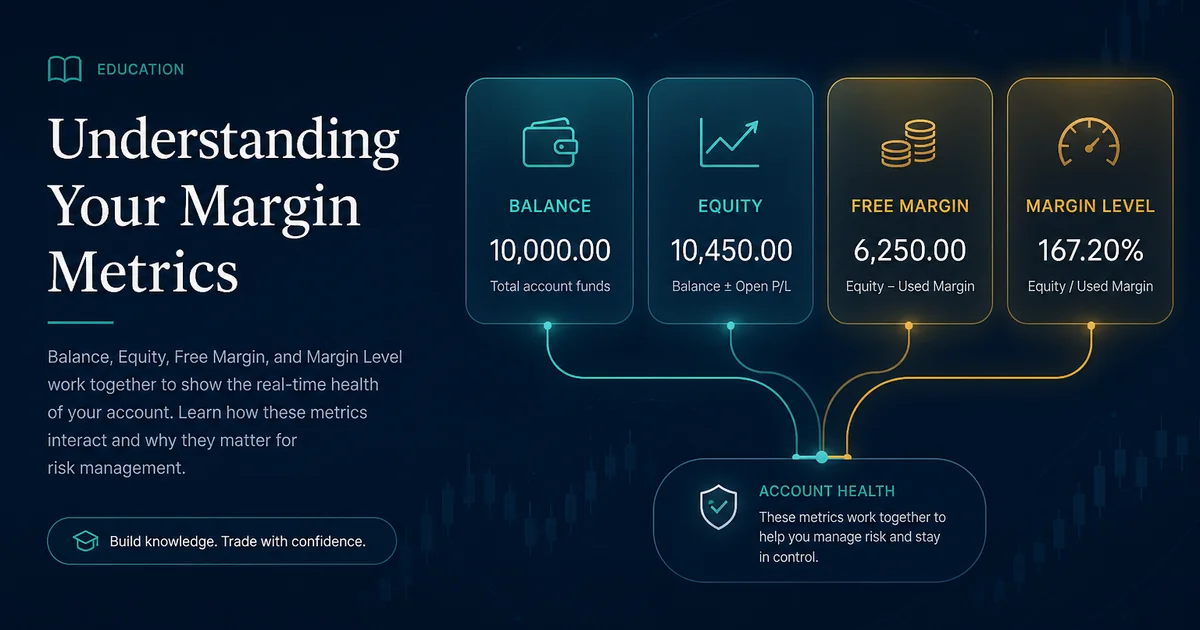
- Balance is settled closed-trade cash; equity adds open floating P/L
- Margin is collateral locked for open positions; free margin is equity minus used margin
- Margin level = equity ÷ used margin × 100 and is the gauge that approaches stop-out
- Free margin is not permission to open the biggest possible lot
- On XM and Exness the labels match MetaTrader conventions—always verify stop-out and leverage for your entity

Affiliate disclosure: ForexTradeLab may earn a commission from qualifying partner links, without increasing your cost. Read our affiliate disclosure.
Quick Decision Framework#
Short Answer
Balance is settled cash after closed trades, deposits and withdrawals. Equity is balance plus open floating profit or loss. Free margin is equity minus used margin; margin level is equity divided by used margin times 100. Read free margin as leftover capacity, not permission to maximise lot size.
Detailed Explanation
On XM and Exness, MetaTrader uses the same four ledger labels. Balance stays fixed until you close a trade or move money; equity moves tick by tick with floating P/L. Used margin is collateral locked for open positions. When margin level falls to the entity's published threshold, automatic stop-outs can close positions even if you have not closed them yourself. Stop-out percentages and leverage tiers are entity-specific—confirm them in live terms.
Example
Balance $500 with an open floating loss of −$30 gives equity of about $470. If used margin is $50, free margin is about $420 and margin level is about 940%. With no open positions, balance usually equals equity and margin level is not meaningful.
Common Mistake
Treating $420 of free margin as cash you can safely risk on the next trade. Free margin is unused capacity; planned risk is a separate percentage of current equity.
Professional Tip
Before every new order, write current equity, planned cash risk (for example 1% of equity), and used margin after entry. Confirm stop-out and leverage for your XM or Exness entity in the live platform specs.
Quick Answer#
Short Answer: Balance = settled money. Equity = balance ± open floating P/L. Used margin = collateral locked. Free margin = equity − used margin. Margin level % = equity ÷ used margin × 100. When margin level collapses, automatic liquidations can hit—regardless of brand name.
Detailed Explanation: On XM and Exness, MetaTrader (and equivalent terminals) show roughly the same ledger language. Traders search these terms hardest after funding, when a green or red floating number begins to move. The goal of this guide is terminal literacy, not a profit system. Pair it with what margin is, leverage explained, and margin call / stop-out survival.
Example: Balance $500. Open floating loss −$30. Equity ≈ $470. If used margin is $50, free margin ≈ $420, margin level ≈ 940%.
Common Mistake: Reading free margin $420 as “I can safely risk $420 on the next trade.” Free margin is capacity; your risk rule is a separate percentage of equity.
Professional Tip: Before every new order, write three numbers: equity, planned cash risk (e.g. 1%), used margin after entry. Free margin alone never authorises size.
Risk warning: Leveraged CFDs can produce rapid losses. Stop-out rules, leverage tiers and negative-balance protection depend on your legal entity and live broker documents. This article is educational only—not investment advice. See our disclaimer.
The Four Numbers at a Glance#
Short Answer: Learn the table; then walk through the identity equations with a live ticket open on demo or micro size.
| Term | What it measures | Moves when… |
|---|---|---|
| Balance | Settled account cash after deposits, withdrawals and closed trades | You deposit, withdraw or close P/L |
| Equity | Balance + floating profit/loss (and sometimes credits depending on bonus rules) | Every open-tick price change |
| Used margin | Collateral your broker holds for open positions | You open/close/modify sizes or leverage changes |
| Free margin | Equity − used margin | Equity or used margin changes |
| Margin level | (Equity ÷ used margin) × 100 | Equity or used margin changes |
Detailed Explanation: Think of balance as the official cash ledger. Think of equity as the mark-to-market value right now. Margin language answers: how much of that equity is already pledged as collateral, how much remains, and how stressed the pledge is (margin level). For cost construction after you understand the numbers, read broker-specific pricing: XM spreads and commissions, Exness spread guide.
Example: With no open positions, balance usually equals equity and free margin; margin level is not meaningful.
Common Mistake: Celebrating balance after a closed win while ignoring that free margin looks high only because all risk is closed—then reopening triple size.
Professional Tip: Screenshot the Trade tab once while floating P/L moves so you can see equity update without balance changing.
Balance: The Closed-Book Number#
Short Answer: Balance changes when money enters/leaves the ledger through funding or closed trade results—not tick by tick.
Detailed Explanation: Deposits increase balance after processing. Withdrawals decrease it after approval and payment routing. Open trades do not change balance until closed (or until certain adjustments like some commissions/swaps apply, depending on platform accounting). Bonus/credit lines, if present, may appear as separate fields and can complicate mental equity—read are bonuses legit carefully before treating bonus as withdrawable cash.
Example: You deposit $200. Balance $200. You open a losing micro trade (−$4 floating). Balance still $200 until you close. After close, balance becomes $196 (ignoring commissions/swaps/rounding).
Common Mistake: Taking a withdrawal decision from equity peak while positions are still open; the cash is not settled.
Professional Tip: For funding hygiene, use first deposit process and test a small outbound transfer before large top-ups (withdrawal test).
Equity: Reality Right Now#
Short Answer: Equity is the honest mark-to-market reading of the account including open risk.
Detailed Explanation:
Equity ≈ Balance + Floating P/L (± adjustments)
When equity falls while positions stay open, free margin and margin level fall with it. That is how stop-out maths wakes up even if you “haven’t closed yet.” High-impact news can move equity faster than slow charts suggest—another reason first-week rules ban red-folder entries. See USD news playbook for context, not for gambling.
Example: Balance $1,000, floating +$40 → equity ≈ $1,040. Same balance, floating −$120 → equity ≈ $880.
Common Mistake: Setting risk as 1% of starting deposit forever while equity has already fallen 30%. Update risk from current equity, or your cash risk drifts upward in percentage terms.
Professional Tip: Journal risk in account currency and as % of current equity.
Used Margin and Free Margin#
Short Answer: Used margin is locked collateral; free margin is what is left before new risk.
Detailed Explanation: Required margin scales with notional size and leverage. Simplified educational form for many FX CFDs:
Used margin ≈ (lots × contract size × price) / leverage
Free margin:
Free margin = Equity − Used margin
Important consequences:
- Higher leverage reduces used margin for the same lot—margin level may look healthier while cash stop-loss risk stays the same.
- Increasing lots raises used margin and raises cash stop-loss at a fixed pip distance.
- Free margin near zero means you cannot safely add size even if the chart “looks perfect.”
Deepen leverage maths with XM leverage and margin, Exness leverage, and loss at 1:100 / 1:500 / unlimited-style.
Example (educational only): EUR/USD at 1.1000, 0.10 lot, leverage 1:100 → notional ≈ $11,000 → used margin ≈ $110. At 1:500, same lot used margin ≈ $22. Cash risk of a 50-pip stop remains roughly the same if lot is fixed.
Common Mistake: “I still have free margin, so I can open another trade” with three highly correlated positions (EUR/USD, GBP/USD, XAU risk-on stack).
Professional Tip: Cap total open risk across symbols, not only per ticket free margin.
Margin Level: The Stress Gauge#
Short Answer: Margin level tells you how thick the cushion between equity and used margin is.
Detailed Explanation:
Margin level (%) = (Equity / Used margin) × 100
| Margin level (illustrative) | Typical reading |
|---|---|
| Very high / blank | No positions or tiny used margin |
| High (e.g. > 500–1,000%+) | Comfortable cushion for that size—not a free pass to grow lots |
| Approaching broker warning zone | Stress rising; reduce risk, do not add |
| At stop-out threshold | Broker can auto-close positions |
Exact margin call and stop-out percentages and ordering of closed positions are entity and account specific. Never assume a blog number overrides the client agreement on your XM or Exness entity. Operational survival steps are detailed in margin call and stop-out guide. For NBP framing, see negative balance protection explained.
Example: Equity $470, used margin $50 → margin level ≈ 940%. Equity falls to $55 with same used margin $50 → margin level ≈ 110%—dangerously close depending on your stop-out line.
Common Mistake: Believing negative-balance protection makes stop-out “harmless.” NBP (where it applies) can limit debt beyond zero; it does not protect the capital you already lost on the path to zero.
Professional Tip: Engineer trades so a normal stop hit never takes margin level into emergency zones. That is what position sizing is for—position size guide.
Worked Mini-Scenario (XM or Exness Terminal Literacy)#
Short Answer: Same arithmetic applies on both brands; only live leverage and stop-out settings change.
| Step | Educational numbers |
|---|---|
| Starting balance / equity | $250 |
| Open 0.02 lot major, used margin | $40 (illustrative at some leverage) |
| Free margin at entry with zero float | $210 |
| Price moves against, float −$20 | Equity $230; free margin $190; margin level 575% |
| Float −$80 | Equity $170; free margin $130; margin level 425% |
| Close for −$80 | Balance $170; used margin $0 |
Detailed Explanation: Nothing in the table required a special “XM formula” or “Exness formula.” Brand choice still matters for payments, entity rule sets, average spreads and support—but the four labels are shared MetaTrader literacy. Operational choice of broker stays a due-diligence task: XM vs Exness, is XM safe, is Exness safe.
Example: A trader who only watches balance never sees floating danger early. A trader who watches margin level while stacking positions sees stress form before stop-out.
Common Mistake: Closing the winning trade first when multiple are open during a crisis “to lock profit,” sometimes leaving the loser that destroys free margin—understand your broker’s auto close order from official docs when stressed.
Professional Tip: Practise this scenario on demo with intentional micro losses so the first live equity dip does not feel like a mystery.
First-Week Rules Tied to These Metrics#
Short Answer: Use the numbers as brakes, not as scoreboards.
- Risk money at the stop, not free margin.
- Keep one open risk while learning (first live trade process).
- If floating loss consumes more than a few planned R without SL working, stop trading—investigate process.
- If margin level falls faster than expected, lot size or stop distance is wrong.
- Do not deposit solely to “restore margin level” mid-loser—that is often rescue gambling.
- After process competence, test money out (Exness withdrawal, XM withdrawal delays explained).
Detailed Explanation: Retail CFD risk disclosures exist because leveraged accounts can drop equity quickly. ESMA-style marketing restrictions and retail leverage caps in some jurisdictions exist for the same structural reason—even when your entity allows higher leverage.
Example: Equity $180 after losses. You recompute 1% risk → $1.80. Your old 0.05 lot habit is dead until capital and process recover.
Common Mistake: Setting max leverage on day one because free margin “would look larger.”
Professional Tip: Cap leverage in Members Area / Personal Area deliberately; treat max as a marketing ceiling—see beginner capital framing in XM–Exness beginner capital plan.
XM vs Exness: Where the Labels Meet Entity Reality#
Short Answer: Labels match; protections, leverage tiers and bonuses can diverge by entity.
| Check | Why you verify live |
|---|---|
| Legal entity name | Determines leverage caps and protection wording |
| Dynamic / tiered leverage | Large gold or FX notionals may force higher margin mid-trade |
| Stop-out % | Defines the cliff edge under stress |
| Bonus/credit accounting | Can distort mental equity if misread |
| Instrument margin (gold, indices, crypto CFDs) | Different from majors |
| Server / terminal | MT4 vs MT5 vs app may display the same fields with different layouts |
Example: Two friends both use “Exness” branding but land under different entities; one sees a different max leverage. Both still read Equity the same way.
Common Mistake: Copying a Telegram screenshot of someone else’s margin level as proof your settings are safe.
Professional Tip: Open inspection flows only after literacy:
Partner codes (e.g. XM FXTRD) never rewrite margin maths.
Plain-Bullet Mastery Checklist#
- Locate Balance, Equity, Margin, Free Margin, Margin Level on your terminal
- Open a demo position and watch equity move while balance stays flat
- Compute free margin by hand once: equity − used margin
- Compute margin level by hand once: equity ÷ used margin × 100
- Confirm stop-out language for your legal entity
- Write per-trade cash risk as % of current equity
- Size lots from stop distance, not free margin (lot calculators)
- Avoid news equity shocks in week one
- Keep correlated risk from stacking three near-identical bets
- Journal screenshots of metrics at entry and exit
Key Takeaways#
- Balance is closed-book cash; equity is live value.
- Free margin is leftover capacity—not a bet size.
- Margin level is the stress percentage approaching stop-out.
- Leverage can decorate margin level while hiding cash ruin if lots grow.
- XM and Exness share terminal literacy; entity docs still decide protections.
Glossary#
| Term | Plain meaning |
|---|---|
| Floating P/L | Unrealised profit or loss on open trades |
| Used margin | Collateral currently locked |
| Free margin | Capacity not locked |
| Margin call | Stress warning / restriction phase near low margin level |
| Stop-out | Automatic close of positions at a critical margin level |
| Notional | Full position value controlled via leverage |
| Credit / bonus | Non-standard funds—read terms before treating as cash |
Related Reading and Future Clusters#
- What is a pip
- What is a lot
- How to set stop loss and take profit
- How to place first live trade
- Related topics: partial-close effects on used margin, swap-day equity changes, and multi-position margin for gold baskets.
Affiliate disclosure: ForexTradeLab may earn a commission if you register or fund through tracked XM or Exness links. Commissions do not change how balance, equity or margin maths work on your account. Use links only after you understand the four metrics and can size micro risk.
Optional inspection step: Review XM or Review Exness live for your country after demo practice—verify entity, leverage and payment rails yourself.
Final risk note: Terminal literacy does not make leveraged trading safe. Size positions so your planned stop never depends on hoping margin level “holds.”
Comments
Add a useful note for other traders. We review comments before publishing.