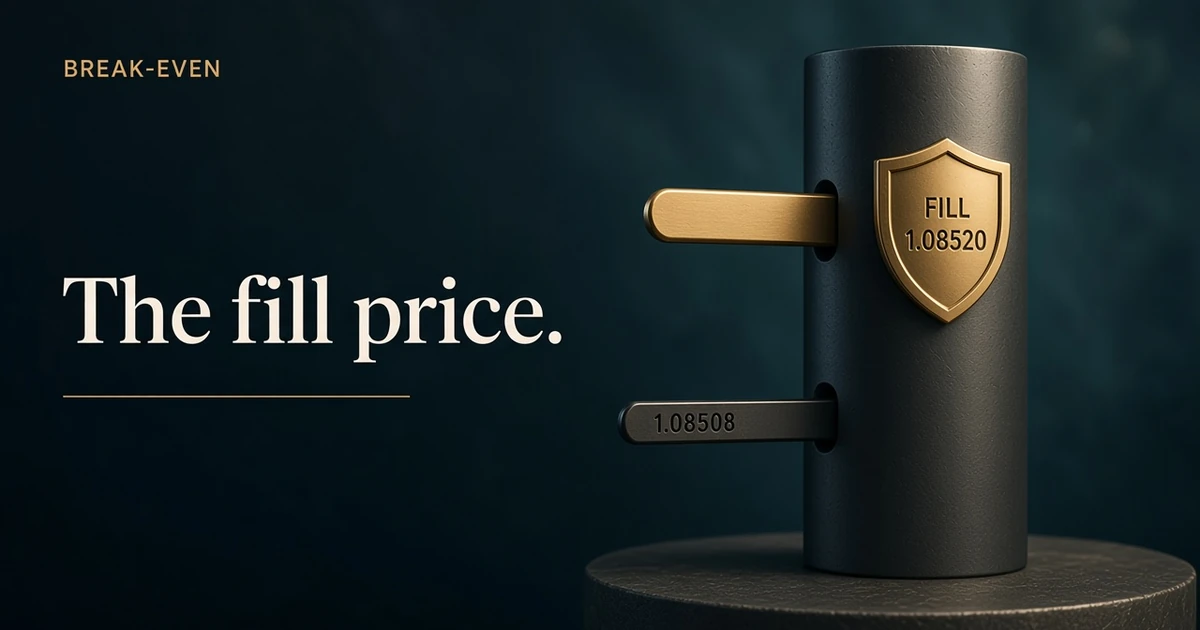
- Price break-even for a long is the open price printed on the ticket, because that position closes on the bid
- A stop on the bid candle from the click still loses about the spread
- Commission and swap belong in the flat price; adding the spread a second time pushes the stop too far
- Stops level, measured in points, can reject a break-even modification until price has moved
- Moving the stop after a small open profit turns would-be winners into scratches and can flip a positive pip model negative
- The flat price
- Short Answer
- Detailed Explanation
- Example
- Common Mistake
- Professional Tip
- Longs and shorts close on opposite sides
- Short Answer
- Detailed Explanation
- Example
- Common Mistake
- Professional Tip
- Commission and swap sit past the flat price
- Short Answer
- Detailed Explanation
- Example
- Common Mistake
- Professional Tip
- The server can reject the modification
- Short Answer
- Detailed Explanation
- Example
- Common Mistake
- Professional Tip
- Moving early spends the winners
- Short Answer
- Detailed Explanation
- Example
- Common Mistake
- Professional Tip
- A ticket you can check on demo
- Short Answer
- Detailed Explanation
- Example
- Common Mistake
- Professional Tip
- Checklist
- Mini glossary
- Key takeaways
- Where this leaves the decision
Affiliate disclosure: ForexTradeLab may earn a commission from partner links, at no extra cost to you. See the affiliate disclosure.
The flat price#
Short Answer
A break-even stop is flat when a fill at that price brings the position's price result to about zero. For a buy, that price is the open price on the ticket. The candle at the click is often a different number.
Detailed Explanation
MetaTrader charts plot the bid unless you change it. A buy is filled at the ask. The position then marks and closes on the bid. Floating profit on a long is the distance from that open ask down or up to the current bid, converted into the deposit currency. OrderCalcProfit does that conversion for the account you are logged into.
So the ladder has three rungs, and only one of them is flat:
| Rung | What it is | Result if a long stop fills there |
|---|---|---|
| Bid on the chart at the click | The candle you can see | About one spread of loss |
| Open price on the position | The ask you actually paid | Price result about zero |
| Open price plus costs in price | Commission and swap included | Cash result about zero, if the fill is clean |
The CFTC's note on stop orders makes the other half of this plain: a stop is a trigger. In a gap or a widened spread the fill can be worse than the price you typed. Break-even is a plan for a normal fill. It is not a guaranteed scratch.
Example
You buy EUR/USD and the position prints an open price of 1.08520. The spread at that second is 1.2 pips, so the bid candle is near 1.08508. Volume is 0.10 lot on a US-dollar account, about $1 a pip before costs.
- Stop at 1.08508: the close is about 1.2 pips against the fill, roughly $1.20.
- Stop at 1.08520: the bid has come back to the ask you paid. Price result is about $0.
These are teaching numbers, not a live quote. Read the open price on your own ticket.
Common Mistake
Dragging the stop to the candle because that is the line your eye remembers. On a buy, that line is the bid. The trade is still short of flat by about the spread.
Professional Tip
Say the flat price out loud from the terminal before you drag anything: "Open price 1.08520." If the chart and the terminal disagree, the terminal is the fill.
Risk warning: Forex and CFDs are leveraged. A stop can fill worse than the price you set, and most retail CFD clients lose money at brokers that publish an outcome warning. This is a way to read a ticket, not a signal to enter. Read the risk disclaimer.
Longs and shorts close on opposite sides#
Short Answer
A long closes on the bid. A short closes on the ask. The open price is already the side you traded, so you do not add the spread on top of it.
Detailed Explanation
A short EUR/USD fills at the bid. Say that print is 1.08508. The position profits when the ask falls below that print. Price result is about zero when the ask trades back at 1.08508. The stop you type is that open price. By the time the ask is there, the bid chart has already moved down by about the spread. The travel was the spread. You do not subtract the spread a second time.
The mirror-image error on a short is setting the stop at the ask you saw when you clicked (1.08520 in this ladder). That is about 1.2 pips worse than the fill, and it locks the spread in as a loss.
| Position | Open price is | Flat stop, before costs | Wrong "visual" stop |
|---|---|---|---|
| Long | Ask | That ask | The bid candle at the click |
| Short | Bid | That bid | The ask that was above the candle |
Bid and ask at the moment of the click, and how a stop uses them later, are covered in why a stop fills worse than the price you set and in what the spread is.
Example
Same ladder. Short filled at 1.08508.
- Stop at 1.08508: price result about zero when the ask trades there.
- Stop at 1.08520: about $1.20 of loss on 0.10 lot, which is the spread, locked in on purpose.
Common Mistake
Adding the spread "to be safe" on top of the open price. The fill already happened on one side of the quote. A second spread pushes a flat stop into a small winner and leaves the trade less room to breathe.
Professional Tip
Write two words on the journal line before the modification: "long, bid" or "short, ask." That is the side that will close you.
Commission and swap sit past the flat price#
Short Answer
A stop at the open price zeros the price result. Cash is flat only after you have also covered commission and any swap you have already been charged.
Detailed Explanation
Convert the cost into pips, then into a price step.
extra pips = round-turn cost in account currency ÷ value of one pip
For a long, add those pips to the open price. For a short, subtract them. If the position has been charged swap, include that debit in the same cost. A swap credit means cash is flat slightly before the open price. Overnight financing itself is a separate subject: what swap is.
The pip value has to be in account currency. A habit copied from EUR/USD will mis-state this step on yen pairs and on euro or pound accounts. The conversion is how forex profit becomes account currency.
Example
Stay with the long at 1.08520, 0.10 lot, about $1 a pip. Suppose the fee schedule is $7 round turn per standard lot. On 0.10 lot that is $0.70, or 0.7 pips. The illustration is the arithmetic, not a claim about any broker's live commission.
Cash-flat stop ≈ 1.08520 + 0.00007 = 1.08527.
A clean fill there covers the commission. A slipped fill does not. There is still no guarantee, which is the point of the CFTC note above.
Common Mistake
Calling the open price "cash break-even" on a raw-spread account that charges commission per side. The price is flat and the cash is still down the round turn.
Professional Tip
If the cost is smaller than the spread you already understand, still write it down. A $0.70 leak repeated on every scratch is a strategy input, not a rounding error.
The server can reject the modification#
Short Answer
Stops level is a band, in points, around the current price. A break-even stop inside that band is refused. The original stop stays where it was.
Detailed Explanation
MetaTrader 5's specification help describes that channel: stop-loss, take-profit and pending prices placed too close come back as a rejection. The distance is SYMBOL_TRADE_STOPS_LEVEL in the symbol constants. Many EUR/USD books show 0. Some other symbols do not. Read the row on the symbol you are modifying. The field guide is how to read the contract specification.
Points are not pips on a five-digit quote. 10 points = 1 pip. A stops level of 20 points is 2 pips. That conversion is the whole of pips versus points.
Freeze level is a second field. When it is above zero it can block a change to an order that is already close to triggering. A rejected modify is not a filled stop.
Example
You want the long stop at 1.08527, and this symbol's stops level is 20 points (2 pips). The bid has to be at least about 1.08547 before that modify is legal. If the bid is only 1.08530, the server refuses it. The protective stop you set at entry is still the one working.
Common Mistake
Clicking Modify, seeing a rejection, and deleting the original stop so the platform will "accept something." The trade is then unprotected while you negotiate with a distance rule.
Professional Tip
If the modify fails, leave the entry stop in place and set an alert at the price where the break-even level becomes legal. The alert is patience. Deleting the stop is a different trade.
Moving early spends the winners#
Short Answer
A break-even rule that fires after a few pips replaces some winners with scratches. The losers usually still pay the full stop. Run that arithmetic before you adopt the rule.
Detailed Explanation
This is a paper model of 20 trades, not a measured win rate and not a forecast. Plan: 10-pip stop, 20-pip target, 8 wins and 12 losses. Costs are left out so the management choice is visible on its own.
| Rule you actually follow | How the 8 winners are treated | Net pips over the 20 trades |
|---|---|---|
| Leave the original stop. Take the target. | 8 trades at +20 | 8×20 + 12×(−10) = +40 |
| Move to flat after +5 pips, and half of those eventual winners fall back | 4 at +20, 4 scratches at 0 | 4×20 + 4×0 + 12×(−10) = −40 |
| Move to flat only after +10 pips, and two winners fall back | 6 at +20, 2 scratches at 0 | 6×20 + 2×0 + 12×(−10) = 0 |
The scratch counts are assumptions, chosen so you can see the mechanism. Change them to match your journal and the sign can change. What does not change is the structure: every scratch used to be a winner in the first row, and the twelve losses are still losses.
A trailing stop, which keeps moving, is a different rule with a different scratch rate. So is taking part of the position off and leaving the rest. Those choices are in trailing stops and partial closes. The 1% risk rule still sizes the original stop. Break-even does not repair a position that was too large at entry.
Example
On the model, the "move it once I'm green" habit turns +2 pips a trade into −2 pips a trade. The entries did not get worse. The exit rule deleted the payoffs that were funding the losers.
Common Mistake
Judging the habit by how a scratch feels. A scratch feels like skill. In the middle row it is a winner you no longer have, and the losers did not shrink to match.
Professional Tip
Pick one distance and keep it for a sample you can count, such as the next 30 demo trades. "After 1R" and "after the trade clears the level that justified the entry" are testable. "When I feel relieved" is not.
A ticket you can check on demo#
Short Answer
Size the stop from the fill, place the original stop there, and write the later flat price on paper before you are allowed to move anything.
Detailed Explanation
Use a US-dollar demo, EUR/USD, equity about $1,000. One percent is about $10. At 0.10 lot, a pip is about $1, so a 10-pip stop from the fill risks about $10 before slippage. Confirm the pip value in the pip calculator and the cash risk in the lot calculator. The walk-through of those tools is the calculator handbook.
Suppose the buy fills at 1.08520.
- Original stop: 1.08420. That is 10 pips under the fill, about $10.
- A 2R target, if you use one: bid at 1.08720, 20 pips above the fill.
- Price-flat modify, later: 1.08520.
- Cash-flat modify, if the round turn really is $0.70: 1.08527.
- If stops level is 20 points, wait until the bid is about 1.08547 before you send step 4.
Measuring the 10 pips from the candle at 1.08508 instead of from the fill puts the stop at 1.08408. The loss from 1.08520 to 1.08408 is 11.2 pips, about $11.20. The risk plan quietly became 1.1%.
Example
You fill at 1.08520, set 1.08420, and price later trades 1.08560. You are not yet allowed to move the stop if your written rule says "only after 1R," because 1R is 1.08620. The 4 pips of open profit are information. They are not permission.
Common Mistake
Editing the stop because the open profit flickered green for a few seconds. The spread can hand you that flicker and take it back without the idea having gone anywhere.
Professional Tip
On the first ten demos, do not move the stop at all. Collect the open price, the spread, and what the trade would have done. You need that sample before a break-even rule has anything honest to say.
Checklist#
- Open price read from the position, not from the candle.
- Long or short written down, so the close side is obvious.
- Original stop measured in pips from that open price.
- Pip value in account currency, from the specification or the calculator.
- Commission and swap converted into a price step, even if the step is under a pip.
- Stops level read in points and converted with the five-digit rule if it applies.
- A written distance that must be reached before a modify is allowed.
- The original stop left in place if the modify is rejected.
- Scratches tagged in the journal as a separate exit, not as a win.
- The same rule on the next sample. One relieved click is not a test.
Mini glossary#
| Term | Meaning in this article |
|---|---|
| Open price | The fill. Ask for a buy, bid for a sell. |
| Price break-even | A later fill at that open price, so the price result is about zero. |
| Cash break-even | The same idea after commission and swap. |
| Stops level | Minimum distance, in points, for a new or modified stop. |
| Scratch | An exit near flat that used to have a chance of being a winner. |
| 1R | A favourable move equal to the original stop distance. |
Key takeaways#
- The flat price for a long is the ticket's open price, because the close happens on the bid.
- The candle at the click still carries about a spread of loss if you park the stop there.
- Commission and swap belong in the cash-flat price. A second copy of the spread does not.
- Stops level can refuse the modify. The entry stop stays until the new one is accepted.
- Moving after a few green pips can turn a positive pip model into a negative one, because scratches replace winners.
Where this leaves the decision#
Use the original stop, sized in cash, until price has travelled a distance you wrote down in advance. When you do move it, move it to the open price plus costs, and only after the server will accept that price.
Practise the ladder on a demo before it is attached to money you care about. The start path is how to start forex, and the sizing rules sit in risk management. If you later want a live account, compare the current specification and fee schedule on XM with the numbers you just calculated. Eligibility depends on your country and the legal entity.
Two related pages are still worth writing on their own: what a guaranteed stop actually charges to remove the gap, and how margin currency differs from profit currency on the same specification screen.
Comments
Add a useful note for other traders. We review comments before publishing.