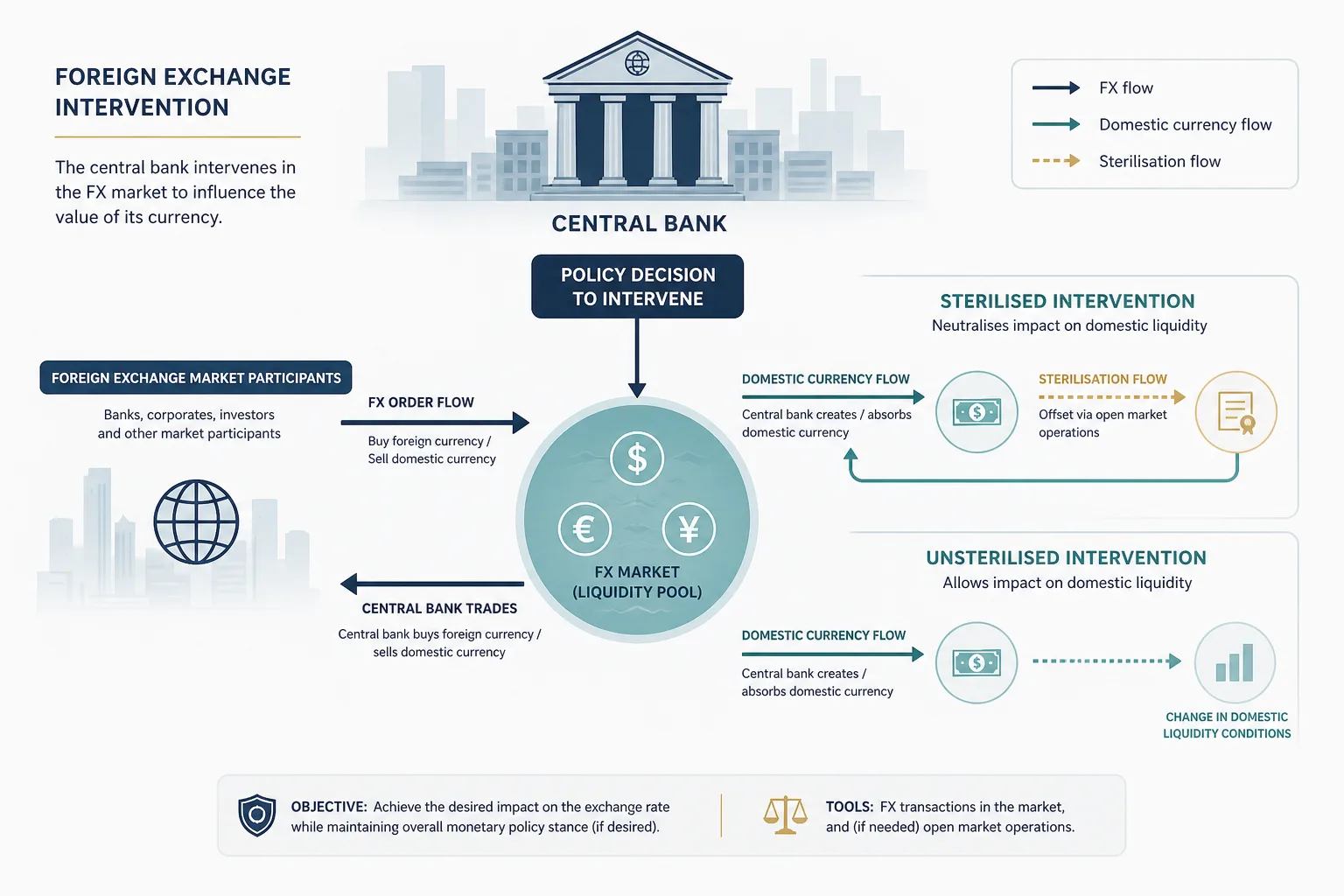
- FX intervention is when a monetary authority buys or sells foreign currency (or credibly threatens to) to influence the exchange rate or dampen disorderly conditions
- Sterilised intervention offsets the domestic-liquidity effect; unsterilised intervention changes domestic money-market conditions and is closer to a policy-mix shift
- Verbal intervention can move prices with little or no immediate reserve use if credibility is high
- Retail traders cannot see the full order book; they see headlines, spikes, widening spreads and failed breakouts
- The professional response is smaller size, wider invalidation and no revenge trading into a defence
- Reserves, policy rates and capital-flow context matter more than a single print

Quick Decision Framework#
Short Answer
Central bank FX intervention is official buying or selling of foreign currency against the domestic currency, sometimes with verbal warnings. The aim is to influence the rate, restore orderly trading, or signal policy—not to give retail traders an edge. Sterilised operations try to leave domestic liquidity unchanged; unsterilised operations let the FX deal affect money markets.
Detailed Explanation
Intervention can be actual dealing or a credible threat (verbal intervention). Effectiveness depends on size versus the OTC market—the BIS Triennial Survey is the size context—plus credibility, capital mobility, and whether the stance matches fundamentals. Retail traders do not see the official order book; they see headlines, spikes, wider spreads, and failed breakouts. The professional response here is smaller size, wider invalidation, and no revenge fade into a defence. Reserves, policy rates, and capital-flow context matter more than a single print. Fading every spike is how accounts die.
Example
When a central bank buys foreign currency and pays in domestic money, it typically injects domestic liquidity. If it sterilises, it drains that liquidity elsewhere so the policy-rate corridor is not rewritten by the FX ticket. A retail trader who shorts the spike because "interventions always fail" is trading a slogan, not that distinction.
Common Mistake
Fading an intervention headline with full size because a past episode reversed, while spreads are already wide and you cannot tell verbal talk from actual reserve use.
Professional Tip
Name the central bank, the pair, and whether the news is verbal or confirmed dealing. Cut risk in that pair before you invent a fade. Wait for an official statement or a recognised wire—not a screenshot.
TL;DR — Intervention Types in One Screen#
| Type | What happens | What you feel in spot |
|---|---|---|
| Verbal | Statement, threat, “monitoring closely” | Jump, then fade or follow-through |
| Spot dealing | Official buys/sells FX | Spike, spread blowout, failed levels |
| Sterilised | FX deal + offsetting domestic liquidity | FX move possible without a rate-path rewrite |
| Unsterilised | FX deal changes domestic reserves | More like a policy-mix shift |
| Question | Short Answer |
|---|---|
| Is this a trading system? | No |
| Can I see the orders? | Almost never in real time |
| First retail action? | Smaller size, not a clever fade |
| Related tools? | Calendar, rates, reserves, correlation |
Related: interest rates and forex, USD/JPY analysis, safe-haven currencies.
What Official FX Intervention Is#
Short Answer
It is the monetary authority transacting (or credibly standing ready to transact) in the foreign-exchange market to influence the exchange rate or calm disorderly trading.
Detailed Explanation
Unlike a retail market order, intervention is a policy operation. ECB monetary-policy operations notes place FX swaps among official fine-tuning tools; the Fed research literature treats intervention as an official-sector instrument, not a retail signal.
Typical instruments:
- Spot purchases/sales of foreign currency against the domestic currency
- Sometimes forwards or other FX derivatives (jurisdiction-specific)
- Verbal intervention: communication designed to change expectations
IMF Global Financial Stability work regularly returns to FX funding stress and official-sector responses. Effectiveness is not automatic: in a highly mobile-capital world, a small operation against a huge OTC market can be a signal more than a stock-flow sledgehammer.
Example
A finance ministry says it is “ready to act” against disorderly depreciation. Spot gaps, spreads widen, and a prior breakout fails. You do not need to know the exact reserve ticket to recognise headline liquidity risk.
Common Mistake
Assuming every sharp move is “the central bank.” Dealers, options hedges and thin hours create spikes too.
Professional Tip
Log who spoke, which venue, which pair, and whether dealing was confirmed. Vague “they intervened” notes are not a journal.
Key point: Intervention is official flow plus signalling. Retail CFDs sit at the end of that chain with extra spread and gap risk.
Sterilised vs Unsterilised#
Short Answer
Sterilised intervention tries to neutralise the domestic money-market effect of the FX deal. Unsterilised intervention lets domestic liquidity change — closer to mixing FX and monetary policy.
Detailed Explanation
When a central bank buys foreign currency and pays with domestic currency, it typically injects domestic liquidity (banks hold more domestic reserves). Sterilisation offsets that (for example by draining liquidity elsewhere) so the policy-rate corridor is not mechanically rewritten by the FX ticket.
Unsterilised purchases leave the liquidity injection in place. That can look more like easing (or tightening, if selling FX drains domestic liquidity). This is why traders should not read an FX spike as “rates just changed” unless the operation is clearly unsterilised or paired with an explicit policy shift.
Interest-rate policy remains the main domestic lever in inflation-targeting regimes. Intervention is often a complement or emergency tool, not a substitute for the policy rate.
Example
A bank sells dollars and buys the local currency (supporting the local unit) and fully sterilises. The local currency may still jump on the print; overnight rates may barely move. A trader who shorts the local currency “because rates didn’t hike” can still be run over by the FX flow.
Common Mistake
Equating every intervention with a surprise rate decision.
Professional Tip
If the statement mentions both FX operations and money-market fine-tuning, assume you need two models, not one.
Why Effectiveness Varies#
Short Answer
Because official size is often small versus global FX turnover, and because capital flows can lean against the operation unless the signal is believed.
Detailed Explanation
The BIS Triennial Survey documents multi-trillion-dollar daily OTC FX activity. A one-day official ticket can still matter at a specific time and venue (Tokyo morning, a thin cross, a stop cluster) even if it is small versus global turnover.
Research themes you will see in IMF/BIS-style papers:
- Signalling channel — markets update the expected policy path
- Portfolio-balance channel — changing the relative supply of domestic vs foreign assets (more relevant when sterilised and when assets are imperfect substitutes)
- Order-flow / microstructure — hitting a thin book
None of these give you a licensed “fade the spike” rule.
Example
Verbal intervention in a G10 pair during London–New York overlap may mean-revert. The same words into a thin EM cross after a holiday can gap through stops and not come back the same day.
Common Mistake
Backtesting “buy the dip after intervention” on one famous episode and calling it a system.
Professional Tip
Treat famous historical episodes as case studies, not as parameters for an EA.
What Retail Traders Should Do#
Short Answer
Reduce risk, respect spreads, and do not fight a defence with size you cannot afford.
Detailed Explanation
A practical protocol:
- If you hold the defended currency the wrong way, cut first, analyse later.
- Watch market hours and slippage.
- Recheck correlations — USD, gold and regional crosses can move together.
- Do not confuse intervention with a PPP cheap/expensive story. Officials may lean against a REER they dislike; that can take years.
- Rebuild only with position sizing and a stop that assumes another spike.
CFTC fraud warnings still apply: anyone selling “central-bank signals” as a subscription is a red flag.
Example
You are long a high-yielder versus JPY. A Japanese official warns against excessive yen weakness. USD/JPY spikes down 150 points in minutes. The professional move is flatten or hedge — not double the long “for the bounce.”
Common Mistake
Moving the stop further away because “they always fail.”
Professional Tip
If your plan requires predicting the next official ticket, you do not have a plan. You have a hope.
Comparison Table — Intervention vs Rate Decision vs Data Print#
| Event | Primary channel | Typical retail error |
|---|---|---|
| Policy rate decision | Domestic stance, path | Ignoring FX intervention the same week |
| CPI / NFP | Expectations | Oversizing into the number |
| FX intervention | Official flow + signal | Fading the spike with max leverage |
| Verbal only | Expectations | Treating words as confirmed dealing |
Use the economic calendar for scheduled data. Intervention is often unscheduled.
Checklist — Intervention Headline Protocol#
- Actor and currency pair identified
- Verbal vs confirmed dealing distinguished
- Open risk in that pair reduced
- Spread and gap risk accepted
- Sterilisation status treated as unknown unless stated
- No add-on from social screenshots
- Re-entry only with written stop and 1% (or less) risk
- Fraud “signal service” offers ignored
Glossary#
| Term | Meaning |
|---|---|
| FX intervention | Official purchase/sale of foreign currency to influence the exchange rate or restore order |
| Verbal intervention | Communication intended to change FX expectations without (or before) dealing |
| Sterilised intervention | FX operation whose domestic liquidity effect is offset |
| Unsterilised intervention | FX operation allowed to change domestic money-market liquidity |
| Foreign-exchange reserves | Official foreign-currency assets available for intervention and other uses |
| Disorderly market | Conditions of extreme volatility, illiquidity or one-way stress (definition is policy-specific) |
| Signalling channel | Intervention as information about future policy |
| Microstructure spike | Short-horizon price jump from thin liquidity and order flow |
Key Takeaways#
- Intervention is policy, not a retail setup
- Sterilised vs unsterilised changes what you can infer about rates
- Global FX turnover is huge; timing and venue still create violent local prints
- First response: size down, do not fade with ego
- Words and deals are different; journal them separately
Related Reading#
- How interest rates and central banks affect forex
- Why the yen is weak — USD/JPY analysis
- Purchasing power parity and REER
- Safe-haven currencies
- Forex market hours, liquidity and slippage
- Covered interest parity and the FX basis
- Forex weekend gap risk
Future related articles (planned cluster): FX reserves adequacy rules of thumb; capital-flow measures vs FX; how to read official intervention reports after the fact.
Next step: practise headline discipline on demo. Verify any broker entity on licensed brokers before funding.
Risk warning: CFDs are complex instruments and come with a high risk of losing money rapidly due to leverage. A large share of retail investor accounts lose money when trading CFDs. Official FX operations can gap through stops. Past performance is not indicative of future results.
Comments
Add a useful note for other traders. We review comments before publishing.