- A modal hold is not an edge if it was the priced path
- Score action, path and risk-balance surprises on separate lines
- June 2026 FOMC minutes are the public teaching case for a hold that drops easing-bias wording
- September 2026: Fed hike plus higher SEP medians; ECB hike plus a Q&A path refusal — two different journal rows
- Two timestamps beat one recap adjective
- Stay-flat is a valid journal outcome

Affiliate & risk disclosure: ForexTradeLab may earn a commission from qualifying broker links. See the affiliate disclosure and risk disclaimer.
Risk warning: This page teaches a journal. It does not tell you to trade any FOMC or ECB print. A correctly scored hawkish surprise can still lose money if the fill, the spread or the peer central bank disagrees.
Quick Answer#
Short Answer
A priced-in hold is an unchanged rate the market already treated as the modal call. A guidance surprise is a path edit — or a press-conference refusal — that was not in that call. Journal them as different cells. Do not give yourself credit for “calling the hold.”
Detailed Explanation
The St. Louis Fed’s guide to an FOMC statement is a stack: decision, stance, outlook, guidance, reaction function. This page adds one row above that stack: what was priced. Without that row, every hold looks like genius and every hike looks like a signal.
CME FedWatch and similar tools are not official Fed forecasts. They are a map you may use if you label it. Write your own sentence either way. Then read hawkish versus dovish for the words, the dot plot for the quarterly sketch, and the ECB two-clock guide for 14:15 versus 14:45.
Example
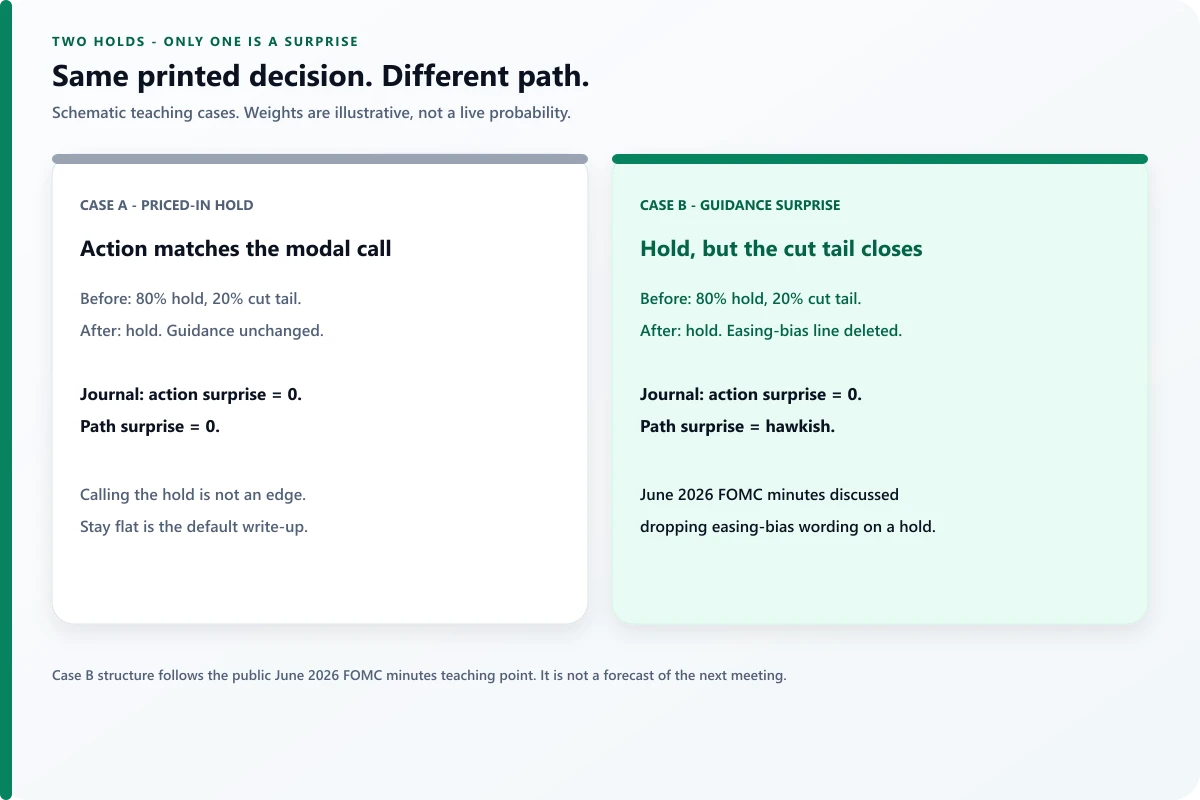
Before: “80 percent hold, 20 percent cut.” After: hold, guidance unchanged. Action surprise = 0. Path surprise = 0. You called the hold. You had no information.
Common Mistake
Posting “I knew they’d hold” as if that were a process.
Professional Tip
If the before-sentence is missing, the page is a diary, not a journal. Fill it next time. Do not backfill from memory.
The One-Page Grid#
Short Answer
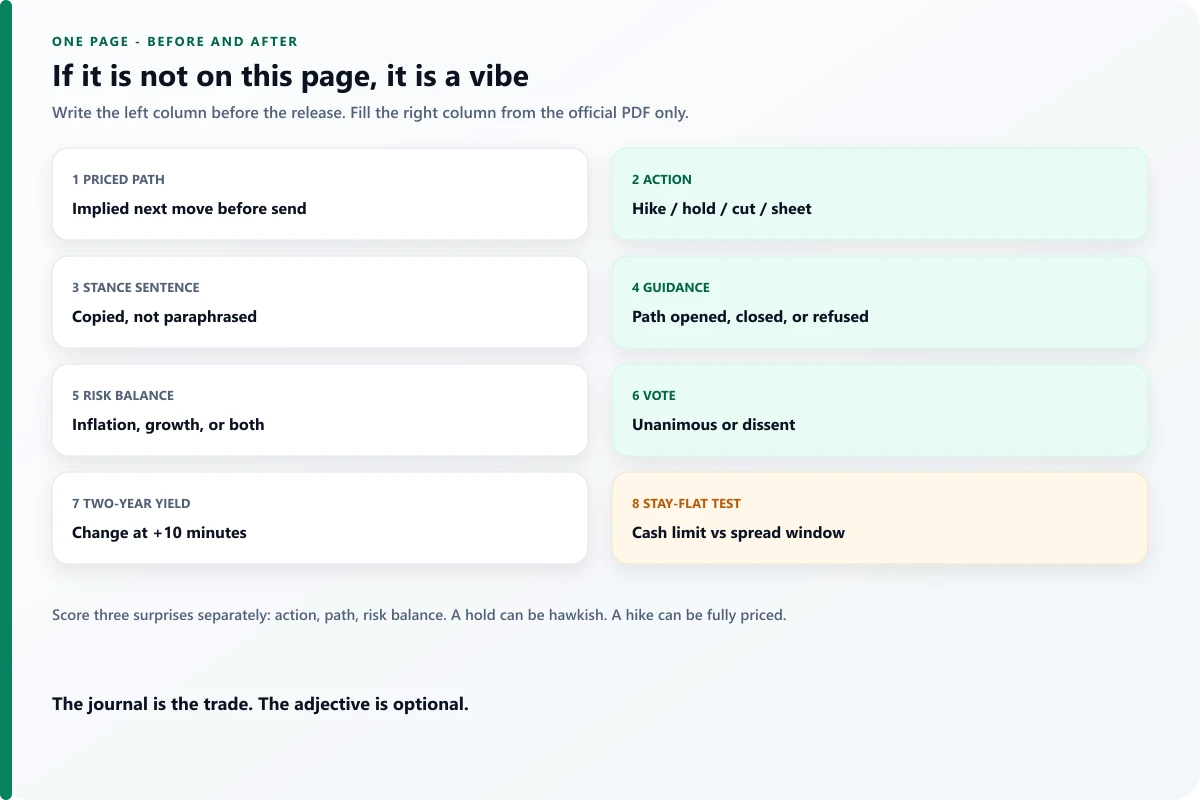
Eight fields. If a field is empty, you do not get to invent it in the recap.
Detailed Explanation
| # | Field | When | What “done” looks like |
|---|---|---|---|
| 1 | Priced path | Before | One sentence, including the peer bank |
| 2 | Action | After | Hike / hold / cut / sheet — copied |
| 3 | Stance sentence | After | Quote, not paraphrase |
| 4 | Guidance / path | After | Opened, closed, refused, or unchanged |
| 5 | Risk balance | After | Inflation, growth, or both |
| 6 | Vote | After | Count or “unanimous” from the official text |
| 7 | Two-year yield | +10 min | Direction and rough size, not a scalp |
| 8 | Stay-flat test | Before + after | Cash limit versus the live spread window |
Score three surprises from those fields: action, path, risk balance. Each is hawkish / dovish / zero versus line 1. A page can be 0 / hawkish / zero. That is a guidance surprise. A page can be hawkish / zero / zero. That is an action the market may already have owned.
Example
You write “Priced: 25 bp Fed hike, year-end 4.1.” The statement hikes 25 bp and the SEP median prints 4.1. Action surprise ≈ 0 if that was truly priced. Path surprise depends on 2027–28 medians and the chair. See the September 2026 SEP.
Common Mistake
Merging the three scores into “hawkish day” so you cannot audit last quarter.
Professional Tip
Print the grid. Phones invite adjectives. Paper invites quotes.
Case A — The Priced-In Hold#
Short Answer
If the hold was the modal call and the path text did not change, the correct journal is boring. That is success.
Detailed Explanation
Schematic: 80 percent hold, 20 percent cut. Statement holds. Guidance repeats last month. Vote unanimous. You have a priced-in hold. The 20 percent tail is still there if the chair keeps optionality.
FX may still twitch on spreads. A twitch is not a thesis. Log spread and slippage, then stay flat unless a written plan already owned that window.
Example
You flatten at 13:50 Eastern, the hold prints, you write “0 / 0 / 0,” and you leave. That row will teach more than a forced EUR/USD scalp.
Common Mistake
Inventing a path surprise because you were bored.
Professional Tip
Boredom is a stay-flat signal. See when not to trade.
Case B — The Guidance Surprise on a Hold#
Short Answer
The rate print can match the modal call and still reprice if the path language closes a tail.
Detailed Explanation
The public June 2026 FOMC minutes are the teaching file already used in the hawkish guide: members kept the funds target at 3.50–3.75 percent and agreed the statement would not repeat earlier easing-bias language, while stressing price stability. Action unchanged. Communication tighter.
That is Case B. Journal: action surprise = 0 (if the hold was modal). Path surprise = hawkish (deleted easing bias). Risk balance = read the inflation sentence, do not guess.
Do not copy June 2026 onto the next live meeting. Paths change. The method repeats.
Example
Before: “Hold, but they still sound open to a cut.” After: hold, easing-bias line gone. You do not automatically buy USD. You ask whether the cut tail was actually in the two-year note. If it was not, the “surprise” was only on Twitter.
Common Mistake
Calling every inflation mention a guidance surprise. Dual-mandate statements mention inflation every time.
Professional Tip
Diff the PDF. Circle only the sentences that changed. Unchanged boilerplate is not a signal.
Two Live Teaching Files from September 2026#
Short Answer
ECB 10 September: hike plus a Q&A path refusal. FOMC 16 September: hike plus higher SEP medians. Same month, different journal rows.
Detailed Explanation
ECB 10 September 2026: +25 bp, deposit rate 2.50% from 16 September, unanimous. Q&A: “We have not actually debated at all any kind of future path.” Journal the 14:15 action and the 14:45 refusal as two clocks. Full map: ECB statement versus press conference.
FOMC 16 September 2026: +25 bp to 3.75–4.00%, vote 12–0. SEP median funds-rate path 4.1 / 4.1 / 3.9 for 2026–28 (June: 3.8 / 3.6 / 3.4). Journal the hike and the 2027–28 revision separately. The 2026 median sitting near a priced year-end is not the same cell as a 50 basis-point lift in the 2027 median. Details: dot-plot guide and fan charts.
Example
Week of 10–16 September 2026 in one notebook: ECB path refused; Fed path sketch raised. EUR/USD is the relative residual, not two isolated “hawkish” stickers.
Common Mistake
One sticky note that says “CBs hawkish” for the whole week.
Professional Tip
One row per clock. ECB 14:15, ECB 14:45, FOMC 14:00 ET statement, FOMC SEP, FOMC first path-changing answer. Five rows beat one week.
After the Page: Stay-Flat or Size#
Short Answer
A filled journal is not a permission slip. It is the input to a stay-flat test.
Detailed Explanation
If action and path surprises are both zero, the professional result is usually no trade. If a path surprise exists, you still need the peer bank, a cash limit, and an execution plan. Convert any later size with the lot calculator. First-print fills belong in second-wave thinking: the chair can overwrite the PDF.
Log spread at send. A “correct” hawkish score with a 12-pip spread is a cost event. News spread log.
Example
Path surprise = hawkish. Cash limit = $40. First tradable quote implies $90 if stopped. Journal: stay-flat. That is a passing grade.
Common Mistake
Raising size because the journal looks clever.
Professional Tip
Review 10 rows a month. Count how often “I called the hold” was Case A. That number is the point of the page.
Key Takeaways#
- Priced-in hold = modal action, unchanged path.
- Guidance surprise = path cell moved, even if the rate did not.
- Three surprise scores, two timestamps.
- June 2026 minutes: hold plus deleted easing bias.
- September 2026: ECB refusal versus Fed SEP lift — two rows.
- Stay-flat is a result you can be proud of.
Glossary#
- Priced path: Your pre-release sentence about the modal action and the implied path.
- Action surprise: Difference between the printed decision and that sentence.
- Path / guidance surprise: Difference in forward language or Q&A versus that sentence.
- Risk-balance surprise: Which mandate was re-weighted.
- Stay-flat test: Whether spread, gap and cash limit fit before any click.
Checklist#
- Priced-path sentence written before the clock.
- Official PDF only.
- Five statement lines filled.
- Three surprise scores filled (including zeros).
- Two timestamps (or “path refused”).
- Two-year yield noted, not scalped by default.
- Stay-flat or size decided from cash risk.
- Filename includes the date.
Future related articles#
- A printable CSV template for 20 FOMC/ECB rows
- How to score a split vote without over-weighting one dissent
- How to journal a second-wave fill versus the statement wick
Comments
Add a useful note for other traders. We review comments before publishing.