
- Hawkish tilts toward tighter policy or inflation vigilance; dovish tilts toward easier policy or growth/employment vigilance
- The FX move is usually the surprise versus prior pricing, not the raw hike, hold or cut
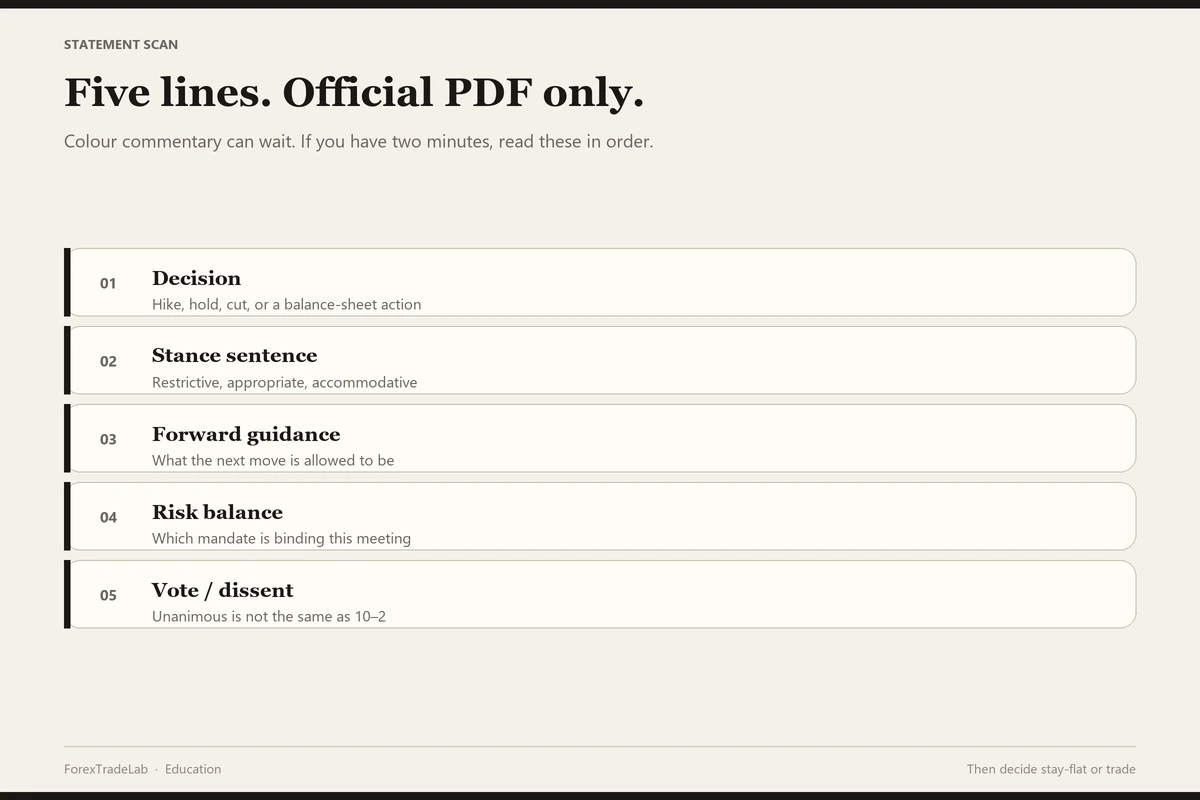
- Read the decision, the stance sentence, forward guidance, the risk balance and the vote — in that order
- A hold that removes easing-bias language can reprice like a hawkish surprise
- Press-conference answers can overwrite a carefully drafted statement within minutes
- Do not trade the first spike unless spread, slippage and a cash loss limit already fit the plan
Open Exness — clearer spreads and multi-market trust
- Spreads from 0.0 depending on account type
- Clients and trading volume worldwide
- Automated processing is available for eligible withdrawals
- Start from $10 on the account that fits your country
- MT4, MT5 and the Exness app
- Verify the legal entity before funding
Affiliate & risk disclosure: ForexTradeLab may earn a commission from qualifying broker links. See the affiliate disclosure and risk disclaimer.
Risk warning: Central-bank releases can gap through stops and widen spreads for minutes. This page is language education, not a call to trade any FOMC, ECB, BoE or BoJ decision. Never size a position you cannot survive if the fill is several times worse than the last quote.
Quick Answer#
Short Answer
Hawkish language tilts toward tighter money or stronger inflation vigilance. Dovish language tilts toward easier money or stronger growth and employment vigilance. In forex, the tradeable fact is usually the surprise versus prior pricing — not whether a commentator used the adjective.
Detailed Explanation
The Federal Reserve’s dual mandate is maximum employment and 2 percent inflation over the longer run. The St. Louis Fed’s guide to reading an FOMC statement treats the statement as a stack: the decision, the stance sentence, the outlook, forward guidance, and the reaction function. Kansas City Fed research models official statements as a mix of more-dovish and more-hawkish alternative drafts. That is the professional definition: stance on a spectrum, not a mascot.
A hike can be dovish if officials immediately signal that the cycle is done. A hold can be hawkish if they drop easing-bias language. The June 2026 FOMC minutes recorded members agreeing not to repeat prior wording that had suggested an easing bias, while keeping the funds target at 3.50–3.75 percent. That is a live illustration that words can reprice a hold.
Example
Illustrative only. Futures imply a 70 percent chance of a 25-basis-point cut. The statement holds the rate and says the committee is “strongly committed to returning inflation to 2 percent,” with no cut bias. USD can rise against EUR on the missing cut, even though the printed decision is “unchanged.”
Common Mistake
Hearing “hawkish” on a livestream and buying USD before you have compared the text with the path you wrote down an hour earlier.
Professional Tip
Write one sentence before the release: “Priced path is X; I will only act if the package is clearly easier or tighter than X.” If you cannot write that sentence, you are not reading the statement — you are watching a headline.
What Hawkish Actually Means#
Short Answer
Hawkish means the official is more willing to keep policy tight, tighten further, or delay easing because inflation or inflation expectations are the binding risk.
Detailed Explanation
In Kansas City Fed staff work, the more-hawkish alternative draft typically raises rates or reduces stimulus to fight inflation. Retail glossaries collapse that into “hawkish = buy the currency.” The mechanism is narrower: hawkish communication can lift expected short rates and real yields relative to another currency. Whether the exchange rate follows depends on the peer central bank, risk sentiment, and positioning. See how interest rates affect forex for the yield channel, and the US dollar and DXY guide for when USD is a risk asset versus a funding currency.
Hawkish is not the same as restrictive. Restrictive is a claim about the level of the policy rate versus an estimated neutral rate. Hawkish is a claim about direction and tone. Policy can already be restrictive and still sound dovish if officials start mapping a cut path.
Example
A president says “we are not thinking about thinking about cuts” while inflation prints remain above target. That is hawkish guidance, even if the rate is unchanged that day.
Common Mistake
Calling every inflation mention hawkish. Officials mention inflation on every dual-mandate statement. The hawkish content is whether they raised the weight on inflation versus the last text.
Professional Tip
Diff the PDF. Print last meeting and this meeting. Circle only the sentences that changed. Unchanged boilerplate is not a signal.
What Dovish Actually Means#
Short Answer
Dovish means the official is more willing to ease, ease sooner, or hold back from tightening because growth, employment, or financial conditions are the binding risk.
Detailed Explanation
The more-dovish alternative in Fed staff drafts typically lowers rates or adds stimulus to support activity and employment. Forward guidance such as “the Committee will be patient” — the St. Louis Fed’s 2019 teaching example — is classic dovish optionality: it reduces the chance of the next hike without promising a cut.
Dovish is not “the currency must fall.” A dovish Fed can coincide with a stronger USD if Europe or Japan eases faster, or if a growth scare triggers a risk-off bid for dollars. The carry trade can also unwind when the funding currency’s central bank turns hawkish faster than the target currency’s bank.
Example
The statement cuts 25 basis points and adds that further reductions are likely if labour-market cooling continues. That package is easier than a “one-and-done” cut. Rate-sensitive USD pairs can sell off even if the cut itself was 80 percent priced.
Common Mistake
Treating “data dependent” as dovish. Almost every modern committee is data dependent. It is a refusal to pre-commit, not an easing promise.
Professional Tip
Score three buckets separately: the action (hike / hold / cut / QE / QT), the path (more / less / unclear), and the balance of risks (inflation / employment / both). Dovish usually shows up in the path or the risk balance, not only in the action.
Why a Hold Can Move the Currency More Than a Hike#
Short Answer
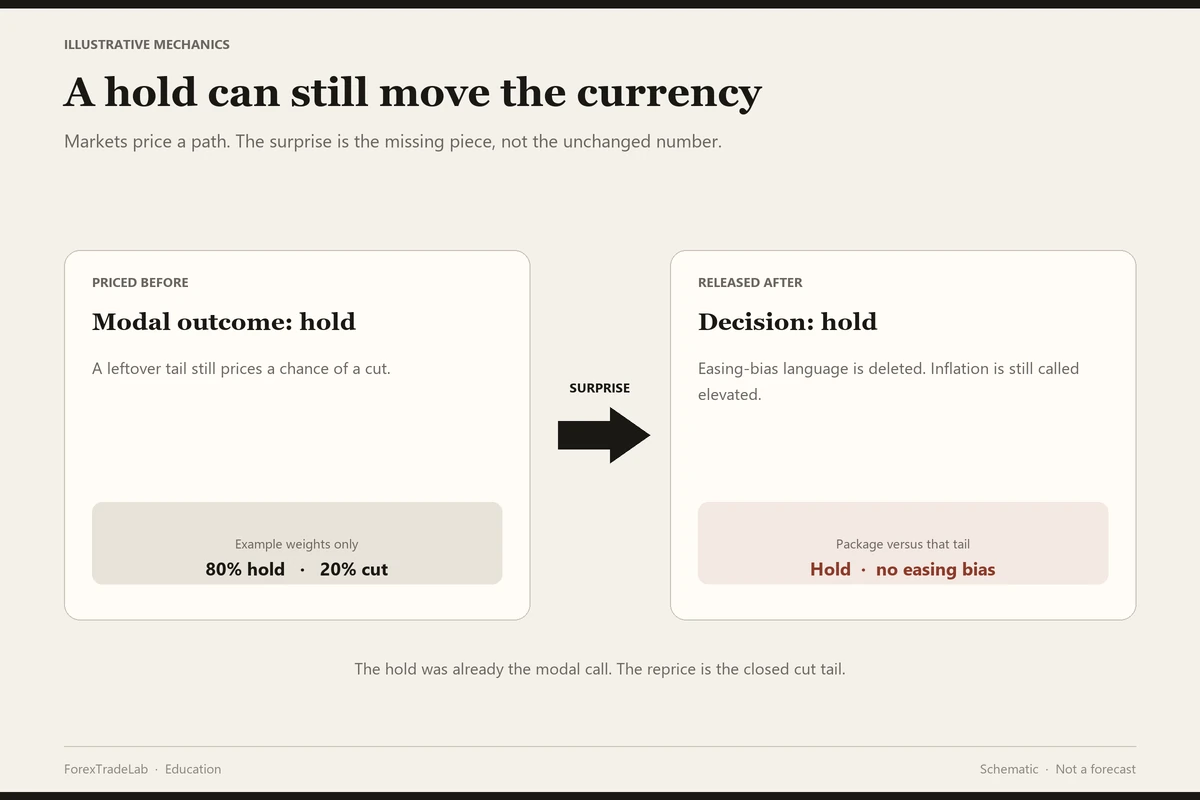
Markets price a path. If the path was a cut and the committee holds with hawkish language, the surprise is the missing easing — not the unchanged number.
Detailed Explanation
CME FedWatch and similar tools translate futures into implied probabilities. They are not official Fed forecasts. They are a map of what was priced. The St. Louis Fed stresses that forward guidance exists so households and markets can plan. When guidance changes, the plan changes.
The June 2026 FOMC discussion of shortening the statement and dropping easing-bias language is the institutional version of this point: members knew the public would read the deletion as information. Forex desks do the same thing every decision day.
Pair this with how Fed decisions affect markets and the USD news playbook. The first print is often untradeable. The second-wave exists because the press conference can overwrite the statement.
Example
Implied odds: 80 percent chance of hold, 20 percent chance of cut. Statement holds, but the chair says a cut in the next meeting is “not the baseline.” USD can still jump because the 20 percent tail was just closed.
Common Mistake
Measuring success by “I called the hold.” The hold was the modal outcome. The money, if any, was in the guidance surprise.
Professional Tip
Log two timestamps: statement time and first press-conference answer that changes the path. Many retail tickets die between those two clocks. See broker server time versus local time.
The Five-Line Statement Checklist#
| Line | What you extract | Hawkish tilt | Dovish tilt |
|---|---|---|---|
| 1. Decision | Hike, hold, cut, balance-sheet action | Tightening or slower QT unwind | Easing or faster QT unwind |
| 2. Stance sentence | Restrictive, accommodative, appropriate | “Remain restrictive until inflation returns to 2%” | “Policy is well positioned to support…” |
| 3. Forward guidance | Next likely action | “Further firming may be appropriate” | “Patient” / “ready to ease if…” |
| 4. Risk balance | Which mandate is binding | Inflation risks “elevated” or “two-sided but inflation-led” | Employment / growth risks dominate |
| 5. Vote / dissent | Unanimous or split | Dissent for a hike or against a cut | Dissent for a cut or against a hike |
Short Answer
If you only have two minutes, read those five lines on the official PDF. Everything else is colour.
Detailed Explanation
The St. Louis Fed’s public explainer is built for this scan. The ECB’s monetary-policy decision page is the euro equivalent: decision, statement, then the press conference. Do not start on a trading chat. The BIS Triennial Survey reminds us that FX is a $9.6 trillion-a-day OTC market (April 2025); your broker quote is not the official text.
Use the economic calendar to mark the release, then how to read the calendar so you do not confuse statement time with press-conference time.
Example
You highlight: hold; “committed to 2 percent”; no easing bias; inflation “elevated”; unanimous. Versus a priced 30 percent cut probability, the package is hawkish even if a friend texts “nothing happened.”
Common Mistake
Skipping the vote. A 10–2 cut with two hawkish dissents is a different committee from a unanimous cut.
Professional Tip
Save the PDF with the date in the filename. Next meeting, you will need last month’s file more than any recap thread.
Phrase Book: Words That Usually Tilt the Path#
These are tendencies, not codes. Context can flip any phrase.
| Language cluster | Typical tilt | Why desks care |
|---|---|---|
| “Returning inflation to 2 percent,” “elevated inflation,” “further tightening” | Hawkish | Raises the weight on the inflation mandate |
| “Patient,” “monitor incoming data,” “ready to adjust” (no direction) | Neutral-to-dovish optionality | Removes a pre-committed hike |
| “Ready to ease if the outlook deteriorates,” “downside risks to activity” | Dovish | Opens a cut path |
| “Ample reserves,” QT pace changes | Mixed | Balance-sheet news can matter as much as the rate |
| “Data dependent” | Neutral | Refuses to pre-commit; not a signal by itself |
Short Answer
Circle verbs of direction (raise, cut, remain, reduce) and nouns of risk (inflation, employment, growth). Adjectives without a path are decoration.
Detailed Explanation
Forward guidance is official talk about the possible future path. It can move two-year yields — and therefore FX — without a rate change. It can also be ignored if the committee has a history of rewriting it. That is why you compare this text with last text and with the priced path, not with a glossary tattooed on your monitor.
Example
Last statement: “the Committee will be patient.” This statement deletes “patient” and adds “further adjustments could include additional firming.” Same rate. Different path. That is a hawkish edit.
Common Mistake
Building an EA that buys USD on the word “inflation.” The word appears in almost every statement.
Professional Tip
If you use AI to summarise the statement, force it to quote the five lines and to state the prior priced path. A summary without those two inputs is entertainment. See whether ChatGPT can choose a broker for the same “checklist over vibe” rule.
How Forex Actually Prices the Surprise#
Short Answer
Liquid USD pairs often move on US two-year yields and rate differentials in the first minutes. The currency is a relative price. A hawkish Fed versus a hawkish ECB is not the same trade as a hawkish Fed versus a dovish ECB.
Detailed Explanation
Fundamental analysis is comparative. EUR/USD is a Fed-versus-ECB story as often as it is a “USD story.” USD/JPY adds BoJ constraints and yen-funding carry. Gold often trades the real-rate channel; that is a different contract. Do not copy a USD index headline onto XAU without checking yields. Details: gold trading pillar.
Execution is a separate risk. At release, spreads can jump and stops become market orders. That is slippage, not a broken platform. Read why a stop can fill worse than you set and news spread logging.
Example
Fed hawkish surprise, ECB statement still due in six days. EUR/USD can fall on the Fed print and then reverse if the ECB sounds even hawkish-er. The first move was a relative surprise, not a permanent verdict on the euro.
Common Mistake
Holding a news scalp through the press conference because “the statement was hawkish.” The chair can walk it back in the first answer.
Professional Tip
If you must be in the event, pre-define a maximum acceptable fill in money, not in pips. If the first tradable quote is beyond that, you already violated the plan — flatten and journal it.
A Worked Read — Hold With a Deleted Easing Bias#
Short Answer
Unchanged rate + deleted easing bias + inflation still “elevated” is a hawkish hold if cuts were partly priced.
Detailed Explanation
Use only official minutes and statements for the structure; do not invent a live forecast. The public June 2026 FOMC minutes show members keeping 3.50–3.75 percent and agreeing the statement would not repeat earlier easing-bias language, while stressing price stability. That sequence is a teaching case: action unchanged, communication tighter.
Your job on the next live decision is to repeat the method, not to copy 2026-06 as a template for 2026-09. Paths change. The FOMC calendar is the schedule; your notes are the comparison.
Example
Before: “Markets price one cut by year-end.” After: hold, no easing bias, inflation elevated. You do not automatically sell EUR/USD. You ask whether EUR pricing already assumed a more-hawkish Fed. If yes, the move may already be in the two-year spread.
Common Mistake
Screenshotting a commentator’s “hawkish hold” graphic and treating it as the primary source.
Professional Tip
Keep a one-page journal: priced path, five lines, two-year yield change, spread at send, fill, and whether you stayed flat. That page teaches more than a month of recap videos.
Key Takeaways#
- Hawkish = tighter tilt or inflation vigilance. Dovish = easier tilt or growth/employment vigilance.
- The FX price is usually the surprise, not the adjective.
- Read decision, stance, guidance, risks, vote — on the official PDF.
- A hold can be hawkish; a cut can be hawkish if it is smaller or colder than priced.
- Press conferences overwrite statements.
- If the loss limit does not fit the spread window, the professional trade is no trade.
Glossary#
- Hawkish: Communication or action tilting toward tighter money or delayed easing.
- Dovish: Communication or action tilting toward easier money or delayed tightening.
- Forward guidance: Official language about the possible future policy path.
- Stance: Where policy sits now (restrictive, neutral, accommodative) — not the same as hawkish/dovish tilt.
- Surprise: Difference between the released package and the path that was priced.
- Reaction function: The paragraph that says which data will drive the next move.
Checklist#
- Write the priced path before the release.
- Open only the official statement URL.
- Mark the five lines in the table above.
- Diff against last meeting.
- Check the peer central bank, not only “the dollar.”
- Decide stay-flat if spread or press-conference risk exceeds the cash limit.
- Journal statement time and first path-changing answer separately.
Future related articles#
- How to read the FOMC dot plot without treating median dots as a promise
- ECB statement versus press conference: what actually reprices EUR
- How to journal a priced-in hold versus a guidance surprise

Comments
Add a useful note for other traders. We review comments before publishing.