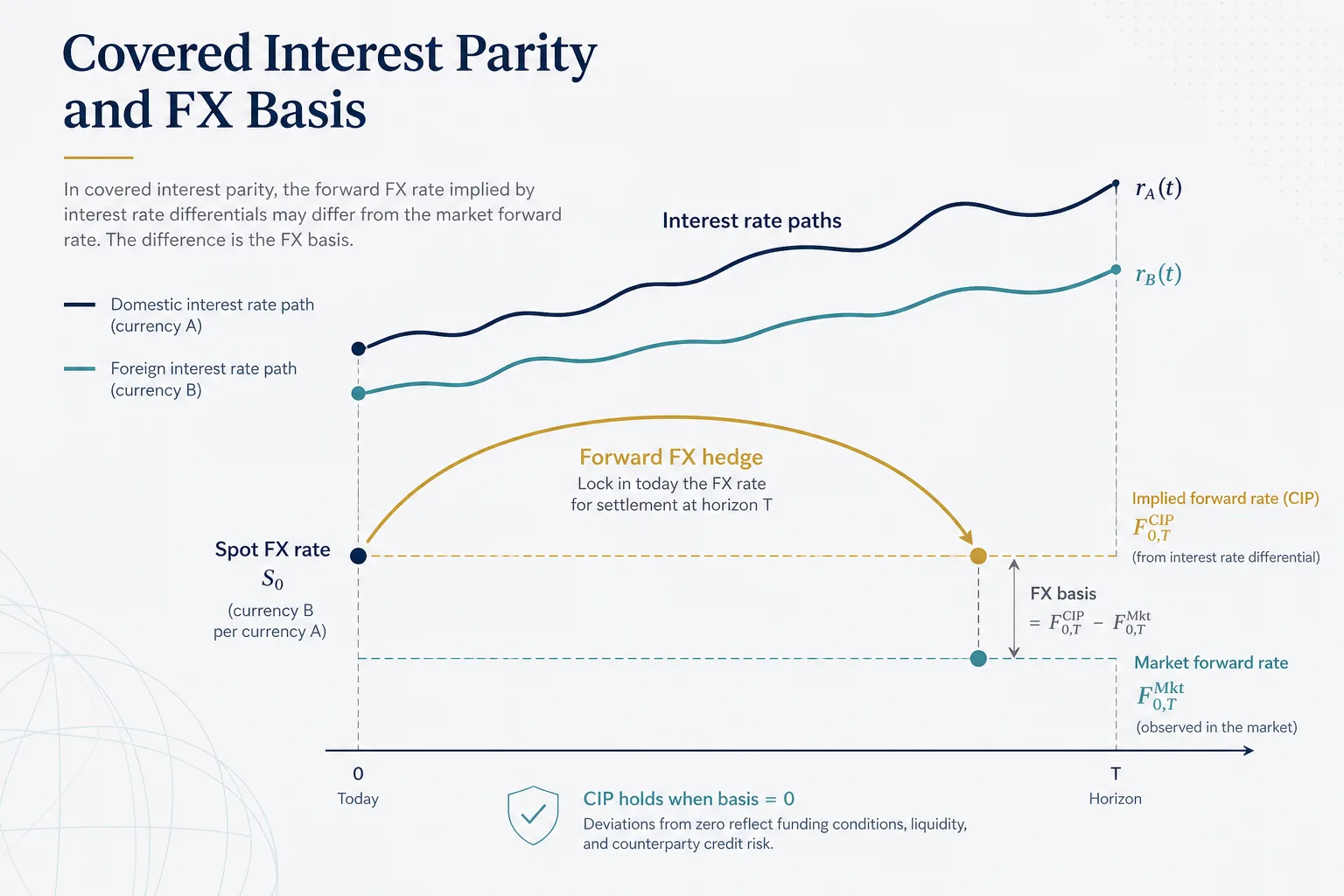
- Covered interest parity says interest differentials should equal the forward premium/discount when FX risk is hedged with forwards or swaps
- After the global financial crisis, persistent CIP deviations — the cross-currency basis — became a major research topic in BIS and central-bank literature
- CIP can fail when balance-sheet costs, regulation and hedging demand prevent textbook arbitrage
- Uncovered interest parity is a riskier hypothesis and is not a trading guarantee
- Retail overnight swaps are not the same object as the institutional FX basis, but both remind traders that ‘rate differential alone’ is incomplete

Quick Decision Framework#
Short Answer
Covered interest parity (CIP) is the no-arbitrage link between two interest rates and the spot and forward FX rates when FX risk is hedged. When prices do not match that textbook identity, the gap is often called the cross-currency basis. Since the 2007–09 crisis, BIS research has documented persistent CIP deviations from hedging demand and bank balance-sheet costs—not a retail free lunch.
Detailed Explanation
CIP assumes the FX risk is hedged with forwards or swaps. Uncovered interest parity (UIP) leaves the FX risk open and assumes expected currency moves offset the rate differential—a riskier hypothesis that is often rejected in the data. After 2008, regulation and balance-sheet costs made textbook arbitrage harder, so a non-zero basis became normal research territory, not a glitch. Retail overnight swaps on a CFD account are a broker financing schedule with markup; they are not the wholesale FX-swap market that defines CIP. Carry that looks only at "high yield minus low yield" ignores hedging cost and dollar-funding stress.
Example
Reading a non-zero basis as an invitation to arbitrage it on a $500 CFD account is the mistake this article flags. A carry trader who checks the broker swap schedule as a retail cost, and asks what happens if dollar funding tightens, is using the research the way the piece intends.
Common Mistake
Treating a positive swap on a high-yield pair as proof of CIP or as a substitute for a stop, then holding through a funding-stress unwind.
Professional Tip
Write down whether your trade is hedged (CIP world) or open FX risk (UIP/carry world). If it is open, size from stop distance and a 1% rule—and read the swap as a broker fee, not as an institutional basis quote.
TL;DR — CIP vs Basis vs Retail Swaps#
| Concept | Hedged FX risk? | What it answers |
|---|---|---|
| Covered interest parity (CIP) | Yes (forward/swap) | Do interest differentials match the forward premium? |
| FX / cross-currency basis | Measured in hedged space | How far do markets deviate from CIP? |
| Uncovered interest parity (UIP) | No | Do expected spot moves offset rate differentials? |
| Retail overnight swap | Broker financing on your position | What does your broker charge/pay to hold? |
| Question | Short Answer |
|---|---|
| Did CIP “break”? | Persistent deviations after the crisis are well documented by the BIS |
| Free lunch for retail? | No — capacity, credit and access constraints dominate |
| Link to carry? | Carry is closer to uncovered risk; hedging costs can still matter indirectly |
| Best retail use of this knowledge? | Avoid naive “rate differential = edge” thinking |
Related reading already on ForexTradeLab: carry trade strategy guide, what is swap / overnight financing, and how interest rates affect forex.
What Covered Interest Parity Says#
Short Answer
If you invest in currency A versus currency B and hedge FX risk with a forward (or FX swap), the interest differential should line up with the forward premium or discount — otherwise a textbook arbitrage would exist.
Detailed Explanation
Classic CIP intuition (simplified):
- Borrow in currency X.
- Convert spot into currency Y.
- Invest in Y.
- Sell Y forward back into X (locking the FX rate).
In a frictionless market with no counterparty or balance-sheet costs, the locked return should match borrowing costs. Equivalently: interest differential ≈ forward premium/discount.
That relationship is what “covered” means: FX risk is covered. It is a no-arbitrage pricing link, not a forecast that the spot rate will move a certain way.
The wholesale instruments that make CIP operational are primarily FX swaps and forwards, which sit inside the enormous OTC FX market measured in the BIS Triennial Survey.
Example
If USD interest exceeds JPY interest, CIP expects the dollar to trade at a forward discount versus the yen roughly consistent with that differential — when positions are hedged. The exact quotes are market prices, not a retail app widget.
Common Mistake
Using CIP language to justify an unhedged long of high-yield FX. That is a different hypothesis (UIP / carry), with different risk.
Professional Tip
Whenever someone says “parity,” ask: covered or uncovered? One word changes the entire risk box.
Key point: CIP is about hedged interest–FX consistency. It is not a promise that an open carry trade will profit.
Uncovered Interest Parity Is a Different Claim#
Short Answer
UIP says expected spot changes should offset interest differentials when FX risk is left open. Empirically it is unreliable as a trading rule.
Detailed Explanation
Uncovered interest parity drops the hedge. The claim becomes: high-interest currencies should depreciate enough (in expectation) to erase the yield advantage. Carry traders effectively bet against a strong form of that idea: they collect the differential and hope depreciation is smaller than the yield — or even that appreciation helps.
That is why our carry trade guide focuses on regime risk, funding stress and position sizing rather than “rates make free money.”
Example
A long AUD/JPY carry can earn positive overnight differential for long stretches and still suffer violent drawdowns when risk appetite collapses and high-yield FX sells off.
Common Mistake
Calling an open carry position “CIP arbitrage.” If FX risk is open, it is not covered.
Professional Tip
Journal carry trades under risk-on/risk-off regimes, not under “the differential is still positive so I’m fine.”
What the FX Basis Means#
Short Answer
The cross-currency basis is a market measure of CIP deviation: hedged cross-currency funding is not priced as the simple textbook differential predicts.
Detailed Explanation
The BIS Quarterly Review explains that shifts in demand for FX swaps/currency swaps can push forward prices away from CIP, producing a non-zero basis. In a frictionless textbook, arbitrage would instantly close that gap. In real markets after the crisis, balance-sheet costs, regulation and limited arbitrage capital can leave deviations persistent.
BIS Working Paper 590 emphasises hedging-demand channels: quantities of FX hedging demand affect derivative prices and help explain the sign and persistence of long-term CIP deviations. Earlier crisis work such as BIS Working Paper 267 studied large CIP deviations during 2007–08 market turmoil.
For traders, the practical translation is:
- Dollar funding stress can show up as basis moves.
- “Interest differential alone” is incomplete when hedging and balance-sheet constraints bind.
- Institutions care about this daily; retail traders should at least stop pretending parity always holds.
Example
During funding stress, entities that need dollars via the FX swap market can face higher effective costs than a naive Libor/OIS-style differential suggests. That is a basis story, not a retail indicator pop-up.
Common Mistake
Reading a non-zero basis as a personal arbitrage invitation on a $500 CFD account.
Professional Tip
Treat basis research as regime awareness: when dollar funding is stressed, reduce fragile carry and correlated risk rather than “adding to the arb.”
Why Textbook CIP Broke After the Crisis#
Short Answer
Because the assumptions behind continuous, balance-sheet-free arbitrage stopped matching the post-crisis banking system.
Detailed Explanation
Pre-crisis, CIP was often a close approximation in major currencies. Post-crisis, several frictions rose in importance:
- Bank balance-sheet constraints — capital and leverage ratio costs make “infinite arb” impossible.
- Regulation and funding rules — holding certain hedged positions is not free.
- One-sided hedging demand — corporates, asset managers and non-US entities can create persistent swap demand that dealers cannot costlessly absorb.
- Stress dynamics — in turmoil, deviations can gap wider before mean-reverting, if they revert at all on your horizon.
The Boston Fed discussion paper Uncovering Covered Interest Parity sits in the same literature: elevated basis raises costs for investors who rely on dollar funding through FX swaps.
IMF Global Financial Stability reporting periodically revisits FX funding stress as a systemic theme — useful context when risk assets and high-yield FX sell off together (IMF GFSR hub).
Example
A strategy that assumed “CIP always pins forwards” would misprice hedged returns in a year when the basis is wide and sticky. Institutions update models; retail blogs often still teach the 1990s textbook only.
Common Mistake
Concluding “markets are inefficient, so I will arb it on MT5.” Inefficiency for constrained banks is not opportunity for unconstrained retail leverage.
Professional Tip
If you cannot access competitive FX-swap markets with prime brokerage, you are a price taker of retail financing — learn CIP for literacy, not for arb fantasies.
Retail Overnight Swaps Are Related — Not Identical#
Short Answer
Your broker’s swap is a retail overnight financing schedule. The CIP basis is a wholesale hedged-pricing gap. Do not mix the labels.
Detailed Explanation
| Feature | Retail overnight swap | CIP / FX basis |
|---|---|---|
| Market | Broker CFD/spot account | Wholesale FX swaps/forwards |
| Purpose | Charge/pay for holding overnight | Hedged cross-currency pricing |
| Drivers | Policy rates + broker markup + internal model | Rates + hedging demand + dealer balance sheets |
| Retail actionable? | Yes — read the schedule | Mostly literacy / regime filter |
| Covered FX risk? | Your position may still be open FX risk | CIP assumes hedge |
Use what is swap in forex and swap rate broker comparison for the retail cost layer. Use this article for the macro reason “differentials are not the whole story.”
Example
Two brokers can show different swap on the same pair on the same night. That difference is markup and model — not proof you measured the G10 basis correctly.
Common Mistake
Optimising only for the most positive swap while ignoring execution, entity risk and gap risk.
Professional Tip
If swap income is material to your plan, stress-test a week of zero or negative swap and a risk-off gap on the same book.
What This Means for Carry and Rate Traders#
Short Answer
Keep rate differentials as one input. Add funding stress, correlation and position sizing — or you are trading a slogan.
Detailed Explanation
A practical checklist for discretionary FX:
- Know whether the trade is open risk (carry/UIP world) or hedged (CIP world). Most retail spot/CFD carries are open risk.
- Watch for dollar funding stress and risk-off correlation (safe-haven currencies).
- Respect central-bank regime shifts (interest rates and forex).
- Size for ruin risk first (risk of ruin).
- Do not confuse a tidy interest differential with a validated edge.
Example
Positive swap on a high-yield long can look excellent on a spreadsheet and still produce a −15R month if the currency collapses in a risk-off wave.
Common Mistake
Scaling into carry because “CIP says it should be fine.” CIP does not bless open risk.
Professional Tip
If you trade rates narratives, keep a separate note titled funding stress. When that note is red, cut gross exposure even if the differential is still attractive.
Worked Intuition — Numbers Without Fake Precision#
Short Answer
You do not need a live Bloomberg basis screen to understand the logic.
Detailed Explanation
Suppose currency Y yields more than currency X.
- CIP world: After hedging with a forward, you should not expect a locked free surplus equal to the full differential; the forward price should absorb most of that gap. If it does not, institutions ask why balance-sheet limits block arb — that residual is basis territory.
- Carry world: You skip the hedge, keep the differential (retail: swap), and accept FX mark-to-market risk. Profitability is path-dependent.
Example
A learner compares two notebooks: one labels every positive-swap trade “CIP.” The corrected notebook relabels them “unhedged carry” and tracks max adverse excursion. The second notebook stops mysterious “parity” losses.
Common Mistake
Backtesting carry with swap credits but without realistic gap weekends and correlation spikes.
Professional Tip
For education, read one BIS page before adding another carry EA. Literacy beats parameter spam.
Checklist — CIP Literacy for Forex Traders#
- Can explain CIP vs UIP in one sentence each
- Knows that post-crisis CIP deviations are a mainstream BIS topic
- Does not call open carry “covered arbitrage”
- Reads retail swaps as broker financing, not as the wholesale basis
- Has a funding-stress / risk-off rule for carry books
- Sizes positions with cash risk rules, not with differential size
- Uses primary sources (BIS) when making strong claims about parity
- Avoids “free lunch” social-media CIP threads
Glossary#
| Term | Meaning |
|---|---|
| Covered interest parity (CIP) | Hedged no-arbitrage link between interest differentials and forward FX premium/discount |
| Uncovered interest parity (UIP) | Hypothesis that expected spot moves offset interest differentials without hedging |
| FX / cross-currency basis | Market expression of CIP deviation in hedged cross-currency funding |
| FX swap | Exchange of currencies spot and reverse exchange forward — key CIP instrument |
| Forward premium/discount | Difference between forward and spot FX prices |
| Balance-sheet cost | Capital/leverage cost that limits bank arbitrage capacity |
| Carry trade | Typically unhedged long high-yield vs low-yield currency exposure |
| Retail overnight swap | Broker financing credit/debit for holding positions past rollover |
Key Takeaways#
- CIP is a hedged pricing relation; UIP/carry leaves FX risk open
- Persistent CIP deviations (the FX basis) are documented in BIS research after the global financial crisis
- Deviations can persist because arbitrage is constrained, not because retail traders missed a button
- Retail swaps ≠ wholesale basis — related theme, different market
- Use this knowledge to reject naive differential stories and to respect funding-stress regimes
Related Reading#
- Forex carry trade strategy guide
- What is swap / overnight financing
- Best swap rates broker comparison
- How interest rates and central banks affect forex
- Safe-haven currencies: USD, JPY, CHF, gold
- Forex correlation and concentration risk
- COT report forex trading guide
Future related articles (planned cluster): purchasing power parity (PPP) for FX traders; yield curve shapes and currency regimes; central-bank FX intervention mechanics; CLS settlement and value-date basics for FX literacy.
Next step: if you trade overnight, read your broker’s swap schedule with eyes open, then stress-test carry on demo using demo account before any live scale-up.
Risk warning: CFDs are complex instruments and come with a high risk of losing money rapidly due to leverage. A large share of retail investor accounts lose money when trading CFDs. Currency and rate strategies can lose money even when an interest differential looks favourable. Past performance is not indicative of future results.
Comments
Add a useful note for other traders. We review comments before publishing.