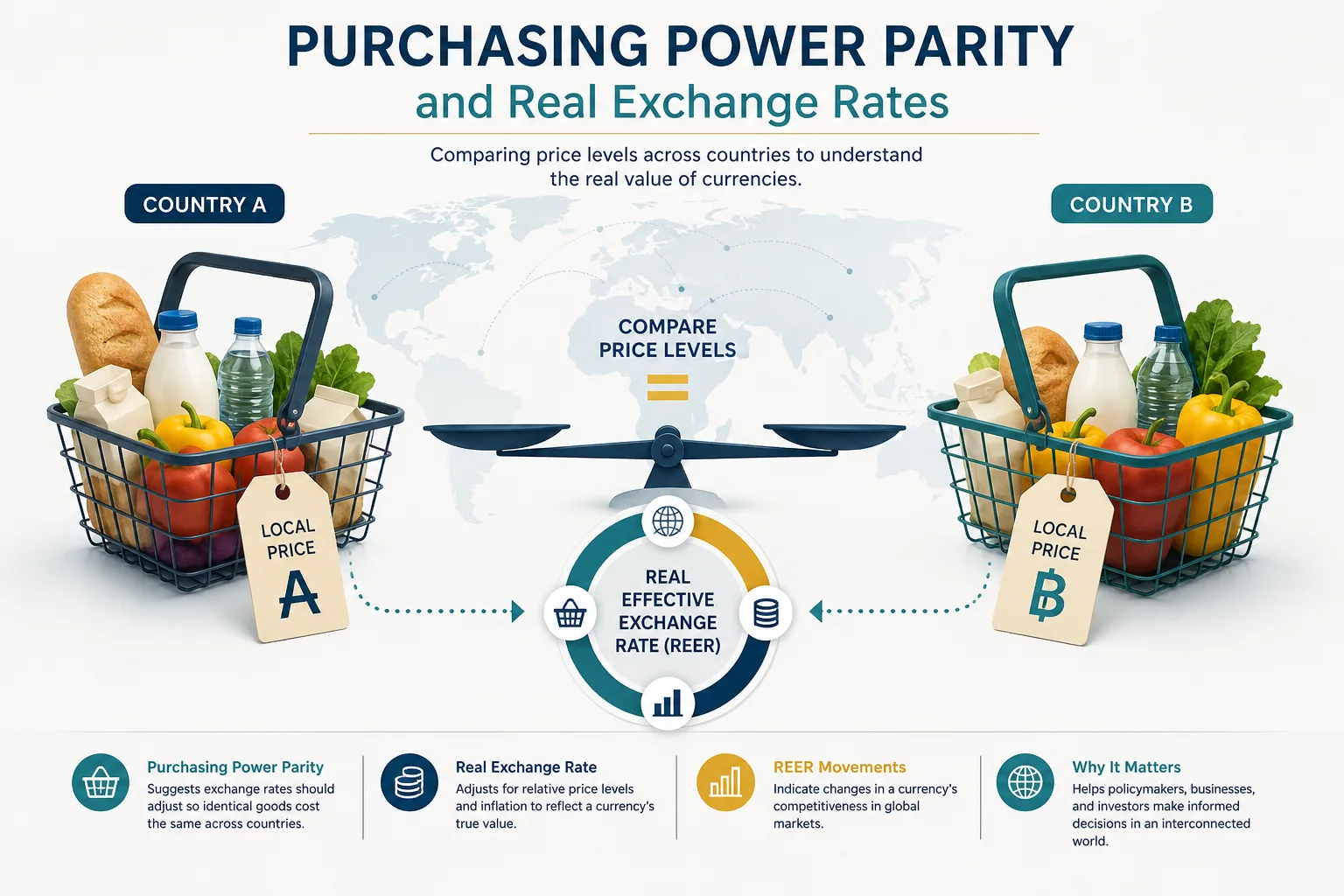
- Purchasing power parity says identical tradable baskets should cost the same across countries once converted at the exchange rate — in a frictionless textbook
- Relative PPP links inflation differentials to changes in the nominal exchange rate over long horizons
- The real exchange rate (and trade-weighted REER) measures whether a currency looks expensive or cheap after inflation adjustment
- IMF research finds PPP deviations can last many years; half-lives around several years are common in industrial-country samples
- Retail traders should treat PPP/REER as a regime and valuation context, not as a market-order trigger

Authoritative source note: The IMF Finance & Development explainer on real exchange rates is the cleanest public introduction to what a currency can buy. The World Bank International Comparison Program is the standard statistical programme for comparable price levels across countries. This article is educational, not a forecast.
Affiliate & risk disclosure: ForexTradeLab may earn commissions from regulated broker links elsewhere on the site. CFD and forex trading can result in rapid loss of capital. See our disclaimer and affiliate disclosure.
TL;DR — PPP vs REER vs Spot FX#
| Concept | What it measures | Typical horizon |
|---|---|---|
| Absolute PPP | Same basket, same price after FX conversion | Long run, often violated |
| Relative PPP | Inflation gap vs change in the nominal FX rate | Years |
| Real exchange rate | Nominal FX adjusted for relative prices | Cycle / years |
| REER | Trade-weighted real rate vs many partners | Policy / valuation dashboard |
| Spot CFD quote | Bid/ask now | Seconds to days |
| Question | Short Answer |
|---|---|
| Can PPP time EUR/USD this week? | No |
| Is a “cheap” REER a buy? | Not by itself |
| Who publishes serious PPP data? | IMF, World Bank ICP, national statistical offices |
| Best retail use? | Context for inflation, carry and regime — not an order type |
Related: how inflation affects currencies, interest rates and forex, and covered interest parity / FX basis.
What Purchasing Power Parity Claims#
Short Answer
PPP says tradable goods should not systematically cost more in one country than another after you convert prices at the market exchange rate — otherwise goods arbitrage would, in a frictionless textbook, close the gap.
Detailed Explanation
The textbook law of one price is about one identical, freely traded item. Purchasing power parity extends that idea to a basket. Absolute PPP is the strong form: the exchange rate equals the ratio of national price levels.
Reality adds frictions the BIS Triennial Survey does not remove:
- Many goods are non-tradable (housing, local services).
- Trade costs, tariffs, VAT and quality differences break exact equality.
- Capital flows can dominate goods arbitrage for long stretches.
So economists usually discuss relative PPP: if country A inflates faster than country B, A’s currency should tend to depreciate by a similar amount over a long horizon. That is a statement about changes, not a guarantee that today’s quote is “fair.”
Example
If country A’s CPI runs 6% and country B’s runs 2%, relative PPP suggests A’s currency should weaken by roughly 4% versus B over a comparable period if PPP were the only driver. Interest-rate surprises, risk-off flows or intervention can swamp that 4%.
Common Mistake
Treating a tourist-price anecdote (“coffee is cheaper there”) as a complete PPP basket.
Professional Tip
If you cannot name whether you mean price levels or inflation differentials, you are not using PPP — you are using a slogan.
Key point: PPP is a long-run goods-market parity. Spot FX is a financial-market price. They meet slowly, if at all, on a retail trading calendar.
Real Exchange Rates and REER#
Short Answer
The real exchange rate adjusts the nominal quote for relative prices. The real effective exchange rate (REER) averages those real rates across trading partners using trade weights.
Detailed Explanation
The IMF real-exchange-rate explainer emphasises what money can buy. A currency can look strong in nominal terms while still being cheap in real terms if domestic prices have fallen relative to partners — or the reverse.
REER is the policy dashboard version: not just versus the dollar, but versus a basket of partners. A rising REER often means the currency has become more expensive in real, trade-weighted terms (competitiveness pressure). A falling REER often means it has become cheaper.
REER is not the same as PPP. PPP is the theoretical equilibrium idea. REER is an observed index. Analysts often interpret REER deviations through a PPP lens, but the index can also move because of real shocks (productivity, commodities, terms of trade), not only because “parity is broken.”
Example
A commodity exporter’s REER can rise during a terms-of-trade boom even if a simple CPI-based PPP versus the US still looks “cheap.” Using one bilateral PPP chart would miss the trade-weighted story.
Common Mistake
Reading one EUR/USD PPP fan chart and calling the euro “20% undervalued” without checking a multilateral REER.
Professional Tip
When you quote undervaluation, specify versus which partners, which price index, and which base year. Otherwise the number is not comparable.
How Slow Is Mean Reversion?#
Short Answer
IMF-style empirical work typically finds that real-rate gaps close over years, not trading sessions — and some deviations look persistent after real shocks.
Detailed Explanation
Sarno and Taylor’s IMF Staff Papers survey treats PPP as a possible long-run parity among major industrial bilateral rates, with nonlinear mean reversion: small gaps can linger; large gaps may correct faster. Later IMF staff work using REER panels has reported average half-lives on the order of several years, with some countries showing little reversion.
For a retail trader, the operational translation is brutal:
- A 10–20% “misalignment” can sit there through many news cycles.
- Financing costs, carry and drawdowns can kill a “value” position before PPP helps.
- Real shocks can reset the equilibrium you thought you were fading.
Example
A trader shorts a high-REER currency because it “must revert.” Carry stays positive, growth surprises, and the REER stays high for three years. The thesis can still be directionally right on a decade chart and still ruin a 50:1 CFD account.
Common Mistake
Importing equity “mean reversion” timeframes into FX valuation.
Professional Tip
If your holding period is days, PPP is background, not the setup. Pair it with session liquidity and risk rules.
PPP vs Inflation vs Interest Rates vs CIP#
Short Answer
Inflation feeds relative PPP. Policy rates feed carry and CIP. Do not collapse all four into one arrow on the chart.
Detailed Explanation
| Framework | Core link | Typical user |
|---|---|---|
| Relative PPP | Inflation differential ↔ nominal FX change | Macro / valuation |
| Real rate / REER | Prices + FX vs partners | IMF, treasuries, corporates |
| Uncovered / carry | Open FX risk vs yield gap | Discretionary FX |
| CIP / basis | Hedged rates vs forwards | Banks, treasurers |
Inflation can weaken purchasing power and support a currency if markets price tighter policy. That is why “high CPI = sell the currency” fails so often.
Example
Hot CPI → higher rate odds → currency up on the day, even though relative PPP says that extra inflation should weaken it over years.
Common Mistake
Using a PPP undervaluation label as permission to ignore rate differentials.
Professional Tip
Keep two notebooks: goods-market value (PPP/REER) and asset-market price (rates, risk, liquidity). Trades live in the second; the first is a veto or a patience filter.
What Retail Traders Should Actually Do#
Short Answer
Use official REER/PPP as a regime check: avoid treating a crowded, expensive currency as “easy carry,” and avoid treating a cheap REER as a market buy.
Detailed Explanation
A practical stack:
- Read inflation correctly (CPI/PCE and policy).
- Glance at a multilateral real-rate measure, not a meme index.
- Ask whether carry is fighting or agreeing with valuation.
- Watch safe-haven and dollar cycles (DXY).
- Size so a multi-month wait cannot liquidate you (1% risk).
World Bank ICP data are for comparable living costs and GDP, not for timing USD/JPY on Sunday open.
Example
REER looks stretched and carry is crowded. You reduce size or skip adding — you do not automatically reverse the whole book.
Common Mistake
Building an EA that fades every 5% REER move.
Professional Tip
If you cannot survive the documented half-life in years, you are not running a PPP strategy. You are running leverage.
Comparison Table — Useful vs Misleading PPP Use#
| Use | Verdict |
|---|---|
| Explaining why high-inflation currencies often depreciate over decades | Useful |
| Cross-checking IMF/central-bank REER comments | Useful |
| Timing NFP or CPI prints | Misleading |
| Ranking brokers | Irrelevant |
| Justifying oversized mean-reversion shorts | Harmful |
Checklist — Before You Quote “Undervalued”#
- Named absolute vs relative PPP
- Named price index (CPI vs other)
- Named partner set (bilateral vs REER)
- Horizon matches years, not minutes
- Rate, growth and risk-off drivers listed
- Position size survives a years-scale wait
- Primary source is IMF, World Bank ICP or a central-bank REER note
- CIP/carry not confused with goods-market PPP
Glossary#
| Term | Meaning |
|---|---|
| Purchasing power parity (PPP) | Hypothesis that exchange rates align national price levels (absolute) or inflation differentials (relative) |
| Law of one price | One tradable good, one price after FX conversion, ignoring frictions |
| Real exchange rate | Nominal FX adjusted for relative price levels |
| REER | Trade-weighted average of bilateral real exchange rates |
| NEER | Nominal effective (trade-weighted) exchange rate, no inflation adjustment |
| Half-life | Time for half of a deviation from a baseline to decay in a statistical model |
| International Comparison Program (ICP) | World Bank-led programme for comparable price levels across countries |
| Non-tradable | Goods/services hard to arbitrage across borders (e.g. local housing) |
Key Takeaways#
- PPP is a long-run goods-market idea; spot FX is an asset price
- Relative PPP and REER are the versions institutions actually use
- Empirical reversion is often measured in years
- Do not trade PPP like a moving-average crossover
- Use valuation as a filter, then size risk like any other FX idea
Related Reading#
- How inflation affects currencies and forex
- How interest rates and central banks affect forex
- Covered interest parity and the FX basis
- Forex carry trade strategy guide
- US dollar DXY trading guide
- Safe-haven currencies
- Economic calendar reading guide
Future related articles (planned cluster): Penn effect and non-tradables; terms of trade and commodity currencies; Balassa–Samuelson in plain language.
Next step: practise reading inflation and REER as context on a demo account before any live valuation trade. For broker entity checks, use licensed brokers — not a PPP chart.
Risk warning: CFDs are complex instruments and come with a high risk of losing money rapidly due to leverage. A large share of retail investor accounts lose money when trading CFDs. Long-run valuation ideas can stay wrong longer than an account can stay funded. Past performance is not indicative of future results.
Comments
Add a useful note for other traders. We review comments before publishing.