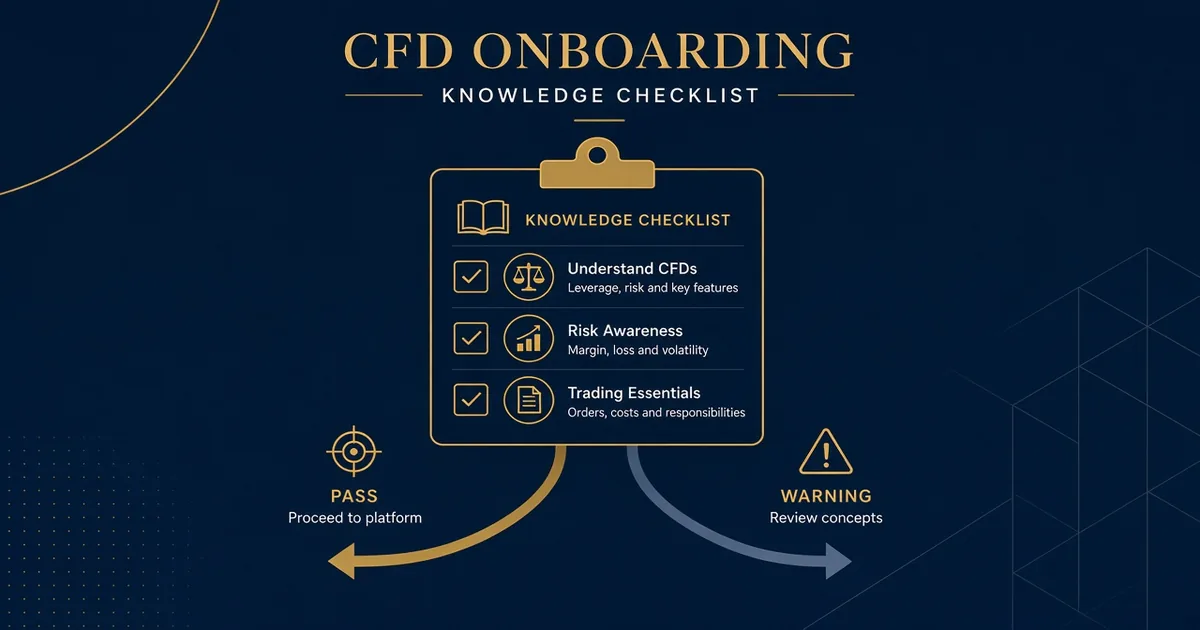
- An appropriateness assessment checks whether you have enough knowledge and experience to understand the risks of a complex product such as CFDs — it is not investment advice and not a credit check
- Under FCA COBS 10-style rules, firms must gather relevant knowledge/experience information and must not nudge you to skip answers
- CFDs are treated as complex; a tick-box “I understand the risks” is not a substitute for a real assessment
- If the firm concludes the product is not appropriate, it should warn you clearly and may interrupt onboarding rather than let you click straight through
- Answer honestly, study core mechanics first, and treat a fail as useful feedback — not as a prompt to lie on a retake

Open a free Exness demo
- Practice with virtual funds before you deposit
- Start on a small account before you size up
- MT4, MT5 and the Exness app
- Spreads from 0.0 by account type
- 800K+ active clients
- Confirm the legal entity before you fund
- Withdrawals are requested in the client area; arrival time varies
- Fund a live account only after the demo is clear
- TL;DR — Appropriateness in One Screen
- Why You Face a Quiz Before You Can Trade
- Short Answer
- Detailed Explanation
- Example
- Common Mistake
- Professional Tip
- Appropriateness vs Suitability vs KYC
- Short Answer
- Detailed Explanation
- Example
- Common Mistake
- Professional Tip
- What Good Assessments Look For (and What Weak Ones Did Wrong)
- Short Answer
- Detailed Explanation
- Example
- Common Mistake
- Professional Tip
- What Happens If You Fail
- Short Answer
- Detailed Explanation
- Example
- Common Mistake
- Professional Tip
- How to Prepare Honestly (Without Cheat Sheets)
- Short Answer
- Detailed Explanation
- Example
- Common Mistake
- Professional Tip
- Appropriateness and Your Real Go-Live Decision
- Short Answer
- Detailed Explanation
- Example
- Common Mistake
- Professional Tip
- Checklist — Appropriateness Day
- Glossary
- Key Takeaways
- Related Reading
Authoritative framing: Under the FCA Handbook COBS 10, firms providing certain non-advised services must assess whether a client has the necessary knowledge and experience to understand the risks of the product. The FCA has publicly criticised weak CFD take-on practices in its multi-firm review on appropriateness assessments and related Dear CEO correspondence. Parallel MiFID II appropriateness duties apply across much of the EEA. This guide is educational, not legal advice.
Affiliate & risk disclosure: ForexTradeLab may earn commissions from regulated broker links elsewhere on the site. CFDs and forex can result in rapid loss of capital. See disclaimer and affiliate disclosure.
TL;DR — Appropriateness in One Screen#
| Item | Short answer |
|---|---|
| What is it? | A knowledge/experience check before non-advised CFD access |
| What it is not | Investment advice, a credit score, or a profit licence |
| Why it exists | CFDs are complex, leveraged products with high retail loss rates |
| If you fail | Expect a clear warning and possibly a pause — study, don’t fabricate |
| Best prep | Learn mechanics honestly; complete start scorecard |
Related: how to read broker risk-warning percentages, retail leverage limits, how to start forex.
Why You Face a Quiz Before You Can Trade#
Short Answer
Because retail CFDs are complex enough that firms in major regimes must check whether you understand the risks — not merely whether you clicked “I agree.”
Detailed Explanation
People who intend to start forex often expect: email → password → deposit → chart. On many UK and EEA entities, an extra gate appears: a questionnaire about leverage, margin, prior trading, education, or occupation. That gate is the appropriateness assessment.
COBS 10.2 requires a firm, when the chapter applies, to ask for information on the client’s knowledge and experience relevant to the product or service, and to determine whether the client has the necessary experience and knowledge to understand the risks involved. Information can include:
- Types of services, transactions and investments the client is familiar with
- Nature, volume, frequency and period of prior transactions
- Level of education, profession, or relevant former profession
Firms must not encourage a client not to provide information required for the assessment.
CFDs sit on the complex side of the product spectrum. The FCA’s CFD take-on work found firms that relied on crude self-certification tick-boxes, irrelevant scoring factors, or inadequate warnings after fails — practices supervisors rejected.
Example
You create an account on a CySEC- or FCA-facing brand. Before the first deposit is accepted for CFD trading, you answer 10–20 questions on leverage, stop-out, and experience. That is not the broker being “difficult.” It is the onboarding control the regime expects for complex products.
Common Mistake
Treating the quiz as a CAPTCHA to rush through with Google and Discord answer keys. That only proves you can search — not that you understand rapid loss risk.
Professional Tip
If a site offering leveraged FX to retail clients in a MiFID/FCA-style market has no knowledge check and only a one-line waiver, slow down and verify the legal entity. Light onboarding can be a jurisdiction/entity signal, not a customer perk.
Key point: Appropriateness asks whether you appear to understand CFD risks. It does not certify that trading is wise for your household budget.
Appropriateness vs Suitability vs KYC#
Short Answer
Three different gates: identity (KYC), risk understanding (appropriateness), and advised fit (suitability).
Detailed Explanation
| Process | Main question | Typical forex/CFD context |
|---|---|---|
| KYC / AML | Who are you and where do funds come from? | ID, proof of address, source-of-funds checks |
| Appropriateness | Do you understand the product risks given your knowledge/experience? | Non-advised CFD onboarding quizzes |
| Suitability | Is this recommendation aligned with objectives and situation? | Advised services — less common on pure DIY CFD platforms |
Passing KYC does not mean CFDs are appropriate. Passing appropriateness does not mean a $5,000 deposit fits your life. Separately define risk capital you can afford to lose.
Example
A surgeon passes KYC easily, scores well on education fields, but has never traded leveraged products and cannot explain margin close-out. A serious assessment may still issue a not appropriate warning until knowledge is demonstrated.
Common Mistake
Confusing “account verified” with “ready to risk money.” Verification is identity plumbing.
Professional Tip
Complete KYC documents accurately and early, but schedule a separate study block for appropriateness topics before you sit the quiz.
What Good Assessments Look For (and What Weak Ones Did Wrong)#
Short Answer
Good assessments probe CFD-relevant knowledge and real experience; weak ones overweight irrelevant biodata or rely on a tick-box waiver.
Detailed Explanation
From the FCA’s published CFD take-on findings, problem patterns included:
- Too little detail on familiar product types and transaction history
- Scoring that overweighted age or address tenure so knowledge stopped driving the result
- Self-certify tick-boxes instead of assessing understanding
- Weak or unclear risk warnings after a fail
- Processes that let failed applicants proceed with almost no interruption
The FCA multi-firm review emphasises that risk warnings after a fail should interrupt the application, use clear language that the product is not appropriate based on the applicant’s answers, and recommend against proceeding.
For you as an intending trader, the practical translation is: expect substantive questions; expect friction after a fail; be suspicious of frictionless “everyone passes instantly” funnels in regimes that require real assessments.
Example
A questionnaire asks whether losses can exceed deposits on a retail account with negative balance protection, what 30:1 leverage implies for margin, and how many leveraged trades you placed last year. Those are on-topic. A quiz that passes you solely because you are “over 25 and employed” is the pattern supervisors criticised.
Common Mistake
Getting angry at a cooling-off timer. The interrupt is the protection working.
Professional Tip
Screenshot the fail warning (for your records) and list the topics you missed. That list is your study syllabus for the next two weeks.
What Happens If You Fail#
Short Answer
You should receive a clear warning; many firms add a pause or education step. Do not invent experience to force a pass.
Detailed Explanation
Exact outcomes vary by firm policy and local rules, but a responsible sequence looks like:
- Clear warning that CFDs appear inappropriate given your answers
- Recommendation not to proceed
- Meaningful interruption (for example a cooling-off period or mandatory educational content)
- Optional retake after study — still answered honestly
A fail is cheaper feedback than a live blow-up. Pair it with is forex safe for beginners and the risk-warning percentage decoder so the warning has context.
Also remember: even when a firm eventually lets you proceed after warnings, you still decide whether funding is rational. Regulatory process ≠ personal green light.
Example
Sam fails twice on leverage and margin questions. He spends ten evenings on what is leverage, what is margin, and a demo journal. Third attempt passes. He still deposits only money tagged as risk capital.
Common Mistake
Using a second passport / second email to “get a clean quiz.” That can breach terms and AML controls and solves nothing educationally.
Professional Tip
If you cannot explain why a 2% adverse move can erase a highly geared account, you are not ready — regardless of quiz score. See why leverage destroys retail accounts.
How to Prepare Honestly (Without Cheat Sheets)#
Short Answer
Learn six mechanics, one cost stack, and one risk rule — then answer from memory.
Detailed Explanation
Minimum concept set before the test:
| Concept | One-sentence target |
|---|---|
| Pip | A standardised small price increment used to measure FX moves |
| Lot | The trade size / notional units you control |
| Leverage | Buying power relative to margin — amplifies gains and losses |
| Margin | Collateral locked to open/maintain leveraged exposure |
| Spread | Difference between bid and ask — a core trading cost |
| Stop-loss | Pre-set exit to limit loss if price hits your invalidation (subject to gaps/slippage) |
Add: overnight financing/swap, margin call vs stop-out, and the fact that a majority of retail CFD accounts lose money per firm disclosures.
Study path:
- What is forex
- What is a pip / what is a lot / what is spread
- Leverage + margin
- Risk management
- Optional demo drills on demo account
Example
Before sitting the quiz, write six sentences with the screen off. If any sentence collapses into vibes (“leverage is when you make more money”), study another night.
Common Mistake
Only memorising that “ESMA leverage is 30:1.” Caps matter, but questions often test whether you understand loss speed, not the lobbying history of the number.
Professional Tip
Prepare as if the firm’s reviewer might later ask you to explain one answer in a support chat. If that thought is scary, you are underprepared.
Appropriateness and Your Real Go-Live Decision#
Short Answer
A pass is necessary plumbing on many entities — not sufficient proof you should deposit.
Detailed Explanation
After a pass, still run:
- Should I start? Scorecard
- Risk capital definition — afford to lose
- Entity verification — how to verify a licence
- Demo sample with a journal
- Tiny live size only if bands clear
The CFTC continues to warn about forex fraud patterns globally. An appropriateness pass at a regulated firm does not protect you if you later chase unregulated “account managers” on social apps.
Example
Nora passes the quiz on day one, scores 35/100 on the readiness scorecard, and waits. That is consistent, adult decision-making — not “missing the market.”
Common Mistake
Depositing the same afternoon you passed because the platform showed a deposit bonus countdown. Incentives are exactly what many CFD interventions tried to restrain for retail clients.
Professional Tip
Put a calendar hold: “No live deposit for 14 days after first appropriateness pass.” Use the two weeks for demo evidence.
Checklist — Appropriateness Day#
- Serving legal entity identified
- Risk-warning percentage read and understood at a basic level
- Six mechanics explainable without notes
- Experience answers factual (including “none”)
- No second-account bypass attempt
- Fail plan ready: study list + wait period
- Pass plan ready: scorecard + risk capital + demo — not instant max funding
- Scam filters still active for any “pass then copy my signals” pitch
Glossary#
| Term | Meaning |
|---|---|
| Appropriateness assessment | Firm process to judge if a client’s knowledge/experience fits understanding the risks of a product/service |
| Suitability | Stronger advised-service assessment including objectives and financial situation |
| Non-advised service | Client deals without a personal recommendation from the firm |
| COBS 10 | FCA Conduct of Business sourcebook chapter on appropriateness for certain non-advised services |
| Cooling-off / interruption | Pause or friction after a fail so applicants cannot instantly override a warning |
| Complex instrument | Product (such as many CFDs) that generally triggers appropriateness rather than execution-only exemptions for retail |
| Retail client | Classification with maximum conduct protections in many regimes |
| Onboarding | Account opening sequence: registration, assessments, KYC, funding |
Key Takeaways#
- The appropriateness test is a risk-understanding gate for complex leveraged products.
- Regulators expect real questions and real warnings — not theatrical tick-boxes.
- A fail is feedback; fabricating experience is how people fund accounts they still do not understand.
- A pass is not a personal suitability blessing or a profit expectation.
- Pair any pass with capital rules, entity checks, and demo process before live risk.
Related Reading#
- How to read a forex broker risk warning percentage
- Money you can afford to lose — forex risk capital
- Should I start forex trading? Scorecard
- Open forex trading account checklist
- Forex account requirements — documents, age, deposit
- What is leverage in forex
- How to start forex trading
Next step: study the mechanics above, take any broker assessment honestly, then practise on demo. If you later open a live account with a regulated broker available in your country (for example XM where eligible), keep position size tiny until your journal shows rule-following under live stress. Eligibility depends on country and entity.
Risk warning: CFDs are complex instruments and come with a high risk of losing money rapidly due to leverage. A large share of retail investor accounts lose money when trading CFDs. Passing an appropriateness assessment does not remove that risk. Educational content only — not personal advice.
Comments
Add a useful note for other traders. We review comments before publishing.