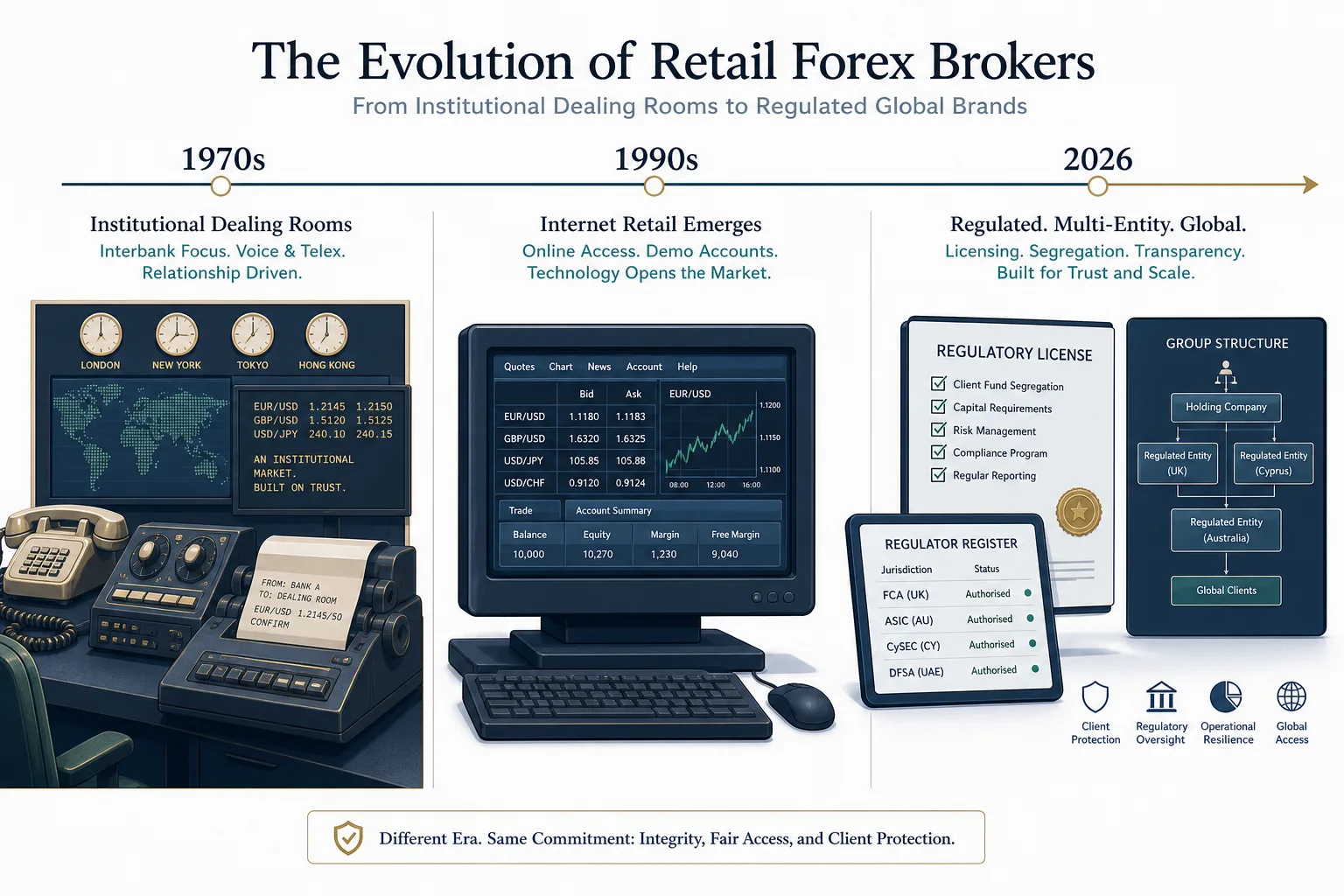
- Protection follows the legal company in your client agreement, not the logo on the website
- A useful current list includes only brands that are still operating; closed, licence-revoked and widely documented scam names should stay off the map
- Retail access is a late-1990s/2000s layer on top of a much older institutional FX market measured by the BIS
- The 28-row table is ForexTradeLab’s currently documented subset — not a claim that only 28 brokers are active worldwide
- This page is a cluster pillar for history, groups and entity checks — not a ‘best brokers 2026’ ranking

Quick Decision Framework#
Short Answer
Read a current brokers list as a map of still-active brand families — not a ranking and not proof of regulation. Retail FX/CFD brands arrived with internet access in the late 1990s and standardised on MetaTrader and multi-entity licensing in the 2000s–2010s. A clean 2026 list drops dead and scam names, then groups what remains by role. ForexTradeLab’s 28 documented entity pages are a subset, not the whole industry. Protection still follows the legal company in your agreement.
Detailed Explanation
Institutional FX is much older than retail platforms; the BIS still measures that wholesale market. Retail access is a late-1990s/2000s layer on top. Multi-asset incumbents, large retail FX/CFD brands and newer second-wave names are different roles, not a quality score. Closed, licence-revoked and widely documented scam names should stay off an “active” map. Historical failures — including UK retail casualties around extreme FX events — belong in risk education, not in the 2026 table. This page is a cluster pillar for history and entity checks, not a “best brokers 2026” ranking.
Example
A reader sees 28 rows and assumes only 28 brokers exist, or that every row is equally regulated. In practice one brand may have an FCA company and an offshore company; another row may be a newer name with a thinner public record. A dead UK retail firm from a past shock stays in the history section so it is not mistaken for a live counterparty.
Common Mistake
Treating the table as a recommended shortlist or as proof that a logo on the website is licensed in your country. Presence on an educational map is not onboarding advice.
Professional Tip
Pick one brand you actually might use, open its entity page, then verify that exact company on the regulator register for your residence before any deposit. If you cannot name the company, you are still on the logo.
TL;DR — History, then a Current Map#
| Era | What changed for retail |
|---|---|
| 1944–1971 | Bretton Woods pegs; little to “trade” in the modern sense |
| 1973 onward | Major floats; institutional FX dealing grows |
| Late 1990s | Internet retail brokers appear |
| 2005–2010s | MT4/MT5 standardisation; multi-entity global brands |
| 2018 onward | Retail CFD leverage caps in ESMA-style regimes |
| 2026 | Same logos, many legal companies — verify the entity |
| Question | Short Answer |
|---|---|
| Ranking? | No — a map of still-active types |
| Scam/closed brands? | Out of a current list |
| Licence ticks in this article? | No — use registers and licensed brokers |
| ForexTradeLab documented subset | 28 names currently documented in licensed brokers — not a complete worldwide list |
This page is the Forex Brokers 2026 landscape pillar. Use it with regulation, licence verification, brand vs legal entity, how to choose a broker, and the licensed brokers entity pages.
Why a “Current List” Is Not a Hall of Fame#
Short Answer
A useful 2026 list answers “who is still a real, operating brand family?” It does not answer “who is safest for you?” and it does not resurrect dead names.
Detailed Explanation
Retail search loves “top 100 forex brokers.” That format breaks in three ways:
- Dead inventory — failed, revoked or abandoned brands pollute old SEO lists.
- Logo inflation — one name, several companies (brand vs entity).
- Country fiction — a .com page is not permission to onboard your residence (including Turkey). Local law decides.
CFTC forex-fraud material is still the right instinct globally: guaranteed returns and unverifiable firms are not “tier 3 brokers.” They are not brokers for this map.
Example
A 2014 blog still ranking a UK entity that entered insolvency after the 2015 CHF event is not “historical colour.” It is a dangerous current list.
Common Mistake
Copying a 100-row table of green ticks for FCA/ASIC/CySEC from a marketing PDF.
Professional Tip
Keep two artefacts: this landscape article (types and history) and a register-backed directory (licensed brokers). Do not merge them into fake certainty.
Key point: History explains why so many brands exist. Entity checks decide whether you should fund one of them.
From Dealing Rooms to Retail Logos#
Short Answer
Institutional FX is decades older than the MetaTrader login. Retail brokers are a distribution layer on a BIS-scale OTC market.
Detailed Explanation
As in our market-evolution guide:
- Bretton Woods limited tradable volatility.
- Post-1973 floats created continuous institutional dealing.
- Late 1990s internet let non-bank firms offer leveraged FX/CFDs to private clients.
- 2000s platforms (MT4 from 2005, then MT5) made the product look the same across brands.
- 2010s multi-entity groups used one brand in many licences.
- 2018 ESMA-style caps changed retail gearing in Europe-aligned regimes (leverage limits).
OANDA, Saxo and similar names belong to the early internet-retail wave. Many high-volume names you see in 2026 ads (XM, Exness, IC Markets and peers) scaled in the post-MT4 global retail wave. Neither wave is automatically “higher quality.”
Example
A trader compares a 1990s-origin multi-asset firm with a 2009-origin retail specialist. The older firm may have a different product mix (shares, options, listed access). The newer firm may be built around MT4/MT5 and high-leverage CFDs. Age is a clue to business model, not a safety score.
Common Mistake
Treating “founded 1996” as FSCS/ICF protection.
Professional Tip
Ask: listed multi-asset vs OTC CFD specialist? That split explains more than founding year.
What Matters More Than the Broker Brand?#
Short Answer
The legal entity that holds your account. The brand is the wrapper. Protection, leverage, compensation schemes and complaint routes follow the company named in the client agreement.
Detailed Explanation
Search queries such as “Is Exness regulated?” are incomplete. The extractable answer is: which Exness legal entity, under which licence, for which country of residence?
Read the stack in this order:
| Layer | What it is | Why it matters |
|---|---|---|
| Broker brand | The public name and website | Marketing, platform look, ads |
| Legal company | The firm named in your client agreement | The counterparty that actually holds the account |
| Licence | The authorisation number on that company | What the firm is allowed to offer |
| Regulator | The authority that issued that licence | Rules, leverage caps, complaint route |
| Country of residence | Where you live | Who may onboard you; which entity you get |
| Client agreement | The contract you accept | Spreads, NBP, withdrawals, governing law |
Same logo, different company, different protection. That is why brand vs legal entity and licence verification sit next to this map.
Example
Two clients both “open XM.” One is onboarded by a CySEC investment firm with ESMA-style 30:1 leverage. Another is onboarded by a different group company with a different leverage cap and a different compensation scheme. The brand did not change. The legal entity did.
Common Mistake
Asking “Is [brand] regulated?” and stopping at a footer collage of regulator logos.
Professional Tip
Write one sentence before you fund: “My account is with [company], licence [id], register [URL], country [residence].” If you cannot complete it, you are still choosing a logo.
Key point: Protection still follows the legal company in your client agreement — not the brand on the homepage.
ForexTradeLab’s Three Editorial Groups (2026)#
Short Answer
We group still-active names by typical role — not by a secret quality score. Three groups keep the map readable.
Detailed Explanation
This grouping is how we keep research coherent. It is not a regulator classification.
Group A — Multi-asset / long-standing retail names
Brands often associated with broader investment access, longer public histories, or “incumbent” positioning in several OECD markets. Names commonly discussed in this bucket in 2026 include:
IG, Interactive Brokers, Saxo, OANDA, Swissquote, CMC Markets, FOREX.com
Use them when the research question is “multi-asset vs pure FX/CFD,” not “highest leverage.”
Group B — Large retail FX/CFD brands
A visibility and distribution bucket, not a single product architecture. These names have high global retail reach in leveraged FX/CFDs. Some are MT4/MT5 specialists. Others use a different product mix or client profile (multi-asset CFDs, share dealing, or app-first onboarding) while still competing in the same large-retail CFD market.
Names commonly discussed here include:
Exness, XM, IC Markets, Pepperstone, FxPro, AvaTrade, HFM, FP Markets, FXTM, Tickmill, Eightcap, Plus500, eToro, XTB, Axi, Admirals, Markets.com
Inside that list, treat product shape as a second filter: Exness, XM, IC Markets and Pepperstone are typically platform-led CFD specialists; eToro, XTB, Plus500, Admirals and Markets.com often reach a different client mix. Group B answers “who do retail searchers meet most often?”, not “who has the same account type.”
ForexTradeLab’s deeper entity notes currently concentrate on a 28-name documented subset inside licensed brokers — see the founding-year table below. Affiliate testing on the site also concentrates on XM and Exness with IC Markets as a comparison name — that is a content/conversion cluster, not a claim that Group B has only three members.
Group C — Newer or second-wave names
Brands you still meet in 2026 ads and reviews, often later-scaled or more regionally skewed. Names that still pass the active and not fraud-associated filter include:
Capital.com, Fusion Markets, BlackBull Markets, Trade Nation, FBS, JustMarkets, RoboForex, Vantage, ThinkMarkets, ACY Securities
Some widely advertised brands sit outside this article’s current documented subset because they do not meet the editorial inclusion criteria used for this map. Sourced exclusion notes belong in a separate article — not in an active-map section. “Second wave” means later in the retail timeline or less incumbent in OECD multi-asset, not “unsafe by default” and not “better spreads by default.”
Example
A beginner comparing “IG vs XM vs FBS” is mixing Group A, B and C. That is fine if the checklist is identical: entity, register, withdrawals, cost. It is not fine if they pick by ad frequency.
Common Mistake
Reading Group A as “safe,” Group B as “one product type,” and Group C as “scam.” Scams are a different set — they do not get a group letter.
Professional Tip
If a name is not in A/B/C and not in our directory, start from how to verify a licence before you add it to your personal shortlist.
28 Forex Brokers Currently Documented by ForexTradeLab#
This is not a complete list of active forex brokers worldwide. It is the subset currently documented by ForexTradeLab.
Short Answer
Twenty-eight still-active retail FX/CFD brands currently have entity notes in licensed brokers. The table is ordered by founding year. Age is a business-model clue, not a safety score. InstaForex remains in the directory but is omitted here because it was not on the large-brand filter used for this map.
Detailed Explanation
This is ForexTradeLab’s documented subset, not a ranking, not a licence-tick spreadsheet, and not a claim that only these brokers are active in 2026. Each row links to the ForexTradeLab entity page. Protection still follows the legal company in your client agreement, which you match on the official register.
| # | Broker | Founded | Age in 2026 | Entity notes |
|---|---|---|---|---|
| 1 | IG | 1974 | 52 | FCA, ASIC |
| 2 | OANDA | 1996 | 30 | CFTC/NFA, FCA, ASIC |
| 3 | FOREX.com | 1999 | 27 | CFTC/NFA, FCA |
| 4 | Admirals | 2001 | 25 | FCA, CySEC, FSA Seychelles |
| 5 | FP Markets | 2005 | 21 | ASIC, CySEC, FSCA, FSA Seychelles |
| 6 | AvaTrade | 2006 | 20 | CBI Ireland, ASIC, FSCA, ADGM |
| 7 | FxPro | 2006 | 20 | FCA, CySEC, FSCA |
| 8 | IC Markets | 2007 | 19 | ASIC, CySEC, FSA Seychelles |
| 9 | Axi | 2007 | 19 | ASIC, FCA, CySEC, DFSA |
| 10 | eToro | 2007 | 19 | FCA, CySEC, ASIC |
| 11 | Exness | 2008 | 18 | FSCA, FSA Seychelles; FCA/CySEC (non-retail) |
| 12 | Plus500 | 2008 | 18 | FCA, CySEC, ASIC |
| 13 | Markets.com | 2008 | 18 | CySEC, FSCA — UK retail under this brand is not treated as current |
| 14 | XM | 2009 | 17 | CySEC, DFSA, FSCA, FSA Seychelles |
| 15 | FBS | 2009 | 17 | CySEC, FSC Belize |
| 16 | Vantage | 2009 | 17 | ASIC, FCA, CIMA, VFSC |
| 17 | RoboForex | 2009 | 17 | FSC Belize |
| 18 | Eightcap | 2009 | 17 | ASIC, FCA, CySEC |
| 19 | Pepperstone | 2010 | 16 | FCA, ASIC, CySEC, DFSA |
| 20 | HFM | 2010 | 16 | FCA, CySEC, FSCA, FSA Seychelles |
| 21 | ThinkMarkets | 2010 | 16 | FCA, ASIC, CySEC, FSCA |
| 22 | FXTM | 2011 | 15 | FCA, FSCA, FSC Mauritius |
| 23 | ACY Securities | 2011 | 15 | ASIC, FSCA |
| 24 | JustMarkets | 2012 | 14 | CySEC, FSCA, FSA Seychelles |
| 25 | Tickmill | 2014 | 12 | FCA, CySEC, FSCA, FSA Seychelles |
| 26 | BlackBull Markets | 2014 | 12 | FMA New Zealand, FSA Seychelles |
| 27 | Capital.com | 2016 | 10 | CySEC, FCA, ASIC |
| 28 | Fusion Markets | 2017 | 9 | ASIC, FSA Seychelles, VFSC |
Regulator labels in that table are group footprints, not a promise that your account sits under the strongest entity. Confirm the company named in the agreement.
Wider-map names that are still active and not fraud-associated, but not yet given a ForexTradeLab entity page, include Interactive Brokers, Saxo, Swissquote, CMC Markets, XTB and Trade Nation.
Example
A trader born in 2005 might assume FP Markets is “old therefore safer than Tickmill.” FP Markets is older; Tickmill still has FCA and CySEC entities. Age does not settle which company will onboard you.
Common Mistake
Treating the 28-row table as “the only legal brokers in the world,” or copying the regulator column as if every client gets FCA/FSCS protection.
Professional Tip
Use the table to pick at most three names, then run licence verification on the exact entity. Do not skip to funding because a brand is on this page.
What This Article Deliberately Does Not Do#
Short Answer
It does not tick FCA/ASIC/CySEC/FSA boxes, does not certify Turkey service, and does not rank IB programmes.
Detailed Explanation
A master spreadsheet of the form Broker | Founded | HQ | Active | FCA | ASIC | CySEC | FSA | Turkey | MT4/MT5 | IB | ForexTradeLab priority is a data product. It is only honest if every licence cell is an entity + register URL + date. Publishing 100 green ticks in Markdown would rot within a quarter.
What we will maintain instead:
| Artefact | Job |
|---|---|
| This article | History + active types + the 28-row documented subset |
| Licensed brokers | Entity-level notes for those 28 names (plus InstaForex) |
| Broker quiz | Educational fit, not a licence |
| Official registers | Live legal status |
Turkey: this article does not state who may legally onboard Turkish residents. Capital-markets rules change; offshore .com funnels are not a legal opinion. Check primary local rules and the company named in any agreement.
Platforms / IB: MT4, MT5, cTrader and introducing-broker programmes differ by entity and campaign. Confirm on the live site of the company you contract with.
Example
Pepperstone’s ASIC company is not the same contract as a different group company that might accept another passport. A single “ASIC: yes” cell for the word “Pepperstone” is the error.
Common Mistake
Using an IB payout screenshot as proof of regulation.
Professional Tip
If you build the 100-row sheet internally, store legal company name + licence number + register link + last verified date. Anything less is marketing.
Closed, Revoked, Scam — Keep Them Off the Map#
Short Answer
A current list is a negative list first: who must not appear as if they still take your money under yesterday’s brand story.
Detailed Explanation
Exclude, at minimum:
- Firms in insolvency or compulsory closure in a major centre
- Licence withdrawals/revocations still in force
- Brands the CFTC RED list or equivalent warnings flag as impersonation/fraud risks
- Clone sites using a real logo with a different domain
Historical failures (for example UK retail casualties around extreme FX events) belong in risk education, not in an “active 2026 brokers” table.
Absence from ForexTradeLab’s documented subset is not the same as a sourced enforcement verdict. Brands outside this map either lack an entity page yet, or they do not meet the editorial inclusion criteria used here. Detailed, cited exclusion notes belong in a dedicated article.
Example
Keeping a shuttered brand in a “top brokers 2026” roundup so the article keeps old backlinks is SEO malpractice and client harm.
Common Mistake
“They rebranded, so the old scandal is gone.” Rebrands need a new entity check.
Professional Tip
When a name disappears from this map, it should disappear from internal linking too — except in scam/warning articles.
How to Compare Across Groups Without a Fake Score#
Short Answer
Same due-diligence stack for Group A, B and C — brand last, legal entity first.
Detailed Explanation
- Legal company in the agreement
- Register match (FCA, ASIC, CySEC, or the true authority)
- Leverage and NBP for that entity (NBP, leverage caps)
- Cost: spread + commission + swap (swap guide)
- Withdrawal test on a small deposit (first withdrawal)
- Support you can actually reach (test support)
Then use how to choose a broker and, if you want a style prompt only, the broker quiz.
Example
Two Group B names can be opposite experiences if one client is under CySEC 30:1 and the other is under an offshore high-leverage entity.
Common Mistake
Picking Group A because “banks use them” without reading your own agreement.
Professional Tip
Write one sentence: “My account is with [company], licence [id], register [URL].” If you cannot, you are not ready to fund.
Forex Brokers 2026 — Topic Cluster#
This article is the landscape pillar. It should not sit alone. Read it with:
| Cluster page | Job |
|---|---|
| Forex broker regulation | What FCA, ASIC, CySEC and offshore licences actually mean |
| How to verify a forex broker license | Register check, not a logo collage |
| Broker brand vs legal entity | Why the company in the agreement beats the homepage |
| How to choose a reliable forex broker | Decision process after the map |
| Forex broker comparison 2026 | Side-by-side research, not a medal table |
| Retail forex leverage limits | Caps by regime, not by brand slogan |
| Negative balance protection | Entity-level, not brand-level |
| First withdrawal test | Prove money movement before scaling |
| Evolution of the forex market | Institutional history behind the retail layer |
| Licensed brokers directory | Entity pages for the documented subset |
Entity pages currently in that subset: Admirals, FP Markets, AvaTrade, FxPro, IC Markets, Axi, Exness, XM, FBS, Vantage, RoboForex, Pepperstone, HFM, FXTM, JustMarkets, Tickmill, IG, OANDA, FOREX.com, eToro, Plus500, Eightcap, ThinkMarkets, Capital.com, Fusion Markets, BlackBull Markets, ACY Securities, Markets.com.
Checklist — Building a Personal 2026 Shortlist#
- Dead, revoked and scam names removed
- Group A/B/C used only as a map, not a score
- The 28 documented names used as a starting subset, not the universe
- Legal company copied from the agreement before the brand is trusted
- Official register checked the same day
- Country access not assumed (including Turkey)
- MT4/MT5/cTrader confirmed for that entity
- IB/affiliate pitch ignored as a safety signal
- Small deposit and withdrawal test planned
Glossary#
| Term | Meaning |
|---|---|
| Active brand family | A name still operating in 2026 under one or more legal companies |
| Multi-asset incumbent | Firm whose retail offer often includes more than OTC FX/CFDs |
| Large retail FX/CFD brand | High-visibility retail name in leveraged FX/CFDs; product mix may still differ inside the group |
| Second-wave name | Later-scaled or less incumbent brand still commonly advertised |
| Legal entity | The company named in your client agreement |
| Register check | Matching that company on the regulator’s public database |
| Dead inventory | Closed or revoked names kept alive only by old SEO lists |
| Editorial group | ForexTradeLab’s A/B/C map — not a regulator tier |
| Documented subset | The 28 names with ForexTradeLab entity pages as of this article — not a worldwide census |
Key Takeaways#
- A current list is first a list of who is still operating
- What matters more than the brand is the legal entity that holds the account
- Retail brokers are a recent layer on an old institutional FX market
- Groups A/B/C are a research map, not medals; Group B is a visibility bucket, not one product type
- The 28-row table is ForexTradeLab’s documented directory subset, not “the only 28 active brokers”
- Licence and Turkey columns belong in a dated entity database, not in unchecked article ticks
- XM/Exness/IC Markets remain a comparison cluster, not the whole industry
Related Reading#
- Evolution of the forex market
- Forex broker regulation: FCA, ASIC, CySEC, offshore
- Broker brand vs legal entity checklist
- How to verify a forex broker license
- How to choose a reliable forex broker
- Forex broker comparison 2026
- Retail leverage limits ESMA/FCA/ASIC
- Negative balance protection
- First withdrawal test
- Licensed brokers directory
- Admirals · FP Markets · AvaTrade · FxPro
- IC Markets · Axi · Exness · XM
- FBS · Vantage · RoboForex · Pepperstone
- HFM · FXTM · JustMarkets · Tickmill
- IG · OANDA · FOREX.com · eToro
- Plus500 · Eightcap · ThinkMarkets · Capital.com
- Fusion Markets · BlackBull Markets · ACY Securities · Markets.com
Future related work: a sourced exclusion article for brands that fail the inclusion filter; a register-backed internal sheet (company, licence ID, last verified) — published only for entities we have actually checked. Country-access flags (including Turkey) only after a legal-source pass.
Next step: pick at most three names from the 28-row table, then run licence verification and a demo before any live deposit.
Risk warning: CFDs are complex instruments and come with a high risk of losing money rapidly due to leverage. A large share of retail investor accounts lose money when trading CFDs. Appearing on an industry map is not an endorsement and not a prediction of safety. Past performance is not indicative of future results.
Comments
Add a useful note for other traders. We review comments before publishing.