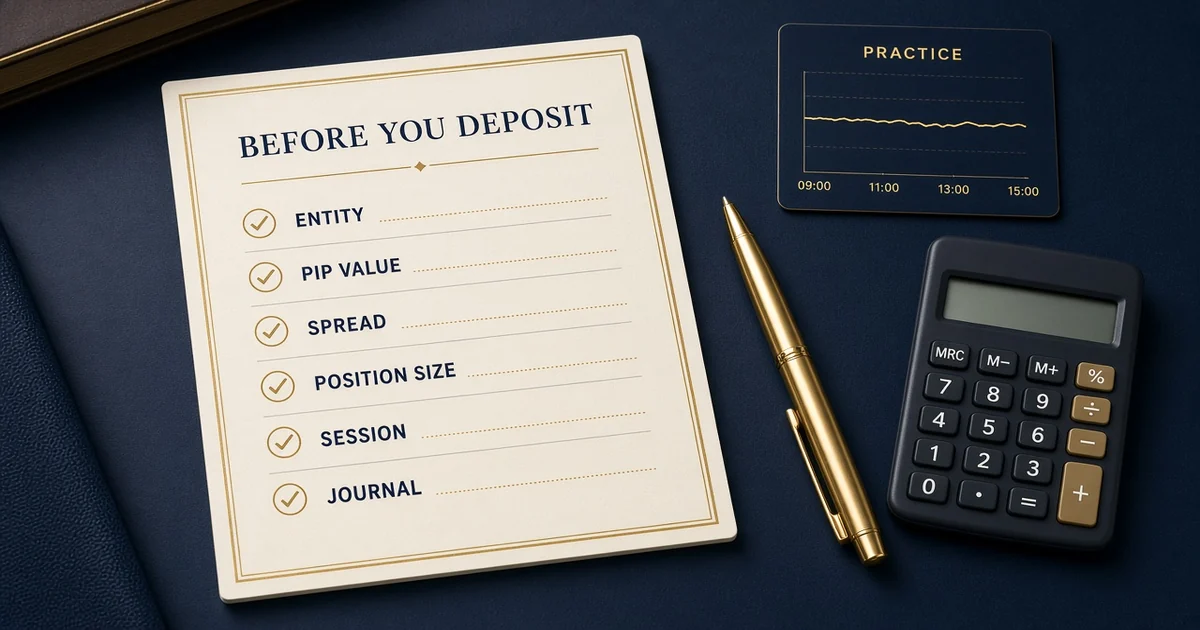
- If you cannot do these six items on a blank page, the next step is practice, not a deposit
- On USD-quoted EUR/USD, a pip of 0.0001 is about 10 dollars per standard lot and about 1 dollar per 0.10 lot
- Spread is part of the risk budget. A wide spread on a tight stop means the idea is already behind
- Position size comes from cash risk divided by stop distance, not from the maximum leverage the button allows
- The legal entity, the session you will actually attend, and one journal row are skills, not paperwork to skip
 Regulated Global Broker
Trusted by 20M+ traders — open your account in minutes
- Trade 1,400+ instruments
- Country-based bonus offers where eligible
- MT4 & MT5 available
- Easy deposits and withdrawals
- Leverage up to 1000:1, where available
- Copy Trading: auto-copy expert strategy managers
- The gate
- 1. Name the legal entity
- Short Answer
- Detailed Explanation
- Example
- Common Mistake
- Professional Tip
- 2. Price a pip
- Short Answer
- Detailed Explanation
- Example
- Common Mistake
- Professional Tip
- 3. Put the spread next to the stop
- Short Answer
- Detailed Explanation
- Example
- Common Mistake
- Professional Tip
- 4. Size the position from the cash you can lose
- Short Answer
- Detailed Explanation
- Example
- Common Mistake
- Professional Tip
- 5. Name one session you will actually attend
- Short Answer
- Detailed Explanation
- Example
- Common Mistake
- Professional Tip
- 6. Write one journal row a stranger could audit
- Short Answer
- Detailed Explanation
- Example
- Common Mistake
- Professional Tip
- A full pass, worked once
- Checklist
- Glossary
- Key takeaways
- Related reading
Affiliate & risk disclosure: ForexTradeLab may earn a commission from partner links elsewhere on the site. Passing this gate does not make leveraged forex safe. CFDs can wipe out a deposit. See the disclaimer and the affiliate disclosure.
The gate#
People who intend to start forex are usually told to “learn the basics” and then handed a 12-week syllabus. The syllabus is useful. It is not the test. The test is whether six lines come out of your own head before money moves.
| # | Skill | You pass if you can… |
|---|---|---|
| 1 | Entity | Name the legal company and where its permission is checked |
| 2 | Pip value | Price a pip at 1.00, 0.10 and 0.01 lot for your pair and account currency |
| 3 | Spread | Show the spread as a slice of the stop, in pips and in cash |
| 4 | Position size | Turn a 1% cash risk and a stop distance into a lot size |
| 5 | Session | Name one window in your local time, and why you will ignore the others |
| 6 | Journal | Write one row a stranger could audit a week later |
Fail any line and the next action is practice, not funding. The longer study path is the free curriculum. The decision of whether to start at all is the scorecard. This page sits between them.
The CFTC’s pre-trading advisory tells retail clients to understand costs, leverage and the firm before they send money. The six lines are that advice turned into something you can fail on paper.
1. Name the legal entity#
Short Answer
The brand on the advertisement is not the company that would hold your money. You need the company name, the regulator, and the register where you would check it.
Detailed Explanation
Retail forex is a contract with a specific firm. A group can hold several licences. The permission that matters is the one attached to the company in your client agreement, for clients in your country. ESMA’s product rules, the FCA’s retail CFD restrictions, and an offshore registration are not interchangeable stickers.
Before a deposit you should be able to say, in one sentence: “The company is ___, the permission I am relying on is ___, and I would confirm it at ___.” Then use brand versus legal entity and how to verify a licence. If the sentence has a blank, you do not have an account yet. You have a logo.
Example
A reader says “I am opening the blue one, it is regulated in Europe.” That sentence fails. It has no company name and no register. A passing sentence names both, even if the reader later decides not to fund.
Common Mistake
Treating a homepage footer full of licence numbers as if every number protected every client. Entities are assigned after you see the agreement.
Professional Tip
Screenshot the legal name on the agreement the day you read it. Logos get redesigned. The company name is the record.
2. Price a pip#
Short Answer
On USD-quoted EUR/USD, one pip (0.0001) is worth about $10 on 1.00 lot, $1 on 0.10 lot, and $0.10 on 0.01 lot.
Detailed Explanation
A standard lot in this example is 100,000 units of the base currency. A pip of 0.0001 times 100,000 is 10 units of the quote currency. When the quote currency is the US dollar, that is about $10 per pip per standard lot. Scale it down with the lot:
| Lot | Units (this convention) | Approximate pip value, EUR/USD, USD account |
|---|---|---|
| 1.00 | 100,000 | $10 |
| 0.10 | 10,000 | $1 |
| 0.01 | 1,000 | $0.10 |
This is the textbook USD-quote case. It is not a universal constant. A JPY pair uses a different pip size. A USD-base pair converts the result. Gold uses a point size the contract spec defines. The skill is the method, plus the habit of reading the specification. Worked variants live in what a pip is and pip value calculation.
The wholesale market behind these quotes is enormous — about $9.6 trillion average daily OTC turnover in the BIS 2025 survey. That liquidity does not set your pip value. Your contract size does.
Example
You plan 0.08 lots of EUR/USD. Pip value is 0.08 × $10 = $0.80 per pip. A 25-pip stop is then about $20 before extra slippage. If you cannot do that multiplication cold, the ticket is guessing.
Common Mistake
Remembering “a pip is ten dollars” and applying it to a 0.01 lot. On 0.01 that pip is about ten cents. The phrase without the lot size is how small accounts get oversized, and how large accounts get described as tiny.
Professional Tip
Write the three-row table from memory once a week until it is boring. Boring is the point.
3. Put the spread next to the stop#
Short Answer
The spread is a cash cost paid up front. Divide it by the stop. If it is a large slice of the stop, the trade is a cost, not a setup.
Detailed Explanation
You buy at the ask and sell at the bid. The gap is the spread. On a liquid EUR/USD quote it may be well under a pip in a busy session, and several times wider at a rollover or into a data release. The skill is not memorising one broker’s marketing spread. The skill is comparing today’s spread with your stop.
Using the 0.08 lot above ($0.80 per pip):
| Live spread you observe | Cash cost of that spread | Share of a 25-pip stop |
|---|---|---|
| 0.6 pip | about $0.48 | 2.4% |
| 1.5 pips | about $1.20 | 6% |
| 8 pips (thin or news quote) | about $6.40 | 32% |
A 32% slice means nearly a third of the planned risk is gone when the position exists. Add slippage and the stop you drew is not the loss you take. The full stack is in spread, commission, swap and slippage.
Example
A beginner copies a 6-pip stop from a fast-chart video. The platform is quoting a 2-pip spread because the session is quiet. One third of the stop is the spread. The video’s result cannot appear on this ticket. The correct act is to stand aside or to redesign size and stop, not to click faster.
Common Mistake
Measuring the setup from the mid-price and discovering the spread only after the fill. The ask is the buy price. Build it into the idea.
Professional Tip
Write a personal rule in advance: if the spread is more than a set share of the stop (many learners use 10% as a ceiling while practising), there is no trade. The number is a discipline tool. It is not a claim that 10% is optimal.
4. Size the position from the cash you can lose#
Short Answer
Lot size = (account × risk %) ÷ (stop in pips × pip value of 1.00 lot). Leverage is not an input to that sentence.
Detailed Explanation
Take a $2,000 practice balance and a 1% ceiling. Cash at risk is $20. The stop is 25 pips. Loss allowed per pip is 20 ÷ 25 = $0.80. On EUR/USD, $10 per pip is the 1.00-lot reference, so lots = 0.80 ÷ 10 = 0.08.
Check the margin so you know the trade fits, not so you can push it bigger. At a hypothetical EUR/USD price of 1.1000 (a round teaching price, not a live quote):
- Notional is 0.08 × 100,000 = 8,000 EUR, about $8,800
- At 30:1, margin is about 8,800 ÷ 30 = $293
- The planned loss if the stop fills cleanly is still about $20, not $293
30:1 is the ESMA retail cap on major FX in the product-intervention regime, explained in the ESMA measures file. Some firms outside that regime advertise much higher leverage. Higher leverage lowers the margin for the same notional. It does not shrink the $20 you lose if price travels 25 pips. Read leverage for beginners and the one-percent rule examples before you touch the leverage slider.
Your platform’s contract size, margin currency and current price override this sketch. If the ticket disagrees with your page, believe the ticket and redo the page.
Example
The same $2,000 account, same 25-pip stop, but the trader picks 1.00 lot because the margin button allows it. Pip value is about $10, so 25 pips cost about $250, which is 12.5% of the account, not 1%. One full stop, or a gap through it, is a different product from the plan. The button was showing margin, not permission.
Common Mistake
Sizing from “how much margin is free” until the free margin is almost gone. Free margin is unused collateral. It is not a target to fill.
Professional Tip
Do the division on paper, then let a calculator confirm it. The lot calculator is a check, not a substitute for knowing the steps.
5. Name one session you will actually attend#
Short Answer
Pick one liquid window, write it in your local time, and ignore the rest of the clock until the sample is finished.
Detailed Explanation
EUR/USD is usually tightest when London and New York overlap, about 13:00–17:00 GMT. That block is mid-afternoon in London, morning in New York, and evening in parts of the Gulf and South Asia. The skill is converting GMT into the clock on your wall and blocking that time on a real calendar. Hours by city and broker server time versus local time stop the classic error of trading “London open” at the wrong hour because the platform is on a server clock.
One pair belongs with one session. EUR/USD during that overlap is the default classroom. Exotic pairs and gold can be studied later; they are a worse place to learn what a spread does. See which pair to trade.
If the only window you can attend is illiquid for your pair, change the pair or change the plan. Do not keep a job-unfriendly session you will skip, then revenge-trade at midnight.
Example
A reader in a UTC+3 city writes “London–New York overlap is about 16:00–20:00 in winter and about 15:00–19:00 when both centres are on daylight time.” They can attend three of those hours twice a week. That is a session. “I will watch the chart whenever I can” is not.
Common Mistake
Trading every session because the platform is open. Availability is not liquidity, and it is not spare attention.
Professional Tip
Put the window in the journal header. A trade taken outside it fails the process even if it makes money. The first month is easier to read when the clock is constant.
6. Write one journal row a stranger could audit#
Short Answer
A passing row has pair, session, direction, lot, stop distance, spread, cash risk, and the rule that would have cancelled the trade. A screenshot of profit is not a row.
Detailed Explanation
The row exists so that a week later you can tell rule-following from luck. Minimum fields:
- Date and your local time
- Pair and the session name
- Direction, lot size, stop in pips
- Spread at entry, in pips and in cash
- Planned cash risk and whether it was inside 1%
- Whether you followed the written rule
- Result in R, where a full stop is about −1R, after you note extra slippage
You do not need a perfect template on day one. You need one complete row. The longer version is the trading journal guide and the plan template. Twenty complete rows on demo teach more than a month of untitled screenshots.
Example
“EUR/USD, overlap, long, 0.08 lot, stop 25 pips, spread 0.7 pip (about $0.56), risk about $20 on a $2,000 balance, inside the 1% cap, rule followed, stopped for −1.1R after 2 pips of slippage.” A stranger can check the arithmetic. “Nice buy on EU” cannot.
Common Mistake
Journaling only the winners, or journaling the feeling instead of the numbers. The audit fails in both cases.
Professional Tip
Fill the row before you click, and complete the result after. A row written only after a win is a story.
A full pass, worked once#
Assumptions, all stated so you can throw them out when the platform disagrees: USD account, EUR/USD, pip = 0.0001, teaching price 1.1000, balance $2,000, risk 1%, stop 25 pips, observed spread 0.7 pip, leverage setting 30:1.
| Step | Result |
|---|---|
| Cash risk | $20 |
| Pip value at 0.08 lot | $0.80 |
| Loss if stop fills cleanly | 25 × $0.80 = $20 |
| Spread cost | 0.7 × $0.80 = about $0.56, or 2.8% of the stop |
| Notional | 8,000 EUR, about $8,800 |
| Margin at 30:1 | about $293 |
| Decision | The spread slice is small enough for this practice rule. Size stays 0.08. Margin used is not a reason to increase size |
If your observed spread were 8 pips, the same row would end in “no trade.” That ending is a pass of the skill, not a missed opportunity.
Checklist#
- Legal company and register written in one sentence
- Pip value recited for 1.00, 0.10 and 0.01 on your pair
- Spread written as pips, cash, and a share of the stop
- Lot size derived from cash risk, not from free margin
- One session written in local time
- One journal row a stranger could recompute
- The deposit, if you still want one, is risk capital you can lose in full
- You are not resigning a job to fund the experiment — see the resignation test
Glossary#
| Term | Meaning |
|---|---|
| Pip | Here, 0.0001 on EUR/USD. Not the same step on every symbol |
| Lot | A contract size. 1.00 lot in this EUR/USD example is 100,000 base units |
| Spread | Ask minus bid, the dealing gap you pay to enter |
| 1% risk | The cash you plan to lose if the stop is hit, capped near 1% of equity |
| R | That planned loss as one unit. −1R means the stop happened as planned |
| Entity | The legal company on the contract, not the brand |
| Session | The clock window you pre-commit to attend |
Key takeaways#
- Six skills on a blank page beat a long watch-list of indicators.
- EUR/USD pip value in a USD account is about $10, $1 and $0.10 at 1.00, 0.10 and 0.01 lot.
- Compare the spread with the stop before you compare your opinion with the chart.
- Size from cash risk. Leverage only changes margin.
- One session and one auditable journal row are part of being ready. A deposit does not create them.
Related reading#
- Should you quit your job to trade forex?
- How to start forex
- What is a pip?
- Risk management
- Free 12-week curriculum
- One-percent risk examples
- Forex minimum capital
Later pieces that would extend this cluster: a blank one-page worksheet of the six lines for readers to print, and a second worked example on USD/JPY where the pip is 0.01 and the value has to be converted into the account currency.
Next step: close the platform, write the six lines, then reopen a demo and check them against the ticket. Fund only after the lines match and the cash is true risk capital.
Risk warning: Leveraged forex and CFDs can lead to a rapid, total loss of your deposit. ESMA found that 74–89% of retail CFD accounts in its analysis lost money. A passed skills test improves understanding. It does not predict profit. Educational only.
Comments
Add a useful note for other traders. We review comments before publishing.