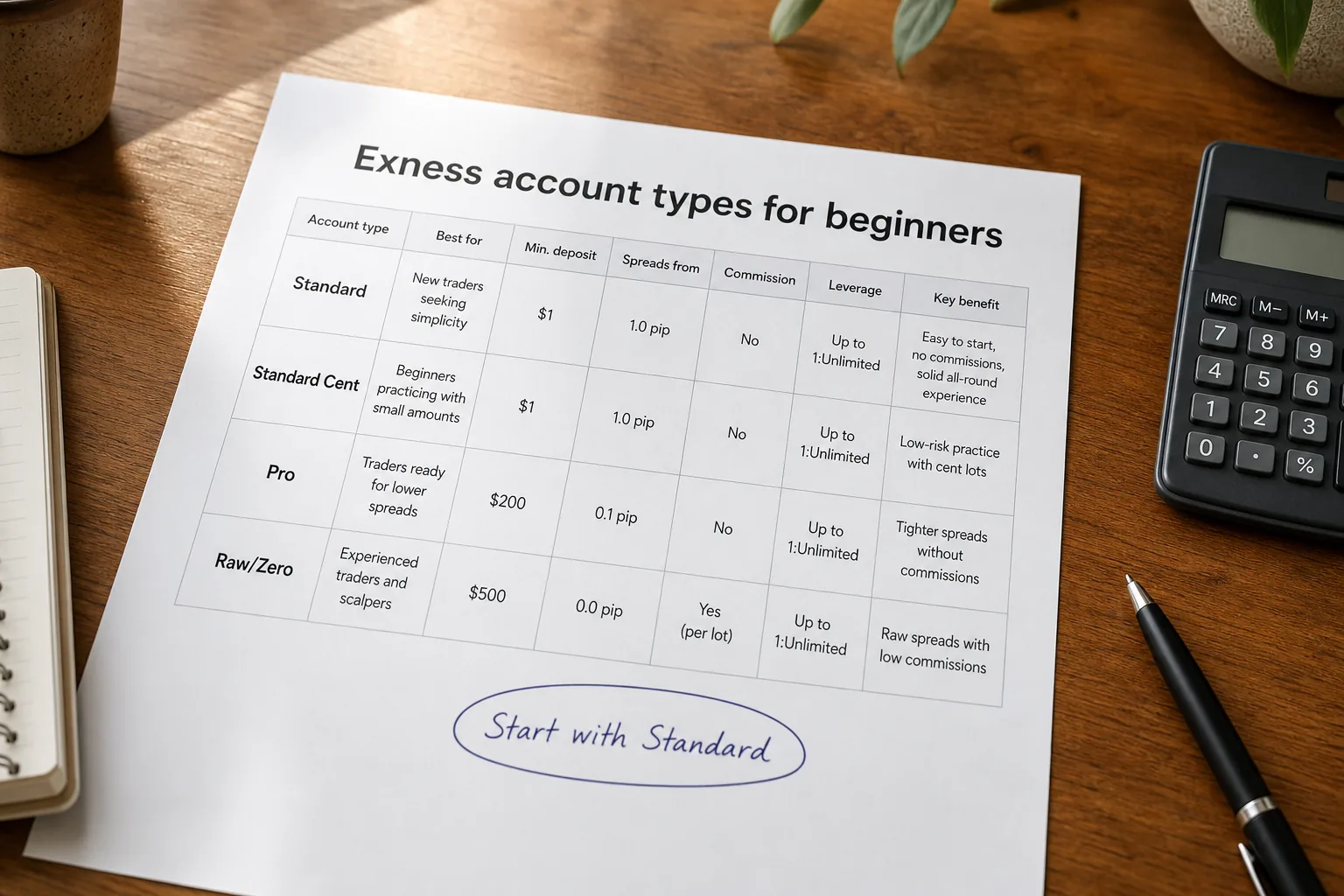
- Standard is the default first live Exness account for most beginners because it is spread-only and listed from $10
- Standard Cent is useful only where it appears and you need smaller real-money size
- Pro, Raw Spread and Zero generally start from $200 and assume you can calculate all-in cost
- Do not pick Raw or Zero for a 0.0 headline on day one
- High or unlimited leverage is conditional and is not a beginner setting
- Open the account after KYC and a written dollar risk limit — not before

Affiliate disclosure: ForexTradeLab may earn a commission from qualifying partner links, without increasing your cost. Read our affiliate disclosure.
Quick Decision Framework#
Short Answer
Exness Standard is usually the first live account for beginners: official pages list it from $10 with spread-only pricing. Use Standard Cent only if it appears for your country and you need smaller size. Leave Pro, Raw Spread and Zero until you can read commission and survive a small withdrawal test.
Detailed Explanation
Account type sets minimum deposit, lot steps and whether you pay spread only or spread plus commission. Standard removes a commission line from the P&L. Pro, Raw Spread and Zero generally start from about $200. High or unlimited leverage, where shown, is conditional and is not a beginner setting. Minimums and symbols vary by Exness entity and country.
Example
On an $80 Standard account, 0.01 lot on EUR/USD with a 30-pip stop is about $3 of planned risk—already nearly 4% of the account. Switching to Raw Spread does not fix that sizing problem. A complete first test is KYC, a $30 Standard deposit, 0.01 EUR/USD in London, then export the statement.
Common Mistake
Opening Zero because a video showed 0.0 pips on EUR/USD. Commission, news spreads and your lot size dominate the first 20 trades. The $10 listed minimum is also not enough capital to trade gold safely at 0.01.
Professional Tip
Write deposit, max loss per trade in dollars, and pair before you click Open Account. Complete KYC first, fund only a test amount, and confirm the payment name matches KYC. If those three numbers do not fit Standard minimum volume, you are not ready for Pro, Raw or Zero either.
Short Answer#
Start with Exness Standard. Add Standard Cent only if it is listed for your country and you need smaller live size. Ignore Pro, Raw Spread and Zero until you can explain all-in cost in dollars.
Why Account Type Matters for Beginners#
Short Answer
Account type sets minimum deposit, contract sizing, spread vs commission, and how easy it is to keep risk at 1%.
Detailed Explanation
A beginner does not need the tightest headline spread. A beginner needs:
- A cost model you can read without a spreadsheet
- A minimum you can fund as a test, not a lifestyle deposit
- Lot steps that do not force 3–10% risk on a $50–$100 account
- The same payment name as KYC
Exness Standard is built for that first job. Professional accounts are built for traders who already know their session, pair and average trade duration.
Example
On a $80 Standard account, 0.01 lot on EUR/USD with a 30-pip stop is about $3 of planned risk. That is already nearly 4% of the account. Switching to Raw Spread does not fix the sizing problem; a larger cash buffer or Cent sizing does.
Common Mistake
Opening Zero because a video showed 0.0 pips on EUR/USD. Commission, news spreads and your lot size dominate the first 20 trades.
Professional Tip
Write three numbers before you click Open Account: deposit, max loss per trade in dollars, pair. If those three do not fit Standard minimum volume, you are not ready for Pro/Raw/Zero either.
Exness Account Types at a Glance#
| Feature | Standard | Standard Cent | Pro | Raw Spread | Zero |
|---|---|---|---|---|---|
| Listed minimum | $10 | $10 where available | Generally $200 | Generally $200 | Generally $200 |
| Pricing | Spread only | Spread only | Tighter spread, no commission line | Raw quote + commission | 0.0 on selected symbols + commission |
| Official spread label | From 0.2 pips | From 0.3 pips | From 0.1 pips | From 0.0 pips | From 0.0 on selected symbols |
| Commission | None | None | None | Up to $3.50/side/lot | From $0.05/side/lot |
| Beginner role | Default first live | Micro-risk if offered | Later upgrade | Demo first | Demo first |
Source labels come from Exness Standard and professional account pages. Payment methods can impose higher practical minimums. Full broker matrix: Exness account types 2026.
Standard — The Default Beginner Account#
Short Answer
Standard is spread-only, listed from $10, and the account most new Exness clients should fund first.
Detailed Explanation
Standard removes a commission line from your P&L. You still pay the spread, swaps and any conversion. That is enough complexity for week one.
It fits:
- First live account after demo
- Discretionary beginners on major FX
- Traders who will size 0.01 and journal fills
It does not make leverage safe. Conditional 1:Unlimited or other high caps, where shown, can still liquidate a small account quickly.
Example
You complete KYC, deposit $30 on Standard, trade 0.01 EUR/USD during London, and export the statement. That is a complete beginner test. Adding a second professional account the same day is not.
Common Mistake
Treating the $10 listed minimum as “enough capital to trade gold.” Gold’s tick value can make 0.01 too large for a $10–$50 account. See position sizing.
Professional Tip
If you want XM-style micro lots and a $5 floor instead, compare best XM account type for beginners before duplicating live risk.
Standard Cent — When Smaller Live Size Matters#
Short Answer
Use Cent only if the Personal Area shows it and Standard’s minimum volume risks too much of your cash.
Detailed Explanation
Standard Cent is a micro-risk practice account where available. It is not guaranteed in every country. If the tile is missing, it is not your account type.
Cent is for:
- Sub-$200 live tests where 0.01 standard lots are too big
- Psychology practice with real P&L but smaller notional
Cent is not for:
- Assuming it appears worldwide
- Avoiding KYC
- Trading news with “toy” size and max leverage
Example
A $50 account that cannot keep EUR/USD stop risk near 1% on Standard may be able to on Cent. A $2,000 account usually does not need Cent.
Common Mistake
Waiting weeks for Cent in a country that never lists it. Open Standard or stay on demo.
Professional Tip
Availability belongs in your notes next to entity name. Do not plan a strategy that requires Cent until the tile exists.
Pro, Raw Spread and Zero — Not First Accounts#
Short Answer
These generally start from $200 and assume you can measure all-in cost. Beginners should demo them, not fund them first.
Detailed Explanation
- Pro — tighter spread-only pricing for experienced discretionary traders.
- Raw Spread — very tight quotes plus commission (official pages cite up to $3.50 per side per lot). Useful for scalpers and EAs who record cost.
- Zero — 0.0 on selected symbols under stated conditions, plus commission from a small per-side amount. Pair-focused, not a universal “free spread” account.
Deep dives: Exness Raw Spread, Exness spread, Exness scalping.
Example
An EA that targets 2 pips cannot be judged on Standard demo alone. Run the same week on Raw demo, add commission, then decide. A discretionary beginner placing one setup a day rarely needs that test in week one.
Common Mistake
Funding Raw with $200 because “that is what serious traders use,” then taking 0.10 lots on gold. The account type did not create skill; it increased burn rate.
Professional Tip
Open extra account types under one verified profile after Standard works — deposit, trade, withdraw. The opening guide is the sequence; this page is only the type choice.
Beginner Decision Table#
| Your situation | Open this |
|---|---|
| First live Exness account | Standard |
| Country shows Cent and Standard lots are too big | Standard Cent |
| You already journal costs and trade frequently | Demo Pro / Raw / Zero, then fund one |
| You want $5 Micro lots and possible welcome credit | XM Micro path |
| You have not checked country eligibility | Restricted countries then opening guide |
Leverage, Islamic and Copy Features#
Short Answer
Extra features do not change the beginner recommendation: Standard, modest leverage, written stop.
Detailed Explanation
High leverage, swap-free/Islamic status and copy or social tools can appear by entity, instrument and eligibility. They are optional layers. Read Exness leverage and Exness Islamic account after the account type is chosen.
Retail loss warnings still apply. A swap-free Standard account can lose money as fast as a swapped one if the lot is too large.
Example
Eligible clients may request swap-free on some symbols. That does not remove administrative charges or make overnight gold “free.”
Common Mistake
Maxing leverage to “use the $10 better.” Margin looks cheap; liquidation is faster.
Professional Tip
Cap effective leverage in your own rules (for many beginners, far below the platform maximum) regardless of the slider Exness shows.
How This Compares With XM for Beginners#
XM’s beginner default is often Micro from about $5 with 1,000-unit lots. Exness’s beginner default is Standard from $10 with spread-only pricing and a different payout workflow. Neither is universally cheaper.
Use:
- XM vs Exness for the broker choice
- This page for the Exness type
- Best XM account type for beginners for the XM type
Do not open both live and copy the same trades. That doubles fees and correlated risk.
Pre-Open Checklist#
- Country is accepted on the official Exness flow
- KYC documents are ready (verification guide)
- First account will be Standard, or Cent if listed and needed
- Deposit is a test amount, not rent money
- Max loss per trade is written in dollars
- Professional accounts stay on demo until Standard operations work
- Platform will be downloaded from Exness only
Common Mistakes#
- Choosing by minimum spread screenshot
- Ignoring commission on Raw/Zero
- Assuming Cent exists everywhere
- Funding before KYC
- Using someone else’s payment method
- Treating unlimited leverage as a beginner perk
Key Takeaways#
- Standard is the beginner account at Exness
- Cent is conditional and size-driven, not a status upgrade
- Pro / Raw / Zero are later tools, generally from $200
- Account type cannot replace risk management
- Register through the step-by-step opening guide, not through a random “manager”
Related Reading#
- How to open an Exness account
- Exness account types
- Exness deposit
- Exness KYC
- Exness review 2026
- XM vs Exness
- Best XM account type for beginners
- Open forex account checklist
Practical next step: pick Standard (or Cent if shown), complete KYC, then review live terms. Open Exness account terms only after you can state your deposit, per-trade dollar risk and country eligibility. CFDs can cause rapid losses.
Comments
Add a useful note for other traders. We review comments before publishing.