- Understand mechanics before risking money
- Set clear cash limits
- Review costs and terms
- No outcome is guaranteed
Introduction#
Short Answer
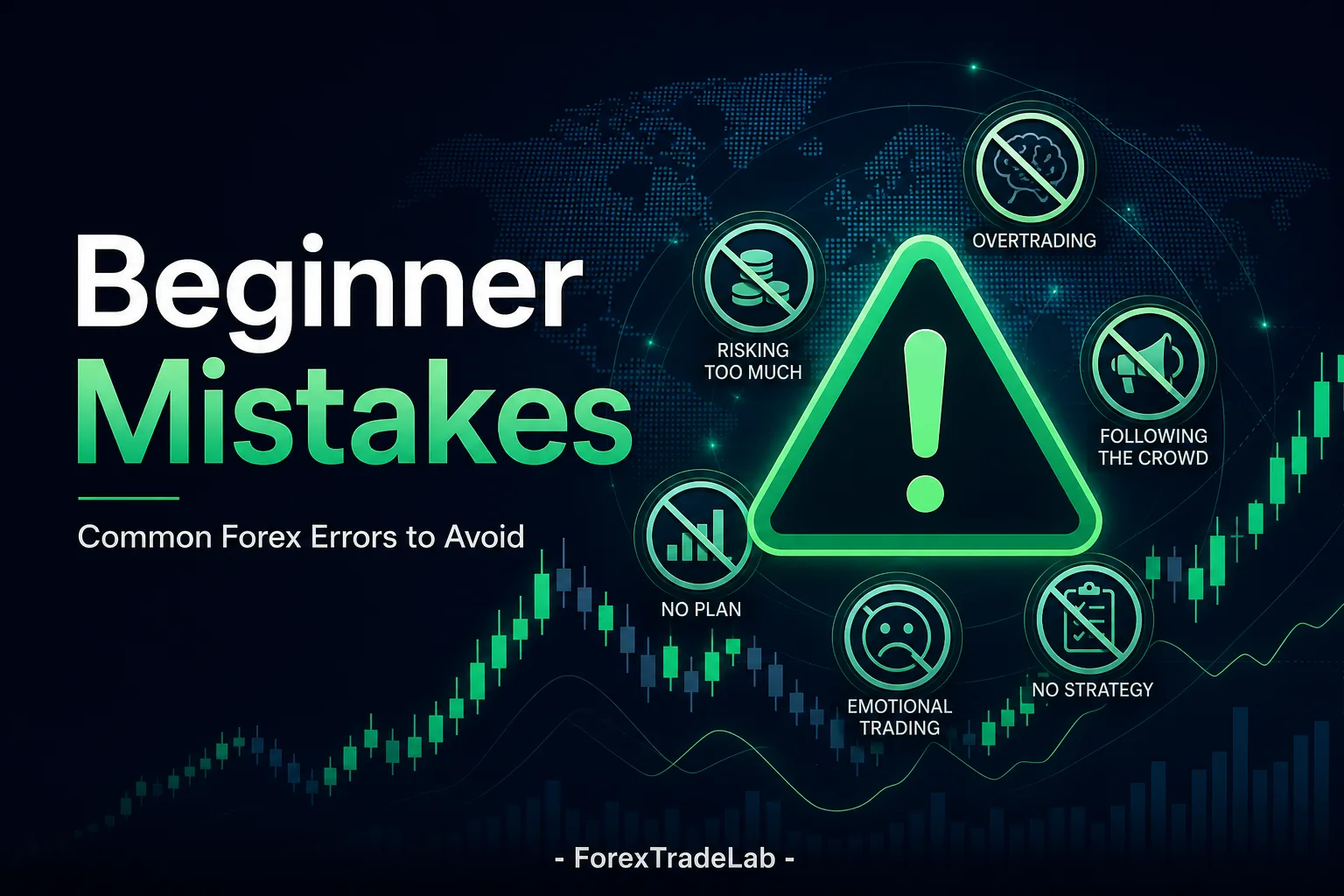
Most beginner losses are not caused by one bad indicator. They come from a chain of controllable decisions: oversizing, entering without a defined invalidation point, treating a loss as a personal insult, and changing the rules after the trade is open.
Mistake One: Treating Leverage as Buying Power#
Short Answer
Leverage is collateral mechanics, not a measure of sensible exposure. A platform may permit a large position, but the position can still lose a harmful share of equity on a routine market move.
Detailed Explanation
Leverage is collateral mechanics, not a measure of sensible exposure. A platform may permit a large position, but the position can still lose a harmful share of equity on a routine market move. Calculate effective leverage and the cash loss at the stop before entry. If either number feels uncomfortable, reduce size or skip the trade.
Example
Calculate effective leverage and the cash loss at the stop before entry. If either number feels uncomfortable, reduce size or skip the trade.
Common Mistake
The mistake is treating this principle as a guarantee or applying it without calculating cost and total exposure. Check the terms and figures in your own account before deciding.
Professional Tip
Write the decision and calculations before placing the order, then review the outcome in a trading journal. Use the related educational links to deepen understanding.
Mistake Two: Opening a Trade Without an Exit#
Short Answer
A stop-loss order is not perfect protection; fast conditions can produce worse execution. It is still a necessary planning device because it defines where the original idea is wrong and lets position size be calculated.
Detailed Explanation
A stop-loss order is not perfect protection; fast conditions can produce worse execution. It is still a necessary planning device because it defines where the original idea is wrong and lets position size be calculated. Place the stop where the trade premise is invalidated, not at a random round number or at the maximum loss you hope to avoid.
Example
Place the stop where the trade premise is invalidated, not at a random round number or at the maximum loss you hope to avoid.
Common Mistake
The mistake is treating this principle as a guarantee or applying it without calculating cost and total exposure. Check the terms and figures in your own account before deciding.
Professional Tip
Write the decision and calculations before placing the order, then review the outcome in a trading journal. Use the related educational links to deepen understanding.
Mistake Three: Risking Too Much After a Win#
Short Answer
A recent profit does not improve the probability of the next setup. Increasing size because a trader feels invincible turns normal variance into a drawdown event.
Detailed Explanation
A recent profit does not improve the probability of the next setup. Increasing size because a trader feels invincible turns normal variance into a drawdown event. Keep a fixed risk framework across wins and losses. Review it on a schedule, not in the emotion of a live position.
Example
Keep a fixed risk framework across wins and losses. Review it on a schedule, not in the emotion of a live position.
Common Mistake
The mistake is treating this principle as a guarantee or applying it without calculating cost and total exposure. Check the terms and figures in your own account before deciding.
Professional Tip
Write the decision and calculations before placing the order, then review the outcome in a trading journal. Use the related educational links to deepen understanding.
Mistake Four: Moving a Stop to Avoid Being Wrong#
Short Answer
Widening a stop after entry changes the planned loss and often converts a managed trade into an unplanned investment. The market may reverse, but hope is not a risk control.
Detailed Explanation
Widening a stop after entry changes the planned loss and often converts a managed trade into an unplanned investment. The market may reverse, but hope is not a risk control. If new information genuinely changes the thesis, close or reassess according to written rules. Do not revise the stop solely because price approached it.
Example
If new information genuinely changes the thesis, close or reassess according to written rules. Do not revise the stop solely because price approached it.
Common Mistake
The mistake is treating this principle as a guarantee or applying it without calculating cost and total exposure. Check the terms and figures in your own account before deciding.
Professional Tip
Write the decision and calculations before placing the order, then review the outcome in a trading journal. Use the related educational links to deepen understanding.
Mistake Five: Confusing Activity With Progress#
Short Answer
More charts, alerts, and trades do not create an edge. Overtrading can multiply spread, commission, fatigue, and correlated exposure while reducing the quality of decisions.
Detailed Explanation
More charts, alerts, and trades do not create an edge. Overtrading can multiply spread, commission, fatigue, and correlated exposure while reducing the quality of decisions. Set conditions that must exist before any order is placed. A day with no qualified setup is a successful day of discipline.
Example
Set conditions that must exist before any order is placed. A day with no qualified setup is a successful day of discipline.
Common Mistake
The mistake is treating this principle as a guarantee or applying it without calculating cost and total exposure. Check the terms and figures in your own account before deciding.
Professional Tip
Write the decision and calculations before placing the order, then review the outcome in a trading journal. Use the related educational links to deepen understanding.
Mistake Six: Trading News Without a Process#
Short Answer
Economic releases can widen spreads and create rapid price changes. The headline result, revisions, expectations, policy language, and positioning can all matter at once.
Detailed Explanation
Economic releases can widen spreads and create rapid price changes. The headline result, revisions, expectations, policy language, and positioning can all matter at once. Know the calendar, decide in advance whether positions remain open, and never assume a positive headline must make a currency rise.
Example
Know the calendar, decide in advance whether positions remain open, and never assume a positive headline must make a currency rise.
Common Mistake
The mistake is treating this principle as a guarantee or applying it without calculating cost and total exposure. Check the terms and figures in your own account before deciding.
Professional Tip
Write the decision and calculations before placing the order, then review the outcome in a trading journal. Use the related educational links to deepen understanding.
Mistake Seven: Ignoring Correlation#
Short Answer
Several positions can be one directional bet in disguise. Long EUR/USD, long GBP/USD, and short USD/CHF may all be exposed to a broad move in the US dollar.
Detailed Explanation
Several positions can be one directional bet in disguise. Long EUR/USD, long GBP/USD, and short USD/CHF may all be exposed to a broad move in the US dollar. Map net currency exposure before adding positions. Diversification is about different drivers and controlled aggregate loss, not the number of tickets.
Example
Map net currency exposure before adding positions. Diversification is about different drivers and controlled aggregate loss, not the number of tickets.
Common Mistake
The mistake is treating this principle as a guarantee or applying it without calculating cost and total exposure. Check the terms and figures in your own account before deciding.
Professional Tip
Write the decision and calculations before placing the order, then review the outcome in a trading journal. Use the related educational links to deepen understanding.
Mistake Eight: Chasing a Loss#
Short Answer
Revenge trading attempts to make emotional discomfort disappear through a larger or faster trade. It usually removes the distance needed to judge a setup objectively.
Detailed Explanation
Revenge trading attempts to make emotional discomfort disappear through a larger or faster trade. It usually removes the distance needed to judge a setup objectively. Use a daily loss limit and a mandatory break after it is reached. Record the urge to re-enter; do not treat it as a signal.
Example
Use a daily loss limit and a mandatory break after it is reached. Record the urge to re-enter; do not treat it as a signal.
Common Mistake
The mistake is treating this principle as a guarantee or applying it without calculating cost and total exposure. Check the terms and figures in your own account before deciding.
Professional Tip
Write the decision and calculations before placing the order, then review the outcome in a trading journal. Use the related educational links to deepen understanding.
Mistake Nine: Copying Signals Without Understanding Risk#
Short Answer
A signal, influencer, or copied strategy cannot transfer the provider's account size, timing, execution, or hidden positions to you. Past returns are incomplete without drawdown, costs, and method context.
Detailed Explanation
A signal, influencer, or copied strategy cannot transfer the provider's account size, timing, execution, or hidden positions to you. Past returns are incomplete without drawdown, costs, and method context. Read copy trading and judge any provider by risk, duration, drawdown, and transparency rather than a short return ranking.
Example
Read copy trading and judge any provider by risk, duration, drawdown, and transparency rather than a short return ranking.
Common Mistake
The mistake is treating this principle as a guarantee or applying it without calculating cost and total exposure. Check the terms and figures in your own account before deciding.
Professional Tip
Write the decision and calculations before placing the order, then review the outcome in a trading journal. Use the related educational links to deepen understanding.
Mistake Ten: Skipping Practice and Review#
Short Answer
A demo cannot create real-money emotion, but it can reveal whether a trader understands order types, pip values, and platform rules. A journal turns trades into evidence rather than memories.
Detailed Explanation
A demo cannot create real-money emotion, but it can reveal whether a trader understands order types, pip values, and platform rules. A journal turns trades into evidence rather than memories. Practise the full routine: market preparation, entry, stop, target, monitoring, exit, and review. Then use the demo account before taking meaningful live risk.
Example
Practise the full routine: market preparation, entry, stop, target, monitoring, exit, and review. Then use the demo account before taking meaningful live risk.
Common Mistake
The mistake is treating this principle as a guarantee or applying it without calculating cost and total exposure. Check the terms and figures in your own account before deciding.
Professional Tip
Write the decision and calculations before placing the order, then review the outcome in a trading journal. Use the related educational links to deepen understanding.
Pre-Trade Checklist#
- Understand the product, legal entity, and its terms.
- Define the maximum cash loss before entry.
- Check spread, commission, financing, and possible slippage.
- Review total exposure and correlations.
- Accept that no trade is a valid decision when conditions are absent.
Conclusion#
Disciplined understanding of mechanics, costs, and risk matters more than any promise of quick returns. Use this guide as a starting point, verify official terms, and keep cash limits that you can actually follow.
Further Perspective: Mistake One: Treating Leverage as Buying Power#
Leverage is collateral mechanics, not a measure of sensible exposure. A platform may permit a large position, but the position can still lose a harmful share of equity on a routine market move. Calculate effective leverage and the cash loss at the stop before entry. If either number feels uncomfortable, reduce size or skip the trade. Do not treat this as a universal rule detached from your circumstances; connect it to account size, costs, broker terms, and the risk plan. Calm comparison of scenarios before execution protects against impulsive decisions.
Further Perspective: Mistake Two: Opening a Trade Without an Exit#
A stop-loss order is not perfect protection; fast conditions can produce worse execution. It is still a necessary planning device because it defines where the original idea is wrong and lets position size be calculated. Place the stop where the trade premise is invalidated, not at a random round number or at the maximum loss you hope to avoid. Do not treat this as a universal rule detached from your circumstances; connect it to account size, costs, broker terms, and the risk plan. Calm comparison of scenarios before execution protects against impulsive decisions.
Further Perspective: Mistake Three: Risking Too Much After a Win#
A recent profit does not improve the probability of the next setup. Increasing size because a trader feels invincible turns normal variance into a drawdown event. Keep a fixed risk framework across wins and losses. Review it on a schedule, not in the emotion of a live position. Do not treat this as a universal rule detached from your circumstances; connect it to account size, costs, broker terms, and the risk plan. Calm comparison of scenarios before execution protects against impulsive decisions.
Further Perspective: Mistake Four: Moving a Stop to Avoid Being Wrong#
Widening a stop after entry changes the planned loss and often converts a managed trade into an unplanned investment. The market may reverse, but hope is not a risk control. If new information genuinely changes the thesis, close or reassess according to written rules. Do not revise the stop solely because price approached it. Do not treat this as a universal rule detached from your circumstances; connect it to account size, costs, broker terms, and the risk plan. Calm comparison of scenarios before execution protects against impulsive decisions.
Further Perspective: Mistake Five: Confusing Activity With Progress#
More charts, alerts, and trades do not create an edge. Overtrading can multiply spread, commission, fatigue, and correlated exposure while reducing the quality of decisions. Set conditions that must exist before any order is placed. A day with no qualified setup is a successful day of discipline. Do not treat this as a universal rule detached from your circumstances; connect it to account size, costs, broker terms, and the risk plan. Calm comparison of scenarios before execution protects against impulsive decisions.
Further Perspective: Mistake Six: Trading News Without a Process#
Economic releases can widen spreads and create rapid price changes. The headline result, revisions, expectations, policy language, and positioning can all matter at once. Know the calendar, decide in advance whether positions remain open, and never assume a positive headline must make a currency rise. Do not treat this as a universal rule detached from your circumstances; connect it to account size, costs, broker terms, and the risk plan. Calm comparison of scenarios before execution protects against impulsive decisions.
Further Perspective: Mistake Seven: Ignoring Correlation#
Several positions can be one directional bet in disguise. Long EUR/USD, long GBP/USD, and short USD/CHF may all be exposed to a broad move in the US dollar. Map net currency exposure before adding positions. Diversification is about different drivers and controlled aggregate loss, not the number of tickets. Do not treat this as a universal rule detached from your circumstances; connect it to account size, costs, broker terms, and the risk plan. Calm comparison of scenarios before execution protects against impulsive decisions.
Further Perspective: Mistake Eight: Chasing a Loss#
Revenge trading attempts to make emotional discomfort disappear through a larger or faster trade. It usually removes the distance needed to judge a setup objectively. Use a daily loss limit and a mandatory break after it is reached. Record the urge to re-enter; do not treat it as a signal. Do not treat this as a universal rule detached from your circumstances; connect it to account size, costs, broker terms, and the risk plan. Calm comparison of scenarios before execution protects against impulsive decisions.
Further Perspective: Mistake Nine: Copying Signals Without Understanding Risk#
A signal, influencer, or copied strategy cannot transfer the provider's account size, timing, execution, or hidden positions to you. Past returns are incomplete without drawdown, costs, and method context. Read copy trading and judge any provider by risk, duration, drawdown, and transparency rather than a short return ranking. Do not treat this as a universal rule detached from your circumstances; connect it to account size, costs, broker terms, and the risk plan. Calm comparison of scenarios before execution protects against impulsive decisions.
Further Perspective: Mistake Ten: Skipping Practice and Review#
A demo cannot create real-money emotion, but it can reveal whether a trader understands order types, pip values, and platform rules. A journal turns trades into evidence rather than memories. Practise the full routine: market preparation, entry, stop, target, monitoring, exit, and review. Then use the demo account before taking meaningful live risk. Do not treat this as a universal rule detached from your circumstances; connect it to account size, costs, broker terms, and the risk plan. Calm comparison of scenarios before execution protects against impulsive decisions.
Further Perspective: Mistake One: Treating Leverage as Buying Power#
Leverage is collateral mechanics, not a measure of sensible exposure. A platform may permit a large position, but the position can still lose a harmful share of equity on a routine market move. Calculate effective leverage and the cash loss at the stop before entry. If either number feels uncomfortable, reduce size or skip the trade. Do not treat this as a universal rule detached from your circumstances; connect it to account size, costs, broker terms, and the risk plan. Calm comparison of scenarios before execution protects against impulsive decisions.
Further Perspective: Mistake Two: Opening a Trade Without an Exit#
A stop-loss order is not perfect protection; fast conditions can produce worse execution. It is still a necessary planning device because it defines where the original idea is wrong and lets position size be calculated. Place the stop where the trade premise is invalidated, not at a random round number or at the maximum loss you hope to avoid. Do not treat this as a universal rule detached from your circumstances; connect it to account size, costs, broker terms, and the risk plan. Calm comparison of scenarios before execution protects against impulsive decisions.
Further Perspective: Mistake Three: Risking Too Much After a Win#
A recent profit does not improve the probability of the next setup. Increasing size because a trader feels invincible turns normal variance into a drawdown event. Keep a fixed risk framework across wins and losses. Review it on a schedule, not in the emotion of a live position. Do not treat this as a universal rule detached from your circumstances; connect it to account size, costs, broker terms, and the risk plan. Calm comparison of scenarios before execution protects against impulsive decisions.
Further Perspective: Mistake Four: Moving a Stop to Avoid Being Wrong#
Widening a stop after entry changes the planned loss and often converts a managed trade into an unplanned investment. The market may reverse, but hope is not a risk control. If new information genuinely changes the thesis, close or reassess according to written rules. Do not revise the stop solely because price approached it. Do not treat this as a universal rule detached from your circumstances; connect it to account size, costs, broker terms, and the risk plan. Calm comparison of scenarios before execution protects against impulsive decisions.
Further Perspective: Mistake Five: Confusing Activity With Progress#
More charts, alerts, and trades do not create an edge. Overtrading can multiply spread, commission, fatigue, and correlated exposure while reducing the quality of decisions. Set conditions that must exist before any order is placed. A day with no qualified setup is a successful day of discipline. Do not treat this as a universal rule detached from your circumstances; connect it to account size, costs, broker terms, and the risk plan. Calm comparison of scenarios before execution protects against impulsive decisions.
Further Perspective: Mistake Six: Trading News Without a Process#
Economic releases can widen spreads and create rapid price changes. The headline result, revisions, expectations, policy language, and positioning can all matter at once. Know the calendar, decide in advance whether positions remain open, and never assume a positive headline must make a currency rise. Do not treat this as a universal rule detached from your circumstances; connect it to account size, costs, broker terms, and the risk plan. Calm comparison of scenarios before execution protects against impulsive decisions.
Further Perspective: Mistake Seven: Ignoring Correlation#
Several positions can be one directional bet in disguise. Long EUR/USD, long GBP/USD, and short USD/CHF may all be exposed to a broad move in the US dollar. Map net currency exposure before adding positions. Diversification is about different drivers and controlled aggregate loss, not the number of tickets. Do not treat this as a universal rule detached from your circumstances; connect it to account size, costs, broker terms, and the risk plan. Calm comparison of scenarios before execution protects against impulsive decisions.
Further Perspective: Mistake Eight: Chasing a Loss#
Revenge trading attempts to make emotional discomfort disappear through a larger or faster trade. It usually removes the distance needed to judge a setup objectively. Use a daily loss limit and a mandatory break after it is reached. Record the urge to re-enter; do not treat it as a signal. Do not treat this as a universal rule detached from your circumstances; connect it to account size, costs, broker terms, and the risk plan. Calm comparison of scenarios before execution protects against impulsive decisions.
Further Perspective: Mistake Nine: Copying Signals Without Understanding Risk#
A signal, influencer, or copied strategy cannot transfer the provider's account size, timing, execution, or hidden positions to you. Past returns are incomplete without drawdown, costs, and method context. Read copy trading and judge any provider by risk, duration, drawdown, and transparency rather than a short return ranking. Do not treat this as a universal rule detached from your circumstances; connect it to account size, costs, broker terms, and the risk plan. Calm comparison of scenarios before execution protects against impulsive decisions.
Further Perspective: Mistake Ten: Skipping Practice and Review#
A demo cannot create real-money emotion, but it can reveal whether a trader understands order types, pip values, and platform rules. A journal turns trades into evidence rather than memories. Practise the full routine: market preparation, entry, stop, target, monitoring, exit, and review. Then use the demo account before taking meaningful live risk. Do not treat this as a universal rule detached from your circumstances; connect it to account size, costs, broker terms, and the risk plan. Calm comparison of scenarios before execution protects against impulsive decisions.
Further Perspective: Mistake One: Treating Leverage as Buying Power#
Leverage is collateral mechanics, not a measure of sensible exposure. A platform may permit a large position, but the position can still lose a harmful share of equity on a routine market move. Calculate effective leverage and the cash loss at the stop before entry. If either number feels uncomfortable, reduce size or skip the trade. Do not treat this as a universal rule detached from your circumstances; connect it to account size, costs, broker terms, and the risk plan. Calm comparison of scenarios before execution protects against impulsive decisions.
Further Perspective: Mistake Two: Opening a Trade Without an Exit#
A stop-loss order is not perfect protection; fast conditions can produce worse execution. It is still a necessary planning device because it defines where the original idea is wrong and lets position size be calculated. Place the stop where the trade premise is invalidated, not at a random round number or at the maximum loss you hope to avoid. Do not treat this as a universal rule detached from your circumstances; connect it to account size, costs, broker terms, and the risk plan. Calm comparison of scenarios before execution protects against impulsive decisions.
Further Perspective: Mistake Three: Risking Too Much After a Win#
A recent profit does not improve the probability of the next setup. Increasing size because a trader feels invincible turns normal variance into a drawdown event. Keep a fixed risk framework across wins and losses. Review it on a schedule, not in the emotion of a live position. Do not treat this as a universal rule detached from your circumstances; connect it to account size, costs, broker terms, and the risk plan. Calm comparison of scenarios before execution protects against impulsive decisions.
Further Perspective: Mistake Four: Moving a Stop to Avoid Being Wrong#
Widening a stop after entry changes the planned loss and often converts a managed trade into an unplanned investment. The market may reverse, but hope is not a risk control. If new information genuinely changes the thesis, close or reassess according to written rules. Do not revise the stop solely because price approached it. Do not treat this as a universal rule detached from your circumstances; connect it to account size, costs, broker terms, and the risk plan. Calm comparison of scenarios before execution protects against impulsive decisions.
Further Perspective: Mistake Five: Confusing Activity With Progress#
More charts, alerts, and trades do not create an edge. Overtrading can multiply spread, commission, fatigue, and correlated exposure while reducing the quality of decisions. Set conditions that must exist before any order is placed. A day with no qualified setup is a successful day of discipline. Do not treat this as a universal rule detached from your circumstances; connect it to account size, costs, broker terms, and the risk plan. Calm comparison of scenarios before execution protects against impulsive decisions.
Further Perspective: Mistake Six: Trading News Without a Process#
Economic releases can widen spreads and create rapid price changes. The headline result, revisions, expectations, policy language, and positioning can all matter at once. Know the calendar, decide in advance whether positions remain open, and never assume a positive headline must make a currency rise. Do not treat this as a universal rule detached from your circumstances; connect it to account size, costs, broker terms, and the risk plan. Calm comparison of scenarios before execution protects against impulsive decisions.
Further Perspective: Mistake Seven: Ignoring Correlation#
Several positions can be one directional bet in disguise. Long EUR/USD, long GBP/USD, and short USD/CHF may all be exposed to a broad move in the US dollar. Map net currency exposure before adding positions. Diversification is about different drivers and controlled aggregate loss, not the number of tickets. Do not treat this as a universal rule detached from your circumstances; connect it to account size, costs, broker terms, and the risk plan. Calm comparison of scenarios before execution protects against impulsive decisions.
Further Perspective: Mistake Eight: Chasing a Loss#
Revenge trading attempts to make emotional discomfort disappear through a larger or faster trade. It usually removes the distance needed to judge a setup objectively. Use a daily loss limit and a mandatory break after it is reached. Record the urge to re-enter; do not treat it as a signal. Do not treat this as a universal rule detached from your circumstances; connect it to account size, costs, broker terms, and the risk plan. Calm comparison of scenarios before execution protects against impulsive decisions.
Further Perspective: Mistake Nine: Copying Signals Without Understanding Risk#
A signal, influencer, or copied strategy cannot transfer the provider's account size, timing, execution, or hidden positions to you. Past returns are incomplete without drawdown, costs, and method context. Read copy trading and judge any provider by risk, duration, drawdown, and transparency rather than a short return ranking. Do not treat this as a universal rule detached from your circumstances; connect it to account size, costs, broker terms, and the risk plan. Calm comparison of scenarios before execution protects against impulsive decisions.
Further Perspective: Mistake Ten: Skipping Practice and Review#
A demo cannot create real-money emotion, but it can reveal whether a trader understands order types, pip values, and platform rules. A journal turns trades into evidence rather than memories. Practise the full routine: market preparation, entry, stop, target, monitoring, exit, and review. Then use the demo account before taking meaningful live risk. Do not treat this as a universal rule detached from your circumstances; connect it to account size, costs, broker terms, and the risk plan. Calm comparison of scenarios before execution protects against impulsive decisions.