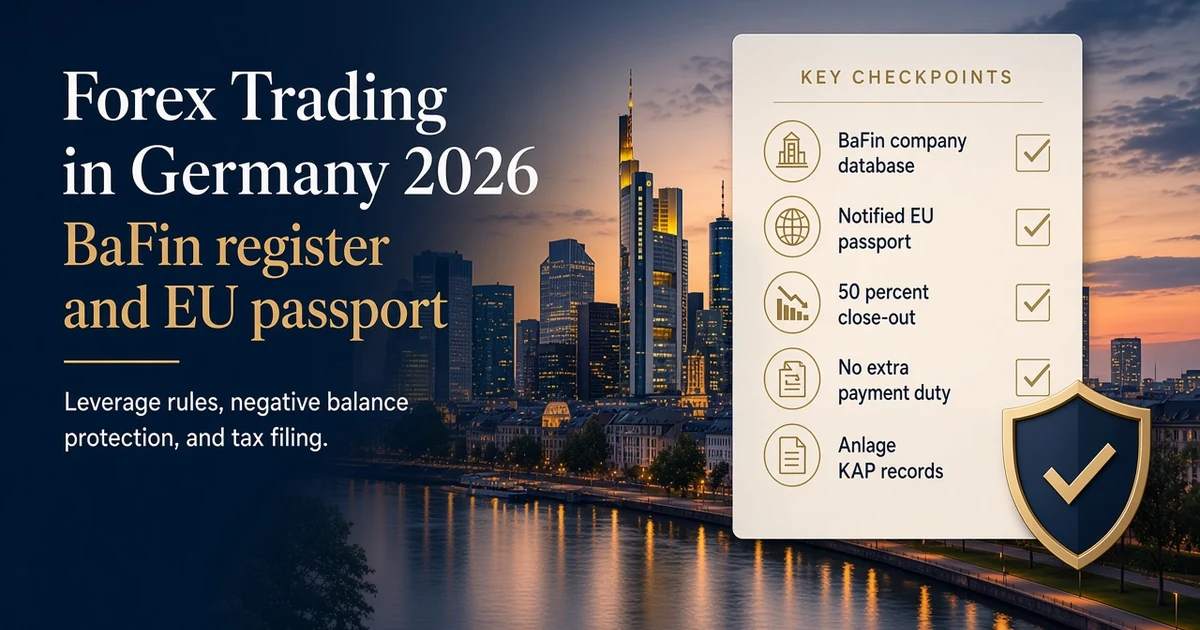
- Always check the contracting company in the BaFin Unternehmensdatenbank before sending money—either as a German-licensed institution or a notified EEA passported firm
- BaFin's General Administrative Act of 23 July 2019 enforces a 30:1 cap on major FX pairs, a 50% margin close-out, a ban on Nachschusspflicht (additional payment obligations), and a strict bonus ban
- Frankfurt CET/CEST puts the entire London session and the afternoon New York overlap inside normal daytime hours
- The Annual Tax Act 2024 abolished the €20,000 annual loss-offset cap for Termingeschäfte (including CFDs), though foreign accounts still require self-reporting in Anlage KAP
- Quick Decision Framework
- Short Answer
- Detailed Explanation
- Example
- Common Mistake
- Professional Tip
- Step 1: Verify the Contracting Company in BaFin's Database
- Short Answer
- Detailed Explanation
- Step 2: Position Sizing Under BaFin's 30:1 Leverage and 50% Close-Out Rules
- Short Answer
- Detailed Explanation
- Example
- Step 3: Frankfurt Clock (CET/CEST) and ECB Event Risk
- Short Answer
- Detailed Explanation
- Step 4: SEPA EUR Funding and Tax Record-Keeping (Anlage KAP)
- Short Answer
- Detailed Explanation
- 2026 Checklist for German Forex & CFD Traders
- Glossary
Affiliate disclosure: ForexTradeLab may earn a commission from qualifying partner links, without increasing your cost. Read our affiliate disclosure.
Quick Decision Framework#
Short Answer
For a resident of Germany, safe forex and CFD onboarding starts with entity verification in the BaFin Company Database, not a comparison of advertised spreads or leverage headlines. Every lawful retail CFD account in Germany—whether held with a domestic German Wertpapierinstitut or an EEA firm operating on a MiFID II passport—must obey BaFin's permanent CFD General Administrative Act of 23 July 2019 (30:1 major-pair leverage cap, 50% margin close-out, ban on Nachschusspflicht, and zero retail bonuses).
Detailed Explanation
This guide is the practical operational companion to our Best Forex Brokers in Germany 2026 hub. While our broker hub compares regulatory routes and compensation schemes (EdW vs Cyprus ICF), this guide walks you through how to set up, size, fund, and document a forex/CFD account from Germany—from checking your contract under §§ 73–74 WpIG to sizing positions under 30:1 margin rules, timing the Frankfurt/London/New York sessions, and keeping clean records for Anlage KAP after the repeal of the €20,000 Termingeschäfte loss-offset cap.
Example
A software engineer in Munich wants to trade EUR/USD and DAX (GER40) after work. Instead of signing up with an offshore site promising 1:500 leverage and a 50% deposit bonus, they verify Trading Point of Financial Instruments Ltd (CySEC 120/10) in the BaFin cross-border database, open a EUR account with 30:1 FX / 20:1 DAX margin caps, fund via SEPA, and export annual EUR statements for their tax return.
Common Mistake
Treating a .de domain or German-language customer support as proof of BaFin authorisation, or applying for "Professional Client" re-categorisation just to bypass the 30:1 cap (which strips away mandatory retail negative balance protection).
Professional Tip
Bookmark our XM Europe (CySEC 120/10) Review 2026 and broker brand vs legal entity checklist to verify your exact contracting company before sending a SEPA transfer.
Step 1: Verify the Contracting Company in BaFin's Database#
Short Answer
Match the exact corporate name in your Client Agreement to BaFin's Unternehmensdatenbank and to the home EEA regulator's register.
Detailed Explanation
Under Germany's Securities Institutions Act (Wertpapierinstitutsgesetz, WpIG), a firm serving German retail clients online typically appears in one of two lawful categories:
| Legal Route | Statutory Basis | Prudential & Conduct Split | Investor Compensation Scheme |
|---|---|---|---|
| German Authorised Firm (Wertpapierinstitut / Bank) | Domestic BaFin licence | BaFin + Deutsche Bundesbank | EdW (90% of eligible claim, capped at €20,000) |
| EEA Cross-Border / Branch Passport (e.g., CySEC CIF) | §§ 73–74 WpIG (MiFID II Passport) | Home EEA regulator (e.g., CySEC) + BaFin CFD Act | Home EEA Fund (e.g., Cyprus ICF: lower of 90% or €20,000) |
| Non-EEA Offshore Firm | No EEA passport | Unauthorised to solicit in Germany | None under German/EU law |
note that within our verified broker catalog, XM serves EEA retail clients via Trading Point of Financial Instruments Ltd (CySEC 120/10), whereas Exness's CySEC entity (Exness (Cy) Ltd) does not onboard retail clients.
Step 2: Position Sizing Under BaFin's 30:1 Leverage and 50% Close-Out Rules#
Short Answer
At 30:1 leverage (3.33% initial margin), your account needs enough free margin to absorb normal intraday swings without approaching the 50% margin close-out level.
Detailed Explanation
BaFin's General Administrative Act of 23 July 2019 sets binding initial margin percentages by asset class. Because positions begin closing automatically as soon as total account equity drops below 50% of required initial margin, over-allocating your balance to initial margin leaves almost no room for drawdown:
| Asset Class | BaFin Retail Leverage Cap | Minimum Initial Margin | Required Margin for €10,000 Notional (0.10 Lot EUR) | 50% Close-Out Trigger Level |
|---|---|---|---|---|
Major FX Pairs (EUR/USD, GBP/USD, USD/JPY) | 30:1 | 3.33% | €333.33 | €166.67 equity |
Minor FX, Gold (XAU/USD), Major Indices (DAX) | 20:1 | 5.00% | €500.00 | €250.00 equity |
| Other Commodities & Minor Indices | 10:1 | 10.00% | €1,000.00 | €500.00 equity |
| Individual Shares | 5:1 | 20.00% | €2,000.00 | €1,000.00 equity |
| Cryptocurrencies | 2:1 | 50.00% | €5,000.00 | €2,500.00 equity |
Example
Suppose you fund a €1,000 account and open 0.20 standard lots of EUR/USD (€20,000 notional). Your initial margin locked is €666.67, and your 50% margin close-out sits at €333.34. By contrast, if you size the trade using our 1% risk rule guide and lot size calculator—risking €10 with a 25-pip stop-loss (around 0.04 lots, €133.33 margin)—your stop-loss executes cleanly long before margin close-out is ever threatened.
Step 3: Frankfurt Clock (CET/CEST) and ECB Event Risk#
Short Answer
Germany's CET (UTC+1) / CEST (UTC+2) time zone places the Xetra & London open at 09:00 and the London–New York overlap between 14:00 and 18:00.
Detailed Explanation
For German traders, the two most important recurring calendar windows are:
- 09:00–11:00 and 14:00–18:00 German Time: The morning European cash open (when Xetra and London liquidity converge) and the afternoon US overlap (when US macro data lands at
14:30German time outside DST transition weeks). - ECB Governing Council Thursdays (Frankfurt): The European Central Bank publishes its interest-rate decision in Frankfurt at 14:15 CET/CEST, followed by the President's press conference at 14:45 CET/CEST. Spreads on
EUR/USD,EUR/GBP, andDAXcan widen sharply across both timestamps.
Check live session overlaps on our Forex Market Hours tool and read forex market hours, liquidity and slippage.
Step 4: SEPA EUR Funding and Tax Record-Keeping (Anlage KAP)#
Short Answer
Always open a EUR base-currency account, fund via a same-name SEPA transfer, and export annual EUR statements for Anlage KAP now that the Annual Tax Act 2024 has repealed the €20,000 Termingeschäfte loss-offset cap.
Detailed Explanation
- SEPA EUR Funding: Using
EURas your trading account base currency eliminates deposit and withdrawal FX conversion spreads when transferring from a German Girokonto. Confirm that the recipient IBAN belongs to the contracted legal entity. - Tax Documentation (Abgeltungsteuer & Jahressteuergesetz 2024): Under the BMF letter of 14 May 2025, CFDs are classified as Termingeschäfte under § 20(2) sentence 1 no. 3 EStG (25% Abgeltungsteuer plus 5.5% solidarity surcharge and church tax where applicable, after the €1,000 / €2,000 Sparer-Pauschbetrag). Crucially, the Annual Tax Act 2024 (Jahressteuergesetz 2024) abolished the controversial €20,000 annual loss-offset cap on Termingeschäfte across all open cases. Because passported non-German brokers do not withhold German Abgeltungsteuer at source, download your annual realised P&L statement in EUR for
Anlage KAPand consult a Steuerberater.
2026 Checklist for German Forex & CFD Traders#
- Verify the exact company from your Client Agreement in the BaFin company database.
- Confirm the agreement includes BaFin's permanent CFD rules (30:1 cap on majors, 50% margin close-out, no Nachschusspflicht, no bonuses).
- Open a EUR base-currency account and fund via a same-name SEPA transfer.
- Keep per-trade risk at or below 1% of equity using the lot size calculator.
- Download annual EUR statements at year-end for
Anlage KAP.
Glossary#
- BaFin: Germany's Federal Financial Supervisory Authority (Bundesanstalt für Finanzdienstleistungsaufsicht).
- WpIG (Wertpapierinstitutsgesetz): The German Securities Institutions Act governing investment firms and EEA passport notifications (§§ 73–74).
- Nachschusspflicht: An obligation to pay additional funds beyond your account deposit; banned for retail CFD clients in Germany.
- Termingeschäfte: Forward/derivative transactions under § 20(2) no. 3 EStG, which includes CFDs for German tax purposes.
Risk warning: CFDs are complex instruments and come with a high risk of losing money rapidly due to leverage. Most retail investor accounts lose money when trading CFDs. BaFin rules and negative balance protection prevent debt beyond your CFD account deposit, but you can still lose 100% of your deposited funds. This guide is educational research for residents of Germany, not investment, legal or tax advice.
Next step: read our in-depth Best Forex Brokers in Germany 2026 regulatory guide, inspect our XM Europe (CySEC 120/10) Review, and compare verified entities on Licensed Brokers.
Comments
Add a useful note for other traders. We review comments before publishing.