- A decline is usually a bank or compliance filter — not proof the broker ‘stole’ the attempt
- Never retry large amounts after a soft decline; diagnose first
- The deposit method should be in your name and usable for withdrawals
- 3-D Secure failures are user-fixable more often than people think
- Chargebacks, third-party cards and VPN payment tricks create withdrawal risk later
 Regulated Global Broker
 Trusted by 20M+ traders — open your account in minutes
- Trade 1,400+ instruments
- Country-based bonus offers where eligible
- MT4 & MT5 available
- Easy deposits and withdrawals
- Leverage up to 1000:1, where available
- Copy Trading: auto-copy expert strategy managers
- Quick Decision Framework
- Short Answer
- Detailed Explanation
- Example
- Common Mistake
- Professional Tip
- Who Actually Said No
- Short Answer
- Detailed Explanation
- Example
- Common Mistake
- Professional Tip
- Bank Policy: CFD and Forex Merchant Codes
- Short Answer
- Detailed Explanation
- Example
- Common Mistake
- Professional Tip
- 3-D Secure, OTP and Browser Hygiene
- Short Answer
- Detailed Explanation
- Example
- Common Mistake
- Professional Tip
- Name, KYC and Third-Party Cards
- Short Answer
- Detailed Explanation
- Example
- Common Mistake
- Professional Tip
- Country, Entity and Method Lists
- Short Answer
- Detailed Explanation
- Example
- Common Mistake
- Professional Tip
- Safer Sequence After a Decline
- Short Answer
- Detailed Explanation
- Example
- Common Mistake
- Professional Tip
- What Not to Do After a Decline
- Short Answer
- Detailed Explanation
- Example
- Common Mistake
- Professional Tip
- Checklist — Declined Forex Card Deposit
- Mini Glossary
- Key Takeaways
- Bottom Line
Affiliate disclosure: ForexTradeLab may earn a commission from qualifying partner links, without increasing your cost. Read our affiliate disclosure.
Quick Decision Framework#
Short Answer
Most declines are the bank or card scheme blocking a CFD/forex merchant category, a failed 3-D Secure or OTP step, a name that does not match KYC, or a country/entity that does not accept that card. Fix the cause, then send a small name-matched test by an allowed rail. Do not use a third-party card, a VPN to “unlock” payments, or a chargeback as a trading tactic.
Detailed Explanation
A declined deposit is a payment diagnosis, not a market signal and not automatic proof of fraud. Card networks, issuing banks and broker cashiers each run filters. CFD and forex merchants sit in categories many retail banks treat as high-risk. That is why a card that buys groceries can fail on a broker cashier even when the broker is the firm you intended. The useful sequence is: identify who said no, match the card to your KYC name, confirm the contracting entity serves your country, then use one allowed method at a test size. Size philosophy lives in the first deposit guide and the broader funding guide.
Example
The cashier shows a red decline. Your bank app shows a 3-D Secure timeout. The broker never received a cleared payment. Calling the broker to “release the $200” will not help — the issuer never authorised it. Completing 3-D Secure on a second small attempt, or switching to a listed local method, is the real fork.
Common Mistake
Retrying the same card five times at rising amounts. Issuers read that as card testing.
Professional Tip
Write a three-line log: time, method, who declined (broker page / 3DS / bank SMS). Support and your bank both need that, not “it failed.”
Risk note: Funding an account does not improve your odds. Leveraged forex and CFDs can produce rapid losses, and many retail CFD accounts lose money. Read the disclaimer. Never fund money you need for essentials, and never send funds to a person who promised to ‘place the trades for you.’
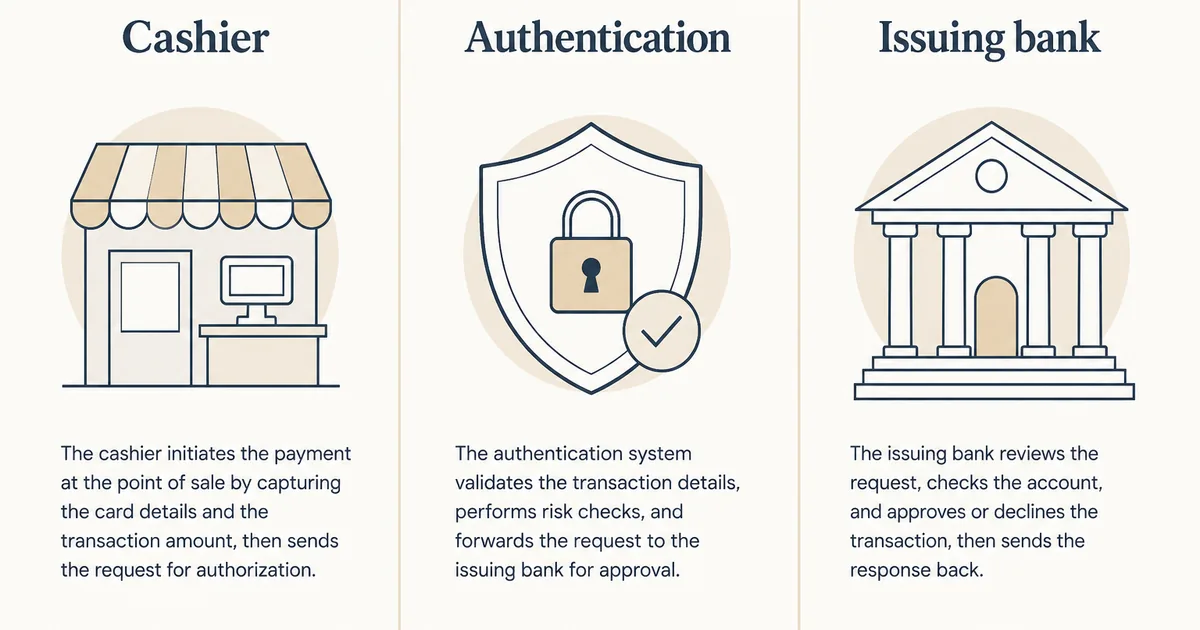
Who Actually Said No#
Short Answer
Broker cashier, card authentication page, and issuing bank are three different no’s.
Detailed Explanation
| Where the no appears | What it usually means | First move |
|---|---|---|
| Broker cashier, before 3-D Secure | Method not offered for your entity, currency mismatch, or KYC gate | Check the live method list; finish verification |
| 3-D Secure / bank OTP page | You cancelled, the OTP expired, or the bank’s risk engine refused | Complete OTP on Wi-Fi you trust; then call the issuer if it still dies |
| Bank SMS “transaction declined” after OTP | Issuer policy: MCC block, daily limit, or suspected gambling/investment MCC | Ask the bank which rule fired |
| Amount captured then reversed | Compliance or name-match review after authorisation | Wait for the reverse; do not send a second large payment |
This is why “XM declined me” or “Exness stole the hold” is often the wrong sentence. Method lists and holds are entity-specific. Read XM deposit and Exness deposit as operational maps, then believe the live cashier over any article — including this one.
If you still need to inspect a real cashier after entity checks, open XM’s current payment page or open Exness terms from a bookmark, not from a chat link.
Example
A Visa debit fails at the OTP screen. A local bank transfer option on the same cashier succeeds the next morning. The broker was reachable; the card scheme path was not.
Common Mistake
Screenshotting only the broker error and ignoring the bank notification that named the rule.
Professional Tip
If funds are held (authorised but not settled), wait for the hold to drop before you try another card. Two overlapping authorisations can freeze more cash than you meant to risk.
Bank Policy: CFD and Forex Merchant Codes#
Short Answer
Many issuers block investment and CFD merchant categories by default. That is a bank setting, not a chart setting.
Detailed Explanation
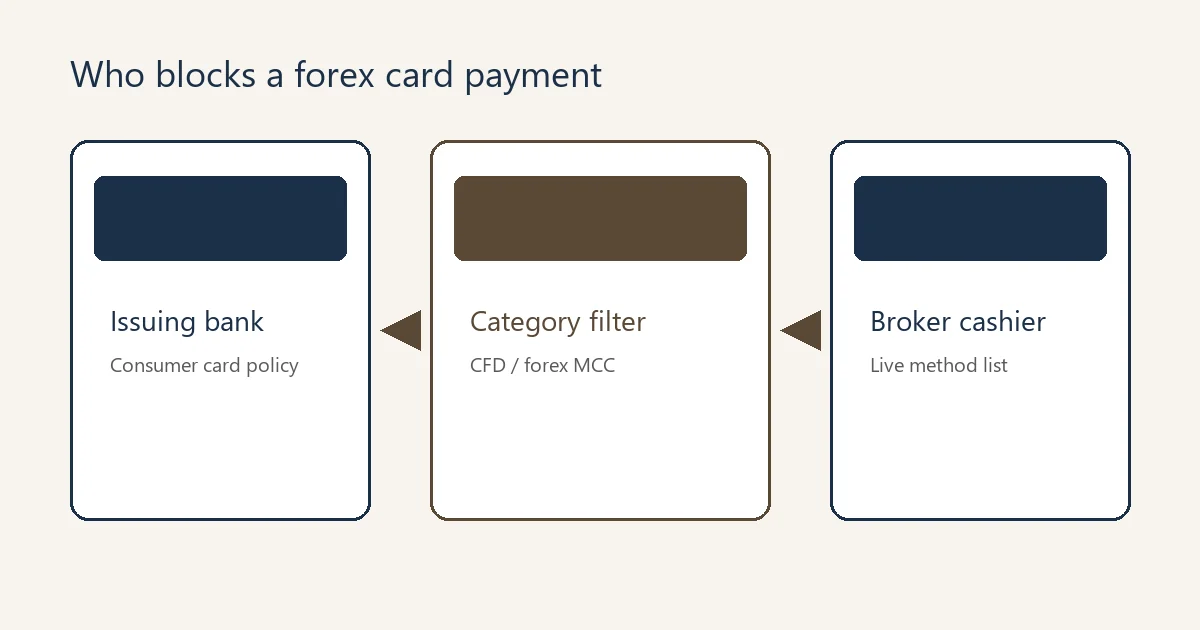
Issuing banks sort merchants by category codes. Retail forex and CFD brokers often sit near investment, financial-risk or related codes that consumer-card products were never designed to bless. A decline here can happen even when:
- The broker entity is authorised somewhere.
- Your KYC is approved.
- You have used the same card on travel sites this week.
The FCA’s CFD materials and ASIC’s CFD warning exist because these products are high-risk — banks know that too. A block can be a crude consumer-protection setting. It can also be a blanket “no offshore investment” rule that does not distinguish a licensed entity from a clone. Your job is not to argue with a call-centre script about pips. Your job is to ask: Is this MCC allowed on this card product? If not, pick another rail the broker lists.
Cross-border payment friction is normal; the BIS payments work is a reminder that rails fail for operational reasons, not because you “picked the wrong pair.”
Example
A UK or EU consumer card declines a non-EU CFD entity even though a friend in another country funded the same brand last month. Residence, entity and card product differ. Their success is not your rail.
Common Mistake
Telling the bank you are “buying software” to sneak the payment through. Mis-description is a lie and can become a fraud issue.
Professional Tip
Ask the issuer for a one-time authorisation or a different product (some banks have a separate investing card). Get the answer in writing if you can. Then use only methods the broker cashier still shows.
3-D Secure, OTP and Browser Hygiene#
Short Answer
A failed authentication page is not the same as a policy block. Fix the page first.
Detailed Explanation
3-D Secure (and scheme cousins) add a bank-controlled challenge: app push, SMS OTP, or a password you set years ago and forgot. Failures look like declines but are often:
- Pop-up blockers or in-app browsers (Instagram → cashier).
- VPN or aggressive DNS filters breaking the bank’s redirect.
- An OTP that expired while you searched for the SMS.
- A stale banking-app session.
Try once more from a normal mobile browser or desktop, on a network you trust, with the official cashier bookmarked. If 3DS passes and the issuer still declines, you have graduated to an MCC or limit problem.
Phishing warning: a page that asks for your card PIN, your email password, and a trading password together is not 3-D Secure. Official challenges stay with the issuer. The CFTC forex fraud advisory is the right tone for unsolicited “deposit unlock” links.
Example
Safari’s pop-up blocker kills the bank challenge. The cashier says declined. Desktop Chrome with the same card succeeds. The card was never the villain.
Common Mistake
Completing 3DS on public café Wi-Fi while a stranger can see the OTP.
Professional Tip
If your bank uses an app push, open the banking app before you press Pay so the challenge is not racing a backgrounded phone.
Name, KYC and Third-Party Cards#
Short Answer
The paying name must be the verified name. Family cards fail later even when they pass now.
Detailed Explanation
Brokers are obliged to understand whose money they hold. A card in a spouse’s name, a friend’s e-wallet, or a crypto address you cannot prove as yours creates a file the withdrawal team will reopen. Some cashiers hard-decline. Others accept and then hold the first withdrawal. Either way, you did not save time.
Do this instead:
- Finish document and age checks first.
- Pay with a method in your legal name.
- Keep the same rail in mind for the first withdrawal test.
If KYC is still pending, a decline may be the cashier refusing to take a payment it cannot later return cleanly. That is inconvenient and correct.
Example
A brother’s card funds $300. Trading goes nowhere. The withdrawal is delayed because the source-of-funds story does not match the account holder. The “help” became the ticket.
Common Mistake
Using a fintech card whose printed name is a trade name that does not match your passport. Ask the broker which name format they need before you fight the bank.
Professional Tip
Photograph (privately) the successful cashier receipt and the matching bank line. Withdrawal disputes are won with timestamps, not memory.
Country, Entity and Method Lists#
Short Answer
A global brand does not guarantee your card or your country on that domain.
Detailed Explanation
XM and Exness are multi-entity groups. The company in your client agreement decides leverage caps, payment brands, and whether a Visa from your issuer is even offered. A promotion tweet is not a payment specification. Confirm:
- The legal entity named in the account.
- That your residence is accepted without workarounds.
- The live deposit list after login — not a screenshot from another country.
Entity thinking is the same discipline as how to verify a licence and how to choose a reliable broker. If your country is not served, stop. Do not VPN the cashier. Do not borrow someone else’s proof of address.
Example
An African-issued card works on one group entity’s cashier and is absent on another entity’s page for the same logo. The logo was never the payment contract.
Common Mistake
Funding a restricted entity through a friend’s account “just this once.” That can become a third-party and residency problem at once.
Professional Tip
Save a dated screenshot of the method list before you pay. If a method disappears after a decline, you have evidence of what the cashier offered that day.
Safer Sequence After a Decline#
Short Answer
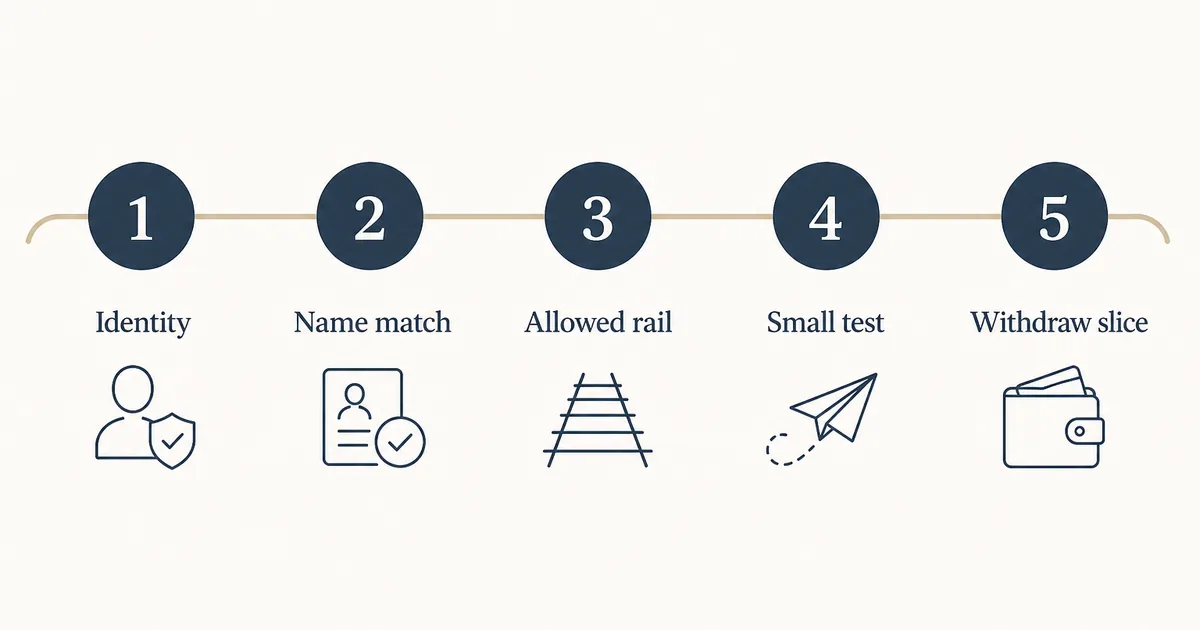
Diagnose, switch rail if needed, test small, withdraw a slice, then — and only then — consider size.
Detailed Explanation
- Stop retrying the failed card at higher amounts.
- Classify the no (cashier vs 3DS vs issuer).
- Call the issuer if 3DS worked and the bank still blocked: ask about merchant-category policy and daily limits.
- Open the live cashier and pick a different name-matched method if your entity lists one: local bank, supported e-wallet, or another card product.
- Send a test in the spirit of the first-deposit article — small enough that a second failure is tuition, not a household event.
- Withdraw a slice after clearance. A deposit that cannot return is not a completed loop.
- Keep live trading tiny until the loop is proven. Funding is not a strategy.
Education-first next step: if you still need an eligible cashier to practise this loop, review XM funding terms or review Exness funding terms after you confirm the contracting entity — then use the checklist below, not a bonus headline.
Example
Card MCC blocked. Local transfer listed. $25 test arrives. $10 withdrawal returns in the published window. Only then does the trader consider a larger training balance. That is operations. The other order — $500 first, withdrawal later — is hope.
Common Mistake
Treating a successful large deposit as proof you should increase leverage the same afternoon.
Professional Tip
If two allowed methods exist, test the one you can also withdraw to. Convenience inbound and friction outbound is how people get stuck.
What Not to Do After a Decline#
Short Answer
No third-party cards, no payment VPN, no “recovery agent,” no chargeback-as-strategy.
Detailed Explanation
| Action | Why it backfires |
|---|---|
| Third-party card or wallet | Name-match and source-of-funds failures at withdrawal |
| VPN to change payment country | Terms and fraud-filter risk; withdrawals suffer |
| Crypto sent to a stranger’s address “to help you fund” | Classic theft; see CFTC-style fraud patterns |
| Chargeback because a trade lost | Banks treat this as payment dispute abuse; brokers can close you |
| Paying a Telegram helper to “bypass the bank” | You are buying a money-mule story |
A decline is allowed to be the end of that rail. It is not a dare.
Example
After three declines, a “payment agent” offers to fund you for a 15% fee via an unrelated account. That is not a broker method. It is a third party with your money.
Common Mistake
Filing a chargeback while also opening a ticket asking the broker to “complete the deposit.” Pick one reality.
Professional Tip
If you believe the site is a clone, stop paying and verify the domain and entity. Do not “test” a suspected clone with a smaller card payment.
Checklist — Declined Forex Card Deposit#
- Wrote down who declined: cashier, 3-D Secure, or bank SMS
- Confirmed KYC name matches the paying method
- Confirmed the contracting entity serves your residence
- Did not retry escalating amounts on the same failed card
- Asked the issuer about MCC / investment-merchant policy if 3DS passed
- Chose a different name-matched method only if the live cashier lists it
- Sent a small test, not a household-sized balance
- Planned a slice withdrawal before any top-up
- Refused third-party cards, payment VPNs and recovery agents
- Next reading: first deposit and open-account checklist
Mini Glossary#
| Term | Meaning |
|---|---|
| MCC | Merchant category code the issuer uses to allow or block a payment type |
| 3-D Secure | Bank-controlled card authentication (OTP or app push) |
| Name match | Paying method legal name equals the KYC name on the account |
| Soft decline | Authorisation failed; no settled deposit |
| Hold / reverse | Temporary capture that later returns to the card |
| Rail | A payment path: card, bank, e-wallet, or other listed method |
| Chargeback | Issuer dispute that can close a trading account if abused |
Key Takeaways#
- A declined forex card is usually a filter, not a verdict on your trading idea.
- Identify who said no before you retry.
- Name-matched methods only — family cards are future withdrawal tickets.
- After a fix, test small and withdraw a slice.
- VPN tricks, third-party funders and chargebacks create worse problems than a declined $20.
Bottom Line#
If you are stuck on a red cashier, treat it as operations homework. ForexTradeLab’s funding pages exist so you do not turn a bank filter into a panic deposit. Use how to choose a broker, keep the risk disclaimer in view, and only inspect XM or Exness payment terms when your country and entity already fit. A working rail is a permission to practise with money you can lose — not a signal that the market owes you a recovery trade.
Comments
Add a useful note for other traders. We review comments before publishing.