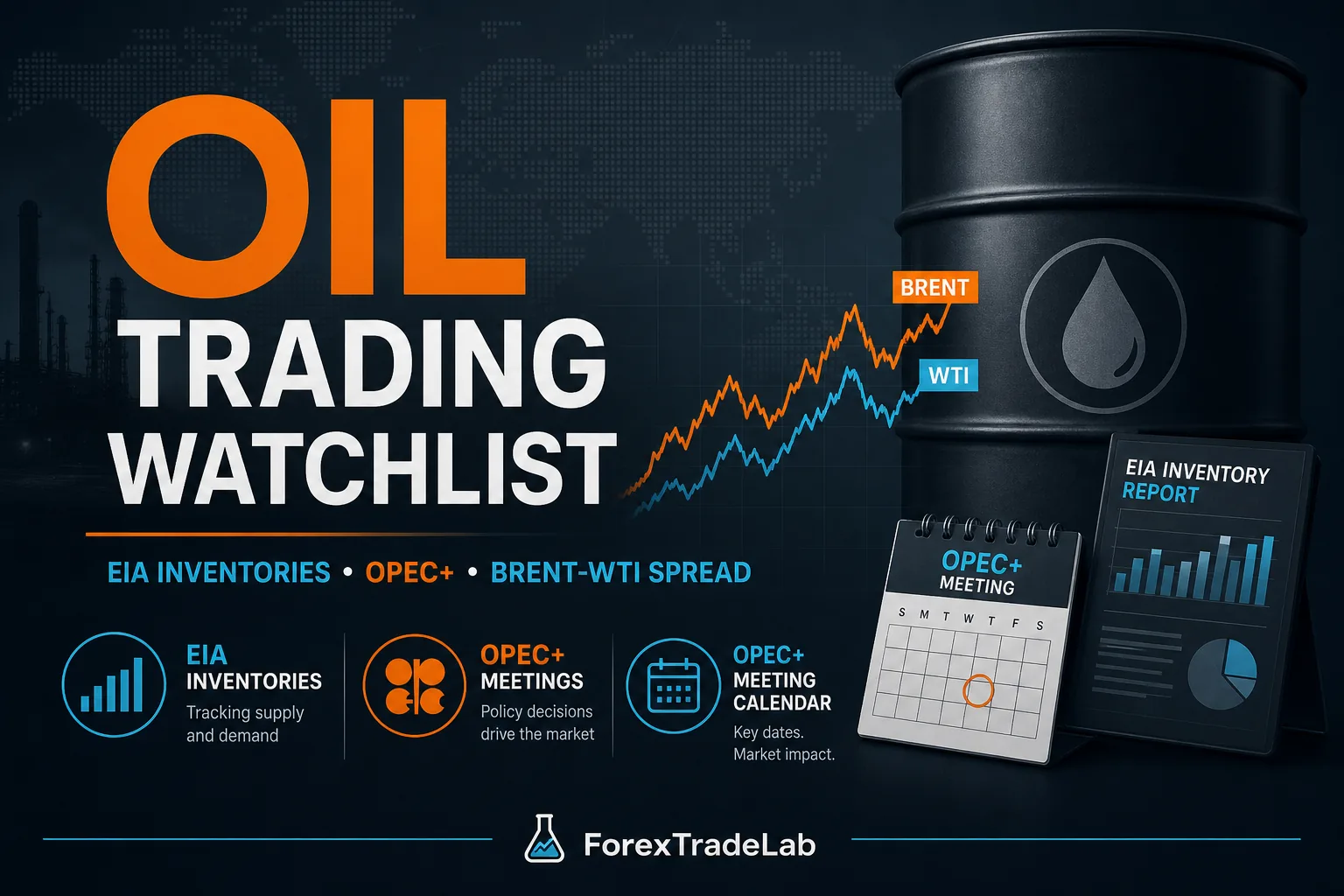
- EIA weekly inventories can move WTI and Brent when crude, gasoline or distillate stocks surprise expectations
- OPEC+ decisions matter because production guidance can change the forward supply balance
- The Brent-WTI spread helps traders see whether the oil story is global or North America-specific
- Oil CFD trades need position sizing based on tick value, volatility and event risk - not forex lot habits

Crude oil is not just another chart. It is a real economy market where inventories, production policy, shipping risk, refinery demand, currency moves and geopolitics can all collide in the same session.
That is why a useful oil trading process starts with a watchlist. Before asking whether WTI or Brent is bullish, ask: which part of the oil balance is changing, and is the market reacting like it matters?
This guide gives active traders a practical watchlist for crude oil: EIA inventories, OPEC+ meetings, demand indicators, Brent-WTI spread, the US dollar and risk management for oil CFDs.
Risk disclosure: Oil CFDs and futures-linked products are volatile and leveraged. Inventory reports, OPEC+ headlines and geopolitical events can cause gaps, slippage and spread widening. This article is educational content, not investment advice.
The Oil Trader's Core Question#
Short Answer
Crude oil traders should watch EIA inventory data, OPEC+ production decisions, demand indicators from the US and China, the Brent-WTI spread, refinery activity, geopolitical supply risk and the US dollar. A tradable oil setup needs a clear supply-demand catalyst, confirmation from price structure and risk sized for oil's higher volatility.
Detailed Explanation
No single headline determines oil direction. Read crude, gasoline and distillate stocks together with refinery utilisation, imports, exports and the market's prior expectation; then compare the signal with OPEC+ guidance, demand data and price structure. Release times and contract terms can change, so verify the EIA calendar and your venue's specification on the trade date.
Example
A larger-than-expected crude draw is not automatically bullish if gasoline stocks build sharply and refinery runs fall. If WTI also fails to hold a breakout, the combined evidence is mixed rather than a reliable long signal.
Common Mistake
Trading the crude-stock headline alone while ignoring products, refinery activity and how much of the surprise was already priced in.
Professional Tip
Save the dated EIA release and OPEC+ statement, then record whether Brent-WTI and price structure confirmed or contradicted your thesis before sizing a CFD trade.
Oil price moves usually come from changes in the expected supply-demand balance.
The market asks:
- Is supply increasing or decreasing?
- Is demand stronger or weaker than expected?
- Are inventories building or drawing?
- Is OPEC+ adding or removing barrels?
- Is geopolitical risk threatening supply?
- Is the dollar helping or hurting commodity prices?
The strongest trades usually occur when several answers point the same way.
Example:
- EIA crude stocks draw more than expected
- Gasoline demand is firm
- Refinery runs are rising
- WTI breaks above resistance
- The dollar is not rallying
That is a coherent bullish oil setup. A crude draw alone is weaker if gasoline demand collapses or price fails to break structure.
EIA Inventories: The Weekly Event Oil Traders Cannot Ignore#
The US Energy Information Administration publishes the Weekly Petroleum Status Report, usually on Wednesdays. It is one of the most watched scheduled events for WTI traders and often affects Brent as well.
The headline number is crude oil inventories, but serious traders read more than one line.
| Data Point | Why It Matters |
|---|---|
| Crude inventories | Shows whether stored supply is building or drawing |
| Gasoline inventories | Indicates consumer fuel demand and refinery balance |
| Distillate inventories | Important for diesel, industry, transport and heating |
| Refinery utilisation | Shows how aggressively refiners are processing crude |
| Cushing stocks | Important for WTI delivery dynamics |
| Implied demand | Helps separate true consumption from one-week noise |
The market reaction depends on the surprise versus expectations.
Inventory Reaction Map#
| Report Pattern | Typical Oil Interpretation |
|---|---|
| Large crude draw + product draws | Bullish; broad inventory tightness |
| Large crude build + product builds | Bearish; weak demand or excess supply |
| Crude draw + gasoline build | Mixed; crude headline may fade |
| Crude build + strong product demand | Mixed; refiners or imports may explain it |
| Big Cushing draw | Often supportive for WTI specifically |
Do not trade only the crude headline. Product inventories can reverse the first move.
API vs EIA: Which Inventory Report Matters More?#
The American Petroleum Institute estimate is often released before the EIA report. Traders watch it because it can shape expectations, but the EIA report is the official US government data and usually carries more weight.
A common pattern:
- API shows a large draw
- Oil rallies before EIA
- EIA confirms the draw
- Price barely rises because the move was already priced
This is another example of the expectation rule. The event matters most when it surprises what the market already positioned for.
OPEC+ Meetings: Production Guidance and Market Psychology#
OPEC+ matters because the group can influence a large share of global supply through production targets, voluntary cuts and forward guidance.
Oil traders watch:
- Production quota changes
- Voluntary cut extensions or reversals
- Compliance language
- Spare capacity
- Demand assumptions
- Comments from Saudi Arabia, Russia and other major producers
The price reaction depends on whether the decision changes the forward balance.
OPEC+ Reaction Map#
| OPEC+ Message | Typical Oil Impact |
|---|---|
| Deeper cuts than expected | Bullish if compliance is credible |
| Extension of existing cuts | Bullish only if not fully priced |
| Gradual supply return | Bearish if demand looks weak |
| No change with hawkish language | Mild support; depends on market expectations |
| Disagreement or compliance doubts | Bearish risk due to supply uncertainty |
The word "credible" is important. A headline cut can fail to lift oil if traders doubt compliance or if demand is deteriorating.
Brent-WTI Spread: Is the Story Global or Local?#
WTI and Brent usually move together, but the spread between them contains useful information.
Brent is the broader global benchmark. WTI is more tied to North American supply, storage and export dynamics.
| Spread Behaviour | Possible Message |
|---|---|
| Brent premium widens | Global supply risk or US-specific oversupply |
| Brent premium narrows | Strong US export demand or tighter WTI market |
| WTI underperforms sharply | Cushing/storage or pipeline issue may matter |
| Brent outperforms on geopolitics | Global seaborne supply risk is being priced |
For CFD traders, the spread is not always directly traded, but it is still useful context. If your WTI trade is bullish but Brent is not confirming, ask whether the story is local rather than global.
Demand Indicators: Oil Is Also a Growth Trade#
Oil demand is connected to transport, industry, aviation, petrochemicals and global growth.
Traders monitor:
- US gasoline demand
- China import data and refinery runs
- Global PMI surveys
- Air travel and jet fuel indicators
- Shipping activity
- IEA and OPEC demand forecasts
Demand data often matters most when the market is worried about recession or China growth. In those regimes, a supply cut may not produce a lasting rally if traders believe demand is weakening faster.
The US Dollar and Oil#
Oil is priced internationally in US dollars. A stronger dollar can pressure oil by making it more expensive for non-dollar buyers. A weaker dollar can support commodities.
But the relationship is not one-to-one.
Oil can rise with the dollar if supply risk is severe. Oil can fall with a weak dollar if demand collapses. Use DXY as context, not as a mechanical signal.
The most useful question is:
Is the dollar helping or fighting my oil thesis?
If the oil setup is bullish and the dollar is falling, the macro background is cleaner. If oil is trying to rally while DXY is surging, the trade may need stronger supply confirmation.
Geopolitics: Supply Risk vs Actual Disruption#
Oil is sensitive to geopolitics because supply routes and production areas are concentrated.
Markets react to:
- Middle East tensions
- Sanctions
- Shipping disruptions
- Pipeline attacks or outages
- Strategic Petroleum Reserve decisions
- War risk near key chokepoints
But not every geopolitical headline creates a lasting move. Oil traders distinguish between risk premium and actual supply disruption.
Risk premium can fade quickly if no barrels are lost. Actual disruption can reprice the market for longer.
A Practical Oil Trading Watchlist#
Use this before taking a WTI or Brent trade.
| Watchlist Item | Bullish Clue | Bearish Clue |
|---|---|---|
| EIA crude stocks | Larger-than-expected draw | Larger-than-expected build |
| Products | Gasoline/distillate draws | Product builds despite crude draw |
| Refinery runs | Rising utilisation | Falling utilisation |
| OPEC+ | Credible cuts or delayed supply return | Supply increase or weak compliance |
| Demand | Strong PMI, imports, fuel demand | Weak PMI, lower imports, demand downgrades |
| Brent-WTI spread | Confirms benchmark story | Diverges from traded instrument |
| DXY | Falling dollar helps oil | Rising dollar pressures oil |
| Chart structure | Breakout with volume/continuation | Failed breakout or reversal |
The goal is not to make every row bullish or bearish. The goal is to avoid trading a single headline while the rest of the market disagrees.
Oil CFD Risk: Do Not Use Forex Lot Habits#
Oil contract values are different from currency pairs. Depending on broker and instrument, one lot may represent a large notional exposure, and a $1 move in oil can be meaningful.
Before trading:
- Read the contract specification
- Check tick size and tick value
- Confirm trading hours and daily breaks
- Know whether the product tracks WTI or Brent
- Check whether expiry or rollover applies
- Size positions by money at risk, not lot habit
Oil also gaps around headlines. A stop is necessary, but it is not a guarantee of exact execution during fast markets.
Example Setups#
Bullish WTI Inventory Setup#
The data:
- EIA crude inventories draw more than expected
- Gasoline inventories also draw
- Cushing stocks decline
- Refinery utilisation is stable or rising
- WTI breaks above the pre-report range
The idea:
The report suggests real tightness, not just a noisy crude headline.
The invalidation:
WTI falls back into the pre-report range and product demand details are ignored by follow-through buyers.
Bearish Oil Demand Setup#
The data:
- Crude inventories build
- Gasoline and distillate inventories build
- PMI data is weak
- OPEC+ does not signal new restraint
- Brent and WTI both reject resistance
The idea:
The market sees demand weakness and no immediate supply offset.
The invalidation:
Price reclaims resistance after a credible supply-risk headline or surprise production cut.
When to Skip Oil Trades#
Skip or reduce risk when:
- EIA crude and product data conflict
- OPEC+ headlines are unconfirmed
- Spreads are unusually wide
- WTI and Brent disagree without a clear reason
- Price is in the middle of a range before a major event
- You do not know the contract's tick value
- The trade depends on a headline continuing to escalate
Oil rewards preparation and punishes assumptions.
Bottom Line#
Crude oil trading is a supply-demand game with macro overlays. EIA inventories, OPEC+ policy, demand indicators, the Brent-WTI spread, geopolitics and the dollar all help explain why WTI and Brent move.
The best oil trades usually have a clear catalyst, confirmation across related data and a defined invalidation level. If you only trade the first headline, you are not trading oil analysis - you are trading noise.
For instrument basics, read our WTI and Brent crude oil trading guide and economic calendar events guide.
Comments
Add a useful note for other traders. We review comments before publishing.