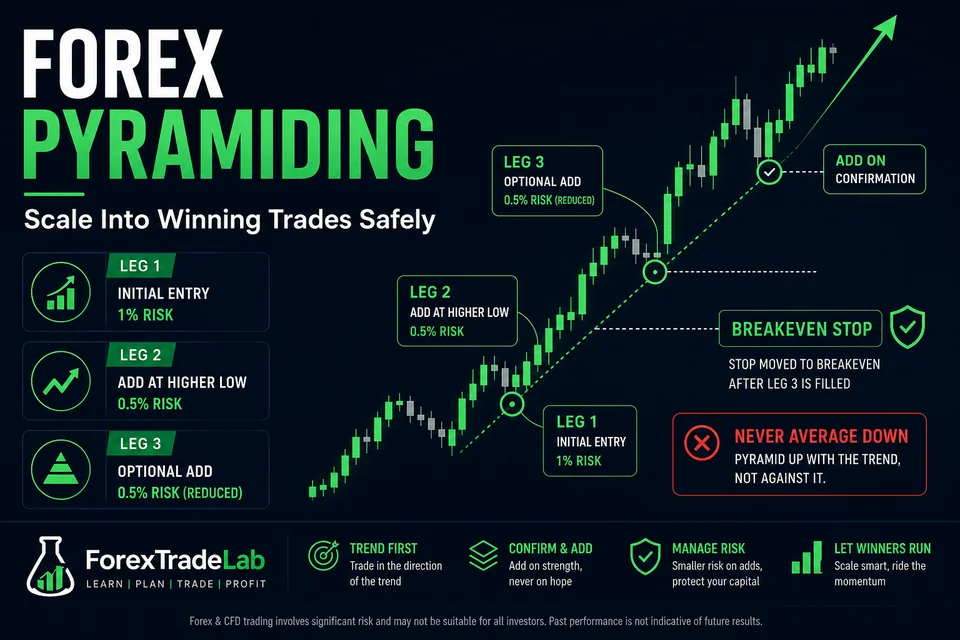
- Pyramiding means adding to a profitable position as price confirms your thesis — never adding to a losing trade
- Professional rule: initial entry risks 1%; each add risks 0.25–0.5% with maximum 2–3 adds per idea
- Move stop to breakeven on the original entry before the first add — the market must prove you right before you scale
- Pyramiding fits trend and breakout strategies; it destroys expectancy on mean-reversion setups
- Total open risk across all legs must stay within your portfolio cap (typically 3% or below)

Quick Decision Framework#
Short Answer
Pyramiding means adding to a winner as price confirms the idea — not averaging into a loser. Risk about 1% on the first leg, move that stop to breakeven before the first add, risk 0.25–0.5% per add, take at most two or three adds, and keep total open risk on the theme at or below about 3%. Done badly, equal-size adds without a moved stop blow the account up.
Detailed Explanation
The market must prove you right before you scale. Pyramiding fits trend and breakout methods; it wrecks mean-reversion expectancy. Each new leg needs its own stop math, and the original stop should no longer risk the first 1% once it is at breakeven. Correlated pairs count as one theme. Micro accounts can pyramid only if the lot step still allows a smaller second leg — on $2,000 that may be $20 then $10 then $5 of risk. Slippage on later adds matters more as size grows.
Example
On a $10,000 account: first EUR/USD long risks $100, stop to breakeven after +1R, second leg risks $50, third $25. On $2,000 the same ratios are $20 / $10 / $5 and may require 0.02 then 0.01 lots. Adding 0.10, then another 0.10, then another 0.10 while the first stop still sits at full loss is not a pyramid — it is a larger initial bet.
Common Mistake
Calling “I added to a loser because it is cheaper now” pyramiding. That is averaging down, and it is how scaled books die.
Professional Tip
Write the three-leg risk table in dollars before the first entry. Do not click add until the original stop is at breakeven and the new leg still fits the remaining theme cap.
TL;DR — Pyramiding Rules#
Short Answer
Pyramiding in forex is the practice of adding to a winning position as the trade moves in your favour — scaling into strength rather than averaging down into weakness. Done correctly, it lets profitable traders increase exposure when the market confirms their thesis, turning a 1R winner into a 2–3R winner without increasing initial risk. Done incorrectly — adding equal size without moving stops, or adding to losers — it accelerates account destruction. The professional standard: risk 1% on the initial entry, move stop to breakeven before the first add, risk 0.25–0.5% per add, maximum 2–3 adds, and never exceed 3% total portfolio risk across correlated legs.
Common Mistake
Professional rule: initial entry risks 1%; each add risks 0.25–0.5% with maximum 2–3 adds per idea
Professional Tip
Move stop to breakeven on the original entry before the first add — the market must prove you right before you scale
| Rule | Detail |
|---|---|
| Initial entry | 1% account risk max |
| First add trigger | Price confirms (new HL in uptrend / new LH in downtrend) |
| Before first add | Move original stop to breakeven |
| Each add size | 0.25–0.5% risk (smaller than entry) |
| Maximum adds | 2–3 per idea |
| Portfolio cap | 3% total open risk across correlated trades |
| Never | Add to losers (averaging down) |
Most retail traders know they should cut losses. Fewer know how to let winners pay without turning a good trade into an oversized gamble. Pyramiding — adding to winning positions — is how trend traders and swing traders extract more from the same setup. It is also one of the fastest ways to blow up if you confuse it with martingale-style averaging down.
This guide is the distinction.
Pyramiding vs. Averaging Down — The Critical Difference#
| Pyramiding (winners) | Averaging down (losers) | |
|---|---|---|
| When you add | Trade is in profit | Trade is underwater |
| Market message | Thesis confirming | Thesis failing |
| Stop logic | Tighten / breakeven | Often widened (hope) |
| Expectancy impact | Can improve R on trends | Structurally negative for most retail |
| Professional use | Common in trend systems | Almost never |
Our golden rules guide states it plainly: never add to losers. The emotional logic behind averaging down — "I'll get a better average price" — ignores that the market is telling you your entry was wrong or early. Pyramiding only works when the market has already voted in your favour.
When Pyramiding Makes Mathematical Sense#
Pyramiding improves results when all three conditions hold:
- Your strategy has positive expectancy on trend continuation — breakouts, pullbacks in established trends, multi-timeframe aligned swings.
- Adds have defined structural triggers — not "it moved 20 pips so I added."
- Risk per add is smaller than initial risk — you are paying for confirmation with reduced size.
It does not improve mean-reversion strategies. If you fade resistance and price pushes through, adding shorts is not pyramiding — it is doubling down on a failed thesis.
The Standard 3-Leg Pyramid Framework#
Leg 1 — Initial entry (1% risk)#
Enter at your planned level with full structural stop. This is the only leg that can lose the full 1% if stopped before confirmation.
Example: Long EUR/USD at 1.0850, stop 1.0820 (30 pips), 1% risk → position sized via lot calculator.
Leg 2 — First add (0.5% risk)#
Trigger: Price breaks structure in your favour and pulls back to a higher low (uptrend) that holds.
Before adding: Move Leg 1 stop to 1.0850 breakeven (or +5 pips to cover spread).
Add: New entry at pullback, new stop below the higher low, risk 0.5%.
Leg 3 — Second add (0.25% risk, optional)#
Trigger: Second structural confirmation — another higher low or breakout continuation.
Stops: Trail all legs under the most recent swing low.
Max total risk if all stops hit simultaneously: In practice, near-zero on Leg 1 (breakeven), 0.5% on Leg 2, 0.25% on Leg 3 — but Leg 1 and 2 stops should be co-trailed so simultaneous hits are rare.
Worked Example — Trend Pyramid on GBP/USD#
| Leg | Entry | Stop | Risk % | Status |
|---|---|---|---|---|
| 1 | 1.2650 long | 1.2610 | 1.0% | Initial |
| — | Price rallies to 1.2720, pulls back | Move stop to 1.2650 | — | Breakeven |
| 2 | 1.2695 long (HL add) | 1.2665 | 0.5% | Confirmed |
| — | Price hits 1.2780, consolidates | Trail stops to 1.2700 | — | Locked profit |
| 3 | 1.2755 long (breakout add) | 1.2720 | 0.25% | Optional |
Outcome if trend continues to 1.2900: Leg 1 ≈ +250 pips, Leg 2 ≈ +205 pips, Leg 3 ≈ +145 pips — weighted by size, total reward multiples exceed a single 1% entry.
Outcome if reversal hits trailed stops at 1.2700: Leg 1 ≈ scratch, Leg 2 ≈ small win, Leg 3 ≈ small loss — net positive or flat, not catastrophic.
Position Sizing Table by Account Size#
Assuming 1% initial / 0.5% first add / 0.25% second add on EUR/USD with 30-pip stops:
| Account | Leg 1 $ risk | Leg 2 $ risk | Leg 3 $ risk | Notes |
|---|---|---|---|---|
| $2,000 | $20 | $10 | $5 | Micro lots; practical minimum |
| $10,000 | $100 | $50 | $25 | Standard scaling works cleanly |
| $50,000 | $500 | $250 | $125 | Watch correlation across pairs |
| $100,000 | $1,000 | $500 | $250 | Consider execution / slippage |
On accounts below $2,000, pyramiding often hits lot-size granularity limits. Focus on single-entry excellence first.
Stop Management — Where Most Pyramids Fail#
Three non-negotiable stop rules:
- Breakeven before add #1. If you cannot get to breakeven, the market has not confirmed — do not scale.
- Never widen stops on any leg to fit a bigger add. The add must fit the stop distance.
- Trail with structure, not greed. Use swing lows, ATR-based stops, or a fixed R-multiple trail — decide before entry.
Pyramiding and Correlation Risk#
Scaling long EUR/USD and long GBP/USD and long AUD/USD is not three pyramids — it is one oversized USD-short bet with triple swap and event risk.
Before pyramiding any leg:
- Check correlation across open positions.
- Count total portfolio risk — if three pairs each carry 1.75% effective risk, you are at 5.25%, not "1% per trade."
Which Strategies Suit Pyramiding#
| Strategy type | Pyramid fit | Why |
|---|---|---|
| Trend following / breakout | Excellent | Continuation adds capture tail |
| Swing pullback (MTF aligned) | Good | HL/LH triggers are clear |
| Scalping | Poor | Spread cost multiplies on each leg |
| Mean reversion / range fade | Avoid | Adds fight the core thesis |
| News straddle | Never | Binary risk; no structural confirmation |
For breakout session logic, see London / NY open breakout strategy.
Common Pyramiding Mistakes#
- Equal size on every leg — turns one 1% bet into 3% without noticing.
- Adding before breakeven — you are scaling hope, not confirmation.
- Pyramiding into resistance — add on pullbacks in trend, not into obvious HTF supply.
- Ignoring the calendar — scaling ahead of NFP/FOMC without adjusted size is how pyramids become blowups. See NFP trading guide.
- No journal field for "add rationale" — if you cannot document why you added, it was impulse.
Weekly Review Checklist for Pyramid Traders#
Add these columns to your trading journal:
- Number of legs
- Was Leg 1 at breakeven before add?
- R-multiple per leg
- Total R on the complete idea
- Would single-entry have been better?
After 30 pyramid trades, compare average R vs. your single-entry baseline. If pyramiding does not add at least 0.2–0.3R per trade on average, simplify back to one entry.
Bottom Line#
Pyramiding is not a way to "make more money faster." It is a position-management technique for traders who already have edge on trend continuation. The formula is boring and effective: small initial risk, breakeven before scale, smaller adds, hard cap on legs, never add to losers.
Master single-entry consistency first. Then let the market invite you to scale — not the other way around.
Risk reminder: Pyramiding increases exposure during trends but does not remove loss risk. Leveraged forex products can lose more than your deposit if stops fail during gaps. This guide is educational only — not personal financial advice.
Comments
Add a useful note for other traders. We review comments before publishing.