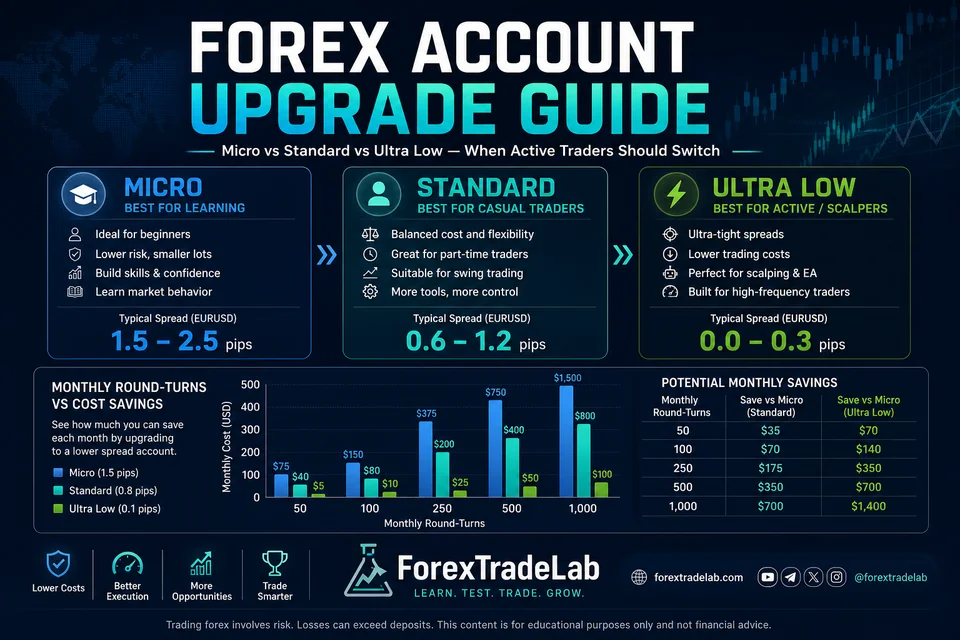
- Micro accounts exist for learning and micro-lot precision — not for minimising cost at volume
- Standard accounts suit casual traders; active traders trading 0.10+ lots regularly often save on Ultra Low despite similar minimum deposits
- Upgrade decision is math: monthly round-turns × spread difference × pip value vs. any platform or bonus trade-offs
- Switch accounts on demo first — EA magic numbers, lot steps and margin tiers can differ
- Never upgrade account type to 'fix' a losing strategy — cost savings cannot create edge

Affiliate disclosure: ForexTradeLab may earn a commission from qualifying partner links, without increasing your cost. Read our affiliate disclosure.
Quick Decision Framework#
Short Answer
Upgrade when monthly volume makes spread savings larger than the friction of switching — not when you want a “serious trader” badge. On most XM-style books, stay on Micro while you trade below 0.10 lots; use Standard for low-frequency swing trades; move to Ultra Low when you run 40+ round-turns a month at 0.10 lots or above, or when you scalp gold and indices where pip cost compounds. Prove the strategy on the current tier first. The upgrade is a cost decision, not a skill decision.
Detailed Explanation
Micro accounts exist for learning and 0.01-lot precision, not for minimising cost at volume. Standard suits casual swing traders. Active day traders and gold scalpers often save on Ultra Low despite a similar minimum deposit because the tighter spread shows up across dozens of round-turns. The breakeven math is monthly round-turns × spread difference × pip value, minus any bonus or platform trade-off. EA magic numbers, lot steps and margin tiers can differ after a switch, so the new account should be tested on demo first. A losing strategy does not become profitable because the spread dropped 0.3 pips.
Example
A learner on a sub-$500 balance trading 0.01–0.05 lots fewer than 20 times a month should stay on Micro. A part-time swing trader at 0.05–0.20 lots and 20–40 round-turns can live on Standard. An active day trader at 0.10–1.0 lots and 40–200+ round-turns, or a gold scalper above 100 tickets a month, is the Ultra Low candidate. Run the same 0.10 lot EUR/USD ticket on both books for a week and compare all-in cost before you migrate.
Common Mistake
Upgrading to “fix” a losing month, or switching live EAs without checking lot-step and margin differences. Cost savings cannot create an edge you do not already have.
Professional Tip
Export one month of tickets, multiply round-turns by the live spread difference and pip value, and switch only if the dollar saving exceeds the hassle. Open the new account on demo, place the same EA or manual size, and confirm margin and lot step before you move real cash.
TL;DR — Account Type Decision Matrix#
Short Answer
Upgrade your forex account type when your monthly trading volume makes spread savings larger than the friction of switching — not when you want a psychological 'serious trader' badge. For most XM-style brokers: stay on Micro while learning below 0.10 lots; use Standard for casual swing trading at low frequency; move to Ultra Low when you execute 40+ round-turns per month at 0.10 lots or above on majors, or when you scalp gold/indices where pip costs compound fast. The upgrade is a cost decision, not a skill decision — prove profitability on your current tier first.
Common Mistake
Standard accounts suit casual traders; active traders trading 0.10+ lots regularly often save on Ultra Low despite similar minimum deposits
Professional Tip
Upgrade decision is math: monthly round-turns × spread difference × pip value vs. any platform or bonus trade-offs
| Trader profile | Lots | Monthly round-turns | Suggested tier |
|---|---|---|---|
| Learning / <$500 | 0.01–0.05 | < 20 | Micro |
| Part-time swing | 0.05–0.20 | 20–40 | Standard |
| Active day trader | 0.10–1.0 | 40–200+ | Ultra Low |
| Scalper / gold active | 0.10+ | 100+ | Ultra Low |
| Stock-only investor | N/A | Low | Shares (different product) |
If you have been trading long enough to care about account types, you are past the "which button opens a trade" phase. The next friction point is cost at scale — spreads that were invisible at 0.01 lot become material at 0.50 lot and painful at 2.0 lots.
This guide is the upgrade checklist I wish more traders read before opening a third live account they do not need.
What Each Account Type Is Actually For#
Using XM's four-tier structure as the reference model (see our complete XM account types guide) — other brokers use similar naming:
| Type | Core purpose | Typical spread (EUR/USD, indicative) | Min deposit (XM) |
|---|---|---|---|
| Micro | Learning, micro-lot sizing | ~1.0 pip | $5 |
| Standard | General retail CFD trading | ~1.0 pip | $5 |
| Ultra Low | Active traders, tighter spreads | from ~0.6 pip | $5 (most regions) |
| Shares | Stock CFDs, 1:1 leverage | per-share commission | $10,000 |
Micro and Standard often share similar headline spreads but differ in lot granularity (micro lots enabled) and sometimes swap tiers. Ultra Low is the meaningful cost upgrade for volume — not a magic execution tier.
For full fee mechanics, see XM spreads, fees and commissions.
The Breakeven Math — When Ultra Low Pays for Itself#
Spread savings only matter relative to volume. Here is illustrative EUR/USD math (verify on your platform):
Assumptions:
- Standard: 1.0 pip round-trip cost (0.5 entry + 0.5 exit, simplified)
- Ultra Low: 0.7 pip round-trip (0.35 each side — optimistic session)
- Saving: 0.3 pips per round-turn
- Pip value at 0.10 lot ≈ $1/pip
| Monthly round-turns | 0.10 lot monthly saving | 0.50 lot monthly saving | 1.0 lot monthly saving |
|---|---|---|---|
| 20 | ~$6 | ~$30 | ~$60 |
| 50 | ~$15 | ~$75 | ~$150 |
| 100 | ~$30 | ~$150 | ~$300 |
| 200 | ~$60 | ~$300 | ~$600 |
At 0.10 lots and 50+ round-turns per month, Ultra Low's spread advantage starts to matter in real dollars. At 0.50 lots, the crossover happens faster.
Gold (XAU/USD) magnifies the calculation — wider spreads and larger pip values mean tier choice matters sooner for active gold traders. See gold scalping strategy.
Five Signals You Are Ready to Upgrade#
- You size in 0.10+ lots routinely without violating 1% risk rules.
- Monthly round-turns exceed ~40 on majors or gold.
- Spread is a measurable line item in your journal — you know cost per trade.
- You have 3+ months profitable or break-even on current tier (process proven).
- You trade during liquid sessions where advertised tight spreads actually print.
Five Signals You Should NOT Upgrade Yet#
- Account below $1,000 and still learning micro-lot risk.
- Strategy still changing weekly — no stable sample size.
- You trade < 15 times per month (spread tier barely matters).
- You want Ultra Low because it sounds "pro" — that is ego, not math.
- You have not read swap, margin, and bonus terms on the new tier.
Micro → Standard: What Changes?#
On many brokers, Micro → Standard is not primarily about spreads — it is about graduating lot size:
| Factor | Micro | Standard |
|---|---|---|
| Min lot | 0.01 micro (1,000 units) | Often 0.01 standard (100,000 units) — verify broker |
| Use case | $1 risk trades on small accounts | Normal retail sizing |
| Psychology | Low stakes, high reps | Real money feel at scale |
If your broker's Standard account minimum lot is 0.01 standard lot, switching too early on a $500 account forces bad risk. Stay on Micro until 1% risk fits naturally at your target stop distance.
Reference: position size calculator guide.
Standard → Ultra Low: What to Verify Before Switching#
Checklist:
- Live spread test on demo Ultra Low during your trading hours
- Swap rates compared — tighter spreads sometimes pair with different overnight costs
- Bonus eligibility — some promotions exclude Ultra Low (confirm current terms)
- EA / copier compatibility — magic numbers and lot steps
- Islamic (swap-free) availability if required
- Margin and leverage caps unchanged for your entity (CySEC vs offshore)
- Internal transfer path from old account if you run parallel accounts
For execution model context (ECN vs STP vs market maker), read broker types explained.
Platform and Infrastructure Upgrades (Beyond Account Type)#
Account tier is only one line item. Active traders at 0.50+ lots should also evaluate:
| Upgrade | When it matters |
|---|---|
| VPS hosting | EAs running 24/5; latency-sensitive entries |
| MT5 vs MT4 | Multi-asset, more timeframes, built-in calendar |
| Faster withdrawal rails | You are trading for income, not hobby |
| Second account for testing | Isolate experimental EAs from main capital |
See XM VPS guide and withdrawal time comparison.
Worked Scenario — Part-Time to Active Trader#
Profile: $15,000 account, London session EUR/USD breakout trader, 0.20 lots average, ~60 trades/month.
| Tier | Est. spread cost/month (illustrative) | Notes |
|---|---|---|
| Standard (~1.0 pip RT) | ~$1,200 | 60 × 0.20 lots × ~10 pips equivalent cost simplified |
| Ultra Low (~0.7 pip RT) | ~$840 | ~$360/month saved |
Over a year, that $4,000+ saving is a full extra R on a $15k account — meaningful, but only if the strategy was already sound. The upgrade did not create edge; it reduced friction.
How to Switch Without Disrupting Open Trades#
- Open the new account type under the same client ID (if broker allows).
- Fund minimally; run one week parallel on demo or micro size.
- Close or migrate positions — do not run duplicate EAs on both without isolation.
- Update copiers, signal subscriptions, and tax logs with new account numbers.
- Archive old account statements for tax reporting.
Bottom Line#
Upgrade your forex account when the spreadsheet says so — not when social media says "raw spreads are for real traders." Micro teaches precision. Standard serves most part-time traders. Ultra Low rewards volume and discipline.
Prove the process. Count the round-turns. Then optimise the pipe.
Disclosure: Examples use XM-style account naming for clarity. Spreads, minimums and bonuses vary by legal entity and region — confirm on the broker's official site before opening or switching. This article is educational, not a recommendation to open any specific account.
Comments
Add a useful note for other traders. We review comments before publishing.